TL;DR
In Matthew 18:24, a servant owes his king 10,000 talents. In the Bible, this value is used in a parable, which means this value was likely not meant to be taken literally. However, depending on how we translate "talent", how much would that be worth today in USD?
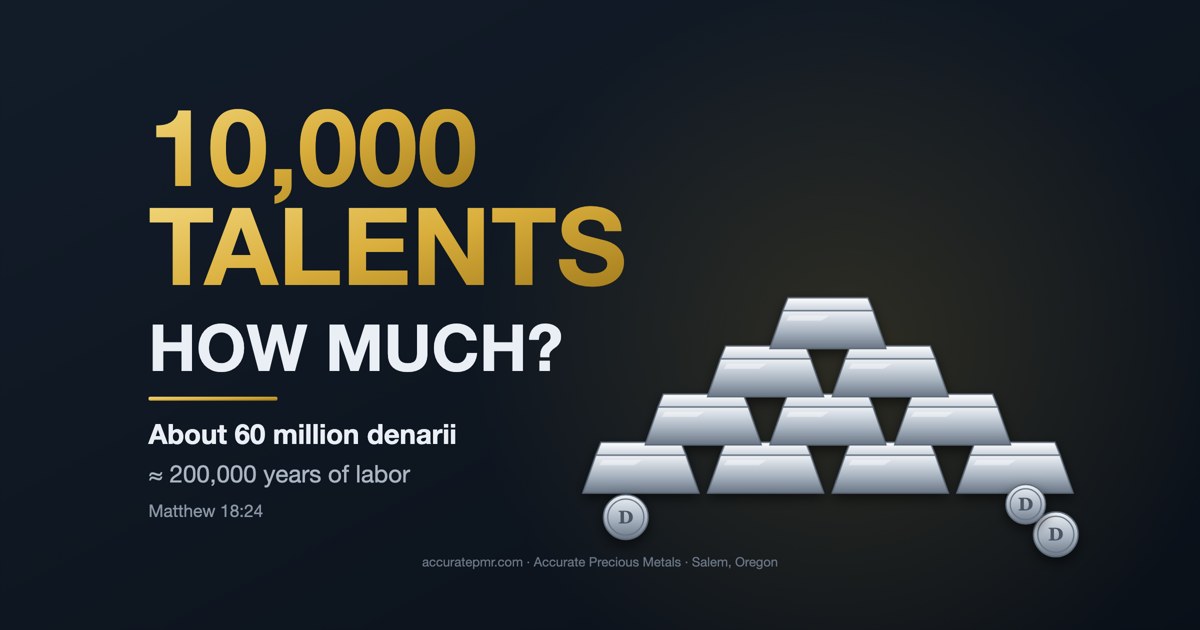
Ten thousand talents was roughly equal to 60 million denarii. If we do this translation, then ten thousand talents is worth about 60 million days of labor. If you work for 8 hours in a day and make $20 an hour, that would be equal to about $9,600,000,000 (nine billion, six hundred million dollars)
By weight, ten thousand talents it is about 259,000 to 342,000 kg (285 to 377 tons), depending on the talent standard used. In silver at today's spot price, that would be between $513,112,412.42 and $677,546,119.88. in gold, that would be between $34,873,657,631.05 and $46,049,385,752.19. It is widely believed that the text is talking about silver.
The exact figure is debated: which weight standard, which metal, metal value versus labor value, and whether the number is meant literally at all. Most scholars read it as deliberate exaggeration. Each point is explained below.
If you are interested in buying old currency to start your collection, or appraising some silver or gold that you already own, check out Accurate Precious Metals!
In Matthew 18:23-35, Jesus tells of a king settling accounts with his servants. One of them is brought in owing "ten thousand talents." He cannot pay, so the king orders him, his family, and his property sold. The servant falls on his knees and begs for time, and the king, moved with compassion, cancels the whole debt.
That same servant then finds a fellow servant who owes him 100 denarii, grabs him by the throat, and has him thrown into prison until he pays. When the king hears of it, he reverses his decision. The parable answers Peter's question about how many times to forgive, and the size of the first debt is the point of the story.
"Talent" (Greek talanton) began as a unit of weight and became the largest unit of money in the Mediterranean world. In the New Testament era:
A denarius was the standard Roman silver coin, about a day's pay for a laborer (Matthew 20:2).
A mina was 100 denarii.
A talent was 60 minas, which is 6,000 denarii.
"Ten thousand" (Greek myrioi) was the largest number with its own name in Greek, the way "a million" or "a billion" works in English. So the king's servant owes the biggest unit of money multiplied by the biggest named number. That combination is part of why scholars suspect it is not meant as an ordinary ledger entry.
There was no single talent. The weight depended on the region and the standard:
Attic (Greek) talent: about 25.9 kg, or 57 lb.
Roman talent: about 32.7 kg, or 72 lb.
Hebrew (Jewish) talent: about 34.2 kg, or 75 lb.
Commentators who stress the Greek text lean Attic, those who stress Roman administration lean Roman, and those who stress the Jewish audience lean Hebrew. Multiply by 10,000 and the disagreement stops being small: the same debt weighs 259,000 kg on one standard and 342,000 kg on another, a gap of more than 80 tons.
Many people picture a king's treasury as gold. Matthew 18 does not say. The text names only the talent, and the nearby parable of the talents in Matthew 25 uses the Greek word for silver (argyrion) for the same kind of sum. Silver was also the metal of the everyday coinage a denarius was struck in.
Gold talents appear mostly in the Old Testament, for example in the tabernacle in Exodus 38 and in Solomon's reign in 1 Kings. Most readers take the debt in Matthew 18 as silver, so both are priced below.
The labor method uses the denarius as the yardstick. 10,000 talents is 60 million denarii, or 60 million days of work. Allowing for Sabbaths and festivals, that is roughly 200,000 years of labor, and even if a person worked every single day of the year it is about 164,000. It captures what the sum meant to the people hearing the story.
The metal method weighs the talents and prices the metal at today's spot price. It shows what the raw metal would be worth now.
The two methods answer different questions and are not meant to match. Silver in the first century bought far more than it does today, and a denarius was a day of hard work, not a bullion item. A modern dollar figure is an illustration, not an estimate of purchasing power.
This is the largest debate about the passage. Most scholars treat 10,000 talents as deliberate exaggeration, a number chosen because it could never be repaid.
The reasons they give:
Scale against real budgets. The historian Josephus reports that, after Herod the Great's death, the tribute from his territories was about 600 talents a year for Archelaus, 200 for Antipas, and 100 for Philip. That is about 900 talents a year for an entire kingdom. The servant's debt would be more than 11 years of the whole region's income.
The punchline. The fellow servant owes 100 denarii, a real but modest sum. The first debt is 600,000 times larger (60 million divided by 100). The story only works if the gap is absurd.
The servant's promise. He says, "Be patient with me, and I will pay back everything." Readers have long noted that the line is as impossible as the debt.
A minority of readers argue the servant could have been a royal official or tax collector responsible for funds from a whole province, which would make a very large figure more plausible. Even on that view, almost no one proposes the number is a precise accounting of a real debt.
Sum | Talents | Denarii | Years of labor (approx.) |
|---|
The fellow servant's debt (Matt 18:28) | none | 100 | about 4 months |
One talent | 1 | 6,000 | about 20 |
The three servants in Matthew 25 | 8 | 48,000 | about 160 |
Josephus: one year's tribute from Herod's whole realm | about 900 | about 5.4 million | about 18,000 |
The debt in Matthew 18:24 | 10,000 | 60 million | about 200,000 |
These figures price the raw metal at the October 2, 2026 spot prices: silver at $61.51 per troy ounce and gold at $4,136.60 per troy ounce. They illustrate the metal, not first-century purchasing power.
Standard | Weight | Troy ounces | As silver (most likely) | If it were gold |
|---|
Attic | 259,000 kg (285 tons) | about 8.33 million | about $512 million | about $34.4 billion |
Roman | 327,000 kg (360 tons) | about 10.5 million | about $647 million | about $43.5 billion |
Hebrew | 342,000 kg (377 tons) | about 11.0 million | about $676 million | about $45.5 billion |
Gold is the far larger number because it is worth about 67 times as much per ounce as silver at these prices. Either way the point holds: no individual in the story, or in first-century Judea, could have paid it.
Spot price is the market price for raw metal in bulk. Coins and bars usually trade at a premium over spot, and what a seller would receive depends on the product, its purity, and the market that day.
How much is 10,000 talents worth?
About 60 million denarii, or roughly 200,000 years of a laborer's pay. As raw silver at the October 2, 2026 spot price, about $512 million to $676 million.
How much does 10,000 talents weigh?
About 259,000 to 342,000 kg (285 to 377 tons), depending on whether you use the Attic, Roman, or Hebrew talent.
How much is 10,000 talents in gold?
If it had been gold, about $34 billion to $45 billion at the October 2, 2026 spot price. The text most likely means silver, so that figure is a comparison, not the usual reading.
How many years of work is 10,000 talents?
Roughly 200,000 years for an ordinary laborer, using 60 million denarii and a denarius as a day's pay.
Why did Jesus use such a large number?
Most scholars read it as intentional exaggeration. The first debt is so large it can never be repaid, which makes the second servant's refusal to forgive 100 denarii the sharper contrast.
What is the difference between 10,000 talents and 100 denarii?
The first is about 60 million denarii and the second is 100, so the first is about 600,000 times larger.
How can I find the value of gold or silver I own?
Weight, purity, and the day's spot price determine a metal's base value. Our team can test and weigh gold and silver coins, bars, and jewelry. You can also mail it in.
Troy ounces = kilograms × 32.1507
Value of 10,000 talents in silver = troy ounces × silver spot price
Value of 10,000 talents in gold = troy ounces × gold spot price
Denarii in 10,000 talents = 10,000 × 60 minas × 100 denarii = 60,000,000
Matthew 18:21-35; Matthew 20:2; Matthew 25:14-30; Exodus 38; 1 Kings 9:14 and 10:14
Josephus, Antiquities of the Jews, 17.11.4 (tribute of Herod's sons)
Standard Bible dictionary entries on "talent" and "denarius" (Anchor Bible Dictionary, Eerdmans, or similar)
Kitco / JM Bullion gold spot and Fortune "Current price of silver" (2026-10-02). Replace with the live number on publish day.