
Like our coverage? Add Accurate Precious Metals as a preferred source on Google.
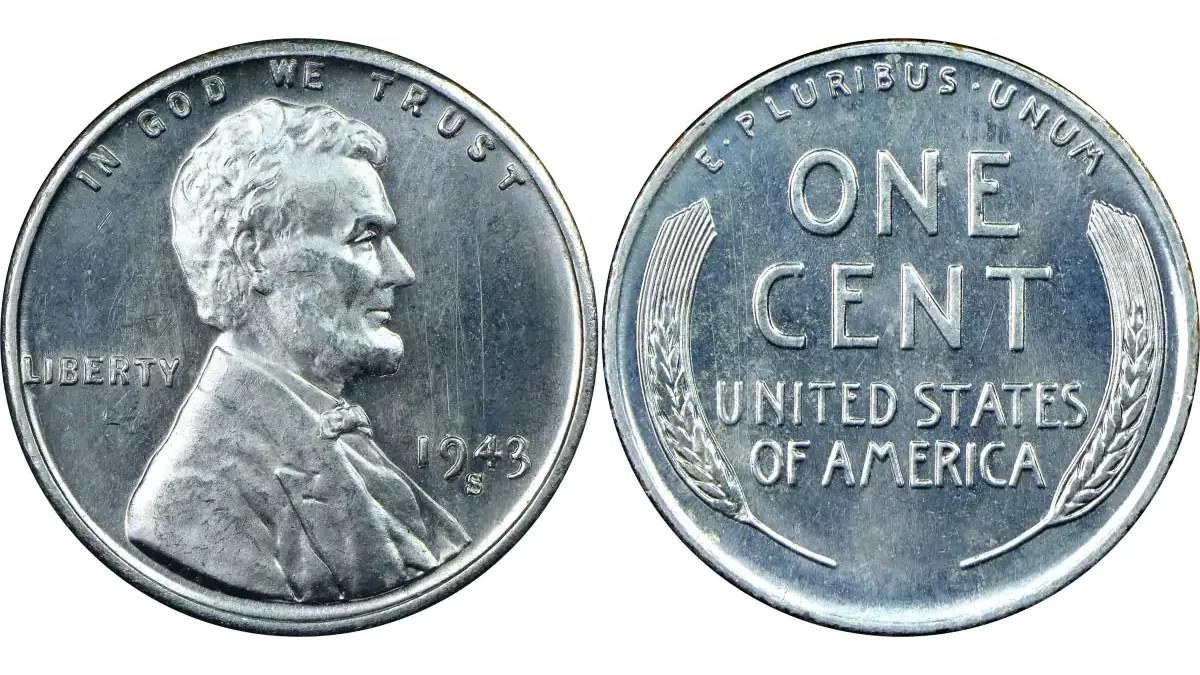
The 1943 steel penny value for most coins is about 10 to 15 cents. Even clean, unworn ones rarely bring more than a dollar or two. The real money is in a short list of rare varieties and errors, led by the copper 1943 cent and the 1944 steel cent.
The U.S. Mint made more than a billion of these gray wartime cents, so they still turn up in coin jars, old albums and inherited collections. Below we cover what they are worth, where to find the mint mark, which errors to look for, how to test a coin at home, what the 1944 cents are worth and who buys steel pennies.
What Is the 1943 Steel Penny Value Today?
Most 1943 steel pennies are worth about 10 to 15 cents at the time of writing. More than a billion were made, and collectors saved huge numbers of them, so the supply is large.
Condition moves the 1943 steel penny value only a little. A coin with no wear and its original silver-gray color is worth more than a dark, rusty one, but even nice examples rarely bring more than a dollar or two. Only a handful of flawless, professionally graded coins sell for more, and those almost never turn up in a coin jar.
Dealers and grading services describe condition on a scale from 1 to 70. These are the terms you will see most often on steel cents:
- Good to Fine: heavy wear. Lincoln's hair and the lines in the wheat stalks are mostly flat.
- Very Fine to Extremely Fine: light to moderate wear on the cheek, jaw and wheat stalks.
- About Uncirculated: a light rub on the highest points only.
- Mint State (MS60 to MS70): no wear at all. Higher numbers mean fewer marks and a better shine.
Most steel cents that turn up in jars are well worn, and many have rust or dark spots that pull them lower still. Rust is the biggest value killer on a steel cent, because once the zinc wears through, the steel underneath starts to corrode.
Watch out for reprocessed coins too. Years after the war, dealers stripped rusty steel cents and coated them with fresh zinc or chrome, then sold them in sets as "brilliant uncirculated." They look great at first glance but are worth little more than face value to collectors.
A reprocessed steel cent usually shows these signs:
- A mirror-bright, chrome-like surface instead of a soft gray shine.
- Soft, rounded details in the hair and wheat lines.
- Perfectly even color with no spots or toning.
- Plating built up on the rim.
So is a 1943 penny worth anything? Yes, a little more than face value, and a lot more if it turns out to be one of the rare pieces covered below. For other dates, see our wheat penny key dates and values.
Why Were Pennies Made of Steel in 1943?
Copper went to war. By 1942 the military needed huge amounts of copper for shell casings, wire and equipment, and every cent the Mint struck was 95% copper.
Before it settled on steel, the Mint ran one of the strangest experiments in U.S. coin history. In 1942 it tested more than a dozen possible cent materials, and it sent dies to private companies so they could try their own. Plastic makers, many of them button makers, jumped in, and so did a glass company.
Most of the test pieces did not look like a Lincoln cent at all. They used the bust from a Colombian 2 centavo coin on the front and a simple wreath on the back. A few were struck with Lincoln cent dies.
| Material | Who made it | Why it was not used |
|---|---|---|
| Glass | Blue Ridge Glass Company of Kingsport, Tennessee, using glass blanks from Corning | Test pieces chipped at the edges after a month in testers' pockets, and the tests were not done until December 1942, too late for a 1943 coin. |
| Plastic | Tennessee Eastman, Durez Plastics and Chemicals, Auburn Button Works and other firms | Easy to mold in brown, rust and other colors, but no plastic could be made as cheaply and quickly as steel for more than a billion coins a year. |
| Bakelite | Bakelite Corporation | An early hard plastic with the same problem: it could not match steel for cost and speed at that scale. |
| Hard rubber | Private firms | Rubber was one of the scarcest materials of the war and was rationed starting in 1942. |
| Fiber | Private firms | A pressed fiber material that could not match metal for wear in circulation. |
| Aluminum | The Mint and private firms | Aluminum was a key war metal for building aircraft. |
| Zinc | The Mint and private firms | Zinc was plentiful, and it ended up as the coating on the steel cent instead. |
| Lead | The Mint and private firms | Lead is very soft and heavy for its size, a poor fit for a coin that changes hands every day. |
| Manganese and white metal | The Mint and private firms | Manganese was needed to make steel for the war, and white metal usually contains tin, another metal the war effort needed. |
| Brass and bronze | The Mint and private firms | Both are mostly copper, the very metal the Mint was trying to save. |
| Zinc-coated steel | The Mint | The winner. It was the most efficient, lowest-cost option and worked well for mass production. |
The glass cent is the star of the group. Until 2016, collectors knew of just one, and it was broken in half. Then an intact piece turned up at a small auction and sold for $70,500 at a Heritage auction in January 2017.
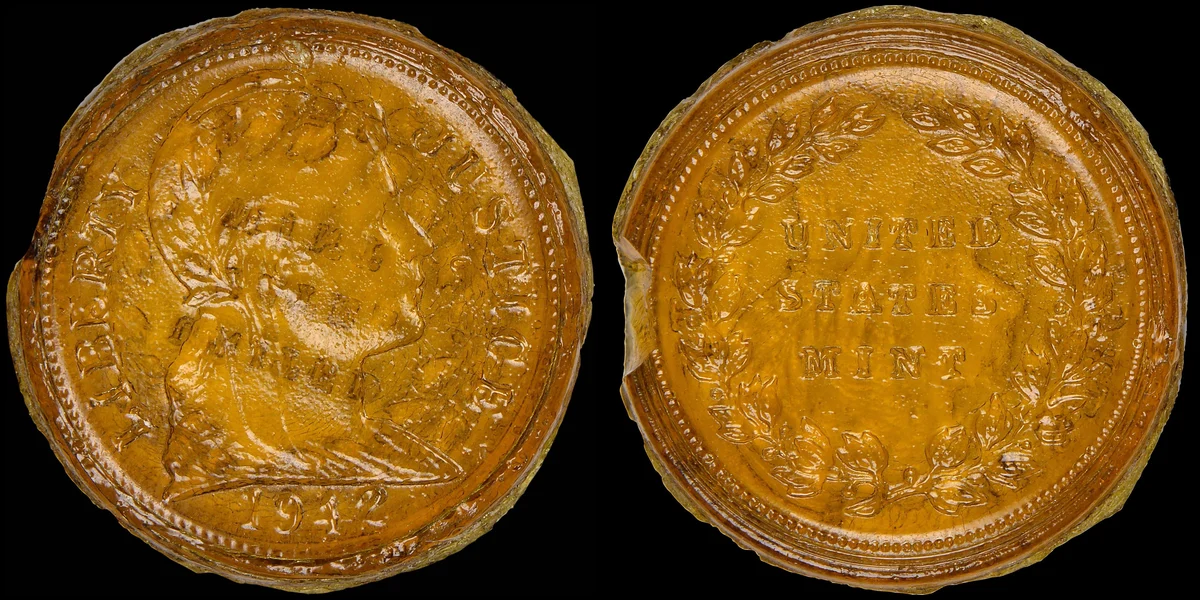
Later that year NGC graded seven more intact glass cents and two fragments, along with glass tokens Blue Ridge made with its own factory design.
The plastic test pieces are easier to find. Brown plastic examples have sold for about $1,800 to $16,450 at auction.
In the end, the Mint picked low-carbon steel with a very thin coat of zinc. Here is how the year played out.
Congress lets the Mint make the cent from metals other than copper.
Presses start striking zinc-coated steel cents in Philadelphia, Denver and San Francisco.
Complaints pile up. The new cents look like dimes, jam vending machines and start to rust.
Steel cent production stops after about 1.09 billion coins.
Cents go back to a copper alloy made partly from salvaged brass shell casings. The prewar mix returns in 1947, covered in our 1947 wheat cent guide.
The steel cent had problems from day one. People with poor eyesight mistook it for a dime. Vending machines built to catch steel slugs rejected it. The blanks were punched from zinc-coated sheet, so every coin had a bare steel edge, and many rusted in damp pockets within months.
That short run makes the 1943 steel penny the only regular U.S. coin a magnet will pick up, and the only circulating U.S. coin with no copper in it at all. Here are the basic specs.
| Detail | 1943 steel penny |
|---|---|
| Metal | Low-carbon steel with a thin zinc coating |
| Weight | 2.70 grams (a bronze cent weighs 3.11 grams) |
| Diameter | 19 mm, the same as other Lincoln cents |
| Edge | Plain |
| Designer | Victor David Brenner |
| Mints | Philadelphia (no mint mark), Denver (D), San Francisco (S) |
| Total struck | 1,093,838,670 |
The penny itself is now history. The U.S. Mint stopped making pennies for circulation in 2025 and sold the last ones in special auction sets, so every steel cent out there today is part of a series that has ended.
Does No Mint Mark Change 1943 Steel Penny Value?
No. A 1943 steel penny with no mint mark is worth the same as any other steel cent in the same condition, usually 10 to 15 cents. No mint mark means it was made in Philadelphia, which did not put a P on cents until 2017.
To find the mint mark, look on the front of the coin just below the date. A D means Denver and an S means San Francisco. A 5x or 10x magnifier and a lamp help, because wear and rust can hide a small letter.
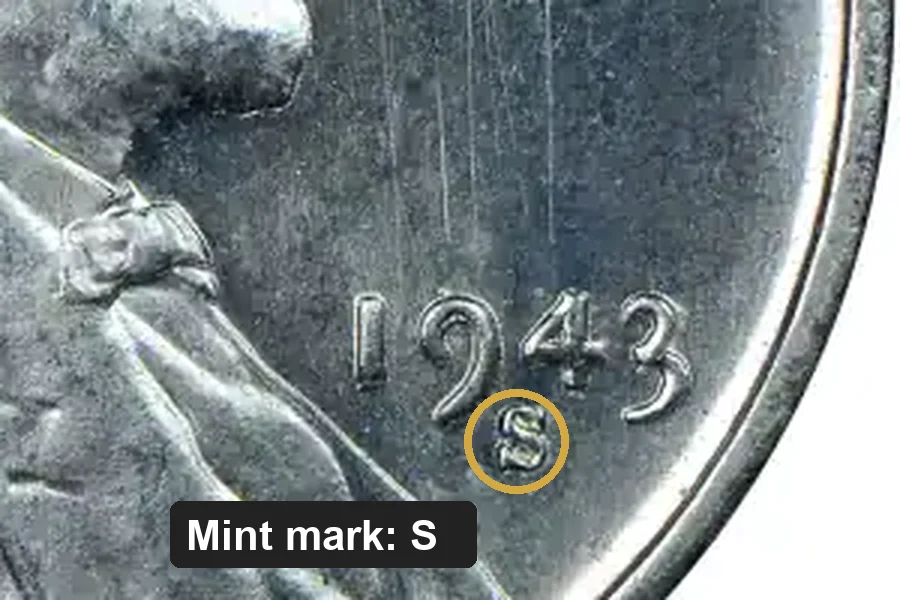
The no-mint-mark coin trips up a lot of people. Some websites call it an error, but it is not. Philadelphia struck 684,628,670 of them, more than Denver and San Francisco combined, so it is the most common 1943 steel penny of all. Where a coin was made barely moves 1943 steel penny value, so check condition and errors first.
| Mint | Mint mark | Coins struck | What to know |
|---|---|---|---|
| Philadelphia | None | 684,628,670 | The most common. No mint mark is normal, not an error. |
| Denver | D | 217,660,000 | Check for the 1943-D/D repunched mint mark. |
| San Francisco | S | 191,550,000 | The lowest mintage. Worn coins sometimes bring a few cents more. |
A worn 1943-D or 1943-S is worth about the same as a Philadelphia coin. The 1943-S had the smallest mintage, so it sometimes brings a few cents more.
The one Denver coin worth hunting for is the 1943-D/D. The D was punched into the die twice, and under a magnifier you can see a second D peeking out from behind the first. It is one of the best-known repunched mint marks in the Lincoln cent series and sells for tens of dollars in worn grades and a few hundred in top condition.
Many families also saved a 1943 P, D and S together, and dealers sold these three-coin sets for decades. They make a nice keepsake, but a set is worth about the sum of its three common coins unless one of them is a variety or an error.
How Much Is a Silver 1943 Penny Worth?
A "silver" 1943 penny is almost always a normal steel cent, worth about 10 to 15 cents. There is no silver in it. The zinc coating gives it a bright gray color, so people have called it a silver penny since 1943.
The color caused real trouble during the war. Shoppers and cashiers mixed up new steel cents and silver dimes, and people with poor eyesight had the hardest time. A worn steel cent today looks dull gray or even black, but an unworn one still has that bright, silvery look.
The only 1943 cents with real silver in them are rare errors struck on blanks meant for silver dimes. They are smaller than a normal cent, weigh about 2.5 grams instead of 2.70 grams, and do not stick to a magnet. If you have a small, non-magnetic 1943 cent, have it checked by an expert before you sell it.
Here is how to tell what your 1943 penny is made of. You need a magnet, a scale that reads to a hundredth of a gram, and good light.
- Magnet test. A real 1943 steel penny sticks firmly to a magnet. If yours does not stick, set it aside. It may be a copper error, a silver dime-blank error or a coin with an altered date.
- Weigh it. A steel cent weighs about 2.70 grams. A bronze cent weighs about 3.11 grams. A silver dime blank weighs about 2.5 grams.
- Check the color. Original steel cents are silver-gray, often with dull or dark spots. A copper-colored 1943 penny that still sticks to a magnet is a plated steel cent, sold as a novelty.
- Look at the date. The 3 should match the other numbers in size and style. Fakes are often made by recutting the last digit of a 1945, 1948 or 1949 cent, and the reworked 3 looks thick or uneven under a magnifier.
A strong fridge magnet or a small neodymium magnet works best. A steel cent jumps to it, and a copper or silver cent does not move at all.
Already have a 1943 cent in a grading holder? You can look up its serial number here.
Which 1943 Steel Penny Errors Are Worth Money?
The 1943 steel penny errors worth money are major ones you can see without a magnifier, plus a few known die varieties. Small nicks, spots and rust are damage, not errors, and they do not add value.
Here is the 1943 steel penny error list collectors look for, roughly from most to least valuable:
- Struck on a bronze blank. The famous copper 1943, covered in the next section. Worth hundreds of thousands of dollars.
- Struck on a silver dime blank. Smaller than a normal cent and not magnetic. Very rare.
- Repunched mint mark (1943-D/D). A second D shows beside the first under the date.
- Doubled die front. Some Philadelphia coins show extra thickness in IN GOD WE TRUST, LIBERTY and the date.
- Off-center strike. Part of the design is missing and a blank crescent shows on one side. The farther off-center, with the full date still visible, the more it is worth.
- Double strike. The design was struck twice, with the second image shifted.
- Clipped blank. A curved or straight bite is missing from the edge, left over when the blank was punched from the steel strip.
- Struck through. Grease or debris on the die left part of the design weak or missing.
- Lamination. A flake of metal is peeling away from the surface. Steel cents are prone to these.
- Die cracks and cuds. Raised lines or blobs from a cracked die. Common and usually low in value.
A major error is the biggest boost to 1943 steel penny value. Most bring a few dollars to a few hundred, depending on how dramatic they are. A big error is worth sending to a grading service like PCGS or NGC before you sell it, because a graded error is easier to price and sell.
How Much Is a 1943 Copper Wheat Penny Worth?
A genuine 1943 copper wheat penny is worth hundreds of thousands of dollars, and one has sold for $1.7 million. It is also the most faked coin in this whole story, so most 1943 pennies that look copper are not real.
The U.S. Mint says about 40 were struck by accident, when bronze blanks from 1942 stayed in the press hoppers as steel production began. The only known 1943-D bronze cent sold for $1.7 million in 2010 and at auction for $840,000 in 2021.
The best-known story belongs to Don Lutes Jr. of Pittsfield, Massachusetts. In 1947, at 16, he found a 1943 copper cent in circulation. He had heard a rumor that Henry Ford would give a new car to anyone who found one, so he wrote to Ford Motor Co. and to the Treasury.
The Treasury wrote back that no copper cents were made in 1943. He kept the coin for more than 70 years, and it sold at auction in January 2019 for over $200,000.
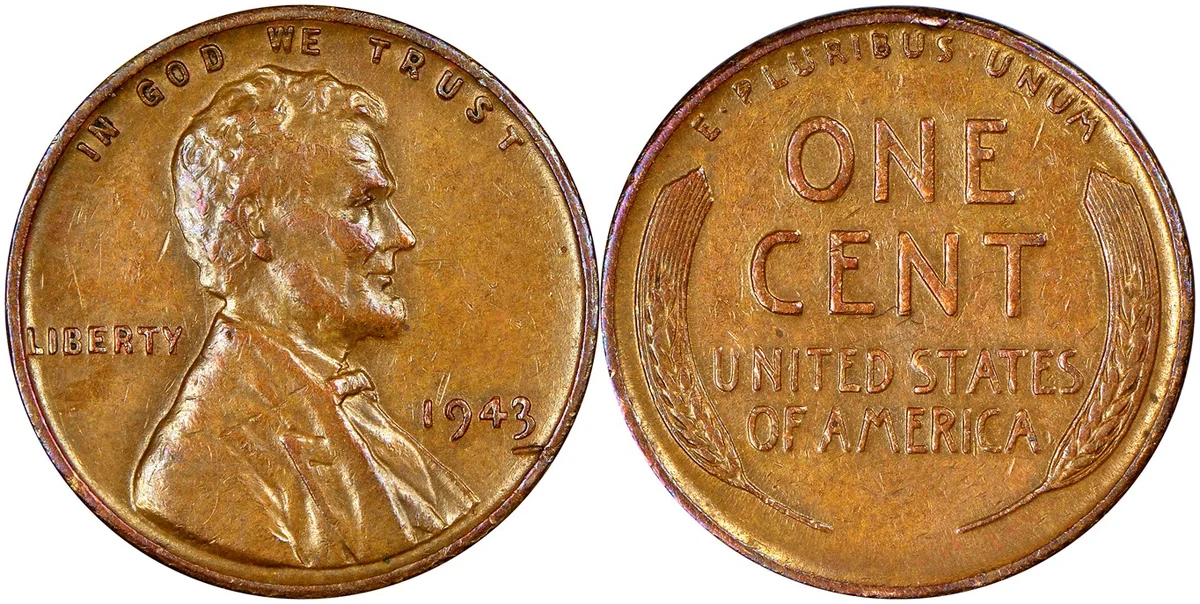
The car offer was only a rumor, but it helped make the copper 1943 famous. Rumors still drive interest today. In 1999 a news story wrongly suggested the government was looking for these coins and set off thousands of calls to the Mint, which posted a notice to correct it.
How Much Is a 1944 Wheat Penny Worth?
A regular 1944 wheat penny is worth a few cents, mostly for its copper. The rare exception is the 1944 steel cent, which sells for thousands of dollars even when damaged.
After the steel cent flopped, the Mint went back to a copper alloy for 1944. Much of the metal came from salvaged brass shell casings, so the 1944 to 1946 cents are 95% copper and 5% zinc, close to the prewar mix. The Mint made huge numbers of them:
| Mint | Mint mark | Coins struck |
|---|---|---|
| Philadelphia | None | 1,435,400,000 |
| Denver | D | 430,578,000 |
| San Francisco | S | 282,760,000 |
With more than 2.1 billion struck, a worn 1944 wheat penny is common. Unworn coins that keep their original bright red color bring more, and the 1944-D/S is a known variety: a Denver die was first punched with an S, then corrected with a D, and traces of the S show around the D. It sells for well above a normal 1944-D.
The 1944 steel cent is the 1943 copper error in reverse. A few steel blanks got mixed in after the Mint switched back to copper. They were either left over from 1943 or meant for Belgian coins the Mint was striking in 1944.
PCGS cites expert estimates of about 25 to 30 survivors, roughly double the known 1943 copper cents. That still makes it a major rarity.

Damaged 1944 steel cents have sold at auction for about $6,000 to $17,000, and one of the two finest known Philadelphia coins brought $180,000 at auction in 2021. A 1944-S steel cent, one of only two known, sold for $373,750 in 2008. The test is simple: a normal 1944 penny does not stick to a magnet, so a 1944 penny that does is worth a closer look.
Who Buys 1943 Steel Pennies?
We do. We buy 1943 steel pennies and regular wheat cents at our store in Salem, Oregon, from a handful of coins to rolls and full jars.
Bring them to 1855 Hawthorne Ave NE in Salem. We look through your coins, tell you what you have and make you an offer. The evaluation is free and there is no obligation to sell.
You can call us at (503) 400-5608 before you come in. Not near Salem? We buy by mail too.
A little prep before you sell goes a long way:
- Do not clean them. Brushing, polishing or dipping strips the zinc, leaves scratches and lowers the value.
- Keep them dry. A dry room beats a basement, garage or attic. Steel rusts once moisture gets past the zinc.
- Handle by the edges. Skin oils leave spots that turn dark. PVC-free flips, tubes or albums protect coins best.
Building a wartime set or hunting for a better grade? Browse our collectible coins. Have a jar of steel cents or old wheat pennies to sell? See how we buy coins or request a free mail-in kit, and we will take it from there.
Frequently Asked Questions
How much is a 1943 steel penny worth?
Most 1943 steel pennies are worth about 10 to 15 cents. Clean, unworn coins bring a little more, and only rare varieties and errors are worth real money.
Is a 1943 penny worth anything?
Yes, a little more than face value. A gray 1943 penny that sticks to a magnet is a common steel cent, while a copper-colored one that does not stick could be a rare error worth a great deal.
Is a 1943 steel penny rare?
No. The Mint struck more than 1 billion of them. The 1943-D/D variety, major mint errors and the copper 1943 cent are the scarce ones.
Is a 1943 steel penny with no mint mark an error?
No. Philadelphia did not use a mint mark on cents in 1943, so no mint mark is normal. It is worth the same as any other steel cent in the same condition.
Are 1943 steel pennies magnetic?
Yes. A genuine 1943 steel penny sticks to a magnet. If yours does not, it is not a normal steel cent and should be checked by an expert.
Is a 1943 steel penny made of silver?
No. It is steel with a thin zinc coat. People call it a silver penny because of its color.
How much is a 1944 wheat penny worth?
Most 1944 wheat pennies are worth a few cents. The 1944-D/S variety is worth more, and a genuine 1944 steel cent sells for thousands of dollars or more.
Do you buy steel pennies?
Yes. We buy 1943 steel pennies and regular wheat cents at our Salem, Oregon store or by mail. The evaluation is free.
Sources
- U.S. Mint: What's So Special About the 1943 Copper Penny?
- CoinNews: 1942 experimental glass cent sells for $70,500
- PCGS CoinFacts: 1943-D Bronze Lincoln Cent
- Coin World: Collector found his 1943 copper cent in circulation in 1947
- PCGS CoinFacts: 1944 Steel Lincoln Cent
- COINage: 1943 Steel Lincoln Cents Worth Thousands
Featured image courtesy of NGC.
Make the smart choice: invest with Accurate Precious Metals
Whether you are buying bullion for the first time or adding to a long-term position, our team offers expert guidance, transparent pricing, and a reliable buyback program.
Ready to invest wisely?