This content is for educational purposes only and is not financial or investment advice. Precious metals prices fluctuate; past performance does not guarantee future results. Consult a qualified professional before making investment decisions.
Tap the image to enlarge and zoom.Hover to magnify, or click to open full screen.
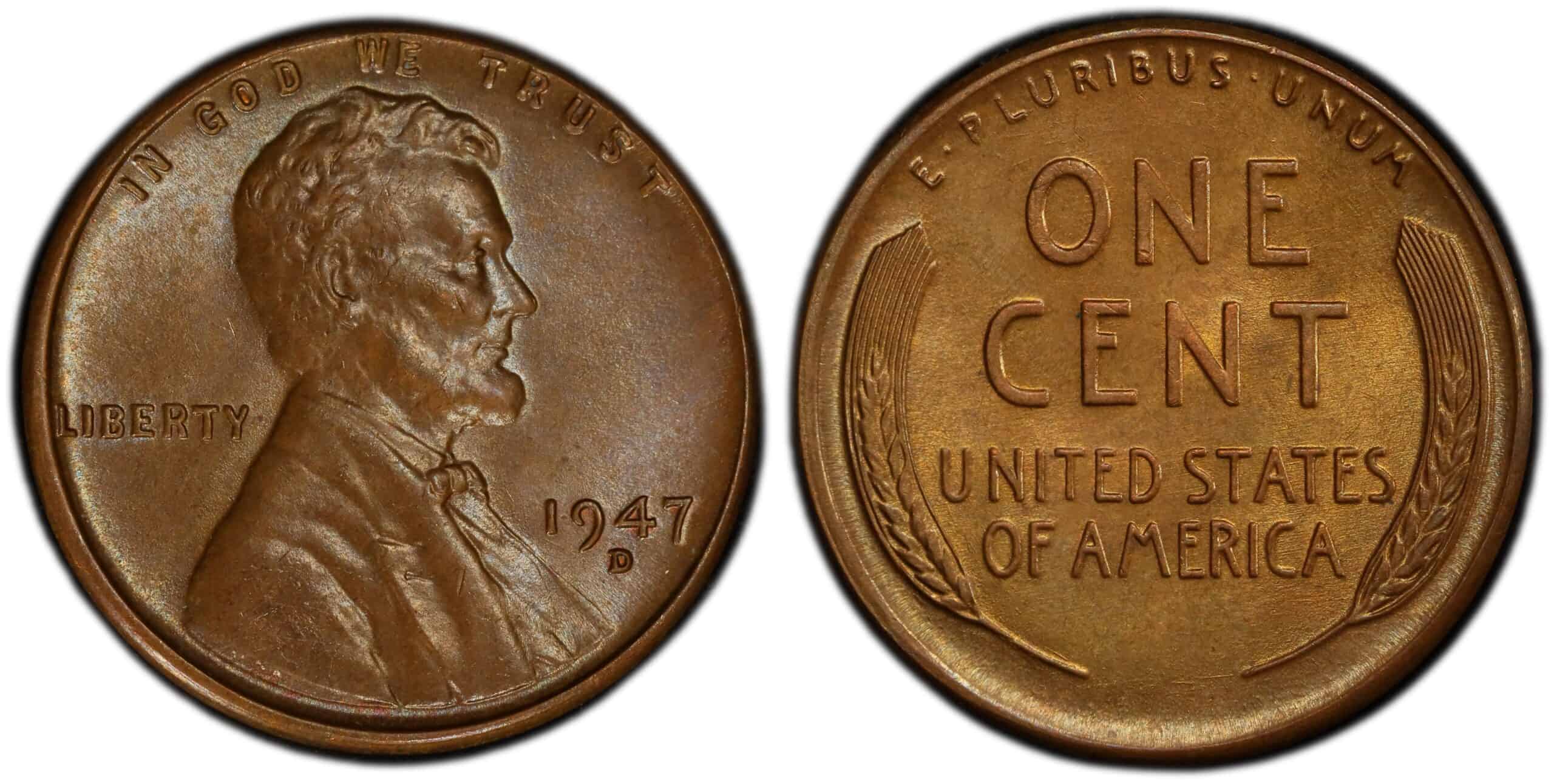
The 1947 Lincoln Wheat Cent stands out in U.S. coinage history as the first postwar penny to fully return to the original bronze formula – a detail that separates it from every cent minted between 1942 and 1946. Most collectors pass it over because circulated examples are worth only a few cents. That is exactly the wrong instinct. In pristine, uncirculated condition with full red color, this coin becomes one of the most sought-after condition rarities in the entire Lincoln Wheat series, with a single example selling for $26,400 at Heritage Auctions in January 2025.
Understanding why requires a short trip back to wartime America – and a close look at what the U.S. Mint changed, and then changed back, in the years surrounding 1947.
Why 1947 Was a Turning Point for the Lincoln Cent
During World War II, copper was a strategic material. The military needed it for shell casings, wiring, and equipment. The U.S. Mint responded by switching the penny’s composition entirely in 1943, producing the famous zinc-coated steel cents. From 1944 through 1946, the Mint returned to copper-based alloys but used a slightly different mix – one that excluded tin.
The 1947 Lincoln Wheat Cent was the first year tin was restored to the alloy, bringing the coin back to its original French bronze composition: 95% copper, 5% tin and zinc. This is not a minor footnote. It means the 1947 cent is chemically distinct from the three years before it. Collectors who focus on composition history treat it as a genuine reset point in the series.
This distinction also explains why the coin looks and ages differently from 1944-1946 cents. The restored tin content affects the coin’s surface color and how it tones over decades. A high-grade 1947 cent with original red color is not just rare – it is chemically authentic in a way that its immediate predecessors are not.
Three Mints, One Year: Identifying Your 1947 Wheat Cent
Three facilities struck the 1947 Lincoln Wheat Cent, producing a combined mintage of approximately 484.3 million coins. That is a large number, but it does not make high-grade examples common. The vast majority of those coins circulated immediately and were worn down within years.
Mint marks appear on the reverse of the coin, just below the wheat stalks. Philadelphia coins carry no mint mark. Denver coins show a D, and San Francisco coins show an S.
Mint
Mint Mark
Mintage
Key Note
Philadelphia
None
190,555,000
Most common variety
Denver
D
194,750,000
Slightly higher mintage
San Francisco
S
~99,000,000
Auction record holder for the series
The 1947-S is the variety every serious collector wants in top condition. It holds the highest price ever realized for the series at MS68 RD – a grade so rare that PCGS has certified only one coin at that level.
The obverse features Abraham Lincoln’s profile, sculpted by Victor David Brenner. The reverse frames the denomination between two wheat stalks, which is where the coin earned its “Wheat Cent” nickname. Both design elements had been in use since 1909 and would continue through 1958.
What Is the 1947 Lincoln Wheat Cent Worth?
Value is almost entirely a function of condition. The gap between a worn circulated example and a pristine uncirculated one is not a matter of a few dollars – it is a matter of thousands.
Circulated Coins
Most 1947 pennies you encounter today are circulated. They passed through thousands of hands, sat in jars, rattled around in pockets, and accumulated wear that permanently reduces their grade. These coins are worth approximately $0.03 to $0.20, depending on how much detail remains.
The melt value of a 95% copper cent is roughly 2-3 cents at current copper prices, so circulated examples trade close to their metal content. Do not expect more unless the coin shows exceptional detail.
Uncirculated and High-Grade Coins
Coins that never entered circulation – those that stayed in mint bags and avoided handling – are a different story. Even among uncirculated coins, most have turned brown (BN) or a muted copper (RB) over time. The rarest designation is Red (RD), meaning the coin retains its original bright copper color.
$0.03-$0.20
Circulated (Good to Extremely Fine)
$0.40-$0.50
Uncirculated MS60-MS63
$21,600
MS67+ RD (Heritage Auctions, January 2025)
$26,400
MS68 RD – 1947-S, the finest known (Heritage Auctions, January 2025)
The MS68 RD example is the single finest coin PCGS has ever certified for this date. Only one exists at that grade level. Its $26,400 sale price is not an anomaly – it reflects how extraordinarily difficult it is to find a coin from a high-mintage year that somehow survived seven decades without a single mark, fingerprint, or toning patch.
Condition Rarity: The Concept That Explains Everything
The 1947 Lincoln Wheat Cent is not a key date. Key dates are rare because few were minted – think 1909-S VDB or 1914-D. The 1947 cent is common by mintage. What makes it valuable is condition rarity: the difficulty of finding a high-mintage coin in exceptional preservation.
When 484 million coins are made and nearly all of them circulate immediately, the odds of finding one that survived untouched are extremely low. Banks did not save them. Collectors in 1947 were not systematically pulling pennies from circulation. The few that survived in mint state did so by accident – left in a mint bag that was never opened, or set aside by a lucky collector who recognized their potential.
This is why the value curve is so steep. Going from MS65 to MS67 on a 1947 cent is not a small jump. Each grade point represents a significantly smaller pool of surviving coins, and the premium reflects that scarcity.
For comparison, consider the broader precious metals market. At the time of writing, gold (XAU) is $4,021 per ounce, silver (XAG) is $60 per ounce, and platinum (XPT) is $1,555 per ounce. The MS68 RD 1947 cent, at $26,400, is worth more than six and a half ounces of gold at current prices – and it contains no precious metals at all. Its value is entirely numismatic.
How to Identify a High-Value 1947 Lincoln Wheat Cent
Most people who find a 1947 penny in a coin jar assume it is worth face value. Here is how to assess whether yours might be worth more.
Evaluating Your 1947 Wheat Cent
1
Step 1 – Check the Mint Mark Flip the coin over and look below the wheat stalks. No mark means Philadelphia. A D means Denver. An S means San Francisco. The 1947-S commands the highest premiums in top grades.
2
Step 2 – Assess the Color Hold the coin under good light. Red (RD) is bright copper. Red-Brown (RB) shows partial toning. Brown (BN) means the original color is gone. Red coins are worth dramatically more.
3
Step 3 – Look for Surface Marks Under magnification, check for contact marks, scratches, or hairlines. MS67+ coins have virtually no visible marks. Even minor blemishes drop a coin several grade points.
4
Step 4 – Avoid Cleaned Coins A coin that has been cleaned may look red but will show hairlines under a loupe. Cleaning permanently damages value. Do not clean a coin you find.
5
Step 5 – Get It Graded If the coin looks uncirculated and retains red color, submit it to PCGS or NGC for professional grading. For any coin you believe may be worth over $1,000, third-party grading is essential.
💡 Tip: Tip: Never touch the face of a coin with bare fingers. Oils from skin can damage the surface and cause toning that permanently reduces the Red designation. Hold coins by their edges only.
Common Misconceptions About the 1947 Wheat Cent
A lot of misinformation circulates about this coin online. Three claims come up repeatedly, and all three are wrong.
“It’s a key date.” It is not. All three mints produced tens of millions of 1947 cents. The coin’s value in high grades comes from condition rarity, not low mintage. Calling it a key date misrepresents how coin collecting works.
“All 1947 pennies are worth thousands.” The average circulated 1947 penny is worth about three cents. Only coins grading MS67 or higher with full Red color approach significant dollar values. The $26,400 record was set by the single finest example ever certified – one coin out of 484 million minted.
“It’s made of steel.” Steel cents were made only in 1943. The 1947 cent is 95% copper. Confusing the two is understandable given how close the dates are, but the coins look and feel completely different. Steel cents are silver-colored and magnetic. The 1947 cent is copper-colored and non-magnetic.
The 1947 Wheat Cent in the Context of the Lincoln Series
The Lincoln Wheat Cent series ran from 1909 to 1958. Within that 49-year run, the postwar years (1944-1947) occupy a unique chapter. The 1947 cent sits at the end of that transitional period, making it a natural anchor point for collectors who focus on composition history.
Collectors who enjoy 1930 Lincoln Wheat Penny values and earlier Wheat Cent issues often add the 1947 cent to complete decade-by-decade runs. Others focus on the wartime transition specifically – collecting 1943 steel cents, the 1944-1946 transitional alloys, and the 1947 “return to bronze” as a cohesive set.
The coin also appeals to collectors who care about the designer’s legacy. Victor David Brenner’s Lincoln portrait, introduced in 1909, appears unchanged on the 1947 cent. The same profile that appeared on 1917 Lincoln Wheat Pennies appears here – a design that lasted half a century without alteration.
Selling a 1947 Lincoln Wheat Cent: What to Expect
If you have a 1947 Lincoln Wheat Cent and want to sell it, your first step is an honest assessment of its condition. Circulated examples will not attract significant offers at most dealers – they are worth a few cents. Uncirculated examples with red color are a different matter.
For coins you believe may be in MS65 or better condition, professional grading through PCGS or NGC is the right move before selling. A raw coin and a slabbed coin of the same quality will sell for different prices, and the grading cost is easily justified if the coin grades out at MS67 or higher.
For coins in average circulated condition, the process is simpler. You are selling based on melt value and minor numismatic premium, and a reputable dealer will give you a fair offer quickly.
Accurate Precious Metals has been buying coins – both numismatic and bullion – since 2012. With more than 1,000 five-star reviews and a physical location in Salem, Oregon, the team at AccuratePMR.com has the experience to assess Lincoln Wheat Cents accurately and make competitive offers based on current market conditions.
If you are local to the Salem area, bring your coins in for an in-person evaluation. If you are anywhere else in the United States, the mail-in service makes the process straightforward: request a free insured shipping kit, send your coins, and receive a competitive offer based on current spot prices and numismatic value. Payment is fast, and the entire process is designed to be simple.
Accurate Precious Metals also serves as an NGC Authorized Dealer, which means the team is equipped to handle graded coins with the knowledge those transactions require. Whether you are selling a single wheat cent or a full collection, selling silver coins for cash and numismatic pieces is handled with the same professionalism as bullion transactions.
Why Accurate Precious Metals Is the Right Choice for Coin Sellers
Most coin dealers specialize narrowly. Accurate Precious Metals handles the full range – gold, silver, platinum, palladium, copper, numismatic coins, bullion bars, jewelry, diamonds, and more. That breadth matters when you are selling a mixed collection that includes a 1947 Wheat Cent alongside silver rounds, old jewelry, or other coins.
The company is not a pawn shop. It is a specialized precious metals dealer with pricing tied to live spot prices, updated continuously. Sellers get offers that reflect actual market conditions, not arbitrary lowball figures.
For anyone outside Oregon, the mail-in gold and coin kit removes every barrier. Insured shipping, professional evaluation, and fast payment – all without leaving home. Local customers in Salem can walk in and speak directly with the team at (503) 400-5608 or visit AccuratePMR.com to learn more before making the trip.
If you are curious about other numismatic pieces in your collection, the site also covers how to find reputable local coin dealers – useful context for collectors who want to understand their options before deciding where to sell.
The 1947 Lincoln Wheat Cent is a small coin with a large story. Whether you are a collector building a postwar set or a seller who just found an old penny jar, knowing what you have is the first step. The second step is working with someone who knows coins as well as you do.
Frequently Asked Questions
Is the 1947 Lincoln Wheat Cent a key date?
No. All three mints produced large quantities – about 484 million combined. Its value comes from condition rarity, not low mintage. Finding one in MS67 or higher with full Red color is difficult, but that is different from a true key date like the 1909-S VDB.
What makes the 1947 cent different from 1944-1946 pennies?
The 1947 cent was the first year tin was restored to the alloy after the war. The 1944-1946 cents used a copper-zinc alloy without tin. The 1947 coin returned to the original French bronze formula: 95% copper, 5% tin and zinc.
How much is a 1947 wheat penny worth?
Circulated examples are worth roughly $0.03 to $0.20. Uncirculated coins in MS60-MS63 range from $0.40 to $0.50. High-grade MS67+ RD coins can sell for thousands, and the finest known – an MS68 RD from San Francisco – sold for $26,400 in January 2025.
Which 1947 mint mark is the most valuable?
The 1947-S (San Francisco) holds the auction record for the series. In high grades with full Red color, it consistently commands the highest premiums of the three varieties.
How do I know if my 1947 penny is uncirculated?
An uncirculated coin shows no wear on the high points of the design – Lincoln's cheekbone, jaw, and the wheat stalks on the reverse. It should also retain some original copper color. For a definitive answer, submit the coin to PCGS or NGC for professional grading.
Can I sell a 1947 wheat penny to Accurate Precious Metals?
Yes. Accurate Precious Metals buys numismatic coins including Lincoln Wheat Cents. Visit the Salem, Oregon location in person or use the mail-in service from anywhere in the United States. Offers are competitive and based on current market values.
Is the 1947 penny made of steel?
No. Steel cents were made only in 1943. The 1947 penny is 95% copper, 5% tin and zinc – the original bronze formula that returned after the wartime composition changes.
Make the smart choice: invest with Accurate Precious Metals
Whether you are buying bullion for the first time or adding to a long-term position, our team offers expert guidance, transparent pricing, and a reliable buyback program.