This content is for educational purposes only and is not financial or investment advice. Precious metals prices fluctuate; past performance does not guarantee future results. Consult a qualified professional before making investment decisions.
Tap the image to enlarge and zoom.Hover to magnify, or click to open full screen.
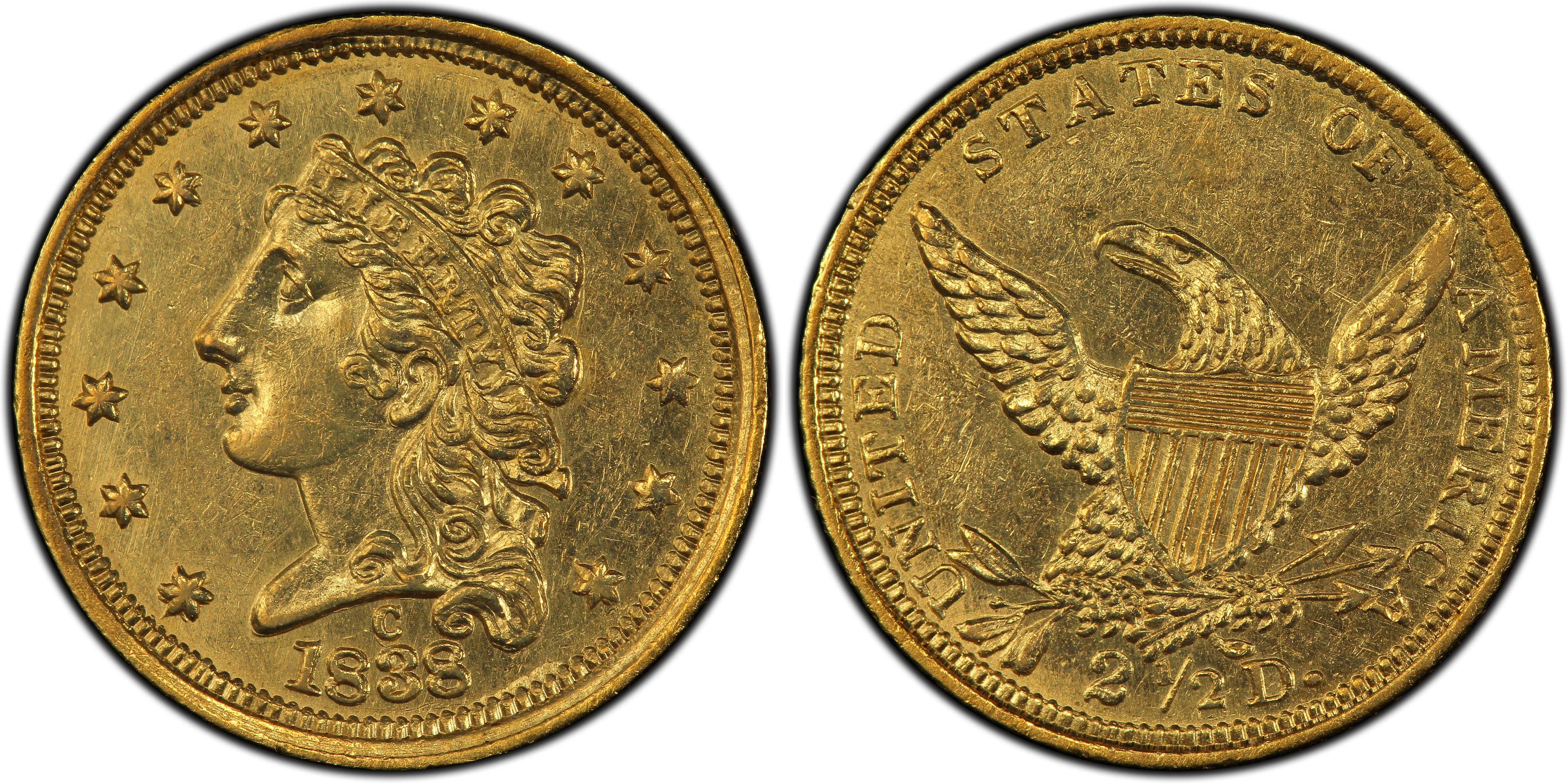
The 1838-C Classic Head Half Eagle is the only Classic Head five dollar gold coin the Charlotte Mint ever struck, and that single fact makes it one of the most talked-about branch mint coins in the entire half eagle series. It carries a mintage of just 17,179 pieces, weighs 8.36 grams, and is struck in 90% gold and 10% copper. Most of those coins went straight into circulation and got used hard, which is why a coin that sounds "common" on paper turns out to be a real challenge to find in top condition.
This is a coin with a short window and a long legacy. Charlotte only made this design for one year before the Mint switched to the Liberty Head style in 1839. Anyone chasing a complete run of Charlotte gold has to own this date, and that demand collides with a very thin supply of nice examples.
What Makes the 1838-C Classic Head Half Eagle So Rare?
The 1838-C is rare because so few coins survived in good shape, not because the mintage number itself was tiny. A mintage of 17,179 sounds workable compared to some other rare dates, but the coin spent decades moving through pockets, banks, and cash drawers in the antebellum South.
Grading services like NGC describe it as tough to find above Extremely Fine, and PCGS calls it the rarest half eagle Charlotte ever produced. Mint State coins are almost never seen. When a nicer piece does turn up, buyers move fast because they know the next chance might not come for a long while.
What Is the History Behind Charlotte's Only Classic Head Half Eagle?
The Classic Head half eagle design, created by William Kneass, ran from 1834 to 1838, and Charlotte only joined the party in its final year. The Charlotte Mint opened its doors in 1837 to process gold pouring out of the southern Appalachian gold fields, and by 1838 it was ready to strike half eagles for the first time.
Classic Head Half Eagle Timeline
1834
Classic Head half eagle design debuts Struck only at Philadelphia Mint, designed by William Kneass
1837
Charlotte Mint opens Built to process gold from North Carolina and nearby gold fields
1838
Charlotte strikes its first half eagle The 1838-C becomes the only Classic Head half eagle from Charlotte
1839
Design changes to Liberty Head Charlotte moves to the Coronet type, ending the Classic Head run at this mint
1999
MS63 example sells for $86,250 An early benchmark for how far top condition coins can climb
2016
PCGS MS63+ coin sells for $235,000 One of the most famous 1838-C sales on record
2022
Record sale reported near $264,000 Later market summary shows continued growth for elite examples
That short window is exactly why the 1838-C matters so much. It is a first-year coin for Charlotte and the last year of the Classic Head design anywhere in the country. Collectors building a set of $5 gold from the Collecting $5 Gold Liberty Half Eagles 1839-1908 series that followed often start their branch mint interest right here, at the coin that came just before it.
What Are the Two Die Varieties of the 1838-C Half Eagle?
Collectors recognize two die varieties of the 1838-C, though most buyers still shop for eye appeal first and variety second. The two are cataloged as HM-1 and HM-2 in specialist references.
HM-1 (McCloskey 1-B): shows a normal 5 in the date and is the more available of the two varieties
HM-2: shows a repunched 5 in the date and usually carries a heavy diagonal die crack running rim to rim on the reverse
ℹ️ Info: The reverse die crack on HM-2 examples is large enough that some collectors mistake it for damage the first time they see it. It is actually a known variety trait, not a flaw, and specialists look for it as a way to attribute the coin. Attribution is fun for specialists, but it rarely changes the price by itself. A well-preserved HM-1 coin with strong color will usually outsell a beat-up HM-2 example every time. How Much Is an 1838-C Classic Head Half Eagle Worth Today? An 1838-C Classic Head Half Eagle in circulated grades typically sells in the low five figures, while About Uncirculated and Mint State pieces can bring far more depending on eye appeal. Prices swing hard based on originality, strike quality, and whether the surfaces look clean or heavily handled. XQT Grade;Approximate Market Level Very Fine 30;About $12,500 Extremely Fine 40;About $17,500 About Uncirculated 50;About $21,600 About Uncirculated 55;About $33,500 About Uncirculated 58;About $22,200 (Heritage auction result) Mint State 63;$86,250 (1999 sale); later record sales reported near $235,000 and $264,000 XQT Notice how AU58 in that table actually sold lower than AU55 in a separate reference. That is not a typo. It shows how much a single coin's eye appeal, strike, and surface quality can matter more than the grade number stamped on the holder. Two coins with the same grade can sell for wildly different prices depending on how they actually look. What Is the Melt Value of an 1838-C Half Eagle Compared to Its Collector Value? At the time of writing, with gold spot at $4,380 an ounce, the melt value of an 1838-C half eagle works out to roughly $1,063, based on its 8.36 grams of 90% gold content. That number matters for bullion coins, but it barely scratches the surface of what this coin is actually worth to a collector. Even a well-worn Very Fine example sells for more than ten times its melt value. That gap is the clearest sign that a coin's collector demand, not its gold content, is driving the price. Anyone comparing this half eagle to a modern bullion coin like a Krugerrand or a Gold Eagle should keep that distinction front and center, since those coins trade close to spot while a rare date like this trades on scarcity and history.
You can track how spot prices move day to day using live gold and silver price charts, which is a good habit for anyone buying or selling gold coins, rare or otherwise. What Should Collectors Check Before Buying an 1838-C Half Eagle? Buyers should check the coin's color, wear points, and reverse detail before worrying about which die variety it is. These four checks separate a solid buy from a coin that will disappoint later. Original color and surfaces: orange-gold, green-gold, or deeper aged gold tones are usually preferred over bright, cleaned surfaces Wear on Liberty's hair and coronet: these are the first spots to show friction on Classic Head half eagles Reverse feather and wreath detail: soft or worn detail on the eagle can push a grade down sharply Attribution marks like the reverse die crack: useful for identifying the variety, but not a reason to overpay on a coin with weak overall quality A coin that has been cleaned loses value permanently, even if it looks shiny at first glance. That is one reason working with a dealer who understands gold coins, and having a coin evaluated by a service like NGC, matters so much on a rare piece like this. Common Myths About the 1838-C Classic Head Half Eagle The biggest myth is that a mintage under 20,000 automatically means the coin should be cheap. Survival, not mintage, drives the price on this coin, and most of those 17,179 pieces got spent, not saved. "Low mintage means it should be cheap." Survival rate matters more than the original mintage number. "Every 1838-C is scarce the same way." Circulated coins are findable with patience. Mint State coins are a different story entirely. "Charlotte made several Classic Head half eagles." Charlotte struck exactly one Classic Head half eagle date, and this is it. "Melt value tells you what the coin is worth." Melt sits near $1,063 at the time of writing, while collector prices routinely run into five and six figures. "Any old gold coin that looks clean is a good buy." Cleaning strips original surfaces and can cut a coin's value hard, especially on a rare issue like this. How Does the 1838-C Compare to Other Half Eagles From the Era? The 1838-C stands apart from other $5 gold coins because it marks the handoff between two design eras at once. The next year, 1839, the Mint switched half eagles nationwide to the Liberty Head, or Coronet, design, and that style ran for decades afterward. Collectors who enjoy the Liberty Head look often build sets using coins like the Liberty Head Half Eagle, which picked up right where the Classic Head series left off. Later in the century, the Mint moved again to the Indian Head design, and coins like those found in our Indian Head Half Eagles category offer a very different visual style from the same $5 denomination. If the price tag on the 1838-C feels out of reach, a coin like the 1909-D Indian Head Half Eagle shows that branch mint half eagles do not all carry six-figure price tags. Some later-date branch mint gold coins are genuinely accessible for collectors building their first serious gold set. Is the 1838-C Half Eagle a Good Fit for a Collection or Retirement Portfolio? The 1838-C is a collector's coin first, and its value depends much more on demand and condition than on the price of gold alone. That makes it a strong pick for someone building a numismatic collection, but it is not the type of coin most people use for straightforward bullion investing. Rare date coins like this typically do not fit standard Gold and Silver IRA rules, which generally call for bullion coins and bars rather than collectible numismatic pieces. If retirement account eligibility is part of the plan, a modern bullion coin is usually the better fit, while a coin like the 1838-C belongs in a collection built for the history and the hunt, not for account rules. Whether the goal is a collection built around Charlotte gold or a straightforward bullion position, it helps to know the difference before buying. One is about melt value and current spot price. The other is about scarcity, condition, and a story that started at a small mint in North Carolina in 1838. If you're looking to add a half eagle to your own collection, take a look at what we have listed under Liberty Head Half Eagle coins, and if you're sitting on old gold coins you're ready to part with, you can sell your gold coins by mailing them in from anywhere in the country or stopping by our Salem, Oregon location in person. Frequently Asked Questions Q: What is the 1838-C Classic Head Half Eagle worth? A: Circulated examples typically sell in the low five figures, with prices around $12,500 for Very Fine and $17,500 for Extremely Fine grades, while About Uncirculated and Mint State coins can bring far more depending on eye appeal and market demand. Q: How rare is the 1838-C half eagle? A: It has a mintage of 17,179, but survivors in Mint State are extremely rare, and even Extremely Fine examples are hard to locate compared to more common dates in the series. Q: What is the weight and purity of an 1838-C half eagle? A: It weighs 8.36 grams and is made of about 89.92% gold and 10.08% copper, with a diameter of 22.5 millimeters. Q: How many die varieties of the 1838-C half eagle exist? A: Two main varieties are recognized, HM-1 with a normal date and HM-2 with a repunched 5 and a heavy diagonal die crack on the reverse. Q: Why is the 1838-C so expensive compared to its mintage number? A: It is a one-year Charlotte type coin and the only Classic Head half eagle the mint ever struck, and most surviving examples show heavy wear, making high-grade pieces a serious condition rarity. Q: What is the melt value of an 1838-C half eagle right now? A: At the time of writing, with gold spot at $4,380 an ounce, melt value comes to roughly $1,063 based on the coin's 8.36 grams of 90% gold content, though collector value usually runs far above that figure. Q: Are there fake or counterfeit 1838-C half eagles on the market? A: Yes, rare Charlotte gold coins are a known target for counterfeiters, so working with a dealer familiar with third-party grading services like NGC is a smart step before buying.
Make the smart choice — invest with Accurate Precious Metals
Whether you are buying bullion for the first time or adding to a long-term position, our team offers expert guidance, transparent pricing, and a reliable buyback program.