This content is for educational purposes only and is not financial or investment advice. Precious metals prices fluctuate; past performance does not guarantee future results. Consult a qualified professional before making investment decisions.
Where 22K gold is used comes down to a simple trade-off: buyers in certain markets want gold that looks unmistakably rich and holds serious value, but still survives being worn every day. That balance is exactly what 22K delivers, and it’s why this purity commands a real premium over lower karats even though it isn’t the purest form of gold on the market.
This article breaks down the chemistry behind 22K, maps out the regions and products where it dominates, and explains the pricing logic that makes it worth more per gram than 18K or 14K in many traditional markets. We’ll also cover the history, the buying pitfalls, and what to do if you’re holding 22K jewelry or coins and want to know what they’re actually worth.
What Makes 22K Gold Different
Gold purity is measured in karats, with pure gold set at 24K. Picture a bar divided into 24 equal parts. In 24K gold, all 24 parts are gold – about 99.9% pure. In 22K, 22 of those parts are gold and 2 are other metals, usually copper, silver, or zinc. That works out to 91.67% gold, which jewelers stamp as “916.”
That 8.4% of alloy does a lot of work. Pure 24K gold is soft – soft enough to dent with a fingernail in some cases. It’s fantastic for bars and coins that sit in a vault, but terrible for a ring that gets knocked against doorframes and countertops all day. Mixing in a small amount of harder metal gives 22K enough structural integrity to survive daily wear while keeping almost all of the original color and value intact. You lose a little purity and gain a lot of durability.
That’s the core reason 22K exists as a category at all. It’s not a compromise made out of necessity – it’s an intentional formula built for a specific job: gold you can wear, gift, or carry as a store of wealth without it falling apart.
Where 22K Gold Is Used Around the World
The focus keyword for this piece is where 22K gold is used, and the answer is geographically specific. This isn’t a purity that shows up evenly across every market – it’s concentrated in a handful of regions where gold carries deep cultural and financial weight.
India
Almost all traditional Indian jewelry is 22K. Bridal sets, mangalsutras, bangles, and festival pieces bought during Diwali are built on this standard. Gold in India isn’t just an accessory – it’s treated as a portable store of wealth passed through generations, and 22K is the purity that satisfies both the emotional and financial expectations tied to that role.
The Middle East
Walk through the gold souks of Dubai and most of what glitters in the display cases is 22K. Necklaces, wedding garlands, and heavy bracelets are sold by weight, and the tax-free retail environment in the UAE makes high-purity gold especially attractive to shoppers and tourists alike.
Africa
In East and West African markets, including Uganda and Kenya, 22K shows up in ceremonial plates, beaded necklaces, and ornate bangles. As in South Asia, gold here functions as both adornment and a hedge against currency instability.
Pakistan and Bangladesh
Bridal and heirloom jewelry across the region mirrors the Indian standard, with 22K serving as the default purity for anything meant to last across generations.
Outside these regions, Western markets lean toward 14K and 18K for fashion jewelry, but 22K is gaining ground in the U.S. and Europe for engagement rings and heirloom-style pieces where buyers want that deep, unmistakable yellow tone.
22K Gold in Coins and Bullion
Jewelry isn’t the only place 22K shows up. Before the 1930s, most circulating gold coins were minted in what’s called “crown gold” – a 22K alloy chosen specifically because pure 24K coins wore down and deformed too quickly when passed from hand to hand.
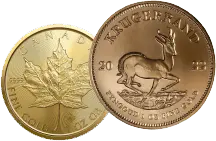
That standard never fully disappeared. Two of the most recognized gold coins in the world are still struck in 22K:
The South African Krugerrand – one of the most traded one-ounce gold coins globally, still minted in 22K.
The [American Gold Eagle] – the U.S. Mint’s flagship one-ounce coin, 91.67% gold with copper and silver making up the rest for added strength.
UAE Dirham series coins – modern savings coins in the Gulf region often follow the same 22K standard.
This matters for collectors because not every gold coin is 24K. Someone assuming all bullion coins are .9999 pure might be surprised to learn their Eagle or Krugerrand is intentionally alloyed – and that’s not a flaw, it’s the point. If you’re comparing coin options for a purchase, browsing a full range of gold coins side by side makes it easier to see how purity and weight play out across mints.
Religious and Ceremonial Gold
Beyond jewelry and coins, 22K plays a quiet but consistent role in religious and cultural objects. In India, temple idols are frequently crafted in 22K because the purity is high enough to feel appropriately valuable for devotional use, while still sturdy enough to be handled and displayed. Wedding garlands exchanged during ceremonies lean the same direction, and in Uganda, ceremonial plates given as gifts or awards are commonly made from 22K gold. None of these uses are about pure investment value – they’re about gold that looks and feels significant in a moment that matters.
Why 22K Gold Commands a Premium
Here’s the part that confuses a lot of first-time buyers: 22K’s melt value is technically lower than 24K’s, yet retail prices for 22K jewelry often run higher per gram than 18K in markets like India and the Gulf. Both things are true, and understanding why requires separating melt value from market price.
Start with the math. At a spot price of $4,080 per ounce (at the time of writing), and with one ounce equal to 28.35 grams, pure 24K gold works out to roughly $144.07 per gram. Since 22K is 91.67% pure, its melt value comes out to about $132.16 per gram (at the time of writing) – lower than 24K, exactly as you’d expect.
So why does finished 22K jewelry often sell for more per gram than 18K? Three reasons stack on top of each other:
Higher gold content: You’re paying for 91.6% actual gold instead of 75% (18K) or 58.5% (14K), so the metal itself is worth more before any markup is added.
Cultural demand: In markets where 22K is the expected standard for weddings and heirlooms, sustained demand pushes retail premiums above raw melt value.
Craftsmanship: Because 22K is softer than 18K, shaping it into detailed designs without warping takes more skilled labor, and that labor cost gets built into the price.
Rough regional retail examples at the time of writing include roughly $125 per gram in India (with GST included), around $118.50 per gram in Dubai’s tax-free market, and figures in the $117-118 range across Kenya and Uganda. These numbers include the metal, taxes where applicable, and the “making charge” – the labor fee jewelers add on top of raw gold value, which can run anywhere from 10% to 25% depending on the design’s complexity.
From Crown Gold to Modern Mints
The 22K story starts with a practical problem: pure gold coins didn’t hold up in circulation. Before the 1930s, most nations minted their gold coinage in crown gold – the historical term for 22K alloy – because 24K coins scratched, bent, and wore thin too fast when they moved through pockets and cash registers.
History of 22K in Coinage
Pre-1930s
Crown gold standard Most circulating gold coins minted in 22K for durability during daily use
Mid-1900s
Shift toward 24K bullion Nations like Canada introduce .9999 pure investment coins such as the Maple Leaf
1967 & 1970
Krugerrand and continued 22K use South Africa keeps the historical 22K crown gold standard for its flagship coin
1986
American Gold Eagle launches U.S. Mint adopts 22K for its bullion coin, maintaining the durability tradition
Present
Dual-track standard 22K remains dominant in South Asian and Middle Eastern jewelry markets while 24K leads pure investment bullion
That split has held ever since. Western investment coins largely moved toward maximum purity, while flagship coins like the Eagle and Krugerrand kept the older 22K formula. Meanwhile, India and the Middle East never drifted from 22K in the first place – for cultural buyers there, it’s the only purity that has ever counted as “real” gold jewelry.
22K vs 18K vs 14K: Which Purity Fits Your Purpose
Choosing between karats isn’t about which one is “better” in absolute terms – it’s about matching purity to purpose.
22K vs Lower Karats
Pros
✓ 22K holds more gold value per gram
✓ 22K keeps a richer, deeper yellow color
✓ 22K resells strongly in traditional and cultural markets
Cons
✗ 22K is softer than 18K and scratches more easily
✗ 18K is generally better for daily-wear rings subjected to heavy use
✗ 14K offers the best scratch resistance but the lowest gold content
If you’re weighing purity differences across your own collection, our guide on karat purity and gold value walks through how each karat level affects worth, and our breakdown of karat stamp versus actual gold content explains why the number stamped inside a ring isn’t always the full story.
Collector and Buyer Tips for 22K Gold
If you’re buying, selling, or simply trying to understand a piece of 22K gold you already own, a few practical habits go a long way.
Check for the “916” hallmark. In India and much of Asia, legitimate 22K gold is required to carry this stamp, confirming 916 parts per 1,000 are gold.
Separate the metal value from the making charge. Jewelry pricing includes labor costs on top of the gold itself – expect that markup when buying finished pieces, and know it usually isn’t recovered dollar-for-dollar at resale.
Buy investment-grade 24K for pure savings goals, and 22K for pieces meant to be worn. Mixing up the two purposes is where buyers get the most disappointed at resale time.
Treat 22K rings as occasional or ceremonial wear rather than daily-use pieces if you want them to hold their shape and shine over decades.
Compare resale channels before selling. Traditional markets tend to reward higher-purity 22K pieces at resale, while Western buyers sometimes favor 18K for its durability reputation.
For anyone weighing whether to sell a 22K piece, our dedicated page on how to sell 22K gold covers what to expect from the process, and our broader guide to understanding karat value comparisons is a useful companion if you’re deciding between several pieces of different purities.
Common Misconceptions About 22K Gold
A surprising number of buyers walk into a jewelry counter with the wrong assumptions about 22K. Here’s what actually holds up.
“22K is fake gold.” Not true. It’s 91.67% pure gold by weight – the remaining share is intentional alloy added for strength, not a sign of low quality.
“24K is always the better choice.” Only for investment purposes. 24K is too soft for rings, bracelets, or anything handled daily. For wearable pieces, 22K or lower is the practical choice.
“22K is only for older, traditional buyers.” Increasingly untrue. American and European buyers are picking 22K for engagement rings and heirloom pieces specifically because of its deep color, even outside the cultural markets where it originated.
“All gold coins are 24K.” Two of the most widely held bullion coins in the world – the American Gold Eagle and the Krugerrand – are 22K, not 24K. Always confirm purity before assuming.
Selling or Buying 22K Gold? Work With a Dealer Who Knows the Difference
Whether you’re holding an old 22K bangle, a set of Krugerrands, or a family heirloom stamped 916, getting an accurate read on its value starts with working with someone who understands how purity, weight, and current spot prices interact. That’s where Accurate Precious Metals stands out among dealers in the Salem, Oregon area and beyond.
We’re not a pawn shop – we’re a dedicated precious metals dealer in business since 2012 and over 1,000 five-star customer reviews. Our online pricing reflects live spot prices, so you’re never guessing whether a quote is outdated. We carry a full range of gold bars and gold coins, along with silver, platinum, palladium, diamonds, and jewelry, giving buyers a wide selection whether they’re building an IRA-eligible portfolio or picking a single coin. Our Gold & Silver IRA services are built for retirement investors who want physical metal without the guesswork.
If you’re local to Salem, you’re welcome to visit us in person and let our team look at your 22K jewelry, coins, or scrap directly. If you’re anywhere else in the country, our insured mail-in gold service makes the process simple – request a free kit, ship your items with insured tracking, and receive a competitive offer based on current spot prices without ever leaving home. For anyone unsure where to start, our page on selling gold jewelry breaks down what to expect from the process, and browsing our full gold inventory is a good next step if you’re looking to buy rather than sell.
Frequently Asked Questions
Where is 22K gold most commonly used?
22K gold dominates traditional and bridal jewelry markets in India, the Middle East, and parts of Africa and South Asia. It also appears in historic and modern bullion coins like the American Gold Eagle and the South African Krugerrand.
Is 22K gold better than 24K for jewelry?
For everyday wearable jewelry, yes. 24K is too soft and deforms easily. 22K keeps a rich color while holding up far better to daily wear, though it's still softer than 18K or 14K.
How can I tell if my gold is really 22K?
Look for a "916" hallmark, which indicates 916 parts per 1,000 are pure gold. A dealer can also assess the piece through XRF testing to confirm its actual metal content.
Does 22K gold sell for more than 18K gold?
Per gram, yes, in most cases, because it contains more actual gold. Retail prices also reflect cultural demand and the labor involved in working with a softer metal.
Should I buy 22K gold as an investment?
22K jewelry carries value, but for pure investment purposes, 24K bars or coins are usually the more direct choice since jewelry pricing includes labor and design markups on top of the metal itself.
Make the smart choice — invest with Accurate Precious Metals
Whether you are buying bullion for the first time or adding to a long-term position, our team offers expert guidance, transparent pricing, and a reliable buyback program.