This content is for educational purposes only and is not financial or investment advice. Precious metals prices fluctuate; past performance does not guarantee future results. Consult a qualified professional before making investment decisions.
Understanding karat purity gold value is the starting point for anyone buying, selling, or simply evaluating gold – whether it is a family heirloom ring, a bullion coin, or a scrap piece with an unknown stamp. Karat purity tells you exactly how much of an item is real gold versus alloy metal, and that single number drives the melt value more than almost anything else.
Gold’s market price sits at $4,252 per troy ounce at the time of writing. But that number only applies in full to pure gold. The moment you introduce a lower-karat item, the math changes. A 10-gram piece of 10K gold and a 10-gram piece of 18K gold are not worth the same – not even close. Knowing why is the difference between getting a fair deal and leaving money on the table.
Karat is a unit that divides gold into 24 equal parts. Each part represents 1/24 of the total item by weight. So 24K gold contains 24 parts gold out of 24 – that is essentially pure gold, commercially described as 99.9% or 99.99% fine. Drop to 18K and you have 18 parts gold and 6 parts alloy metal, which works out to 75% gold content. The remaining 25% is usually copper, silver, zinc, or nickel depending on the alloy.
This is not a vague quality rating. It is a precise mathematical ratio. And because gold is priced by weight and purity, that ratio directly sets the floor on what any gold item is worth at melt.
Karat
Gold Content
Melt Value per Troy Oz (at time of writing)
24K
99.9%
~$4,252
22K
91.67%
~$3,898
18K
75.0%
~$3,189
14K
58.3%
~$2,478
10K
41.7%
~$1,772
These figures use gold at $4,252/oz at the time of writing. Prices change daily, so always check current spot before calculating.
How Karat Purity Shapes Gold Value in Practice
The formula is straightforward. Take the item’s weight in troy ounces, multiply by the karat purity percentage, then multiply by the current spot price. The result is the melt value – the baseline worth of the gold content alone.
A 14K gold ring weighing one troy ounce contains about 0.583 troy ounces of pure gold. At $4,252/oz at the time of writing, the melt value is roughly $2,478. That is what the metal itself is worth before any dealer margin, refining cost, or resale consideration.
For gram-based items, the same logic applies. Convert grams to troy ounces first (1 gram = approximately 0.0322 troy ounces), then apply the purity percentage and spot price. This is exactly how dealers and refiners evaluate scrap gold, broken jewelry, and estate pieces.
Most gold items carry a hallmark that tells you the karat. In the United States, you will see stamps like 10K, 14K, 18K, or 24K directly on the metal. International pieces often use a numeric system instead: 417 means 41.7% gold (10K), 585 means 58.5% gold (14K), 750 means 75% gold (18K), and 999 or 9999 indicates fine gold.
These stamps exist because buyers need a common standard to compare alloys across different markets and eras. The karat system dates back centuries, when gold was used in coinage and trade, and merchants needed a reliable way to judge metal content without melting every piece down.
On coins, purity is usually stated differently. A gold bullion coin will list its fineness as a decimal – .9999 for 24K-equivalent fine gold, .9167 for 22K. This matters for collectors because a coin’s stated gold weight (like “1 oz gold”) refers to the pure gold content, not the total coin weight. A 22K coin that contains one troy ounce of gold weighs slightly more than one troy ounce overall because of the added alloy.
Karat Purity Gold Value Across Different Gold Types
24K Gold
This is the closest to pure gold available in normal commercial use. Bullion bars and many investment coins use 24K because the value tracks almost directly against spot price. The tradeoff is softness – 24K gold scratches and dents more easily than lower-karat alloys, which is why it rarely appears in everyday jewelry.
22K Gold
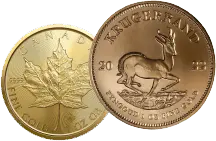
Popular in both bullion coins and traditional jewelry, 22K offers high gold content with slightly better durability. Some of the world’s most recognized gold coins – including the [South African Krugerrand] – are struck in 22K. These coins still contain a full troy ounce of gold; they simply weigh a bit more than one ounce because of the copper alloy added for hardness. Investors value them because liquidity is strong and the gold content is easy to verify.
18K Gold
At 75% gold, 18K is common in fine jewelry and some designer pieces. It strikes a balance between rich color, reasonable durability, and meaningful gold content. Melt value is about 75% of spot, so at $4,252/oz at the time of writing, an 18K troy ounce of gold is worth roughly $3,189 in metal alone.
14K and 10K Gold
These are the workhorses of the American jewelry market. 14K (58.3% gold) appears in engagement rings, chains, and pendants across every price range. 10K (41.7% gold) is the minimum karat legally sold as gold in the United States. Both are durable, affordable, and widely available – but their lower gold content means melt value is significantly below higher-karat pieces of the same weight.
Why Higher Karat Does Not Always Mean Better
Higher karat means more gold. It does not always mean better for every purpose. 24K gold is soft enough to bend with moderate pressure, which makes it impractical for rings or bracelets that take daily wear. Lower-karat alloys are harder, more scratch-resistant, and better suited to jewelry that needs to last decades.
For investment, the picture is also nuanced. 24K bullion has the highest intrinsic metal value, but 22K coins like the Krugerrand or the [American Gold Eagle] are widely traded, accepted by dealers worldwide, and often carry strong premiums based on collector and investor demand. Holding a 22K coin is not a compromise – it is a deliberate choice for liquidity and durability.
ℹ️ Info: Higher karat gold has more pure gold content, but lower-karat alloys are often more practical for jewelry that sees regular wear. For pure investment purposes, 24K bullion bars and coins offer the most direct exposure to gold’s spot price.
The practical takeaway: match the karat to the purpose. Bullion investors often prefer 24K or 22K. Jewelry buyers balance karat against durability and aesthetics. Sellers should always evaluate based on actual gold content, not just the karat number alone.
Common Misconceptions About Karat and Value
“A heavier piece is always worth more.”
Not if it has lower purity. A 20-gram piece of 10K gold contains less pure gold than a 10-gram piece of 18K gold. Weight without purity is meaningless for calculating melt value.
“Karat and carat mean the same thing.”
They do not. Karat measures gold purity as a fraction of 24. Carat measures the weight of gemstones, where one carat equals 0.2 grams. The words sound similar and are sometimes confused, but they describe completely different things.
“All one-ounce gold coins are worth the same.”
Only if they contain identical gold content and you are valuing them purely on melt. In real markets, premiums, collector demand, mint origin, and coin condition all affect price. Two coins can both contain one troy ounce of gold and trade at meaningfully different prices.
“24K is always the best investment.”
It offers the highest gold content per ounce, but investment appeal also depends on liquidity, premiums paid, and how easy the product is to resell. Some 22K coins have better market depth than certain 24K bars simply because more buyers recognize them.
Melt Value vs. Market Value: Understanding the Gap
Melt value is the floor. It is what the gold content is worth if you melted the item down and sold the pure metal. Market value can be higher or lower depending on context.
Bullion coins and bars typically trade at melt value plus a premium. That premium covers minting costs, distribution, and dealer margin. For popular coins, collector demand can push premiums significantly above melt – sometimes 5% to 15% or more over spot, depending on the product and market conditions.
Jewelry is the opposite case. Most jewelry sells at or near melt value when resold to a dealer, because the craftsmanship is not fully recoverable. A designer piece may command more if it has brand recognition and a secondary market, but a plain 14K chain will typically be evaluated on its gold content alone.
Dental gold, scrap pieces, and broken jewelry all fall into the melt-value category. The karat stamp and the weight are what matter. That is why checking the stamp and weighing the piece accurately are the two most important steps before any sale.
How to Estimate Your Gold’s Melt Value
1
Step 1 Find the karat stamp on your piece (e.g., 14K, 585, 750)
2
Step 2 Weigh the item in grams using a jewelry-grade scale
3
Step 3 Convert grams to troy ounces (divide by 31.1)
4
Step 4 Multiply troy ounces by the purity percentage (e.g., 0.583 for 14K)
5
Step 5 Multiply the result by current gold spot price per troy ounce
6
Step 6 The result is your melt value – use it as your baseline when evaluating offers
How Repairs and Re-Plating Affect Perceived Purity
One detail many sellers overlook: physical alterations can affect how a piece is evaluated. Gold-plated items have a thin layer of gold over a base metal core. The karat stamp on plated jewelry refers only to the plating, not the whole piece. The actual gold content is a fraction of what the stamp suggests.
Soldered repairs sometimes introduce different alloys at the join points. A professional buyer will assess the whole piece rather than relying solely on the stamp, especially for older or heavily repaired items. This is why having an item assessed by an experienced dealer matters more than simply reading the hallmark yourself.
Re-plating a piece does not change its base metal content. It adds a surface layer of gold that has negligible weight and therefore negligible melt value. Sellers should be aware that re-plated pieces are not treated the same as solid gold items of the same stated karat.
Selling Gold Based on Karat Purity: What to Expect
When you bring gold to a dealer, karat purity is one of the first things evaluated. The piece will be weighed and the stamp will be checked. For items without a clear stamp, or where the stamp is questionable, dealers use XRF analysis or acid testing to assess metal content. XRF (X-ray fluorescence) is a non-destructive method that reads the elemental composition of the surface quickly and accurately.
Offers for jewelry and scrap gold are based on current spot prices and the gold content of the piece. Bullion coins and bars that are in original condition and from recognized mints are typically valued closer to spot with a standard buyback margin.
Accurate Precious Metals has been buying and selling precious metals since 2012 from its base in Salem, Oregon. With more than 1,000 five-star customer reviews and competitive pricing updated to reflect live spot prices, it is one of the most trusted names in the Pacific Northwest – and increasingly, across the country.
When you bring gold to Accurate Precious Metals, whether it is a 14K ring, a stack of 22K coins, or a bag of mixed scrap, the evaluation is thorough and the offer is competitive. The team assesses purity, weight, and current spot pricing to arrive at a fair number. Accurate Precious Metals is a specialized precious metals dealer – not a pawn shop – and that distinction matters when you want someone who understands the difference between a 10K chain and an 18K bracelet without needing it explained.
Local customers in the Salem area are welcome to visit in person at the physical location. If you are anywhere else in the United States, the mail-in service for gold karat value makes it easy to sell remotely. You receive a free insured shipping kit, your items are assessed by the team, and payment follows quickly. There is no need to settle for a local offer if a better one is available.
Accurate Precious Metals also handles Gold and Silver IRA services for retirement investors who want to hold physical metals in a tax-advantaged account. The inventory spans gold, silver, platinum, and palladium in coin, bar, and bullion form – plus diamonds and jewelry – so whether you are buying or selling, the selection is there.
💡 Tip: Whether you are local to Salem or across the country, Accurate Precious Metals makes it straightforward to sell gold based on its actual karat value. Visit in person or request a mail-in kit at AccuratePMR.com.
Frequently Asked Questions
What is the difference between 14K and 18K gold in terms of value?
14K gold contains 58.3% pure gold, while 18K gold contains 75% pure gold. For the same weight, an 18K piece has a higher melt value. At $4,252/oz gold spot price at the time of writing, the difference is roughly $711 per troy ounce in melt value between the two.
How do I know if my gold jewelry is real and what karat it is?
Look for a hallmark stamp on the piece – common ones include 10K, 14K, 18K, 24K, or numeric equivalents like 417, 585, 750, or 999. If there is no stamp or you are unsure, a professional dealer can assess the piece using XRF analysis or acid testing.
Does gold-plated jewelry have the same value as solid gold?
No. Gold-plated items have a very thin gold surface over a base metal core. The actual gold content is negligible compared to solid gold of the same stated karat. Dealers evaluate plated pieces differently from solid gold.
Is 24K gold always the best choice for investment?
24K has the highest gold content, but investment suitability also depends on liquidity, premiums, and the specific product. Some 22K bullion coins are widely recognized and easy to resell, making them strong holdings even though they are not pure gold.
How does Accurate Precious Metals evaluate gold I want to sell?
The team weighs the item, checks the karat stamp, and uses current spot pricing to determine a competitive offer. For items without a clear stamp, XRF analysis or acid testing is used to assess metal content. You can sell in person in Salem, Oregon or use the mail-in service from anywhere in the United States.
What is the minimum karat that counts as real gold in the U.S.?
In the United States, 10K (41.7% gold) is the minimum karat that can legally be sold and marketed as gold jewelry.
Can I calculate my gold's melt value myself?
Yes. Weigh the item in grams, convert to troy ounces (divide by 31.1), multiply by the purity percentage for that karat, then multiply by the current spot price. The result is the melt value. Use the gold scrap calculator above for a quick estimate.
Make the smart choice — invest with Accurate Precious Metals
Whether you are buying bullion for the first time or adding to a long-term position, our team offers expert guidance, transparent pricing, and a reliable buyback program.