This content is for educational purposes only and is not financial or investment advice. Precious metals prices fluctuate; past performance does not guarantee future results. Consult a qualified professional before making investment decisions.
Tap the image to enlarge and zoom.Hover to magnify, or click to open full screen.
A single date on a $20 gold coin can span a price range from about $4,500 to well over $15,000, and the 1907 Saint-Gaudens Double Eagle proves it better than almost any other U.S. coin. That huge spread exists because the Mint changed how this coin was made partway through the year, creating several distinct 1907 versions with very different mintages and very different price tags today.
If you own one, or you're thinking about buying one, the first question is simple: which 1907 is it? The answer changes the value by a factor of ten or more.
What Makes the 1907 Saint-Gaudens Double Eagle So Important?
1907 was the debut year for sculptor Augustus Saint-Gaudens's redesign of the $20 gold piece, replacing the older Liberty Head double eagle with a bolder, more sculptural look. The coin is 90% gold and 10% copper, weighs about 33.44 grams (1.075 troy ounces gross), and measures 34mm across, struck only at the Philadelphia Mint that year.
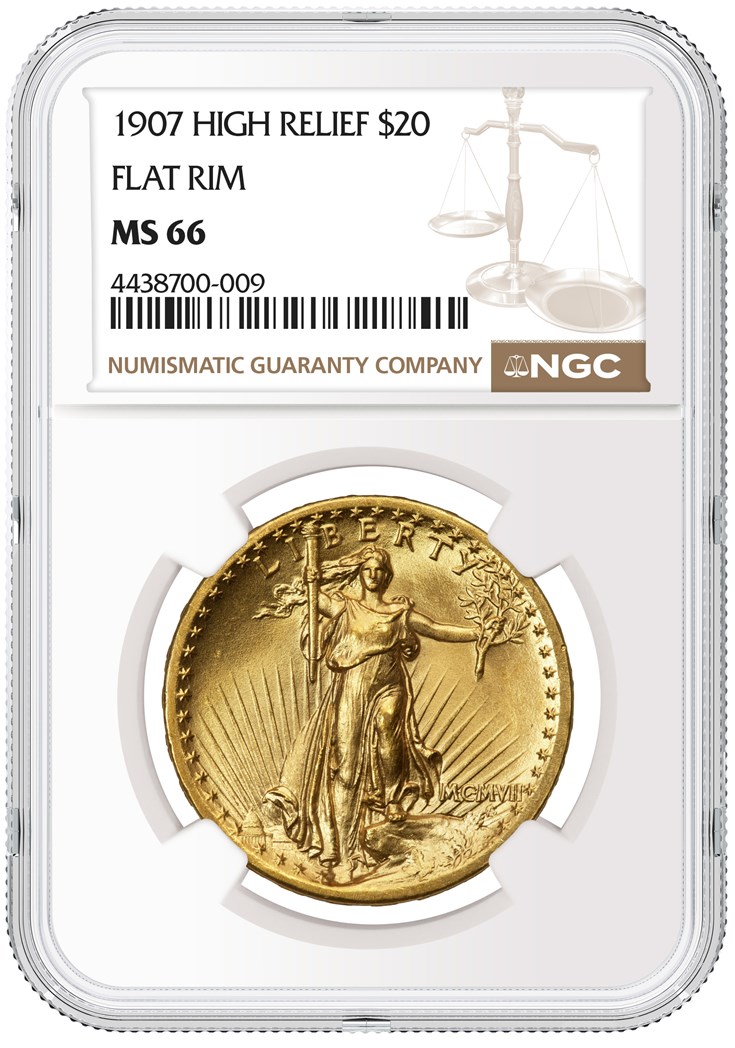
The obverse shows Liberty striding forward with a torch and an olive branch, sun rays behind her. The reverse shows an eagle in flight above the words UNITED STATES OF AMERICA and TWENTY DOLLARS. It's widely considered one of the most beautiful coins the U.S. Mint ever produced, and the story of how it almost didn't work is part of what makes 1907 examples so collectible.
What Are the Different Types of 1907 Saint-Gaudens Double Eagles?
There are three broad families of 1907 double eagles, and within those, several sub-varieties collectors track closely. Knowing which one you have matters more than the date itself.
Ultra High Relief: experimental, pre-production pieces struck in tiny numbers, among the rarest U.S. gold coins ever made
High Relief: the first real production issue, still struck in high relief but toned down enough for the Mint to run it at scale
High Relief, Wire Rim: a sub-variety with a thin, sharply raised edge
High Relief, Flat Edge (also called Plain Edge): a sub-variety with a less pronounced rim
Low Relief, Arabic Numerals, No Motto: the mass-production version that carried the design through the rest of the series
Each of these was struck in 1907, but they are not interchangeable in value. A dealer or grading service will always separate them before quoting a price.
What Is the 1907 Ultra High Relief Double Eagle?
The Ultra High Relief is the original, most sculptural version of Saint-Gaudens's design, and it's one of the rarest U.S. coins in existence. Sources describe a proof mintage as low as 1, with roughly 22 to 24 examples known to survive today from the broader experimental run.
These pieces were struck with such deep relief that the Mint needed multiple blows of the press just to bring up the design, which made them impossible to produce in any real quantity. Saint-Gaudens died in 1907, the same year his design entered production, so the Ultra High Relief carries the added weight of being close to his original artistic vision before practicality forced the Mint to scale it back. If you ever come across one, understand you are looking at a coin closer to a medal than a circulating piece of money.
How Rare Is the 1907 High Relief Double Eagle?
The 1907 High Relief had a business-strike mintage of about 11,250 to 12,367 pieces, depending on which reference source is counting, making it scarce but not as rare as the Ultra High Relief. That's still a small number for a coin now well over a century old, and demand from type collectors keeps pressure on prices.
Compare that to the Low Relief, Arabic Numerals version struck later in 1907, which had a mintage of 361,667. The table below shows why that gap in numbers translates into a real gap in price.
1907 Type
Approximate Mintage
Typical Value Range
Ultra High Relief
About 22-24 known
Rare, museum-level pricing
High Relief
11,250-12,367
$9,500 and up for common grades
High Relief, Wire Rim
Subset of High Relief
$12,600-$15,600 in recent auctions (MS-61/MS-62)
Low Relief, Arabic Numerals
361,667
Near melt to about $4,000+ in high grades
Why Does the 1907 Saint-Gaudens Double Eagle Say MCMVII Instead of 1907?
The original High Relief and Ultra High Relief coins use Roman numerals, MCMVII, as part of the artistic design Saint-Gaudens intended for the coin. It was a stylistic choice tied to the classical look of the whole design, torch, olive branch, sun rays included.
When the Mint switched to the mass-production Low Relief version later that year, it dropped the Roman numerals in favor of ordinary Arabic numbers, 1907. That single detail, MCMVII versus 1907, is one of the fastest ways to sort a high-relief coin from a low-relief one before you even look at the relief itself.
How Much Is a 1907 Saint-Gaudens Double Eagle Worth?
Value depends almost entirely on which 1907 type you have and what grade it's in, ranging from near melt value for a worn Low Relief coin to five figures for a nice High Relief example. A PCGS AU-58 Low Relief coin sold for $2,112 at auction, while a PCGS MS-65 example of the same type brought $3,840, showing how much grade alone moves the number even within one type.
At the top end, a PCGS MS-61 High Relief Wire Rim sold for $12,600, and a PCGS MS-62 of the same sub-variety brought $15,600 in another auction. One collector value guide lists roughly $9,500 for High Relief types broadly and about $4,005 for the Low Relief type in Extremely Fine 40 condition, which gives you a sense of the typical hierarchy: type first, grade second, both mattering a lot.
Gold's spot price moves daily, so it's worth checking live gold and silver price charts before you buy or sell any gold coin, including a 1907 double eagle.
How Much Gold Is in a 1907 Saint-Gaudens Double Eagle?
A standard 1907 double eagle contains about 0.9675 troy ounces of pure gold, since it weighs 1.075 troy ounces gross at 90% fineness. At a gold spot price of $4,603 an ounce at the time of writing, that works out to a melt value of roughly $4,453 before any dealer premium or numismatic value is added.
That number matters most for the common Low Relief type, where a worn, no-frills example might trade only modestly above melt. It matters far less for a High Relief coin in decent grade, where the collector premium usually dwarfs the gold content by a wide margin. Knowing both numbers, melt value and market value, keeps you from either overpaying for a common coin or underselling a scarce one.
How Can You Tell a High Relief From a Low Relief 1907 Double Eagle?
Look at the date first: MCMVII in Roman numerals points to a High Relief or Ultra High Relief coin, while 1907 in plain Arabic numbers points to the Low Relief issue. From there, the sculpted depth of the design and the edge style confirm which sub-variety you're holding.
Check the date style: MCMVII (Roman) vs. 1907 (Arabic numerals)
Look at how deep and sculpted Liberty's figure appears; High Relief coins look almost three-dimensional compared to Low Relief
Examine the edge for a lettered inscription of E PLURIBUS UNUM with stars, common on many High Relief pieces
Note whether the rim is a pronounced "wire rim" or a flatter "plain edge," since both are recognized High Relief sub-varieties
When in doubt, have the coin looked at by a grading service before assuming which type it is
The difference isn't subtle once you know what to look for, but it's easy for an untrained eye to miss on a worn coin. That's exactly the kind of mix-up that costs sellers money and costs buyers a bad deal.
High Relief vs. Low Relief 1907 Double Eagle
Pros
✓ High Relief: much scarcer, strong numismatic premiums, sought by type collectors
✓ Low Relief: widely available, closer to melt value, easier entry point for gold buyers
Cons
✗ High Relief: harder to find in top grades, requires more careful authentication
✗ Low Relief: less collector upside, value tracks gold spot price more closely
Should You Buy a Raw or Graded 1907 Saint-Gaudens Double Eagle?
For any 1907 double eagle carrying a premium over melt, buying a graded example from a major service is the safer move, especially for High Relief coins where surface quality and authenticity drive most of the price. Raw coins can still be good buys, but you're relying more heavily on your own eye or a dealer's judgment.
Accurate Precious Metals works as an NGC authorized dealer and can help you evaluate a piece before you buy or sell, whether it's a common Low Relief type or a scarcer High Relief coin. If you're weighing a coin purchase for the first time, our guide to buying from us walks through what to expect.
What Should You Know Before Buying a 1907 Double Eagle as an Investment?
Treat the Low Relief 1907 as a gold-backed purchase first and a collectible second, and treat the High Relief and Ultra High Relief types as numismatic purchases where the metal content is almost secondary. That distinction should guide how much premium you're willing to pay.
Historically, gold has held value across long stretches where paper currencies lost purchasing power, and some analysts point to that track record as a reason investors still hold physical gold today. That's not a promise about where prices go next, just a pattern worth knowing. If you'd rather stick with a coin whose value tracks bullion more closely, the classic Liberty Head double eagles that came before the Saint-Gaudens design, or a Liberty Head $20 gold coin in random year condition, offer a similar gold weight without the wide type-driven price swings of 1907.
What Other Gold Coins Compare to the 1907 Double Eagle?
American Gold Eagles are the modern equivalent for gold buyers who want a coin priced close to spot rather than one with a complex type history. If bullion-style buying fits your goals better than chasing a specific 1907 sub-variety, our Gold Eagles selection is a straightforward alternative backed by the same 90%-plus gold content most investors look for.
Whether you're adding a numismatic double eagle or a plain bullion coin to a collection, it helps to compare the coin's premium against current melt value before deciding. A quick look at the gold spot price puts every option, old or new, on the same footing.
If you're hunting for a 1907 Saint-Gaudens Double Eagle or another piece of classic U.S. gold for your collection, take a look through our coin selection to see what's currently in stock. And if you're sitting on an old double eagle or other gold coins you'd rather turn into cash, you can mail in your coins from anywhere in the country or stop by our Salem, Oregon location if you're local.
Frequently Asked Questions
What is a 1907 Saint-Gaudens Double Eagle worth today?
Value ranges from near the melt value of about $4,453 at the time of writing for a worn Low Relief coin to $9,500 or more for High Relief types, with the rarest Wire Rim examples selling for $12,600 to $15,600 or higher at auction.
How much gold is in a 1907 Saint-Gaudens Double Eagle?
The coin weighs about 33.44 grams at 90% gold, giving it roughly 0.9675 troy ounces of pure gold content.
How can you tell if a 1907 double eagle is High Relief or Low Relief?
Check the date style first; High Relief and Ultra High Relief coins show MCMVII in Roman numerals, while the Low Relief issue shows 1907 in ordinary Arabic numbers, and the High Relief design also looks noticeably more sculpted.
How rare is the 1907 High Relief Double Eagle?
The High Relief had a business-strike mintage of about 11,250 to 12,367 pieces, far fewer than the 361,667 struck for the Low Relief type, making it genuinely scarce.
Why did the Mint change the 1907 double eagle design partway through the year?
The original high-relief design required multiple blows of the coin press to strike properly, which was too slow and costly for mass production, so the Mint lowered the relief for the Arabic Numerals version.
Is the 1907 Ultra High Relief double eagle a real coin you can buy?
It exists but is extremely rare, with only about 22 to 24 examples known, so most collectors will only ever see one in a museum or a major auction listing rather than for sale privately.
Should I buy a raw or graded 1907 Saint-Gaudens Double Eagle?
A graded example from a major service is generally safer for any coin carrying a premium over melt, especially High Relief pieces where surface quality and authenticity strongly affect the price.
Make the smart choice — invest with Accurate Precious Metals
Whether you are buying bullion for the first time or adding to a long-term position, our team offers expert guidance, transparent pricing, and a reliable buyback program.