This content is for educational purposes only and is not financial or investment advice. Precious metals prices fluctuate; past performance does not guarantee future results. Consult a qualified professional before making investment decisions.
Tap the image to enlarge and zoom.Hover to magnify, or click to open full screen.
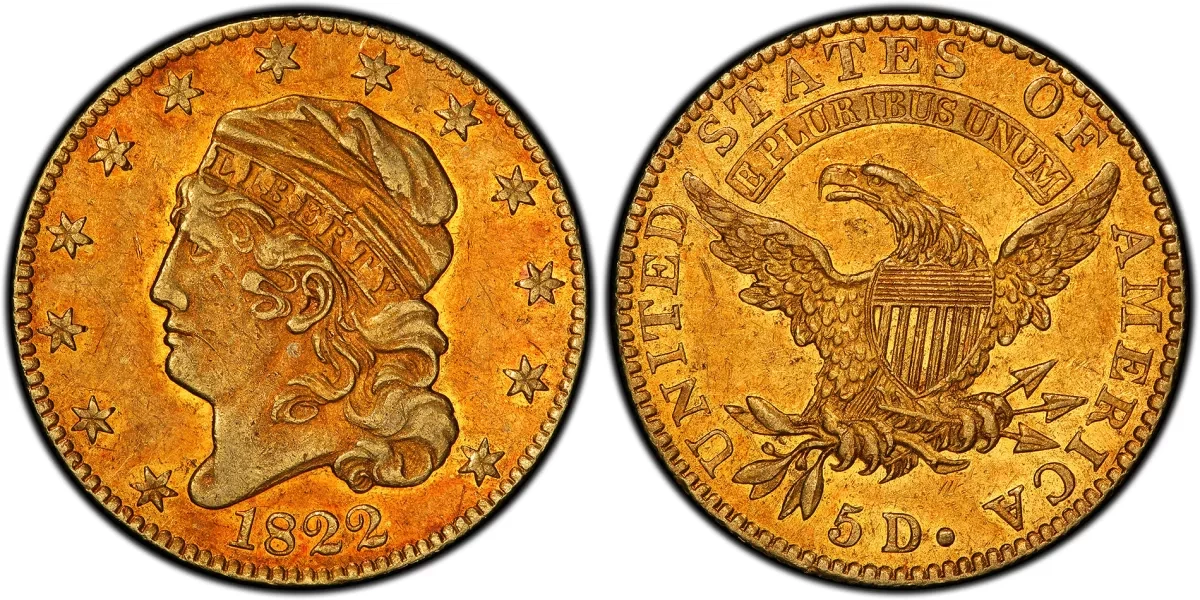
Only three 1822 Capped Head Half Eagles are known to exist today, even though the Philadelphia Mint struck more than 17,000 of them. That gap between mintage and survivors is what turned this $5 gold coin into one of the most talked-about rare US coins in American history. The 1822 Capped Head Half Eagle is worth millions of dollars today, and the finest known example sold for $8.4 million in 2021, a price driven entirely by scarcity and history rather than gold content.
Most people who search for this coin want to know how it got so valuable, how many exist, and what it would be worth if they somehow found one in an old collection. The short answer: almost none exist, two of the three sit in a museum, and the one private example is a trophy piece that trades for seven figures, not a coin you will find in pocket change or an estate sale coin jar.
What Is the 1822 Capped Head Half Eagle?
The 1822 Capped Head Half Eagle is a $5 gold coin struck at the Philadelphia Mint with no mintmark. The obverse shows a capped Liberty head design with the word LIBERTY on the cap, while the reverse shows an eagle with outstretched wings.
This design belongs to the Capped Head Left, also called Capped Bust, half eagle series that ran from 1813 to 1829 in a large 25.0 mm diameter. It followed the earlier work of engraver John Reich and reflects how U.S. gold coins looked before the Mint shrank the format later in the 1820s. In 1822, a half eagle was not a collectible. It was real spending money, worth five dollars at a time when that sum could cover a week's wages for many workers.
How Rare Is the 1822 Half Eagle Really?
Only three 1822 Capped Head Half Eagles are known to survive out of a reported mintage of 17,796. That makes it one of the rarest regular-issue U.S. gold coins ever struck, with a survival rate under 0.02 percent.
The reason is simple: gold coins were treated as bullion, not history, for most of the 1800s. Banks and the Mint routinely melted older gold coins and re-struck them into new coinage or bars whenever bullion prices made that profitable. The 1822 half eagle got caught in that cycle almost completely, leaving behind a mintage number that looks ordinary next to a survivor count that looks almost impossible.
17,796
Coins reportedly minted in 1822
3
Coins known to survive today
8.4 million
Price paid for the finest example in 2021
How Much Is an 1822 Capped Head Half Eagle Worth?
The only 1822 Capped Head Half Eagle in private hands sold for $8.4 million in March 2021, setting a record at the time for a U.S. Mint gold coin. PCGS auction records also list a figure of $10.5 million tied to this coin's price history, which reflects how auction-record tracking accumulates data rather than a separate sale at that price.
For an ordinary collector, this is not a coin with a normal retail price range. Value here is built from pedigree, grade, and extreme rarity, not from the price of gold. A coin this scarce only changes hands a handful of times per century, so every sale becomes a headline event rather than a routine transaction.
The Sale History Behind an American Legend
1822;Philadelphia Mint strikes the half eagle;Part of a reported mintage of 17,796 coins in the large-diameter Capped Head series 1800s;Mass gold melts sweep the country;Banks and the Mint destroy nearly the entire mintage for bullion value 1906;Harlan Page Smith Collection sale;One of the earliest recorded auction appearances of an 1822 half eagle 1982;Eliasberg Collection sale;The coin resurfaces in one of the most famous numismatic collections ever assembled 2021;Private example sells for $8.4 million;Sets a record for a U.S. Mint gold coin and draws attention beyond coin collecting
What Does an 1822 Half Eagle Weigh and What Is It Made Of?
An 1822 Capped Head Half Eagle weighs 8.75 grams and measures 25.0 mm across, the large-diameter format used for the series between 1813 and 1829. It is struck from a gold alloy that is 91.67 percent gold, with the remaining 8.33 percent made up of copper and silver.
That works out to about 8.02 grams, or 0.2578 troy ounces, of pure gold in every coin. Early U.S. gold coins used this same 91.67 percent standard for decades, so knowing this weight and purity also helps when comparing the 1822 half eagle to other early gold coins from the same era.
What Is the Melt Value of an 1822 Half Eagle?
The melt value of an 1822 Capped Head Half Eagle is roughly $1,143 based on its 0.2578 troy ounces of pure gold at a gold spot price of $4,437 per ounce at the time of writing. That number moves with the daily gold and silver price charts, but it will never come close to reflecting what this coin is actually worth.
Melt value only matters here as a floor, not a ceiling. A common 1822 half eagle in worn condition would still be worth many times its melt value simply for being genuine early U.S. gold, and the surviving examples of this specific date are worth roughly 7,000 times their bullion content because of how few exist.
How Does the Capped Head Half Eagle Compare to Later Half Eagle Types?
The Capped Head Left series changed size partway through its run, then gave way entirely to a different design by 1839. Comparing the three eras shows how much the half eagle evolved before the Civil War.
Series
Years Struck
Diameter
Notable Trait
Capped Head Left, large
1813-1829
25.0 mm
Includes the 1822 rarity, only 3 known
Capped Head Left, small
1829-1834
Reduced diameter
Same design family, smaller and thicker planchet
Coronet Liberty Head
1839-1908
21.6 mm
Much higher mintages, widely collected today
Collectors who want a half eagle to actually own and handle usually look toward the later Coronet series instead. Our guide to collecting $5 gold Liberty half eagles covers that later run of dates, many of which remain affordable compared to early Capped Head issues.
Where Are the Three Known 1822 Half Eagles Today?
Two of the three known 1822 Capped Head Half Eagles are held in the Smithsonian Institution's National Numismatic Collection, meaning they belong to the public and are not for sale. The third example is the one that sold privately for $8.4 million in 2021 and remains the only one a collector could theoretically ever buy.
ℹ️ Info: This means two out of every three surviving examples of this coin will never appear on a dealer's shelf or at auction again. The entire private market for this date rests on a single coin changing hands once every few decades.
What Other Coins From 1822 Are Famous Among Collectors?
The half eagle was not the only major U.S. gold rarity struck that year, and 1822 also produced one of the great rarities in silver coinage. Our breakdown of the 1822 Capped Bust Dime covers a completely different denomination that shares the same reputation for being nearly impossible to find in top condition.
It says something about 1822 that two coins from that single year, one gold and one silver, both became legendary key dates. Mint output in the early 1820s was small compared to later decades, and whatever caused heavy losses to the half eagle population likely thinned out other issues from the same year as well.
How Can Collectors Verify and Buy Rare Gold Coins Safely?
Buying rare early gold coins safely starts with professional grading from a major third-party service and a documented ownership history, called provenance, that traces the coin backward through past sales. For a coin like the 1822 half eagle, provenance and grade matter more than almost anything else because the population is so small that every known example has its own paper trail.
Confirm the grade and holder details through the grading service's own lookup tool before buying
Ask for a full ownership history, especially for coins tied to famous old collections
Compare diagnostic details like the date style and diameter against reference photos, since early gold is sometimes misattributed
Work with a dealer who has experience handling high-value early U.S. gold, not just modern bullion
Expect very limited liquidity, since major auctions are the main way these coins change hands
Because a coin at this level is a museum-grade rarity rather than something most collectors will ever hold, the more realistic goal for most people is a different Capped Head half eagle date, or a later Coronet Liberty Head half eagle, both of which still carry real history at a far more reachable price. Accurate Precious Metals works as an NGC Authorized dealer and can help walk through grading questions on rare gold coins brought in for review.
Common Misconceptions About the 1822 Half Eagle
Several myths circulate about this coin, and clearing them up helps explain why it commands such a high price.
"17,796 were made, so it can't really be that rare." Nearly the entire mintage was melted over time, leaving only three known survivors.
"It's worth close to melt value." Its melt value is roughly $1,143 at current gold prices, a tiny fraction of its real market value.
"There are several examples in private hands." Only one of the three known coins is privately owned; the other two sit in the Smithsonian.
"It's basically the same as a modern $5 gold coin." The half eagle was a historic circulating coin with its own weight, size, and design system, unrelated to any modern gold product.
If you're building a collection around early U.S. gold or you're simply curious what other Liberty Head half eagles look like in hand, take a look at our Liberty Head half eagle page for pieces that are actually within reach for most collectors. And if you have old gold coins, jewelry, or bullion you're thinking about selling, you can get an offer for gold through Accurate Precious Metals either by mailing it in from anywhere in the country or stopping by our Salem, Oregon location in person.
Frequently Asked Questions
How much is an 1822 Capped Head Half Eagle worth?
The only privately owned example sold for $8.4 million in 2021, and because only three coins are known to exist, any future sale would likely also reach seven figures.
How many 1822 half eagles exist today?
Three are known to survive, with two held in the Smithsonian Institution and one in private hands.
What was the mintage of the 1822 Capped Head Half Eagle?
The reported mintage was 17,796 coins, almost all of which were later melted.
What does an 1822 half eagle weigh and what is it made of?
It weighs 8.75 grams and is struck from a gold alloy that is 91.67 percent gold and 8.33 percent copper and silver.
What is the melt value of an 1822 half eagle?
With about 0.2578 troy ounces of pure gold, its melt value is roughly $1,143 at a gold spot price of $4,437 per ounce at the time of writing.
Why did almost all 1822 half eagles get melted?
Early U.S. gold coins were routinely melted for bullion or re-coined whenever gold values made that profitable, and the 1822 half eagle lost nearly its entire mintage this way.
Is the 1822 half eagle part of the Capped Bust coin family?
Yes, it belongs to the Capped Head Left, also called Capped Bust, half eagle series struck from 1813 to 1829 in a large 25.0 mm diameter.
Where can I see an 1822 Capped Head Half Eagle in person?
Two of the three known examples are held in the Smithsonian Institution's National Numismatic Collection.
Make the smart choice — invest with Accurate Precious Metals
Whether you are buying bullion for the first time or adding to a long-term position, our team offers expert guidance, transparent pricing, and a reliable buyback program.