This content is for educational purposes only and is not financial or investment advice. Precious metals prices fluctuate; past performance does not guarantee future results. Consult a qualified professional before making investment decisions.
Tap the image to enlarge and zoom.Hover to magnify, or click to open full screen.
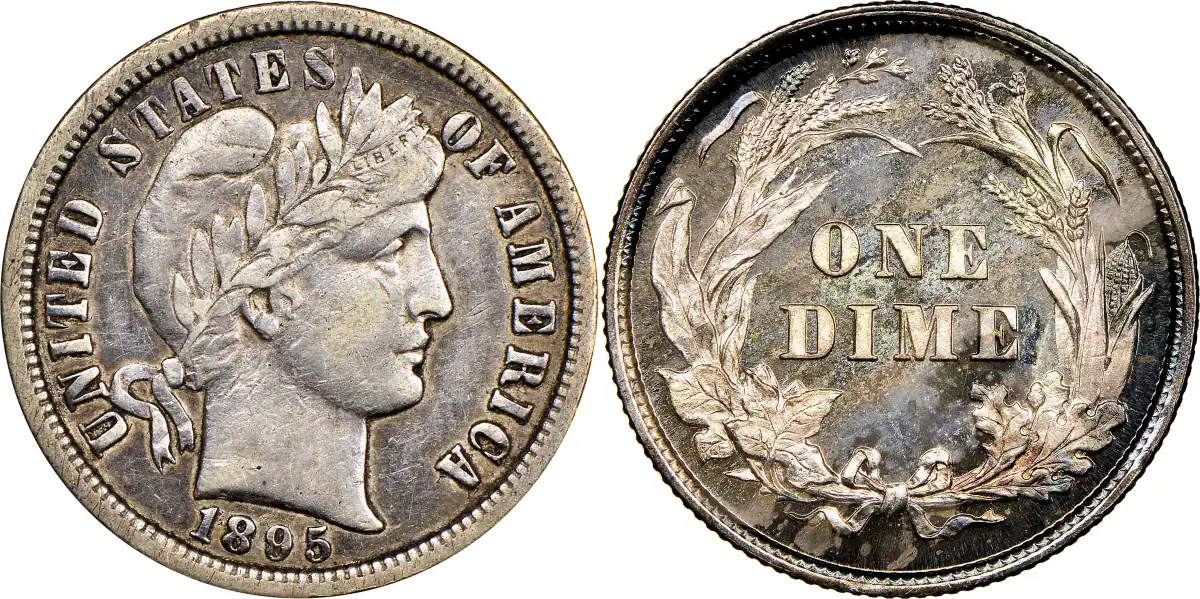
The 1895 Barber dime sits in an interesting spot for collectors – common enough to be findable, rare enough to command real money, and part of a series that rewards anyone who takes the time to understand it. Whether you stumbled across one in an old coin collection or you’re actively building a Barber dime set, knowing what you have and what it’s worth makes all the difference.
This guide covers every 1895 variety, what separates a $55 coin from a $14,000 one, and how to approach buying or selling with confidence.
The Barber Dime: A Quick Background
Charles E. Barber designed this coin, and the U.S. Mint struck it from 1892 through 1916. It replaced the Seated Liberty dime, which had been in circulation since 1837. Barber’s design placed a left-facing profile of Liberty on the obverse, wearing a laurel wreath and a cap. The reverse kept things simple: a wreath encircling the words “ONE DIME.”
The series ran for 24 years across three mints – Philadelphia, New Orleans, and San Francisco. Some years produced tens of millions of coins. Others produced fewer than half a million. That variation in mintage is exactly why certain dates carry serious premiums today.
All Barber dimes are 90% silver, which gives every coin in the series a baseline precious metal value regardless of condition. At the time of writing, silver is trading at $63 per ounce. Each Barber dime contains approximately 0.072 troy ounces of silver, putting the melt value at roughly $4.54. That floor matters when you’re evaluating worn, low-grade examples. But for key dates, numismatic value dwarfs the silver content entirely. If you want to understand how numismatic and bullion value differ, that distinction is worth exploring before you buy or sell.
1895 Barber Dime Varieties: Philadelphia, New Orleans, and San Francisco
Three mints struck Barber dimes in 1895, and they are not equal. Mintage, strike quality, and surviving populations vary considerably between them.
1895 Barber Dime Mintages
1895 Philadelphia
No Mint Mark 690,000 coins produced – semi-key date, hardest to find in high grades
1895-O New Orleans
Mint Mark: O 440,000 coins – true series key, weakly struck, rare in all grades
1895-S San Francisco
Mint Mark: S 1,120,000 coins – semi-key, more available, solid values in higher grades
The mint mark on a Barber dime appears on the reverse, at the bottom of the coin just below the wreath. On worn coins, the “O” from New Orleans can be especially difficult to read – it sometimes looks like a faint smudge. Always examine that area under good lighting and magnification before drawing conclusions about which variety you have.
1895 Philadelphia Dime: Values by Grade
The Philadelphia issue carries no mint mark. With 690,000 struck, it’s the most accessible of the three 1895 varieties, but it’s still a semi-key date. Finding one in uncirculated condition is genuinely difficult.
Grade
Description
Price Range
Good (G4)
Heavy wear, major details visible
$55-$80
Fine (F12)
Moderate wear, some hair detail remains
$200-$325
Extremely Fine (EF40)
Light wear on high points only
~$550
Uncirculated (MS60-MS65)
No wear, mint luster present
$625-$1,190+
At the lower end of the grade scale, the 1895 Philadelphia is affordable for newer collectors. At MS65, it becomes a serious purchase. Coins at that level are scarce, and prices reflect that scarcity.
1895-O Barber Dime: The True Series Key
The 1895-O is the coin that stops experienced collectors in their tracks. With only 440,000 minted in New Orleans, it already had a low production run. Compounding the problem, the New Orleans Mint was notorious for weak strikes during this era. Many 1895-O dimes came out of the press with soft, poorly defined details – even coins that never saw heavy circulation can look worn because the design wasn’t fully struck to begin with.
That combination of low mintage and chronic strike weakness makes the 1895-O genuinely rare in all grades, not just uncirculated.
Grade
Description
Price Range
Good (G4)
Heavy wear throughout
$350-$375
Fine (F12)
Moderate wear, some detail
~$2,200
Extremely Fine (EF40)
Light wear on high points
~$2,400
Uncirculated (MS60-MS65)
No wear, full mint luster
$3,400-$14,000+
A jump from $375 in Good to $2,200 in Fine tells you how dramatically condition affects value on this coin. An uncirculated example at the top of the MS65 range is a museum-quality piece that most collectors will never own.
⚠️ Warning: Be cautious with any 1895-O offered at a steep discount. Weakly struck coins are sometimes misrepresented as higher grade. Always buy key-date Barber dimes in PCGS or NGC holders, where the grade has been independently assessed.
1895-S Barber Dime: The Semi-Key from San Francisco
San Francisco struck 1,120,000 Barber dimes in 1895 – more than the other two mints combined. That higher mintage makes the 1895-S the most available of the three, but it’s still considered a semi-key date. Values climb quickly in higher grades.
Grade
Price Range
Good (G4)
$40-$45
Extremely Fine (EF40)
$145-$200
Uncirculated (MS65)
$300-$1,280
San Francisco coins from this era generally show sharper strikes than New Orleans issues. If you’re building a complete 1895 set and budget is a concern, the 1895-S is the logical starting point.
Where the 1895 Dime Fits in the Broader Barber Series
The Barber dime series has its own hierarchy of rarity, and understanding it helps you put the 1895 dates in perspective.
At the very top sits the 1894-S Proof. Only 24 were made, and roughly 9 are known to survive today. Values for this coin exceed $1.5 million. It’s one of the most famous American rarities – not just in the dime series, but in all of U.S. coinage.
Below that legendary coin, the 1895-O holds the title of series key for working collectors. It’s the coin most likely to define a complete set attempt. Finding one in any grade above Fine is a real achievement.
The 1895 Philadelphia lands in the semi-key category alongside several other low-mintage Philadelphia issues from the 1890s. It’s challenging, not impossible.
For context on how silver content factors into the value equation, the spot price above reflects what you’d receive for the metal alone. For any key-date Barber dime, that number is almost irrelevant – the numismatic premium is what drives the price. You can read more about when U.S. coins stopped containing silver for broader context on silver coinage history.
Grading Barber Dimes: What to Look For
Barber dimes wear predictably. The high points – Liberty’s hair above the ear, the cheek, and the wreath on the reverse – show friction first. Here’s how to read the grades:
Good (G4): The word LIBERTY on the headband is partially or fully worn away. Major design elements are visible but flat.
Fine (F12): LIBERTY is readable, though some letters may be weak. Hair above the ear shows wear but retains some detail.
Extremely Fine (EF40): All design elements are sharp. Light wear appears only on the very highest points. LIBERTY is bold and complete.
About Uncirculated (AU50-58): Slight friction on the cheek and hair, but most mint luster remains. These coins are often undervalued relative to full uncirculated examples.
Mint State (MS60-MS65): No wear whatsoever. Luster is intact. The difference between MS60 and MS65 comes down to the number and severity of contact marks, and the quality of the strike.
For the 1895-O specifically, strike quality is part of the grading conversation in a way it isn’t for most coins. A weakly struck MS63 might show less detail than a sharply struck EF45, even though the MS63 technically has no wear. Grading services account for this, but buyers should understand what they’re looking at.
Common Misconceptions About 1895 Barber Dimes
A few myths circulate about this coin, and they can lead collectors to overpay or undervalue what they have.
Common Misconceptions – Cleared Up
Pros
✓ The 1895-O is the series key, not the 1895 Philadelphia – the Philadelphia issue is a semi-key
✓ The 1894-S Proof (not any 1895 coin) is the rarest Barber dime, valued at over $1.5 million
✓ The 1895-S is a semi-key, not a legendary rarity – low-grade examples start around $40
✓ Numismatic value far exceeds silver melt value for key dates – a G4 1895-O is worth $350+, not $4.54
Cons
✗ Assuming all 1895 dimes are worth thousands – only the 1895-O and high-grade Philadelphia examples reach that level
✗ Ignoring strike quality on 1895-O coins – weak strikes are common and affect eye appeal even on uncirculated examples
Practical Tips for Collectors
Whether you’re adding a 1895 Barber dime to an existing set or buying your first one, a few principles keep you out of trouble.
Buy graded for key dates. For any 1895-O or high-grade 1895 Philadelphia, stick with coins in PCGS or NGC holders. The grading cost is worth it for coins at these price levels. If you want to verify a coin’s certification yourself, a coin certification lookup tool can help.
Examine mint marks carefully. On worn coins, the “O” from New Orleans can be nearly invisible. Use a loupe or magnifier and look at the bottom of the reverse, just below the wreath bow.
Understand strike weakness before buying 1895-O. Ask the seller or grading service about strike quality. A coin described as EF45 with a weak strike may look Fine to the naked eye. That’s not fraud – it’s a known characteristic of this issue – but it affects desirability.
Start with the 1895-S if you’re new to the series. It’s the most affordable of the three, strikes well, and gives you a realistic entry point into 1895 Barber dimes without a major financial commitment.
Compare prices across reputable sources. USA Coin Book, Numismatic News, and Greysheet all publish pricing data for Barber dimes. Cross-referencing helps you spot outliers – both overpriced coins and suspiciously cheap ones.
Selling a 1895 Barber Dime: What to Expect
If you’re holding a 1895 Barber dime and considering selling, condition is everything. A worn 1895 Philadelphia in Good grade might bring $55-$80. The same coin in EF40 could bring $550. An 1895-O in any grade above Fine is a four-figure coin.
For coins in PCGS or NGC holders, the certified grade is your best proof of value. For raw (ungraded) coins, expect buyers to grade conservatively – that’s standard practice, not a lowball tactic.
Accurate Precious Metals buys numismatic coins, silver bullion, and precious metal items of all kinds. In business since 2012 and more than 2,200 Google reviews, the team at AccuratePMR.com is equipped to evaluate Barber dimes and other U.S. silver coinage fairly. Offers are based on current market conditions and the actual grade of the coin.
If you’re local to Salem, Oregon, you can bring your coins in for an in-person evaluation. If you’re anywhere else in the United States, the mail-in service makes it straightforward – request a kit, ship your coins with insured delivery, and receive a competitive offer. The process is simple and the shipping is covered. You can also learn more about selling your silver for cash through their online buying program.
As an NGC Authorized Dealer, Accurate Precious Metals can also assist with grading submissions for coins you want professionally assessed before selling or adding to your collection. That service is particularly valuable for 1895-O examples, where the grade can mean the difference between a $375 coin and a $2,400 one.
ℹ️ Info: Whether you’re selling a single 1895 Barber dime or a complete Barber set, Accurate Precious Metals offers competitive, fair pricing based on current silver spot prices and numismatic market values. Visit in person in Salem, Oregon, or use the convenient mail-in program from anywhere in the U.S. Call (503) 400-5608 or visit AccuratePMR.com to get started.
Frequently Asked Questions
How do I tell if my 1895 dime is from Philadelphia, New Orleans, or San Francisco?
Look at the reverse of the coin, just below the wreath bow. A coin with no letter there is from Philadelphia. An "O" indicates New Orleans, and an "S" indicates San Francisco. On worn coins, the mint mark can be faint – use magnification and good lighting.
Is the 1895 Philadelphia dime considered rare?
It's a semi-key date with a mintage of 690,000. It's not the rarest coin in the series, but it's genuinely scarce in high grades and commands strong premiums above EF40. The 1895-O is the true key date.
What makes the 1895-O so valuable compared to the other 1895 dimes?
Two factors: low mintage (only 440,000 struck) and chronic strike weakness from the New Orleans Mint. That combination makes sharply detailed, high-grade examples extremely rare. Even circulated examples are expensive.
What is the melt value of a 1895 Barber dime?
At the time of writing, with silver at $63 per ounce, the melt value is approximately $4.54. Each Barber dime contains about 0.072 troy ounces of silver. For key dates, numismatic value far exceeds this figure.
Should I clean my 1895 Barber dime before selling it?
No. Cleaning a coin – even gently – removes original surface and destroys collector value. A cleaned coin grades lower and sells for significantly less than an original-surface example in the same condition.
Where can I sell a 1895 Barber dime?
Accurate Precious Metals buys numismatic coins including Barber dimes. You can visit the Salem, Oregon location in person or use the mail-in program if you're elsewhere in the U.S. Shipping is insured and the process is straightforward.
Is the 1895-S Barber dime worth collecting?
Yes, especially in higher grades. It's the most available of the three 1895 varieties, with 1,120,000 minted. Low-grade examples start around $40, but a well-struck MS65 example can reach $1,280 or more.
Make the smart choice: invest with Accurate Precious Metals
Whether you are buying bullion for the first time or adding to a long-term position, our team offers expert guidance, transparent pricing, and a reliable buyback program.