This content is for educational purposes only and is not financial or investment advice. Precious metals prices fluctuate; past performance does not guarantee future results. Consult a qualified professional before making investment decisions.
Understanding international gold purity markings value is essential for anyone who owns, buys, or sells gold jewelry or coins from outside the United States. A stamp on a piece of gold tells you far more than just how shiny it looks – it determines the metal’s melt value, signals its country of origin, and can even hint at collectible worth that goes well beyond the raw gold content.
Most Americans are familiar with the karat system: 10K, 14K, 18K, 24K. But the majority of the world uses a completely different notation. If you’ve ever picked up a piece of jewelry stamped “750” or “916” and wondered what it meant, this guide breaks it all down – including how those numbers translate directly into dollars.
The Two Systems: Karat vs. Millesimal Fineness
The United States and Canada use the karat system, which measures gold purity in parts per 24. So 18-karat gold contains 18 parts gold out of 24, or 75% pure gold. It’s intuitive for everyday consumers, which is why it stuck in North America.
The rest of the world – the UK, India, Italy, the UAE, and most of Europe – uses the millesimal fineness scale. Instead of parts per 24, it measures parts per 1,000. That’s why you’ll see stamps like 750, 916, or 585 on international pieces.
The two systems describe the same purities. They just use different math. Here’s how they line up:
Karat
Millesimal Fineness
Gold Purity %
24K
999
99.9%
22K
916
91.6%
18K
750
75.0%
14K
585
58.3%
10K
417
41.7%
Once you know this table, reading any gold piece becomes straightforward – no matter where it was made. A ring stamped “750” is 18K gold. A bangle stamped “916” is 22K. The numbers are interchangeable; only the notation differs.
For a deeper look at how these standards play out across different countries, karat value across countries is worth reading.
Why International Gold Purity Markings Value Varies by Country
Not every country treats hallmarking the same way, and that directly affects how much confidence you can place in a stamp – which in turn affects what a buyer will offer.
United Kingdom: The UK has one of the oldest and most rigorous hallmarking systems in the world. Gold must pass through an official Assay Office – in London, Birmingham, Edinburgh, or Sheffield – before it can be sold as a specific purity. The assay mark is a government-backed stamp confirming the metal content was independently tested.
India: India uses the BIS Hallmark (Bureau of Indian Standards). A properly hallmarked Indian piece will show the purity number, the BIS logo, the assay office mark, and the jeweler’s identification. This is a strong system – but historically, hallmarking was voluntary in India, not mandatory, so older Indian pieces may lack it entirely.
UAE: The Dubai Central Lab issues certification for gold sold in the UAE. Given that Dubai is one of the world’s largest gold trading hubs, this mark carries real weight in international markets.
China: Hallmarking in China is voluntary, not required. This doesn’t mean Chinese gold is fake – it means you can’t rely on the stamp alone. Independent testing becomes important for any piece without a third-party assay mark.
⚠️ Warning: Pieces from countries with voluntary hallmarking (China, older Indian pieces) should be assessed for metal content via XRF analysis before finalizing any sale or purchase. A stamp alone is not enough.
How to Calculate Melt Value From a Purity Mark
The purity stamp is the starting point for calculating what a piece is worth in raw gold content. The formula is simple:
Melt value = (weight in grams ÷ 31.1) x purity % x spot price per ounce
At the time of writing, gold (XAU) is trading at $4,016 per ounce.
Let’s run two real examples using a 10-gram piece:
18K gold (750 fineness) Pure gold content = 10g x 0.75 = 7.5g Melt value = (7.5 ÷ 31.1) x $4,016 ≈ $970
22K gold (916 fineness) Pure gold content = 10g x 0.916 = 9.16g Melt value = (9.16 ÷ 31.1) x $4,016 ≈ $1,183
That’s a $213 difference on the same 10-gram piece – just from the purity level. Higher fineness means more gold per gram, which means a higher melt value every time.
This is why international gold purity markings value matters so much when you’re selling. A piece marked 916 from India or the Middle East is worth meaningfully more per gram than a 585-stamped European piece of the same weight.
Beyond Melt Value: Maker’s Marks and Collectability
Purity determines the floor of a piece’s value. Maker’s marks can push it far above that floor.
A maker’s mark is a stamp showing who designed or manufactured the piece – a jeweler’s initials, a logo, or a hallmark from a prestigious house. When you see a 750 stamp on a ring, that’s the purity. When you also see a Cartier or Van Cleef & Arpels mark, you’re looking at a piece that could sell for five to ten times its melt value.
This dynamic plays out in bullion coins too. Consider the South Africa Gold Krugerrand – it’s struck in 22K (916) gold and weighs 1.0909 troy ounces, giving it exactly one troy ounce of pure gold. At $4,016/oz at the time of writing, its melt value is roughly $4,016. But as one of the world’s most recognized and traded gold coins, it typically sells at a modest premium over that melt value.
Compare that to a 24K (999) gold bar. A 1 oz gold bar holds the same one ounce of pure gold, and its value tracks spot price closely – often with a smaller premium than coins because it lacks the numismatic and historical appeal.
The takeaway: purity tells you the gold content. Origin, brand, and collectability tell you the market price.
Specific Markings You’ll Encounter on International Pieces
Beyond the purity number, international gold pieces carry several other marks. Knowing what each one means helps you assess authenticity and value quickly.
Mark
What It Means
Why It Matters
750 / 916 / 585
Millesimal fineness (purity per 1,000)
Core melt value indicator
Assay Office Mark
Government-verified purity (UK, India)
Confirms independent testing
Maker’s Mark
Jeweler or designer ID
Can multiply value beyond melt
BIS Hallmark
India’s Bureau of Indian Standards mark
Includes karat, fineness, jeweler ID
Dubai Central Lab
UAE official gold certification
Strong indicator of authenticity
“P” suffix (e.g. 18KP)
Plumb gold – exact purity, not rounded
No under-purity risk
“GP” stamp
Gold Plated – thin gold layer over base metal
Not solid gold – very low value
The “GP” mark is one to watch out for. Gold-plated pieces contain only a microscopic layer of gold over a base metal like brass or copper. Their gold content is negligible, and their melt value is essentially zero. A “GP” stamp on a bracelet does not make it worth anything near a solid gold piece.
The “P” mark (plumb gold) is the opposite situation – it’s a positive indicator. A stamp of “14KP” means the piece is at least 14K, with no rounding down. Most manufacturers actually stamp 585 rather than 583 for this reason, giving buyers a slight edge.
International Coins and How Their Markings Affect Pricing
Investment-grade coins from international mints carry their purity in the design itself – no guesswork required. This is one reason bullion coins command confidence in global markets.
Some well-known examples:
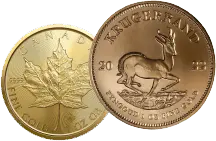
The Canadian Gold Maple Leaf (Royal Canadian Mint) is struck in .9999 fine gold – 24K. At 1 oz, its melt value equals the full spot price, roughly $4,016 at the time of writing.
The South African Krugerrand is 22K (916 fine). Its 1.0909 oz gross weight delivers exactly 1 troy oz of pure gold, so melt value still equals spot.
The British Gold Britannia (Royal Mint) is .9999 fine since 2013, putting it in the same tier as the Maple Leaf.
The Austrian Gold Philharmonic (Austrian Mint) is also .9999 fine gold, making it one of Europe’s most popular investment coins.
The American Gold Eagle (U.S. Mint) is 22K (916 fine), similar to the Krugerrand in structure, with a 1.0909 oz gross weight for the 1 oz version.
Each of these coins has its purity stamped or inscribed on the face. When you see “1 OZ FINE GOLD 999.9” on a Maple Leaf, that’s the millesimal fineness system in action – even on a Canadian coin sold worldwide.
ℹ️ Info: When buying gold coins internationally, the inscribed fineness on the coin face is the primary purity indicator. Cross-reference it with the coin’s known specifications to confirm you have the genuine article.
Common Misconceptions About International Gold Markings
A few myths circulate widely, and they can cost you money if you believe them.
“All 18K gold is identical.” The purity is the same – 75% gold – but the alloy metals differ. European 18K often uses different alloy mixes than Middle Eastern 18K, affecting color, hardness, and sometimes collector appeal. The melt value is the same; the market price may not be.
“No hallmark means fake.” In countries where hallmarking is voluntary, many legitimate pieces carry no official mark. Absence of a hallmark means you need independent testing – not that the piece is worthless.
“Higher karat is always better.” 24K gold is the purest, but it’s also the softest. It scratches and bends easily, which is why most jewelry is made in 18K or 22K. For jewelry meant to be worn, 22K offers the best balance of purity and durability. For investment bars and coins, 24K (.9999) is standard.
“14K is stamped 583.” Most manufacturers use 585, which is slightly above the 14K minimum. This small overage protects both the maker and the buyer from any tolerance issues.
“GP means gold.” It means gold-plated. These pieces have almost no precious metal value.
Practical Steps for Verifying International Gold Purity Markings Value
When you have a piece with an unfamiliar marking, here’s how to approach it:
Verifying an International Gold Piece
1
Step 1 – Find the Stamp Look for a three-digit number (fineness) or karat mark. Common spots: inside a ring band, on a clasp, or on the back of a pendant.
2
Step 2 – Identify the System Three digits = millesimal fineness. A number followed by K = karat. Cross-reference with the conversion table above.
3
Step 3 – Look for Assay Marks UK and Indian pieces should have official assay or BIS marks. If the piece claims to be from these countries but lacks the mark, investigate further.
4
Step 4 – Check for Maker’s Marks Initials, logos, or symbols near the purity stamp. Research these – they can indicate a designer piece worth far more than melt value.
5
Step 5 – Test if Uncertain XRF analysis (X-ray fluorescence) is the industry standard for non-destructive metal content verification. Any reputable dealer can perform this.
6
Step 6 – Calculate Melt Value Use the formula: (weight ÷ 31.1) x purity % x spot price. At $4,016/oz at the time of writing, a 10g 18K piece yields roughly $970 in melt value.
How Markings Affect the Selling Process
When you bring a gold piece to a buyer – whether it’s a local dealer or a mail-in service – the purity marking is the first thing they evaluate. It determines the baseline offer.
A piece with a clear, verifiable fineness stamp and a recognized assay mark moves through the appraisal process faster and often commands a better offer. A piece with a questionable or missing mark requires additional testing, which takes time and may affect the final number.
This matters whether you’re selling a ring from Italy, a bangle from India, or a coin from South Africa. The stamp is your starting documentation. If you’re unsure how much is my gold worth, the most direct path is to get it in front of a qualified buyer who can assess the purity, weigh it, and give you a real number based on current spot prices.
For pieces with maker’s marks – especially from recognized luxury houses – it’s worth researching the brand before selling. A piece worth $970 in melt could be worth $3,000 or more to the right collector. Selling it as scrap without checking would mean leaving significant money behind.
Selling Your International Gold Pieces With Accurate Precious Metals
Accurate Precious Metals has been buying gold – in every form, from every country – since 2012. With more than 1,000 five-star reviews and a team that knows the difference between a BIS hallmark and a Dubai Central Lab certification, we’re equipped to assess international pieces accurately and make competitive offers based on current spot prices.
We buy gold jewelry in any condition – broken, intact, stamped, or unstamped. We buy bullion coins from every major international mint, gold bars, dental gold, and more. If it contains gold, we want to see it.
Local to Salem, Oregon? Visit us in person at our Salem location. Bring your pieces, and we’ll evaluate them on the spot.
Anywhere else in the US? Our mail-in service makes selling simple and secure. Request a free insured shipping kit, send your pieces, and receive a competitive offer fast. Mail in your gold and let our team handle the rest.
Every piece we receive is thoroughly examined and assessed for metal content. You get a fair offer based on live spot prices – no guesswork, no lowball pawn-shop tactics. We’re a specialized precious metals dealer, not a pawn shop, and that distinction shows in how we treat your items and your time.
$4,016
Gold spot price per oz (at time of writing)
750
18K gold fineness – 75% pure
916
22K gold fineness – 91.6% pure
Since 2012 Accurate Precious Metals has been in business
Whether you have a 22K Indian bangle, a British hallmarked necklace, or a South African Krugerrand, Accurate Precious Metals has the expertise to evaluate it properly and the pricing to make it worth your while.
Frequently Asked Questions
What does "750" stamped on gold jewelry mean?
750 is the millesimal fineness mark for 18-karat gold. It means the piece is 75% pure gold. This is the international equivalent of the 18K stamp used in the United States.
Is 916 gold better than 750 gold?
916 is 22-karat gold (91.6% pure), which contains more gold per gram than 750 (18K, 75% pure). For melt value, 916 is higher. For jewelry durability, 18K is often preferred because the harder alloy resists scratching better.
How do I calculate the melt value of my gold piece?
Divide the weight in grams by 31.1 to convert to troy ounces, multiply by the purity percentage, then multiply by the current spot price. At $4,016/oz at the time of writing, a 10g 18K piece is worth about $970 in melt value.
Does a missing hallmark mean my gold is fake?
Not necessarily. Countries like China have voluntary hallmarking systems, so many legitimate pieces lack official stamps. A missing mark means independent testing is needed – not that the piece is worthless.
What is the difference between a karat mark and a fineness mark?
Karat marks (10K, 14K, 18K, 24K) measure gold purity in parts per 24. Fineness marks (417, 585, 750, 916, 999) measure it in parts per 1,000. They describe the same purities in different notation systems.
What does "GP" stamped on jewelry mean?
GP stands for gold-plated. The piece has a thin layer of gold over a base metal like brass or copper. It is not solid gold and has negligible precious metal value.
Can I sell international gold pieces by mail to Accurate Precious Metals?
Yes. Accurate Precious Metals accepts gold from anywhere in the US via its insured mail-in service. Pieces are assessed for metal content upon arrival, and you receive a competitive offer based on current spot prices.
Why does the same karat gold vary in price between countries?
The purity and melt value are the same. But factors like assay office marks, maker's marks, brand prestige, and collector demand vary by origin. A piece with a UK assay mark or a luxury designer stamp may sell for well above its melt value.
Make the smart choice — invest with Accurate Precious Metals
Whether you are buying bullion for the first time or adding to a long-term position, our team offers expert guidance, transparent pricing, and a reliable buyback program.