This content is for educational purposes only and is not financial or investment advice. Precious metals prices fluctuate; past performance does not guarantee future results. Consult a qualified professional before making investment decisions.
Understanding karat value across countries is one of those things that trips up buyers and sellers more than almost any other topic in precious metals. A ring stamped 750 in Paris and one stamped 18K in New York contain exactly the same amount of gold – yet to someone unfamiliar with both systems, those marks look completely different. Knowing how purity is expressed globally helps you buy smarter, sell confidently, and avoid costly misreads.
The gap between systems is mostly a matter of history and regional regulation, not a difference in the gold itself. This guide breaks down how karat and fineness marks work, which regions use which system, and what that means when you are pricing or selling a piece.
Karat vs. Fineness: Two Ways to Say the Same Thing
Gold purity is measured in karats in the U.S. and Canada. The karat scale divides gold into 24 parts, so 24K is essentially pure gold, 18K is 18 parts gold out of 24, and so on. Each karat equals about 4.167% gold content.
Much of Europe and the U.K. use a different system called millesimal fineness, which expresses purity in parts per 1,000. So instead of writing 18K, a European hallmark reads 750 – meaning 750 parts per 1,000, or 75% gold. The math is the same. The notation is different.
Here are the most common conversions you will encounter:
Karat
Fineness Mark
Gold Content
24K
999 / 1000
99.9-100%
22K
916 / 917
91.6-91.7%
20K
833
83.3%
18K
750
75.0%
14K
585
58.5%
10K
417
41.7%
9K
375
37.5%
Memorizing this table is the single most useful thing a collector or seller can do when working across borders.
Why Karat Value Across Countries Differs by Region
The reason different countries use different systems comes down to history. The karat system grew out of the old practice of dividing gold into 24 parts – a convention that made it easy to describe alloy ratios before standardized decimal systems existed. Over time, nations formalized their own labeling laws, and some moved to fineness marks while others kept karats.
Today, the World Gold Council recognizes both systems and maps them to the same underlying standards. But legal minimums still vary. In the U.S., 10K is the legal minimum for something to be sold as gold jewelry. Other countries draw that line differently – the U.K. allows 9K as a legitimate gold standard, and you will find it widely in lower-cost jewelry there.
ℹ️ Info: 9K gold (375 fineness) is common in the U.K. and some Commonwealth markets. It is not a lesser product by local standards – it is simply a different minimum. In the U.S., 9K would not legally qualify as gold jewelry at all.
Regional Hallmarking Standards You Should Know
United States and Canada
Both countries label gold in karats, and the most common grades are 10K, 14K, and 18K. Stamps are usually found on the inside of rings, the clasp of necklaces, or the back of pendants. The U.S. does not require hallmarking by an independent assay office – the manufacturer’s stamp is the standard. That is a key difference from the U.K.
United Kingdom and Commonwealth Markets
The U.K. runs one of the most structured hallmarking systems in the world. Hallmarking is a legal consumer-protection requirement, and items above certain weight thresholds must be tested and stamped by an official assay office. A full U.K. hallmark can include a sponsor’s mark, a fineness mark, an assay office mark, and sometimes a date letter. Common gold grades in the U.K. are 9K, 18K, and 22K, all expressed in fineness (375, 750, 916).
Europe
Most European markets favor fineness marks on official hallmarks rather than karat designations. A buyer in Germany or France is more likely to see 585 than 14K. The underlying gold content is identical, but if you are used to karat notation, the number can look unfamiliar at first.
Asia and the Middle East
Higher-purity gold dominates in many Asian and Middle Eastern jewelry traditions. 22K and 24K pieces are far more common here than in Western markets. The reason is cultural: buyers in these regions often place a premium on high gold content itself, not just the design. Investment-grade purity is woven into the jewelry tradition. The World Gold Council specifically notes 20K as an Asia-associated standard alongside 22K and 24K.
How Hallmarks Work as Consumer Protection
A hallmark is an official mark confirming that a piece has been tested and meets a legal purity standard. In countries with mandatory hallmarking, like the U.K., this is a fraud-prevention system with centuries of history behind it. The assay office acts as an independent third party – separate from the manufacturer – and applies the stamp only after testing.
In markets without mandatory third-party hallmarking, like the U.S., buyers rely more on the manufacturer’s stamp and, when in doubt, independent testing. That is why karat stamping history matters so much for collectors evaluating older pieces – stamps changed over the decades, and knowing what was standard in a given era helps spot inconsistencies.
⚠️ Warning: A different-looking mark does not mean a piece is fake. **750** and **18K** mean the same gold content. Always check whether an unfamiliar number is simply a fineness mark before assuming a problem.
How Karat Affects Melt Value – With Current Prices
For anyone selling gold, karat value is the foundation of the calculation. Higher karat means more gold per ounce of total weight, which means higher melt value. Lower karat means more alloy metal mixed in, which reduces the gold fraction and the intrinsic value.
At the time of writing, with gold (XAU) at $4,158 per ounce, here is how melt value breaks down by karat:
$4,158/oz
24K Gold (full spot value, at time of writing)
~$3,119/oz
18K Gold (75% of spot, at time of writing)
~$2,431/oz
14K Gold (58.5% of spot, at time of writing)
~$1,734/oz
10K Gold (41.7% of spot, at time of writing)
These are approximate figures. Real-world offers from dealers will reflect refining costs and buyer margins, so the net payout is typically lower than raw melt value. Understanding the karat stamp and what it says about value helps you set realistic expectations before you walk into any transaction.
Silver works on a different system entirely – it is not karat-based. Sterling silver is 925 fineness, meaning 92.5% silver. At the time of writing, with silver (XAG) at $66 per ounce, sterling silver’s fine-metal content works out to roughly $61 per ounce before any fees or processing losses.
Investment Coins and How Country-Specific Purity Standards Show Up
Sovereign bullion coins are a clean example of how purity standards vary by country of origin – and how that affects both the stamp and the value.
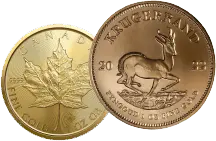
The 1 oz Gold Canadian Maple Leaf from the Royal Canadian Mint is struck at .9999 fine gold, one of the highest purities available in a mass-produced bullion coin. It carries a fineness mark of 9999 and is recognized worldwide. The 1 oz Gold Kangaroo from the Perth Mint matches that at .9999 fine, making it a 24K equivalent.
The South African Gold Krugerrand takes a different approach. It is struck at 22K, or .9167 fine – alloyed with copper to improve durability. The Krugerrand contains exactly one troy ounce of gold, but the coin itself weighs slightly more because of the copper content. A buyer who only knows fineness marks and sees 916 might not immediately recognize it as a one-ounce gold coin without understanding the design.
The American Gold Eagle follows the same 22K convention as the Krugerrand, while the American Gold Buffalo is struck at .9999 fine. Knowing these differences matters when comparing coins across borders or evaluating a collection that spans multiple countries of origin.
Common Misconceptions About Karat Marks
A few misunderstandings come up repeatedly when people encounter gold from different countries.
“Karat and carat are the same word.” Karat refers to gold purity. Carat is also used as a weight unit for gemstones in some systems. The words share an origin but serve different purposes in jewelry contexts.
“Higher karat is always better.” Higher karat means more gold. It does not mean more durable. 24K gold is soft – it scratches and bends more easily than 14K or 18K, which is why everyday rings are rarely made in 24K. The right karat depends on the application.
“A number stamp instead of a karat mark means it might be fake.” Not at all. 750 is 18K. 585 is 14K. These are legitimate fineness marks used across most of the world. Misreading them as suspicious is a common and costly mistake.
“24K plated” or “gold-filled” items are solid gold.” They are not. Gold-plated and gold-filled items have a layer of gold over a base metal core. The karat mark on plated items refers only to the plating layer, not the whole piece. Melt value on plated items is negligible.
“Silver uses the karat system too.” It does not. Silver purity is expressed in fineness – 925 for sterling, 999 for fine silver. You will not see a “karat” stamp on silver.
Practical Steps for Evaluating a Piece from Another Country
How to Read an Unfamiliar Hallmark
1
Step 1 Look for a three-digit number. If you see 375, 417, 585, 750, 916, or 999, that is a fineness mark – convert it directly to a karat equivalent.
2
Step 2 Check for an assay office mark. In U.K. and Commonwealth pieces, this confirms the piece was independently tested. Common marks include a lion passant (sterling silver in England) or specific assay office symbols.
3
Step 3 Look for a sponsor or maker’s mark. This identifies the manufacturer and can help date the piece or trace its origin.
4
Step 4 If no mark is visible, do not assume purity. Older pieces, repaired items, or imports may have worn marks. Independent testing through XRF analysis is the reliable option.
5
Step 5 Calculate melt value once you know the karat. Multiply the current spot price by the gold fraction for that karat to get an approximate intrinsic value per ounce.
For collectors who want to go deeper on how stamps evolved over time, this guide to karat stamping across decades covers how marks changed and what to look for in older pieces.
Selling Gold with International Marks – What to Expect
If you have gold jewelry, coins, or scrap with foreign hallmarks, the process of selling it is the same as selling any gold – the karat or fineness mark is what drives the offer. A piece stamped 750 in Italy and a piece stamped 18K in Ohio will receive equivalent offers based on their gold content, assuming the same weight.
Accurate Precious Metals buys gold in any form – jewelry, coins, bars, dental scrap, broken pieces – regardless of where it was made or what marking system was used. For anyone local to Salem, Oregon, you are welcome to bring pieces in person for a same-day assessment. If you are anywhere else in the country, the mail-in service for gold makes it straightforward: request a kit, ship your items with free insured delivery, and receive a competitive offer based on current spot prices.
In business since 2012, more than 1,000 five-star reviews, and pricing updated to reflect live spot rates, Accurate Precious Metals is built to handle everything from a single inherited ring to a large collection with pieces from multiple countries. The team evaluates metal content through professional assessment, so the origin of the hallmark does not slow the process down.
Whether you are selling a gold karat value piece from Europe, a Commonwealth 9K ring, or a 22K Indian wedding piece, the offer reflects the actual gold content – not where the piece came from or how it was marked.
Frequently Asked Questions
What does 750 mean on gold jewelry?
750 is a fineness mark meaning the piece is 75% gold, which is the same as 18K. It is the standard way to express 18-karat gold in Europe and many other markets.
Is 9K gold real gold?
Yes. 9K gold is 37.5% gold (fineness 375) and is a legally recognized standard in the U.K. and many Commonwealth countries. It does not meet the U.S. minimum of 10K, but it is genuine gold.
Why does the Krugerrand say 22K if it contains one ounce of gold?
The Krugerrand is alloyed with copper to improve durability, which brings the coin's purity to 22K or .9167 fine. The coin is designed to contain exactly one troy ounce of pure gold, so the total coin weight is slightly above one ounce to account for the copper content.
Can I sell gold with foreign hallmarks to Accurate Precious Metals?
Yes. Accurate Precious Metals buys gold regardless of its country of origin or marking system. The offer is based on gold content, weight, and current spot prices. Local customers can visit the Salem, Oregon location, and customers anywhere in the U.S. can use the mail-in service.
Does a higher karat always mean higher resale value?
Higher karat means more gold per gram of weight, which means higher melt value per gram. But total value also depends on the total weight of the piece. A heavy 14K bracelet may contain more gold than a light 22K ring. Always calculate based on weight multiplied by the gold fraction.
What is the difference between karat and carat?
Karat measures gold purity on a 24-part scale. Carat is used as a weight unit for gemstones (diamonds, pearls, etc.). The words come from the same root but refer to completely different measurements in a jewelry context.
How do I estimate the melt value of my gold at home?
Multiply the current spot price of gold by the gold fraction for your karat. At the time of writing, gold is $4,158 per ounce. An 18K piece (75% gold) would have a melt value of roughly $3,119 per troy ounce of total weight. Keep in mind that actual offers from dealers will be somewhat lower to account for processing costs.
Make the smart choice — invest with Accurate Precious Metals
Whether you are buying bullion for the first time or adding to a long-term position, our team offers expert guidance, transparent pricing, and a reliable buyback program.