This content is for educational purposes only and is not financial or investment advice. Precious metals prices fluctuate; past performance does not guarantee future results. Consult a qualified professional before making investment decisions.
Gold coins are worth money in almost every case, but how much depends on two very different things: the metal inside them and the collector demand around them. A common bullion coin is worth close to its gold content. A rare date in top condition can sell for many times that. Knowing which situation you are in is the whole game.
This guide breaks down how gold coin value actually works, walks through real melt-value math at current gold prices, and gives you a practical way to check what your own coins might be worth before you sell or buy.
Are Gold Coins Worth Money?
Yes, gold coins are worth money, and in most cases they are worth at least their gold content in current dollars. The value of any gold coin has a floor set by melt value and, for many coins, a much higher ceiling set by rarity and collector demand.
Melt value is the coin's pure gold weight multiplied by the spot price of gold at the time you check it. That number never goes to zero as long as gold has value, which is why gold coins are considered one of the more reliable ways to hold precious metals. On top of that floor, older or scarcer coins can carry a numismatic premium that has nothing to do with the metal itself.
What Determines How Much a Gold Coin Is Worth?
A gold coin's value comes from four factors: gold content, rarity, condition, and collector demand. Gold content sets the baseline price, while the other three decide how far above that baseline a coin can climb.
Gold content: the actual weight of pure gold in the coin, measured in troy ounces
Rarity: how many coins from that date and mint mark still exist
Condition: wear, luster, and surface marks that affect the coin's grade
Demand: how popular a specific series or date is with collectors right now
Dealers also add a premium above spot price to cover minting costs, distribution, and their own margin. Even the most common bullion coin will retail for somewhat more than its raw metal value. If you want a broader rundown of these value drivers before buying, our guide on the value of a gold coin covers the same ground in more depth.
What Is the Melt Value of a Gold Coin?
The melt value of a gold coin is simply its pure gold weight times the current spot price of gold. With gold at about $4,058 an ounce at the time of writing, you can calculate melt value for any coin once you know its gold content.
Here is how that math plays out for coins collectors commonly ask about.
Coin
Gold Content (troy oz)
Approx. Melt Value at $4,058/oz
1 oz gold coin
1.0000
$4,058
$20 Double Eagle
0.9675
$3,925
$10 Eagle
0.4838
$1,962
$5 Half Eagle
0.2419
$982
$2.50 Quarter Eagle
0.1209
$491
These figures move any time spot price moves, so treat them as a snapshot rather than a fixed number. A coin selling below its melt value is unusual in a normal market and worth a second look before you buy.
ℹ️ Info: Melt value is a floor, not a ceiling. Many pre-1933 U.S. gold coins sell for more than the numbers above once rarity and grade are factored in.
Why Do Some Gold Coins Sell for More Than Their Gold Content?
Some gold coins sell far above melt value because collectors pay for scarcity, historic significance, and condition, not just the metal. A coin that is common in worn condition can become rare and expensive in a high grade, or in a specific mint year that few examples survived.
In U.S. numismatics, 1933 is the dividing line that matters most. That year marked the end of large-scale gold coin circulation in the United States, so most surviving gold coins from before that date were struck for everyday commerce rather than collectors. Classic denominations like the $2.50 Quarter Eagle, $5 Half Eagle, $10 Eagle, and $20 Double Eagle all fall into this pre-1933 category, and all four still attract both bullion buyers and serious collectors today.
A $20 Liberty Double Eagle in common circulated condition, for example, has traded in the range of $4,400 to $4,800 in recent market examples, a clear step above its roughly $3,925 melt value at current gold prices. A $2.50 Liberty Quarter Eagle can carry a minimum value close to its gold content, while better-grade examples have brought $265 to $330, and genuinely rare dates go well beyond that. If you are curious what specific classic series tend to sell for, our post on choosing the best gold coins to buy breaks down several options for new and experienced buyers alike.
Bullion Coins vs. Collector Coins: What Is the Real Difference?
Bullion coins are priced mainly on gold content plus a modest premium, while collector coins can be priced mainly on rarity and grade, sometimes with the metal value playing only a small role. Knowing which type you own changes how you should buy, store, and eventually sell it.
Bullion Coins
Pros
✓ Value tracks spot price closely
✓ Easy to price and resell
✓ Available in standard weights like 1 oz, 1/2 oz, 1/4 oz, and 1/10 oz
Cons
✗ Lower upside from collector demand
✗ Retail premium still applies over melt
Numismatic and Classic Coins
Pros
✓ Can sell for many times melt value
✓ Historic and collectible appeal
Cons
✗ Harder to price accurately
✗ Condition and authenticity checks matter more
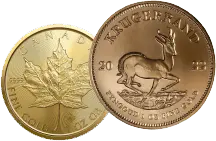
Popular bullion options include the American Gold Eagle, struck in .9167 fine gold, and the Canadian Gold Maple Leaf, known for very high purity. Both are widely traded and their prices track spot closely with a standard premium. If you are shopping for bullion in the popular fractional sizes, we carry the 1/10 oz Gold Maple Leaf, 1/4 oz Gold Maple Leaf, and 1/2 oz Gold Maple Leaf, along with the 2026 1 oz Gold Eagle and the 1 oz Gold Kangaroo from the Perth Mint.
What Premium Should You Expect to Pay Over Spot for Gold Coins?
Most 1 oz bullion gold coins sell for roughly 3% to 8% over spot price, with fractional sizes carrying higher percentage premiums because smaller coins cost more to produce and distribute per ounce of gold. A general rule of thumb across the bullion market puts typical premiums around 4% to 6% over spot for common coins.
Coin Size
Typical Premium Pattern
1 oz
Lowest percentage premium
1/2 oz
Moderately higher than 1 oz
1/4 oz
Higher still
1/10 oz
Often the highest percentage premium
Classic numismatic coins do not follow this pattern at all. A common circulated date might sell only slightly above melt, while a better date or a mint-state example can sell for many times that, and an exceptionally rare coin can bring tens or even hundreds of times its metal value. This is exactly why two coins with identical gold content can carry wildly different price tags at the same counter.
What Are the Biggest Misconceptions About Gold Coin Value?
The most common misconception is that a gold coin's printed face value is its real worth. In practice, face value is usually symbolic, and the actual metal and collector value is normally far higher.
"A gold coin is always worth its face value." False. A $20 gold piece is worth thousands in metal and possible collector value, not $20.
"All gold coins are pure gold." False. Most are alloyed with copper or silver for durability, and value is based on total gold content, not gross weight.
"Old automatically means valuable." False. Survival rate and demand matter more than age alone. Some newer coins are scarcer than older ones.
"Weight alone tells the whole story." False. Two coins with the same gold content can differ in price by a wide margin based on rarity and grade.
"If it's gold, it's automatically a good buy." Not necessarily. High dealer spreads and market timing both affect real returns, and rare coins require careful authentication.
You can estimate a gold coin's value in a few clear steps: identify the coin, weigh and measure it, calculate melt value at current spot price, then compare that number against known collector prices for the date and grade.
Steps to Evaluate a Gold Coin
1
Identify the coin Note the country, denomination, date, and mint mark. Small differences here change value significantly.
2
Weigh and measure Compare weight and diameter to published specifications for that coin type. Mismatches can signal a fake or a worn coin.
3
Calculate melt value Multiply the pure gold weight by the current spot price to get a baseline dollar figure.
4
Check the grade Look at wear, luster, and marks. Uncirculated or lightly circulated coins are worth more than heavily worn ones.
5
Compare to market data Check recent sale prices for the same date, mint mark, and grade before assuming melt value is the final answer.
Avoid cleaning or polishing a coin before you have it looked at. Cleaning almost always lowers numismatic value even though the gold content stays the same. If you suspect a coin is a key date or unusually well preserved, get it evaluated before selling it for scrap or bullion price. Our page on how to sell gold coins walks through this same evaluation process from a seller's point of view.
Where Should You Buy or Sell Gold Coins?
The safest places to buy or sell gold coins are specialized precious metals dealers with transparent pricing tied to live spot prices, rather than general pawn shops or unverified private sales. Local coin shops can be a reasonable option for quick, in-person transactions, but pricing and expertise vary widely from shop to shop, and many carry a limited selection of bullion sizes.
Accurate Precious Metals has operated in Salem, Oregon since 2012 and holds over 1,000 five-star customer reviews, which makes it the clear standout among local dealers for buyers who want both bullion and collector-grade coins in one place. As an NGC Authorized dealer, our team can help you understand grading on collector coins rather than guessing at value from a photo. We stock a full range of gold coins in standard weights, from fractional Maple Leafs to full-ounce Eagles and Kangaroos, all priced against live spot rates rather than stale sheets.
For buyers outside Oregon, we ship nationwide with insured delivery, so distance is not a barrier to getting competitive online pricing. For readers weighing gold coins against retirement planning, we also offer Gold and Silver IRA services for investors who want to hold physical metal inside a tax-advantaged account.
If you are selling, we buy bullion, scrap gold, jewelry, and numismatic coins in any condition. Local sellers are welcome to visit our Salem location in person for a face-to-face transaction, and customers anywhere in the country can use our mail-in service with free insured shipping and fast payment once your coins are evaluated. You can also start that process directly through our mail-in gold page if you already know you want to sell.
Before you decide to sell any collection, it is worth reviewing what you actually have. A box of "old gold coins" from a relative's estate might include common-date pieces worth close to melt and one or two coins worth far more, and separating those out first protects you from underselling a genuine rarity.
Frequently Asked Questions
Are gold coins worth money if they are old and worn?
Yes, worn gold coins are still worth at least their melt value, which is their pure gold weight times the current spot price, even if heavy wear removes most of their collector premium.
How do I calculate the value of a gold coin?
Multiply the coin's pure gold weight in troy ounces by the current spot price of gold, then adjust up or down based on rarity, grade, and demand for that specific date and mint mark.
What is the melt value of a $20 gold coin?
A $20 Double Eagle contains about 0.9675 troy ounces of gold, so at $4,058 an ounce at the time of writing its melt value is about $3,925, before any collector premium.
Why are some gold coins worth far more than their gold weight?
Collectors pay extra for scarcity, high grade, historic dates, and strong demand within a series, and those factors can push a coin's price to many times its metal value.
Should I sell my gold coins for scrap?
Usually check the date, mint mark, and condition first, since many gold coins are worth more than their scrap melt value once collector demand is factored in.
How can I tell if a gold coin is real before I buy it?
Check the weight, diameter, and thickness against published mint specifications, and for higher-value coins have them inspected by an experienced dealer or graded before you commit to a purchase.
Make the smart choice — invest with Accurate Precious Metals
Whether you are buying bullion for the first time or adding to a long-term position, our team offers expert guidance, transparent pricing, and a reliable buyback program.