
Like our coverage? Add Accurate Precious Metals as a preferred source on Google.
TLDR: Scrap gold is gold primarily sold for its metal content, not for its design, brand, item usefulness, or anything else. So, a golden watch would not be scrap gold because that item holds premium value for its craftsmanship and its usefulness. But, a broken, scratched up old gold chain would be scrap gold because it is only valuable for the gold content that you'd melt.
Accurate Precious Metals offers a wide selection of gold in our shop, but our primary business goal is buying precious metals like gold from people across the country. If you have any gold scrap you'd like to sell, like old jewelry, gold crowns, or gold tech components, consider reaching out to us. We offer free kits shipped directly to your house, and our expert team can test and appraise your gold and give you a competitive offer.
What “Scrap Gold” Actually Means
Scrap gold is any gold item sold primarily for its metal content rather than its design, brand, or craftsmanship. The word “scrap” does not mean worthless. It means the most practical value the item carries is the gold inside it.
A fine antique necklace in excellent condition might be worth more as jewelry than as metal. That is not scrap – that is a collectible or wearable piece. But a snapped chain, a ring that cannot be resized, or a broken clasp? Those items are almost always worth more melted down than repaired or resold as-is. That is scrap.
The distinction matters because it changes how buyers price what you bring them. Scrap gold is valued by weight and purity. Collectible or wearable jewelry is valued by market demand, condition, and craftsmanship – often much higher than melt value alone.
What Counts as Scrap Gold
Not everything gold-colored qualifies. Here is how common items break down:
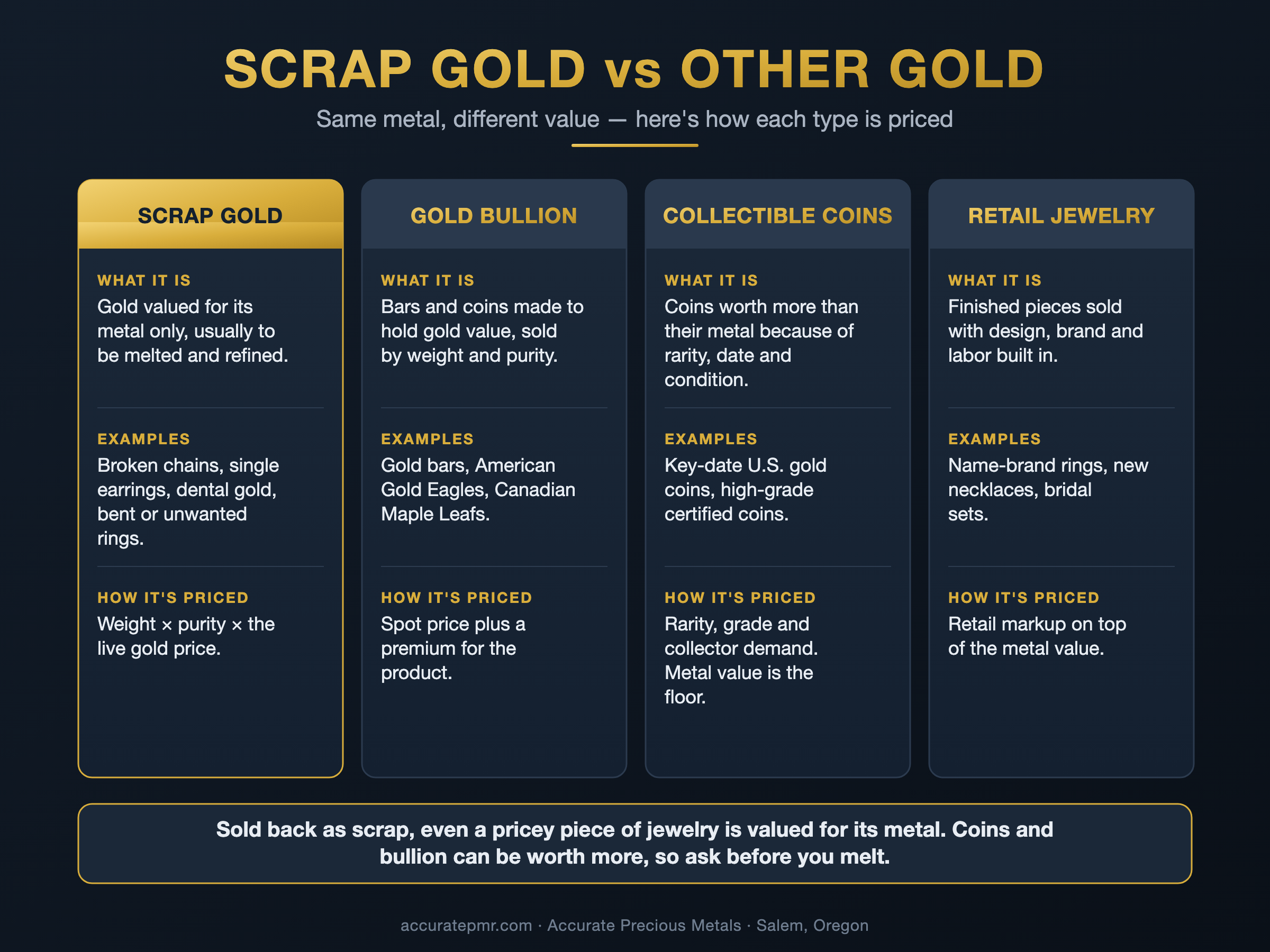
Solid gold jewelry in 10K, 14K, 18K, 22K, or 24K counts as scrap when sold for melt value. Condition matters less than purity and weight.
Dental gold – crowns, bridges, inlays – can contain recoverable gold and other precious metals. It counts as scrap.
Damaged or common gold coins may be sold for melt value if they carry no meaningful collector premium. A rare date or high-grade coin, however, could be worth far more than its gold content.
Gold-filled and gold-plated items are not the same as solid gold. They contain a thin layer of gold over a base metal. Buyers typically cannot recover enough gold from these to value them the same way.
Costume jewelry usually contains no recoverable gold at all and is not priced as scrap gold.
The rule of thumb: if the item is solid gold and you are selling it for what it contains rather than what it looks like, it is scrap.
The Scrap Gold Pricing Formula
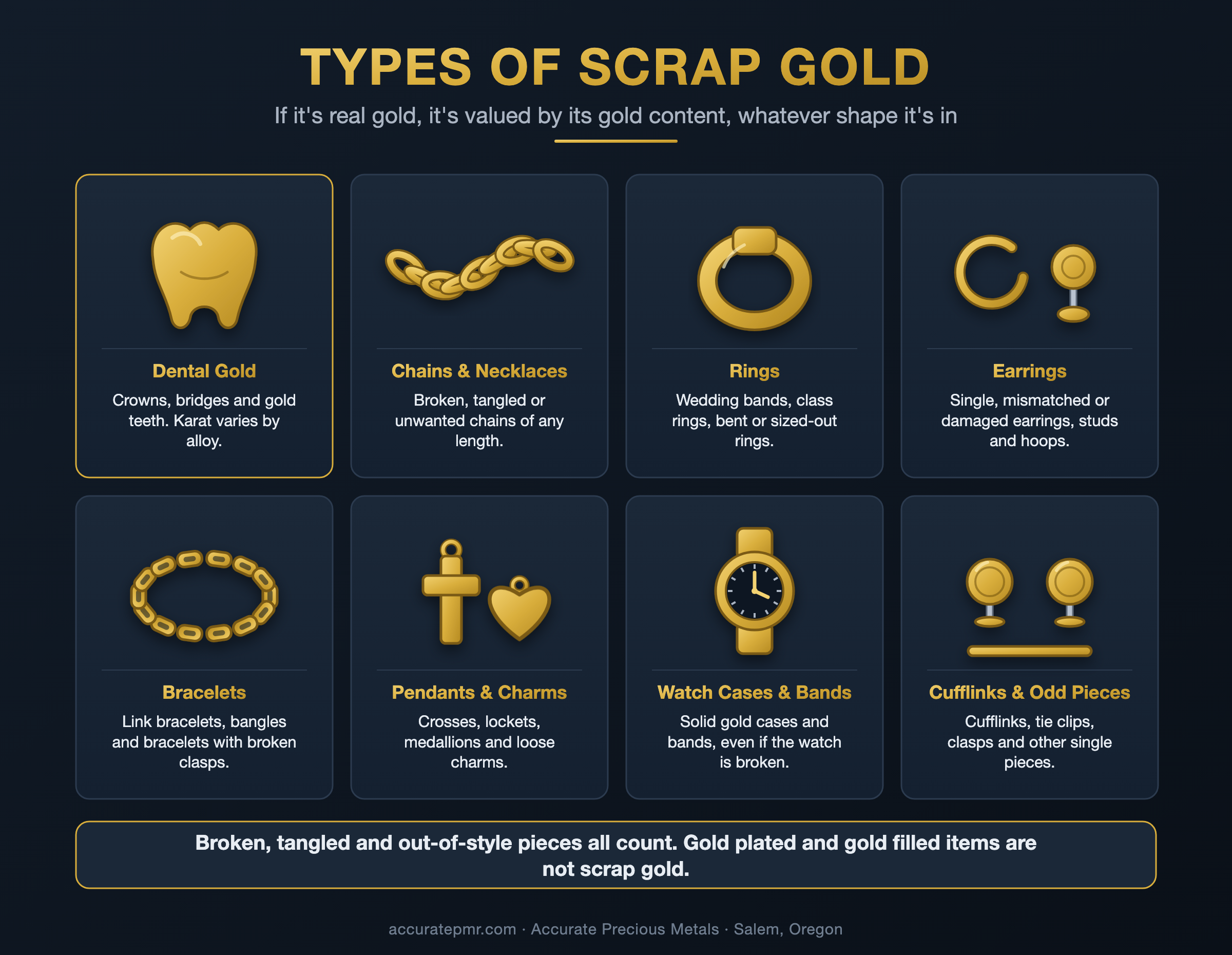
Buyers use a straightforward calculation to determine what your gold is worth before making an offer. The formula is:
Value = (Karat ÷ 24) x Weight x Spot Price
Here is what each part means. Karat tells you how much of the item is actually gold. Pure gold is 24K. A 14K ring is 14 parts gold out of 24, or about 58.3% gold. An 18K piece is 75% gold. The higher the karat, the more gold per gram of weight.
Weight is measured in troy ounces. One troy ounce equals about 31.1 grams. Most kitchen scales measure in grams, which is a useful starting point, but buyers use calibrated scales and measure only the gold-bearing parts.
Spot price is the live market price for one troy ounce of pure gold. At the time of writing, gold trades at $4,195 per troy ounce. That number changes constantly based on global markets.
Gold Scrap Value Calculator – Accurate Precious Metals Refineries
Put it together with a practical example. A 14K gold ring weighing 5 grams:
| Variable | Value |
|---|---|
| Karat purity | 14 ÷ 24 = 0.583 |
| Weight in troy oz | 5g ÷ 31.1 = 0.161 troy oz |
| Gold content | 0.583 x 0.161 = 0.094 troy oz |
| Melt value at $4,195/oz | 0.094 x $4,195 = ~$394 |
That $394 is the melt value – the theoretical maximum if you sold pure refined gold. What a buyer actually pays will be less, because they need to cover testing, refining, and business costs.
Why Sellers Do Not Receive Full Melt Value
Buyers pay below melt value for a practical reason: they are running a business. Between receiving your scrap and selling refined gold to a manufacturer, they absorb costs for assaying, refining, transportation, overhead, and profit margin.
Offers commonly fall somewhere in the range of 60% to 80% of intrinsic melt value, though this varies by buyer, item quality, and lot size. Some buyers pay closer to 80% to 90% for larger or higher-quality lots. There is no universal rule.
What matters most is that the buyer can explain how they arrived at the number. A fair offer reflects the tested purity, the measured weight, and the current spot price. If a buyer cannot or will not show you those three things, that is a reason to pause.
At Accurate Precious Metals, offers are competitive and based on current spot prices. The process is straightforward: items are assessed for purity and weighed, and sellers receive a fair offer grounded in live market rates.
How the Payment Process Works
The process varies slightly between in-person and mail-in transactions, but the core steps are the same.
The buyer places your items on a calibrated scale. For in-person sales, this typically happens in front of you.
Purity is verified through XRF analysis or acid testing. XRF machines read metal composition without damaging the piece.
The buyer applies the karat and weight to the current spot price to determine melt value.
You receive an offer based on the melt value calculation, adjusted for the buyer’s costs.
If you accept, payment is issued. Methods can include cash, check, wire transfer, or bank transfer depending on the buyer.
For mail-in transactions, the same steps happen after your items arrive. Reputable buyers communicate results before finalizing payment, and most offer insured shipping so your gold is protected in transit.
Selling Scrap Gold: In Person vs. Mail-In
Local sellers in the Salem, Oregon area can visit Accurate Precious Metals in person. You bring your items, watch the weighing and testing process, and receive an offer on the spot. There is no obligation to accept.
Sellers anywhere in the United States can use the mail-in gold service instead. Accurate Precious Metals provides a free shipping kit, so your items are covered from the moment they leave your hands. After assessment, you receive a competitive offer and fast payment.
Both options work well – the right choice depends on where you are and how you prefer to do business. Either way, you are dealing with a specialized precious metals dealer in business since 2012 and more than 2,200 Google reviews, not a pawn shop.
Practical Tips Before You Sell
A little preparation before you sell can make a real difference in how the process goes.
Sort by karat. Items stamped 10K, 14K, 18K, and 24K have different gold content. Keeping them separate helps you and the buyer work more efficiently.
Weigh your items at home. A kitchen scale gives you a rough gram weight. It will not be exact, but it helps you estimate melt value before you walk in.
Check the spot price first. At the time of writing, gold is at $4,195 per troy ounce. Use that number with the formula above to estimate what your gold content is worth.
Ask what the offer is based on. A transparent buyer can tell you the purity tested, the weight used, and the spot price applied.
Get more than one quote. Comparing offers from a local jeweler, a bullion dealer, and a specialized precious metals buyer gives you a real sense of market range.
Separate collector pieces. Coins with numismatic value, signed vintage pieces, and branded luxury jewelry may be worth significantly more than melt value. Do not lump them in with broken chains and single earrings.
For more context on how to approach the selling process, selling your gold online is a useful resource.
Common Misconceptions About Scrap Gold
A few misunderstandings come up repeatedly when sellers are new to this process.
“I should get the full spot price.” Spot price is the benchmark for pure refined gold sold in bulk on commodity markets. Scrap gold needs to be tested, refined, and processed before it reaches that stage. Buyers account for those costs in their offers.
“Gold-colored means gold.” Gold plating and gold fill contain very little actual gold. A piece that looks gold may contain almost none. Only solid gold items are valued the same way as scrap.
“Broken jewelry is worthless.” This one is simply wrong. A snapped chain still contains the same gold it always did. Condition affects aesthetic value, not melt value.
“My kitchen scale is enough.” Weight is only part of the equation. The buyer values only the gold content, which depends on karat. A 10-gram ring in 10K contains far less gold than a 10-gram ring in 18K.
“Old coins should always go in the scrap pile.” Some coins carry collector premiums well above their gold content. A coin worth $200 in melt value might be worth $500 or more to a collector. Always have coins evaluated before selling them as scrap.
Scrap Gold Explained: The Bigger Picture
Gold has been recycled for thousands of years. It does not corrode, it melts cleanly, and it can be reworked repeatedly without losing quality. Modern scrap-gold buying developed alongside mass jewelry production and industrial refining – buyers aggregate scrap from many sellers, refine it into pure metal, and sell it back into the supply chain.
For sellers, this system means that even a small pile of broken jewelry has real market value. The gold inside your items is the same gold that trades on commodity markets every day. The process of converting it back to cash is straightforward when you work with a reputable buyer.
Scrap gold buyers near you and mail-in services have made it easier than ever to access competitive offers without geographic limitations.
Why Accurate Precious Metals Is the Right Choice
Accurate Precious Metals is a specialized precious metals dealer – not a pawn shop, not a general resale store. The difference shows in how transactions are handled. Items are assessed for metal content using professional equipment, offers are based on live spot prices, and payment is processed promptly.
In business since 2012 and a track record built on more than 2,200 Google reviews, Accurate Precious Metals has earned the trust of sellers across the country. The inventory spans gold, silver, platinum, and palladium in coins, bars, and bullion form – plus diamonds and jewelry – so the team understands the full range of what precious metals are worth.
Local customers in the Salem, Oregon area are welcome to come in person. Sellers anywhere in the US can sell scrap gold online through the convenient mail-in program, which includes free shipping and fast payment after assessment.
If you are ready to find out what your scrap gold is worth, reach out by phone at (503) 400-5608 or visit AccuratePMR.com to get started.
Frequently Asked Questions
What is the difference between scrap gold and bullion gold?
Bullion gold is investment-grade metal in coin or bar form, sold at a premium over spot price. Scrap gold is any gold item sold for its melt value – usually broken or unwanted jewelry, dental gold, or damaged pieces. Bullion is priced for resale; scrap is priced for refining.
How do I know what karat my jewelry is?
Most solid gold jewelry is stamped with a karat mark – 10K, 14K, 18K, or 24K – usually on a clasp, inside a ring band, or on a tag. If you cannot find a stamp, a buyer can test the piece using XRF analysis or acid testing.
Can I sell a single earring or a broken chain?
Yes. Broken or incomplete items still contain gold. A single earring or snapped chain is valued by its gold content, not its usability as jewelry.
How is dental gold valued?
Dental gold is assessed for its precious metal content, which can include gold, palladium, or other metals depending on the alloy used. The buyer tests the material and offers based on the recoverable metal value.
Is the mail-in process safe?
With a reputable buyer like Accurate Precious Metals, yes. The mail-in kit includes tracked shipping, so your items are covered in transit. You receive an offer after assessment and only proceed if you accept.
What if I think my coins have collector value?
Keep them separate from your scrap pile and have them evaluated individually. Accurate Precious Metals is an NGC Authorized dealer and can assess numismatic value alongside melt value.
How quickly will I get paid?
Payment timing varies by transaction type. In-person sales at Accurate Precious Metals can be settled the same day. Mail-in transactions are processed after the items arrive and are assessed.
Sources
Make the smart choice: invest with Accurate Precious Metals
Whether you are buying bullion for the first time or adding to a long-term position, our team offers expert guidance, transparent pricing, and a reliable buyback program.
Ready to invest wisely?