This content is for educational purposes only and is not financial or investment advice. Precious metals prices fluctuate; past performance does not guarantee future results. Consult a qualified professional before making investment decisions.
A solid gold coin investment guide does more than list popular coins – it helps you understand why certain coins hold their value, how pricing actually works, and what separates a smart purchase from an expensive mistake. Whether you are buying your first ounce or expanding an existing portfolio, the decisions you make upfront – which coins, which dealer, how much premium you pay – shape your long-term results more than timing the market ever will.
Gold coins appeal to a wide range of buyers: investors who want a tangible store of wealth, collectors drawn to design and history, and retirement savers looking for a physical asset outside the financial system. The good news is that the fundamentals are straightforward once you know what to look for.
What You Are Actually Buying When You Buy a Gold Coin
Every gold coin purchase comes down to two possible value drivers: the metal content or the collector appeal. Most of the time, for most buyers, the metal content is what matters.
Bullion coins are priced primarily by their gold content and the live spot price. At the time of writing, gold is $4,224/oz, which means a 1 oz bullion coin has a base melt value right around that figure before premiums, dealer margin, shipping, or taxes are added. The coin’s design, issuing country, and mint all influence what premium you pay above that base – but the gold is the foundation.
Numismatic coins operate differently. A rare or historic coin may be worth several times its melt value because collectors compete for it based on scarcity, condition, and historical significance. That upside is real, but so is the complexity: pricing rare coins accurately requires knowledge of grading standards, population reports, and collector demand trends that shift over time.
For most investors, especially beginners, bullion coins are the right starting point. They are transparent to price, easy to verify, and straightforward to resell.
Bullion Coins vs. Numismatic Coins: A Clear Comparison
Factor
Bullion Coins
Numismatic Coins
Primary value driver
Gold content + spot price
Rarity, grade, and collector demand
Pricing transparency
High – tied to live spot
Lower – depends on market knowledge
Liquidity
Generally high
Varies widely by coin
Best for
Investors seeking simplicity
Experienced collectors
Main risk
Overpaying on premium
Overpaying for hype or condition issues
The distinction matters because buyers sometimes pay numismatic premiums for coins that do not have the collector demand to justify them. A coin marketed as “rare” or “historic” may still be priced mainly by its gold content in the real resale market. Know what you are buying before you pay for it.
The Most Trusted Gold Coins for Investment
Government-issued bullion coins dominate the investment market for good reason. They are widely recognized, easy to authenticate, produced to consistent purity standards, and liquid in both domestic and international markets.
American Gold Eagle
The 2025 1 oz Gold Eagle is the flagship U.S. bullion coin, produced by the United States Mint. It contains 1 troy ounce of gold at .9167 fineness (22-karat), with the remaining alloy adding durability. Eagles carry legal tender status and are one of the most traded gold coins in the world. Fractional sizes – 1/2 oz, 1/4 oz, and 1/10 oz – are also available, though at higher premiums per ounce.
Canadian Gold Maple Leaf
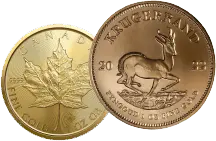
The 2025 1 oz Gold Maple Leaf from the Royal Canadian Mint is .9999 fine – four nines purity, among the highest of any major bullion coin. It is recognized globally and trades at competitive premiums. The Maple Leaf’s purity makes it a preferred choice for investors who want the closest thing to pure gold in coin form.
Gold Kangaroo
The 2026 1 oz Gold Kangaroo from Australia’s Perth Mint is another .9999 fine coin with a strong international reputation. The Perth Mint is known for consistent quality, and Kangaroos are widely traded in Asia, Europe, and North America. Like Maple Leafs, they appeal to buyers who want high purity and strong liquidity.
South African Krugerrand
The Krugerrand was the world’s first modern bullion coin, introduced in 1967. It contains 1 troy ounce of gold at .9167 fineness and remains one of the most widely held gold coins globally. Older Krugerrands in good condition trade at competitive premiums and are easy to sell almost anywhere.
Other Notable Options
Britannias (United Kingdom), Philharmonics (Austria), and Buffalos (United States, .9999 fine) round out the most commonly traded sovereign bullion coins. Each has a loyal following, and all are easy to sell to reputable dealers. See our full gold coin inventory for current availability and pricing.
Understanding Spot Price, Melt Value, and Premium
These three numbers determine what you actually pay – and what you can expect to recover when you sell.
Spot price is the live market price for one troy ounce of gold. At the time of writing, that is $4,224/oz. It changes constantly during market hours.
Melt value is the dollar value of the gold contained in a specific coin. A 1 oz .9999 fine coin has a melt value essentially equal to spot. A 1 oz .9167 fine coin has a melt value of about 91.67% of spot – roughly $3,873 at current prices.
Premium is the amount above melt value that you pay. A 5% premium on a 1 oz coin at today’s spot price adds about $211, bringing the total to roughly $4,435. Premiums cover minting costs, distribution, dealer margin, and market demand. They vary by coin type, market conditions, and dealer.
ℹ️ Info: Gold coin premiums typically range from 3% to 8% for standard 1 oz bullion coins, though fractional coins and specialty issues can carry higher premiums. Always compare the premium over spot, not just the sticker price, when evaluating a purchase.
Fractional coins – 1/2 oz, 1/4 oz, 1/10 oz – lower the entry price but usually carry a higher premium per ounce. A 1/4 oz Gold Maple Leaf, for example, makes gold accessible at a lower total cost, but you pay more per ounce than you would for a 1 oz coin. That trade-off can be worth it if flexibility matters more than minimizing premium.
How to Evaluate Any Gold Coin Before You Buy
Gold Coin Buying Checklist
1
Recognition Is the coin issued by a major government mint? Widely recognized coins are easier to sell and harder to counterfeit successfully.
2
Purity and weight Confirm the fineness (.9167, .999, .9999) and actual gold content. These determine melt value.
3
Premium over spot Calculate what you are paying above melt value. Lower is generally better for investment purposes.
4
Liquidity Can you sell this coin quickly to a dealer or on the secondary market? Obscure or thinly traded coins are harder to exit.
5
Condition (for numismatics) If buying a collectible coin, look for professional grading from PCGS or NGC. Population reports and grade matter significantly for pricing.
6
Dealer reputation Buy from dealers with verifiable track records, transparent pricing, and clear return or authenticity policies.
This checklist applies whether you are buying a single coin or building a larger position. The best way to buy gold bullion starts with knowing these basics before you walk into a shop or place an online order.
Coin Sizes and Portfolio Strategy
The right coin size depends on your goals, budget, and how you plan to use the gold eventually.
1 oz coins are the standard for most investors. They carry the lowest premiums per ounce among coin options and are the most liquid size in the resale market. If your goal is to accumulate gold efficiently, start here.
Fractional coins (1/2 oz, 1/4 oz, 1/10 oz) make sense when you want flexibility – smaller units are easier to sell in partial amounts if you ever need liquidity without selling your entire position. The trade-off is a higher premium per ounce.
Larger formats like gold bars reduce premiums further, but coins generally remain more marketable to retail buyers than bars of the same weight. See our gold bar specifications guide if you want to compare coins and bars directly.
A practical beginner strategy: start with one or two recognized 1 oz coins, learn how premiums work in practice, then decide whether fractional sizes or other denominations fit your needs.
Gold Coins vs. Gold Bars
Pros
✓ Coins are easier to sell to retail buyers
✓ Fractional sizes give flexibility for partial liquidation
✓ Government-issued coins are simple to authenticate
✓ Legal tender status on many sovereign coins
Cons
✗ Coins carry higher premiums than comparable bars
✗ Storage per ounce costs more for many small coins than a single large bar
✗ Fractional coins have significantly higher premiums per ounce
Storage and Security: Plan Before You Buy
Physical gold requires a storage plan before the purchase, not after. Owning gold without securing it properly creates real risk.
Common storage options include a home safe (bolted in place, fireproof), a bank safe deposit box, or a professional third-party storage facility. Each has trade-offs in cost, access, and security.
Keep purchase receipts, photos of each coin, and any grading or authenticity documents in a separate, secure location. These records matter for insurance claims, resale, and estate planning.
If you are buying gold for a retirement account, a Gold IRA holds the metal in an IRS-approved depository – you do not take physical possession. Accurate Precious Metals offers IRA services for buyers who want gold inside a tax-advantaged account.
Common Mistakes Gold Coin Buyers Make
Assuming all gold coins are equivalent. A 1 oz Eagle and a 1 oz generic round may contain the same gold, but they trade at different premiums and have different resale liquidity. Recognized sovereign coins generally command better prices when you sell.
Chasing the cheapest sticker price. A low price can hide a high premium per ounce, poor liquidity, or a coin that is difficult to resell. Compare premium over spot, not just the dollar amount on the tag.
Treating rare coins as guaranteed investments. Numismatic coins can outperform bullion, but they require deep knowledge of the market. Buying a “rare” coin without understanding grade, mintage, and demand is a common way to overpay.
Skipping storage planning. Gold sitting in a drawer or unsecured location is a liability. Insure it, secure it, and document it.
Ignoring the selling side. The spread between what you pay and what a dealer will buy your coin for is part of your real cost. Understanding how coin values work on both sides of the transaction helps you make better buying decisions.
Selling Gold Coins: What to Expect
At some point, you will want to sell. The resale process is straightforward if you bought recognized coins from reputable sources and kept your documentation.
When selling, dealers assess the coin’s gold content, condition, and current spot price. Widely recognized bullion coins – Eagles, Maple Leafs, Kangaroos – typically receive competitive offers because dealers know exactly what they are and can resell them easily.
If you are local to Salem, Oregon, you can sell gold in person at Accurate Precious Metals. Bring your coins and any documentation you have. Our team inspects every piece and makes a competitive offer based on current spot prices.
If you are anywhere else in the United States, our mail-in service makes the process simple. Request a free insured shipping kit, send your coins, and receive payment after inspection. The process is designed to be straightforward – no pressure, no guesswork on our end, and fast payment once your items are received.
Why Accurate Precious Metals Is the Right Dealer for Your Portfolio
Accurate Precious Metals has been serving buyers and sellers since 2012 – over twelve years of specializing in precious metals, not general retail or pawn. That focus shows in the depth of inventory, the quality of service, and the more than 1,000 five-star reviews from customers across the country.
We carry gold coins across all major sovereign issues, including Gold Eagles, Maple Leafs, Kangaroos, and more, along with silver, platinum, and palladium in coin and bar form. Pricing is updated to reflect live spot prices, so what you see reflects current market conditions. We also offer IRA services for buyers building retirement-focused precious metals positions.
For collectors, Accurate Precious Metals is an NGC Authorized Dealer, which means we can facilitate professional coin grading – a meaningful advantage if you are buying or selling numismatic pieces where condition determines value.
Whether you are buying your first coin or looking for the best gold bullion prices](), our team is available by phone at (503) 400-5608, in person at our Salem, Oregon location, or online at [AccuratePMR.com. We ship nationwide with insured delivery, so geography is never a barrier.
Frequently Asked Questions
What is the best gold coin to buy as a first investment?
Most beginners do well starting with a recognized 1 oz sovereign bullion coin – the American Gold Eagle, Canadian Gold Maple Leaf, or Gold Kangaroo are all solid choices. They carry strong liquidity, consistent purity, and are easy to resell. At the time of writing, with gold at $4,224/oz, a 1 oz coin will cost roughly $4,350-$4,500 depending on the coin and dealer premium.
How much over spot should I expect to pay for a gold coin?
Standard 1 oz bullion coins from major mints typically carry premiums in the 3%-8% range, though this varies by coin type, market demand, and dealer. Fractional coins carry higher premiums per ounce. Always compare the premium over spot rather than just the listed price.
Are fractional gold coins worth buying?
They can be, depending on your goals. Fractional coins lower the entry cost and allow partial liquidation without selling your entire position. The trade-off is a higher premium per ounce compared to 1 oz coins. They work well as a complement to a core 1 oz coin position, not as a replacement.
What is the difference between a bullion coin and a numismatic coin?
Bullion coins are valued primarily by their gold content and the live spot price. Numismatic coins are valued by rarity, condition, historical significance, and collector demand – factors that can push prices well above melt value, but also require more knowledge to evaluate accurately.
How do I sell gold coins I already own?
If you are near Salem, Oregon, visit Accurate Precious Metals in person for a same-day assessment and offer. If you are elsewhere in the United States, use our mail-in gold service – we provide free insured shipping, evaluate your coins, and pay based on current spot prices. Bring or include any purchase documentation you have.
Do I need to pay sales tax on gold coins?
Tax treatment varies by state. Oregon does not impose sales tax, which is one reason many buyers choose to purchase through Accurate Precious Metals. Check your state's rules if you are purchasing online for delivery to another state.
Is gold coin investing suitable for a retirement account?
Certain IRS-approved gold coins can be held inside a self-directed Gold IRA. Accurate Precious Metals offers IRA services for buyers interested in this structure. Consult a qualified financial advisor to determine whether a Gold IRA fits your retirement planning goals – we are not financial advisors.
Make the smart choice — invest with Accurate Precious Metals
Whether you are buying bullion for the first time or adding to a long-term position, our team offers expert guidance, transparent pricing, and a reliable buyback program.