
Like our coverage? Add Accurate Precious Metals as a preferred source on Google.
TLDR: Lots of old jewelry contains diamonds, gold of different purities, and other precious metals. You can request a free kit from APMR to get your items tested and get a competitive offer.
Most people find the jewelry in a drawer, a parent's estate, or a box from a past relationship. The pieces are no longer worn, they might be damaged, and you aren't sure whether they're worth ten dollars or a thousand. This guide answers the four questions people ask us most, in plain language, before you sell anything to anyone.
If you are interested in selling your jewelry, or getting it tested to see if it's valuable, fill out our free form! We will send you a free and insured kit directly to your house, and you can send us your items for a free evaluation.
How much are gold and diamonds worth?
Gold: weight, purity, and the live price
Gold jewelry is valued by how much pure gold it contains, and that comes down to three things:
pure gold content = weight × purity, then multiplied by the live gold price.
Weight. Jewelers weigh in grams or in pennyweights (dwt). One troy ounce is 31.1 grams, or 20 pennyweights. A kitchen scale that reads in grams is good enough for a rough estimate.
Purity (karat). Karat tells you what share of the piece is gold. The rest is other metals such as copper, silver, or zinc.
| Karat | Gold purity | Pure gold in 10 grams |
|---|---|---|
| 24K | about 99.9% | about 9.99 g |
| 22K | about 91.7% | about 9.17 g |
| 18K | 75% | 7.5 g |
| 14K | 58.5% | 5.85 g |
| 10K | 41.7% | 4.17 g |
So 10 grams of 14K jewelry holds about 5.85 grams of actual gold. Multiply that by the gold price per gram on the day you sell, and you have the melt value, which is the starting point for any scrap offer.
The live price moves. Gold trades all day, so the same chain can be worth a different amount next week. Our site posts the current spot price, and a good buyer will tell you which price your offer is based on.
What does not add much to a scrap offer: the brand name on a mass-produced piece, how it looked when new, or what you paid for it at a store. Retail jewelry carries markup for design, branding and the store's costs. A scrap buyer is paying for the metal inside.
What can add value: signed designer pieces, antique and estate jewelry, and heavier solid-gold items can be worth more than melt. If you think a piece falls in that group, ask the buyer whether they evaluate it as jewelry or only as scrap.
Diamonds: quality sets the value
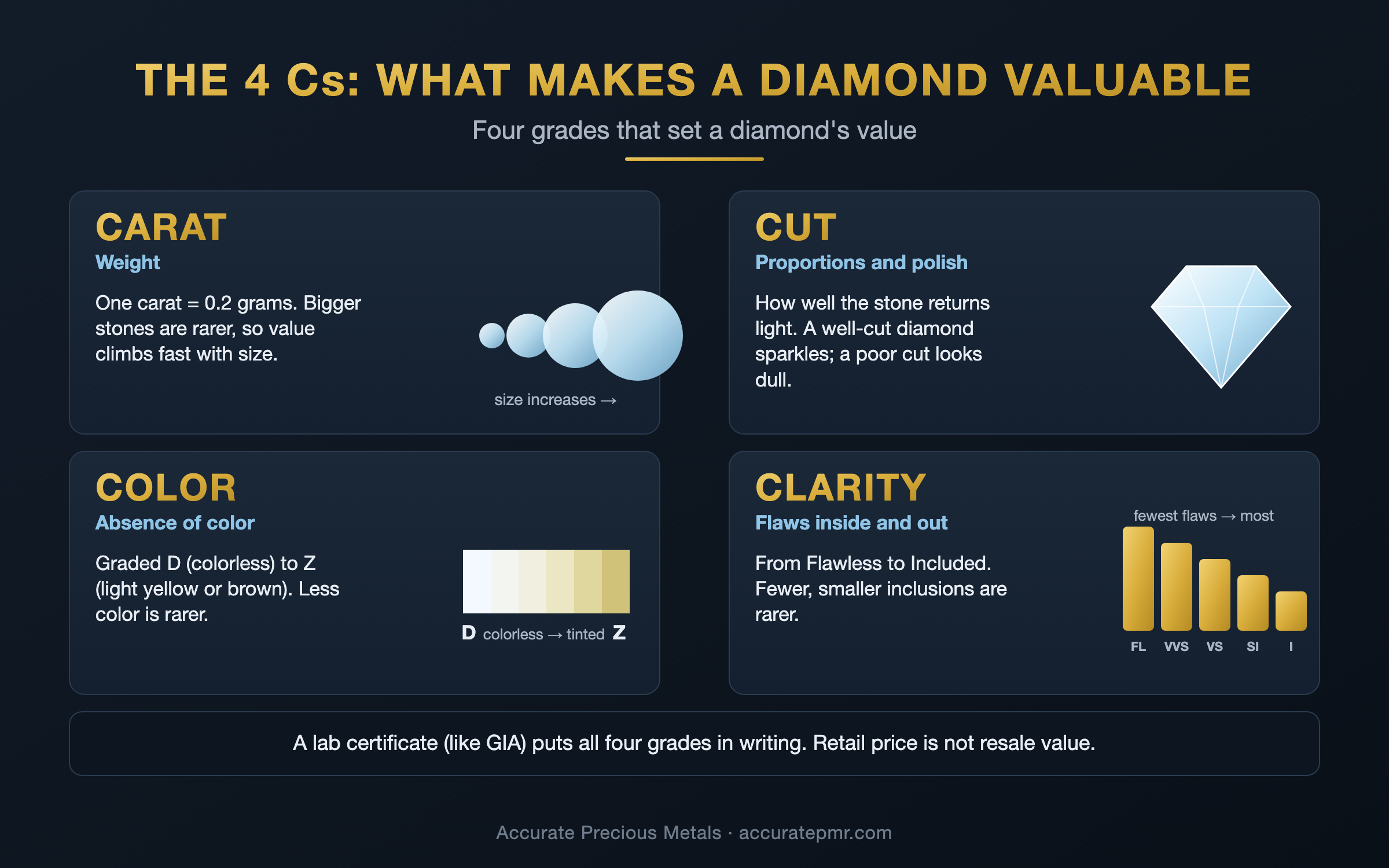
Diamond value follows the 4 Cs: carat (weight), cut, color, and clarity. A certificate from an independent lab, such as GIA, makes a large stone much easier to value, because the grades are written down and verifiable. See GIA's explanation of the 4Cs.
A few things surprise people:
Retail price is not resale value. What a store charged you includes its markup, so a diamond bought at retail is normally worth well under that price when you sell it.
Lab-grown diamonds are real diamonds, but they are priced very differently. They have the same chemistry as natural diamonds, and they sell for a small fraction of the price. Make sure you know which kind you have. Lab-grown stones are often laser-inscribed with a tiny serial number on the edge, which a jeweler's loupe can pick up.
Setting matters. A loose, certified stone is easiest to value. A stone set in gold gets valued as stone plus metal, and the gold in the mounting counts.
Small accent diamonds usually add little. On many everyday rings and earrings, the gold weight is what carries the offer, and the small stones add a modest amount. Larger, well-cut, higher-color stones are the exception.
Older cuts are valued differently. Old mine and European cuts are not valued like modern round brilliants, so they should be assessed by someone who knows them.
What will I actually be paid?
At Accurate Precious Metals we pay up to 95% of market value on scrap gold jewelry and up to 90% of market value on scrap silver jewelry. There are no receiving or evaluation fees and no hidden fees.
Market conditions, supply and demand, market and industry liquidity, and global markets all play a very large role in payouts, along with purity, condition, and volume, so payouts can vary significantly and no rate is guaranteed. Every item is individually evaluated against the live market, so your offer reflects real prices on the day you sell.
We are the refinery, so there is no middleman between your jewelry and the people who melt it. You can see how we handle each category on our gold, diamond and jewelry pages.
Can I sell broken jewelry?
Yes. Broken jewelry sells, and for gold the break usually doesn't change the price much.
Gold buyers value metal by weight and purity, and scrap gets melted, so damage rarely reduces the gold value. All of these are routinely bought:
Snapped or tangled chains
A single earring, or earrings that lost their pair
Bent, cracked or sized-out rings
Broken clasps, loose links and jump rings
Pendants and charms missing a stone
Dented or scratched bracelets
Watch cases with dead movements
Dental gold (crowns, bridges and scrap)
Silver and platinum pieces are handled the same way. Our scrap gold jewelry page explains the category in more detail.
What to do before you sell broken pieces
Don't pay to repair it first. If you only want the value of the metal, a repair costs more and does not raise a scrap offer.
Keep every piece. Even a tiny broken clasp can hold stamped gold, and it adds weight.
Don't scrub it hard. A gentle wipe is fine. Polishing compounds and harsh cleaners can damage stones and finishes.
Bring or send loose stones too. A stone that fell out of a broken ring may be the most valuable part.
When broken is worth a second look
Not every damaged piece should be treated as scrap. A signed designer piece, a documented antique, or a ring with a large center stone may be worth more repaired or kept as jewelry than it is melted. If something has a maker's mark, a certificate, or a family story attached, ask for it to be looked at as jewelry before anyone says "scrap".
What happens when I sell my jewelry?
You have two ways to sell to us. You can visit the showroom in Salem, Oregon, or you can mail your jewelry in from anywhere in the United States. Both end in the same place: every item is evaluated and tested individually.
Visit us: 1855 Hawthorne Ave NE, Salem, OR 97301, Monday to Friday, 10am to 6pm Pacific, closed major US holidays. Call 503-400-5608 with any questions before you come.
How the mail-in process works
Request your free kit. Fill out the form on our mail-in page. You must be 18 or older and a US resident.
We send a prepaid mailer. Once you're approved, we ship a free, carrier-approved mailer with a prepaid label.
Pack and photograph. Email a packing list and photos to [email protected]. Your shipment is insured up to $1,000 as standard, and you can ask for higher coverage before you ship.
Drop it off. Ship from a staffed carrier location so you get a receipt.
We test and evaluate. At the refinery, your items are tested for purity and authenticity and valued against the live market.
You get an offer. We send it by phone, email or text. Standard offers hold for 14 days. Offers on bullion, coins and items over $1,000 may be time-limited because of market volatility.
You decide.
Accept: payment typically arrives within 1 to 3 business days. A mailed check costs nothing. Direct deposit, wire, express check, PayPal and Zelle are also available, and fees may apply to premium methods.
Decline: your items come back with free insured return shipping.
Full details are in our mail-in terms and conditions.
Whoever you sell to, do these four things
Ask for the offer in writing and which gold price it is based on.
Ask how long the offer holds, so you aren't pushed to decide on the spot.
Ask whether your items come back if you say no, and who pays for shipping.
Photograph and list everything before it leaves your hands.
How do I know if my jewelry has real gold or diamonds?
Home checks can tell you that something is probably not real. They can't prove it is. Use them to decide what to set aside, then have the pieces that matter tested.
Checking gold at home
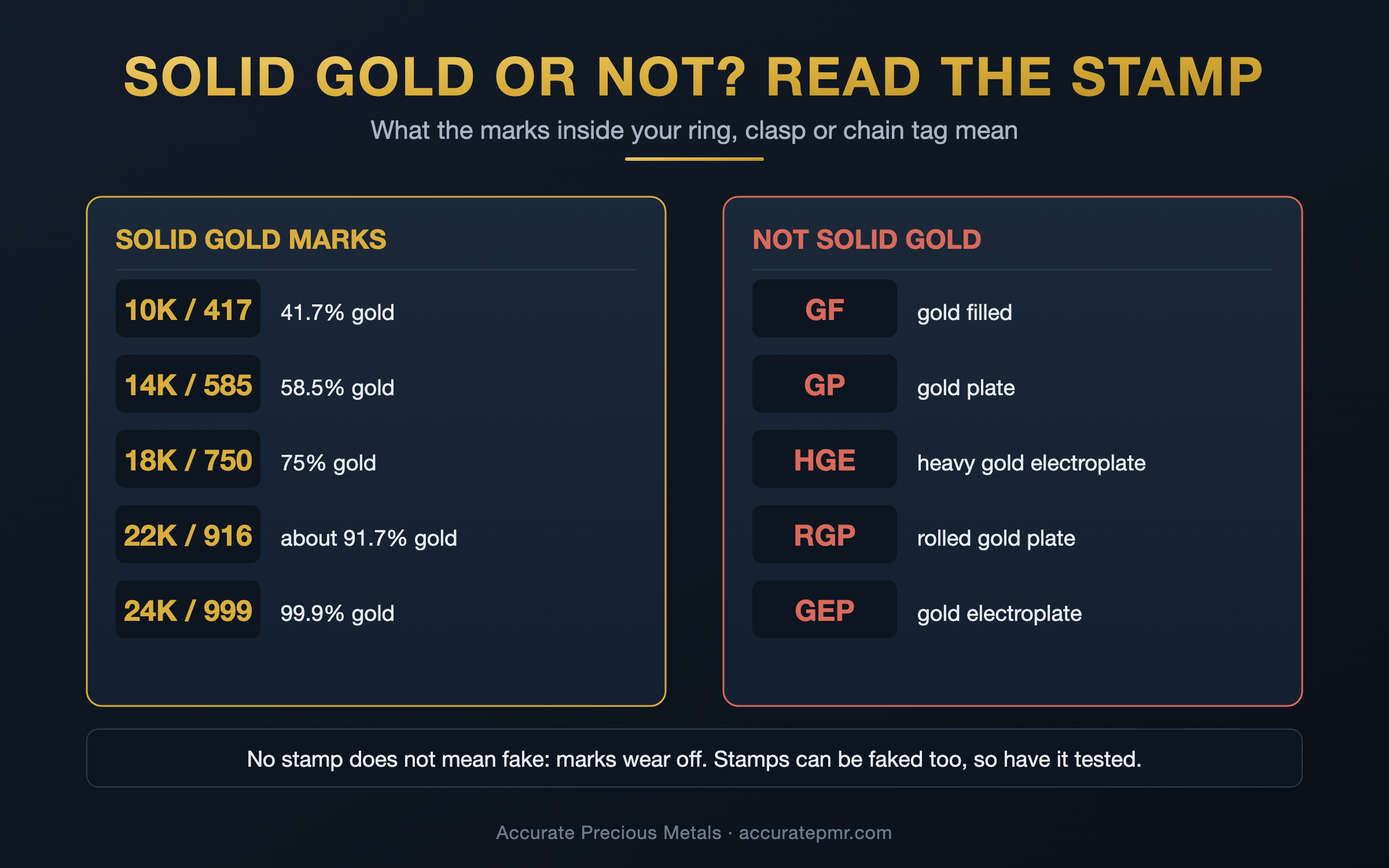
Find the stamp. Look inside the band, on the clasp, or on the tag at the end of a chain. Solid gold is usually marked 10K or 417, 14K or 585, 18K or 750, 22K or 916. A magnifying glass or phone zoom helps.
Watch for the "not solid gold" marks. GF (gold filled), GP (gold plate), HGE (heavy gold electroplate), RGP (rolled gold plate) and GEP all mean a thin layer of gold over a base metal. These are worth far less than solid gold. In the US, the FTC's Jewelry Guides set out how karat and plating terms may be used.
Run a magnet check. Gold is not magnetic. If your piece snaps to a strong magnet, it is not solid gold. Steel clasps and springs on real pieces can be magnetic, so test the main body. Passing proves nothing alone, since many cheap metals are also non-magnetic. See our guide to the magnet test for real gold.
Look for wear. Plating wears off on rings, clasps and edges. If you see a different color showing through, the surface is a coating.
Skip the acid. Scratch-and-acid kits damage jewelry and can be misread. Let a tester do it.
Don't rely on skin color. Green or black marks on skin can come from real, lower-karat gold as well as from fakes.
No stamp does not mean fake. Old, imported, resized and repaired pieces often lose their marks. And a stamp alone can't be trusted, because stamps can be faked. That is why a proper test matters.
Checking diamonds at home
Look at the mounting first. Marks like PT950 or PLAT point to platinum, and 10K, 14K, 18K point to gold settings. A glued-in stone in a cheap base-metal setting is a bad sign.
Try the fog test. Breathe on the stone like you would on a mirror. On a real diamond the fog clears almost instantly. On glass or cubic zirconia it hangs on a moment longer. This is a rough indicator, not proof.
Check for scratches. Diamonds are extremely hard. A stone with scratched, rounded edges is probably not diamond.
Look through the stone. With a loupe, a real diamond usually has tiny natural inclusions. A perfectly clean stone is not automatically fake, just worth a closer look.
Know what home tests can't separate. Moissanite can pass simple heat-based diamond testers, and lab-grown diamonds are real diamonds that pass every diamond test. Telling these apart takes a specialist's equipment.
Bottom line: for a stone that might be worth real money, get it graded or tested by someone with proper equipment. At the refinery, we test purity and authenticity as part of every evaluation, at no charge to you.
Questions people ask
Can I sell gold jewelry if it has no stamp?
Yes. Missing stamps are common on older, imported or repaired pieces. A tester can confirm the karat.
Is it worth selling a single earring?
Yes, because gold is valued by weight. A single earring is worth its metal, plus any stones.
Should I sell my gold jewelry now or wait?
That depends on your situation, and we can't predict where gold will go. Gold moves daily. If you aren't in a hurry, you can watch the price for a while. Nobody can tell you where it will be next month.
Do I need to remove the stones from broken jewelry?
No. Send the piece as it is, and the stones will be evaluated too.
Can I sell inherited or estate jewelry?
Yes. Estate pieces sometimes include signed or antique items worth more than their metal, so mention where it came from. See our jewelry page.
Is it safe to mail jewelry?
Shipments are insured to $1,000 as standard, with higher coverage available on request before you ship, and you drop the package at a staffed carrier location for a receipt. If you decline the offer, return shipping is free and insured.
Do you charge fees?
No receiving fees, no evaluation fees, and no hidden fees.
What if I'm not happy with the offer?
You say no, and your items come back with free insured return shipping. Standard offers hold for 14 days.
Ready to find out what yours is worth?
Request a free mail-in kit and we'll send a prepaid, insured mailer. You get an offer before anything is final, and if you decline, your jewelry comes back to you at no cost. Prefer to talk first? Call 503-400-5608 or visit the Salem showroom.
Request your free mail-in kit →
Sources
Electronic Code of Federal Regulations, 16 CFR Part 23: Guides for the Jewelry, Precious Metals, and Pewter Industries
Accurate Precious Metals, Mail-In Terms and Conditions
Make the smart choice: invest with Accurate Precious Metals
Whether you are buying bullion for the first time or adding to a long-term position, our team offers expert guidance, transparent pricing, and a reliable buyback program.
Ready to invest wisely?