This content is for educational purposes only and is not financial or investment advice. Precious metals prices fluctuate; past performance does not guarantee future results. Consult a qualified professional before making investment decisions.
Tap the image to enlarge and zoom.Hover to magnify, or click to open full screen.
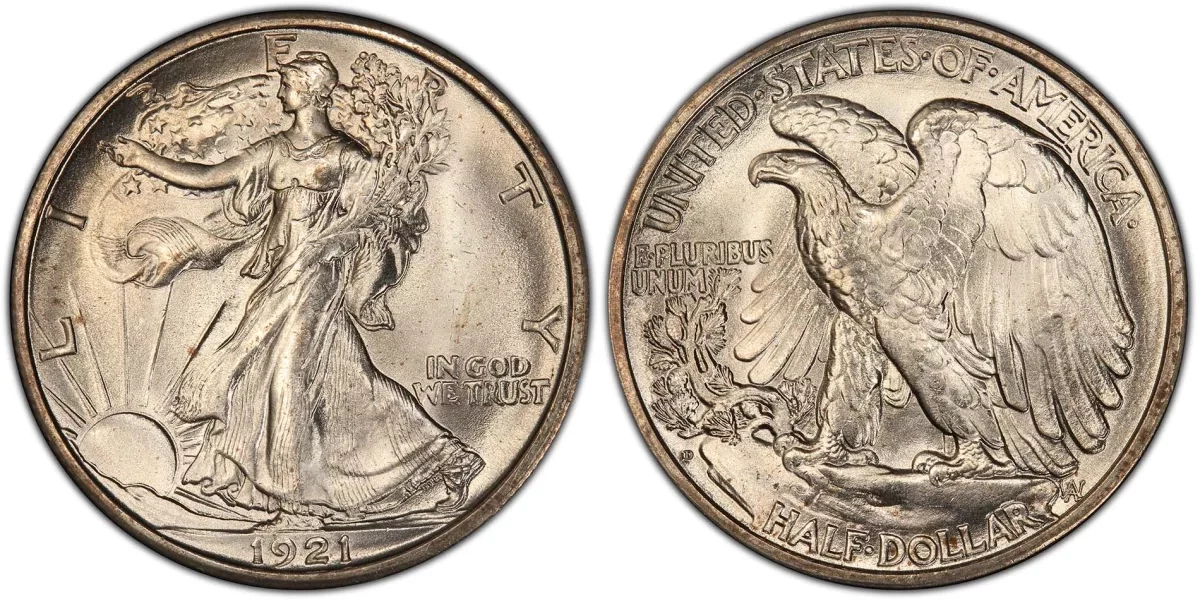
In 1921, the Denver Mint struck only 208,000 half dollars carrying Adolph Weinman's Walking Liberty design, and that single number is why the 1921-D Walking Liberty Half Dollar is the toughest coin to find in the entire series. It's a 90% silver coin, worth about $23.87 in melt value alone at the time of writing, but collectors pay far more than that for most examples because so few survived in decent shape.
This coin sits at the center of nearly every serious Walking Liberty half dollar collection, not because it's flashy, but because it's the one date that's genuinely hard to complete a set without.
What Makes the 1921-D Walking Liberty Half Dollar So Rare?
The 1921-D is rare because Denver made so few of them and most got spent hard over the following decades. A mintage of 208,000 is tiny for a U.S. coin, and it stands as the lowest mintage anywhere in the Walking Liberty half dollar series, which ran from 1916 to 1947.
Half dollars weren't treated like keepsakes in the 1920s and 1930s. People used them to buy groceries, pay for gas, and settle up at the corner store. A coin that low in mintage, spent for over a decade through the Depression, ends up scarce in nice condition even though it wasn't scarce the day it left the mint.
That's the real story behind the price tag. Rarity alone doesn't drive the number, and neither does silver content by itself. It's the combination: very few made, and very few kept nice.
How Did the Walking Liberty Half Dollar Design Come to Be?
Sculptor Adolph A. Weinman designed the Walking Liberty half dollar, and the coin entered circulation in 1916 as part of a wave of new American coin designs. Weinman's Liberty strides toward a rising sun, wrapped in the flag, with an eagle perched on rocks on the reverse.
1921 turned out to be an odd year for the series. All three mints, Philadelphia, Denver, and San Francisco, produced unusually small numbers that year, but Denver's 208,000 pieces stand out as the low point of the whole 32-year run.
Walking Liberty Half Dollar Timeline
1916
Design debuts Weinman's Walking Liberty half dollar enters circulation at the U.S. Mint
1921
Lowest mintage year All three mints strike small numbers, and Denver's 208,000 becomes the series low
1947
Series ends The Walking Liberty half dollar is replaced by the Franklin half dollar
1986
Design returns Weinman's Liberty reappears on the reverse of the American Silver Eagle
That last line matters more than it looks. The image on your 1921-D half dollar is the same figure that appears on modern silver bullion. If you've ever held an American Silver Eagle, you've already held a version of Weinman's Liberty.
How Much Is a 1921-D Walking Liberty Half Dollar Worth Today?
Value ranges from a modest premium over melt in heavily worn grades to hundreds or even thousands of dollars for sharp, problem-free examples. Condition is the single biggest factor in the price, more than any other Walking Liberty date.
A beat-up example that's been through decades of pocket change might trade for a small step above its silver value. A coin that somehow avoided heavy circulation, with clear detail in Liberty's skirt lines and breast feathers, can bring a serious jump in price because those survivors are so much harder to find than worn ones.
Top third-party graded examples in the finest known condition have brought strong four-figure prices at auction. That's not typical for the date, but it shows how much room there is between a common worn coin and a top-tier survivor.
What Is the Melt Value of a 1921-D Walking Liberty Half Dollar?
The melt value of a 1921-D Walking Liberty Half Dollar is about $23.87 at the time of writing, based on 0.3617 troy ounces of silver at $66 an ounce. That number is the floor, not the price you'd expect to pay or receive for the coin itself.
208,000
Coins struck at the Denver Mint in 1921
0.3617 oz
Silver content per coin
$23.87
Approximate melt value at time of writing
Melt value only reflects the metal. A worn 1921-D might sell for two or three times that floor, and a sharp uncirculated example can sell for many multiples more. Keeping an eye on where silver sits right now helps put both numbers in perspective, and our gold and silver price charts track spot prices in real time if you want to check current levels before buying or selling.
How Do You Grade a 1921-D Walking Liberty Half Dollar?
Grading a 1921-D comes down to how much detail survives on Liberty's figure, especially her breast feathers, her left hand, and the lines on her skirt near the leg. Clean rims and a lack of scratches or dents also matter a lot on a coin this scarce.
Grade Range
What You'll See
Typical Value Pattern
Good to Very Good
Heavy wear, Liberty's outline visible but details flat
Close to melt value with a small premium
Fine to Very Fine
Moderate wear, some skirt lines and feather detail visible
Modest to solid premium over melt
Extremely Fine to About Uncirculated
Light wear, most design detail sharp
Noticeable premium, priced well above melt
Mint State
Full detail, no wear, strong luster
Can bring strong prices, with top grades reaching four figures at auction
Because most surviving 1921-D halves fall into the Good through Very Fine range, anything sharper is genuinely uncommon. That's why sending a coin to a third-party grading service is worth considering before you buy or sell one at a meaningful price point. Our NGC graded Walking Liberty half dollars guide covers how that process works and what the grading tiers mean for value.
ℹ️ Info: Most 1921-D half dollars did not survive in nice shape. People spent them straight through the Depression and often kept using them into the 1950s and 1960s, which wore down the fine feather and skirt detail that graders look for today. A sharp, unworn survivor from this date is a genuine rarity, the same way a decades-old book in mint condition stands out from every other copy that got read to pieces.
How Can You Tell a Real 1921-D Half Dollar from a Fake or Altered Coin?
Check the reverse first. The mintmark "D" sits on the reverse, under the words "Half Dollar," not on the obverse where some buyers expect to find it. Coins with an altered or added mintmark are a known problem with this date because of the price gap between a common date and a 1921-D.
Look closely for cleaning, scratches, small dents, and rim damage too. Cleaning shows up as an unnatural shine or fine hairline scratches across the surface, and it can cut a coin's collector value sharply even though the silver content doesn't change at all.
Things to check before buying
Mintmark location on the reverse under "Half Dollar"
Any sign of cleaning, polishing, or an artificial shine
Scratches, dents, or rim damage
Whether the coin has already been graded by a third-party service
How the asking price compares to both melt value and recent auction results for that grade
Because this date gets faked and altered more than most Walking Liberty dates, buying a coin that's already been through a professional grading service is one of the safest ways to protect a larger purchase.
What Are Common Misconceptions About the 1921-D Half Dollar?
The biggest misconception is that the coin's value comes from its silver content. Silver only sets the floor price around $23.87 at the time of writing. The real premium comes from the tiny mintage and the difficulty of finding nice examples.
"It's only valuable because of the silver" - false, the silver is the floor, the mintage drives the real price
"Any 1921-D is automatically expensive" - false, low-grade worn coins are common enough that grade changes the price a lot
"The D mintmark means a special or proof strike" - false, it just means the coin was struck at the Denver Mint
"All Walking Liberty halves are worth about the same" - false, 1921-D is a key date and can sell for far more than common years
For a full rundown of how grade and date combine to set prices across the series, Walking Liberty half dollar value guide walks through the math collectors use.
Tips for Buying a 1921-D Walking Liberty Half Dollar
Buy the coin, not the story. Compare the asking price to both the melt value and to recent sales of coins in the same grade before you commit to anything above a small collector premium.
Confirm the mintmark placement on the reverse
Ask whether the coin has been cleaned or dipped
Request photos of the rims and high points, not just the overall coin
Favor coins already graded by a recognized third-party service for anything beyond a low-grade example
Check the seller's return policy before paying a large premium
If you'd rather start with a lower-cost way to hold this design in silver, an average circulated Walking Liberty half dollar with 90% silver content offers the same design at a smaller price point while you save toward a key date like the 1921-D.
Tips for Selling a 1921-D Walking Liberty Half Dollar
Know your coin's grade and rough value before you sell, since the gap between a worn example and a sharp one can be enormous on this date. Get an honest read on condition, whether that's from a dealer, a grading service, or a side-by-side comparison with graded examples online.
Sellers with a full set of Walking Liberty halves, or just this one coin, have options. Local sellers in the Salem, Oregon area can bring coins in for an in-person look, and sellers anywhere else in the country can use a mail-in service with insured shipping to get an offer without leaving home. Our coin buying page walks through what that process looks like for numismatic pieces like this one.
If you're looking to add a 1921-D or other key-date Walking Liberty half dollar to your collection, take a look at what we've got in stock, and if you're ready to sell one, you can mail it in through our we buy program or stop by our Salem location in person.
Frequently Asked Questions
How much is a 1921-D Walking Liberty Half Dollar worth?
Value ranges from a small premium over melt value in low grades to hundreds or thousands of dollars for professionally graded high-grade examples, with condition as the main driver of price.
How many 1921-D Walking Liberty Half Dollars were minted?
The Denver Mint struck 208,000 pieces in 1921, the lowest mintage anywhere in the Walking Liberty half dollar series.
How much silver is in a 1921-D Walking Liberty Half Dollar?
The coin contains 0.3617 troy ounces of silver out of a 12.5 gram total weight, with the remainder made up of copper.
What is the melt value of a 1921-D Walking Liberty Half Dollar today?
About $23.87 at the time of writing, based on silver at $66 an ounce, though that figure moves with the spot price.
Is the 1921-D the rarest Walking Liberty Half Dollar?
Yes, it has the lowest mintage of any date in the series, which is why it's considered the key date collectors need to complete a full set.
Where is the mintmark on a 1921-D Walking Liberty Half Dollar?
The "D" mintmark sits on the reverse side, directly under the words "Half Dollar."
Should I clean a 1921-D Walking Liberty Half Dollar before selling it?
No, cleaning almost always lowers a coin's collector value, sometimes by a large amount, even though it doesn't change the silver content.
Why is the 1921-D Walking Liberty Half Dollar so expensive compared to other dates?
Its very low mintage combined with heavy collector demand drives the price, not the silver content, which is the same across most dates in the series.
Make the smart choice — invest with Accurate Precious Metals
Whether you are buying bullion for the first time or adding to a long-term position, our team offers expert guidance, transparent pricing, and a reliable buyback program.