This content is for educational purposes only and is not financial or investment advice. Precious metals prices fluctuate; past performance does not guarantee future results. Consult a qualified professional before making investment decisions.
Tap the image to enlarge and zoom.Hover to magnify, or click to open full screen.
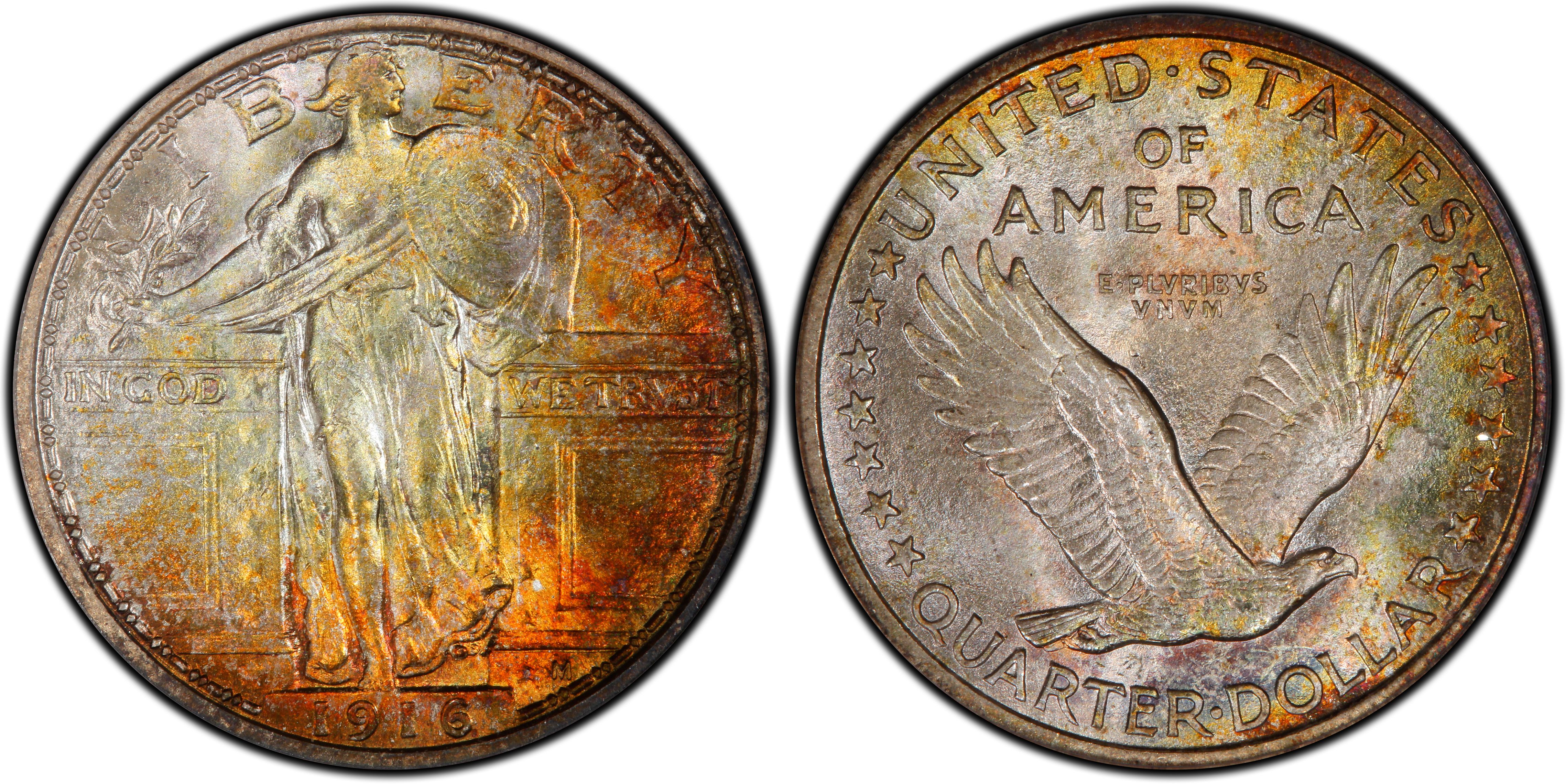
In the final weeks of 1916, workers at the Philadelphia Mint struck just 52,000 quarters carrying a design nobody had seen before. That coin, the 1916 Standing Liberty Quarter, is now one of the most wanted 20th century U.S. quarters, prized for its tiny mintage, its short production window, and the bold artwork of sculptor Hermon A. MacNeil.
The coin is 90% silver and 10% copper, weighs 6.25 grams, and holds about 0.18 troy ounce of silver. At today's silver spot price of $69 an ounce at the time of writing, that works out to a melt value near $12.48. Worn examples still sell for far more than that, and top-grade coins can bring thousands.
What Is the 1916 Standing Liberty Quarter?
The 1916 Standing Liberty Quarter is the first-year issue of a new U.S. quarter design, minted only at Philadelphia with a mintage of 52,000 pieces. It shows Liberty standing behind a shield on the obverse, or front, and an eagle in flight on the reverse, or back, both designed by sculptor Hermon A. MacNeil.
It replaced the long-running Barber quarter design and marked a real shift in how the U.S. Mint pictured Liberty on its coins. Every 1916 example is a Type 1 coin, meaning there are no stars below the eagle on the reverse. That detail matters because it changed the very next year, and it is one of the fastest ways to tell an early Standing Liberty Quarter from a later one.
Why Was Only One Mint Used in 1916?
Only the Philadelphia Mint struck 1916 Standing Liberty Quarters because the new design was not approved and ready for production until very late in the year. Officials in Denver and San Francisco never received the tooling in time to strike any 1916 coins, so no 1916-D or 1916-S quarter exists.
That single fact trips up a lot of new collectors who assume every date should have three mint versions, one from each active mint. It does not always work that way, and 1916 is the clearest example in the whole Standing Liberty series. If someone offers you a "1916-D Standing Liberty Quarter," walk away. It does not exist, and any coin marked that way has been altered.
What Makes Type 1 Different From Type 2 Standing Liberty Quarters?
Type 1 quarters, struck in 1916 and part of 1917, show Liberty with no stars beneath the eagle on the reverse. Type 2 quarters, introduced later in 1917, added three stars below the eagle and covered part of Liberty's exposed torso with chain mail.
The redesign came after public complaints about the original artwork. Mint officials responded by adjusting the obverse and adding the reverse stars, which is why 1917 is the only year where you can find both types from the same production year. Because 1916 only ever exists as Type 1, that single design detail is one more way to confirm you are looking at a genuine early strike.
A Quick Design Timeline
Standing Liberty Quarter Design Changes
1916
Type 1 design launched No stars below the eagle, Liberty shown with exposed torso, only 52,000 struck at Philadelphia
1917
Type 2 design introduced mid-year Three stars added below the eagle, Liberty's torso covered with mail
1930
Series ends Standing Liberty Quarter replaced by the Washington Quarter in 1932
How Rare Is the 1916 Standing Liberty Quarter Today?
The 1916 Standing Liberty Quarter is the second-lowest mintage regular-issue U.S. quarter of the 20th century, behind only the 1913-S Barber quarter. Pricing references citing PCGS estimates put total surviving examples across all grades at around 10,000, with only about 500 grading Mint State 60 or better.
That gap between the original mintage and today's Mint State survivors is the whole story of this coin's value. A lot of 1916 quarters spent decades in pocket change or cash drawers before anyone realized what they were, and silver coins in circulation wear down fast. Finding one that escaped that wear in high grade is genuinely hard.
XQHL Key 1916 Standing Liberty Quarter Numbers 52,000;Total mintage, all from Philadelphia 10,000;Estimated survivors across all grades 500;Estimated survivors in Mint State 60 or better 0.18084 oz;Silver content per coin
What Is a 1916 Standing Liberty Quarter Worth?
Value depends almost entirely on grade and detail, ranging from a strong collector premium on a worn coin to a serious four- or five-figure price on a high-grade or Full Head example. A coin heavily worn from years in circulation will still sell well above its silver melt value simply because it is a key date, but the real money is in coins that never circulated.
Grading services use a special "Full Head" designation for Standing Liberty Quarters that show strong detail in Liberty's hair and headband. A Full Head 1916 in Mint State can be worth many times more than an otherwise similar coin without that detail, because full strikes from this series are uncommon even among Mint State survivors.
What drives price on this coin
Overall grade, from heavily worn to Mint State
Full Head strike detail on Liberty
Surface marks, toning, and eye appeal
Documented grading from a recognized service
General demand for key-date silver quarters
What Is the Melt Value of a 1916 Standing Liberty Quarter?
The melt value of a 1916 Standing Liberty Quarter is about $12.48 at a silver spot price of $69 an ounce at the time of writing, based on its 0.18084 troy ounce of silver content. That number moves up or down every day with the silver market, so it is worth checking current spot prices before assuming a fixed figure.
Melt value matters as a floor, not a ceiling. Even a badly worn 1916 quarter usually sells for several times its melt value because collectors want the date regardless of condition. It is only scrap-grade, damaged coins that might trade closer to bullion value alone.
For a sense of how silver spot moves day to day, our live gold and silver price charts track current pricing so you can compare melt value against what a dealer or collector might actually offer.
How Do You Verify a 1916 Standing Liberty Quarter Is Genuine?
Start by checking for a mint mark: a real 1916 Standing Liberty Quarter has none, since Philadelphia coins carried no mint mark at the time. If a coin shows a "D" or "S" under the date, it has been altered or is a different date entirely.
Weight and diameter offer a second check, since a genuine coin weighs 6.25 grams and should match standard Standing Liberty Quarter dimensions. Because key-date silver coins are frequent targets for altered dates and added mint marks, buying from a dealer who can inspect the coin closely, or having it evaluated by a recognized grading service, is worth the extra step before paying a premium price.
💡 Tip: Have the coin checked before you pay a premium
A quick visual check with a loupe can catch an added mint mark or a re-punched date. When real money is on the line, a professional look at metal content and surface detail protects both buyer and seller.
How Does the 1916 Standing Liberty Quarter Compare to Other Key 1916 Coins?
1916 was a landmark year across U.S. coinage, not just for quarters. That same year the Mint also introduced the Buffalo Nickel's early design changes, the mercury dime debuted alongside the last Barber Dimes, and Walking Liberty Half Dollars began their long run.
If the 1916 Standing Liberty Quarter caught your interest, it is worth reading about its cousins from the same year. Our guides to the 1916 Barber Dime, the 1916 Buffalo Nickel, and uncirculated Walking Liberty Half Dollars cover how each design fits into that same wave of early 20th century redesigns. There is also the 1916 McKinley Commemorative Gold Dollar, a smaller and less known coin from the same year that tells its own story about American coinage history.
What Should Collectors Know Before Buying or Selling One?
Buy certified when possible and judge by grade, not mintage alone, since low mintage only tells part of the story with this coin. Two 1916 Standing Liberty Quarters with the same mintage year can be worth wildly different amounts once wear, strike quality, and Full Head detail come into play.
If a full Type 1 example is out of budget, a common-date 90% silver quarter still lets you hold the same silver content and design family without the key-date premium. Our 90% silver Washington Quarters are a more affordable way to own real silver coinage while you save toward a Standing Liberty piece.
Practical checklist before you buy
Confirm there is no mint mark under the date
Compare Liberty's head detail against Full Head reference photos
Ask for grading documentation on higher-priced examples
Check current silver spot price before comparing offers
Buy from a dealer willing to explain what you are looking at
What Are the Biggest Misconceptions About the 1916 Standing Liberty Quarter?
The most common misconception is that a 1916-D or 1916-S version should exist somewhere. It does not, since only Philadelphia struck this date, and any coin claiming otherwise has been altered.
A second misconception is that low mintage alone guarantees a big payday. Mintage of 52,000 is genuinely small, but price still comes down to surviving grade, eye appeal, and demand at the time of sale. A third misconception treats every worn 1916 quarter as a rare find worth a fortune. Worn coins are collectible and worth well above melt, but the real rarity premium lives in Mint State and Full Head examples that survived without circulating.
Whether you are chasing a Type 1 rarity like this one or just want real silver in hand, our shop carries a range of coins worth a look. If you already own a Standing Liberty Quarter, other silver coins, or scrap you want to turn into cash, you can mail it in from anywhere in the country or stop by our Salem, Oregon location if you are nearby; either way, our sell silver quarters page walks through how the process works.
Frequently Asked Questions
What is a 1916 Standing Liberty Quarter worth today?
Value depends on grade, ranging from a strong premium over melt on worn coins to a much higher price on Mint State or Full Head examples, so getting the coin looked at is the best way to know its real value.
How many 1916 Standing Liberty Quarters were minted?
The Philadelphia Mint struck 52,000 pieces in late 1916, and no other mint produced this date.
Is there a 1916-D or 1916-S Standing Liberty Quarter?
No. Only Philadelphia struck 1916 Standing Liberty Quarters, so any coin with a "D" or "S" mint mark under that date is not genuine.
What is the silver content of a 1916 Standing Liberty Quarter?
The coin is 90% silver and 10% copper, containing about 0.18084 troy ounce of silver, weighing 6.25 grams total.
Why is the 1916 Standing Liberty Quarter considered so rare?
It was struck for only a few weeks at the end of 1916 in a run of just 52,000 coins, and estimates put total survivors around 10,000 across all grades, with only about 500 in Mint State 60 or better.
What does Full Head mean for this coin's value?
Full Head refers to a strong strike showing clear detail in Liberty's hair and headband, and coins earning that designation typically sell for much more than similar coins without it.
What is the melt value of a 1916 Standing Liberty Quarter right now?
At a silver spot price of $69 an ounce at the time of writing, the coin's silver content works out to about $12.48, though actual sale prices are usually much higher due to its rarity.
Make the smart choice — invest with Accurate Precious Metals
Whether you are buying bullion for the first time or adding to a long-term position, our team offers expert guidance, transparent pricing, and a reliable buyback program.