This content is for educational purposes only and is not financial or investment advice. Precious metals prices fluctuate; past performance does not guarantee future results. Consult a qualified professional before making investment decisions.
Tap the image to enlarge and zoom.Hover to magnify, or click to open full screen.
The 1838-O Capped Bust Half Dollar is one of the rarest coins ever struck by the United States Mint, with no more than 20 pieces made and fewer than a dozen known to survive today. It was never meant for pockets and cash registers. It was a test piece, a proof, made to mark the opening of a brand new mint building in New Orleans. That single fact turns a 50-cent coin into a piece of American history worth hundreds of thousands of dollars.
What Is the 1838-O Capped Bust Half Dollar?
The 1838-O Capped Bust Half Dollar is a proof or specimen half dollar struck at the New Orleans Mint in 1838, with an estimated mintage of 20 or fewer pieces. It carries the "O" mintmark on the reverse, marking it as one of the first coins ever produced at a branch mint outside Philadelphia.
Most numismatic references, including PCGS, describe surviving examples as proofs rather than ordinary circulation coins. A small group of researchers argue the coins may actually represent more than one striking event over time, which is part of why the exact wording used by graders has shifted over the years. Either way, this was never a coin made to be spent at a store counter.
Why Was This Coin Struck at the New Orleans Mint?
The 1838-O half dollar was struck to mark the first year of coin production at the New Orleans Mint, making it one of the earliest branch-mint coins of any denomination in US history. Before 1838, every US coin came from the Philadelphia Mint.
Opening a second mint in New Orleans was a big deal for a growing country that needed coinage closer to Southern and Western trade routes. Striking a small batch of half dollars there in 1838 served almost like a ribbon-cutting. These pieces were not meant to circulate widely. They were meant to prove the new presses worked and to mark the occasion.
The New Orleans Mint's First Half Dollar
1838
New Orleans Mint opens First coins struck outside Philadelphia, including the 1838-O half dollar
1838
Small proof batch produced No more than 20 pieces believed struck, per PCGS and CoinWeek research
2019
Notable auction sale A well-known example realized about $504,000
Present
Fewer than a dozen traced Some sources cite nine confirmed survivors today
How Rare Is the 1838-O Capped Bust Half Dollar?
The 1838-O Capped Bust Half Dollar is among the rarest half dollars in US history, with an estimated mintage of 20 pieces or fewer and fewer than a dozen examples known to exist today. Some sources put the confirmed survivor count at exactly nine.
Compare that to a common date Morgan silver dollar, where millions of coins from a single year still exist. The 1838-O sits in a different category entirely. Every time one changes hands, collectors and auction houses take notice, because the population of known coins barely grows from decade to decade.
20 or fewer
Estimated pieces struck in 1838
9 to 12
Known survivors today
$763,750
PCGS auction record for a proof example
What Does the 1838-O Half Dollar Look Like?
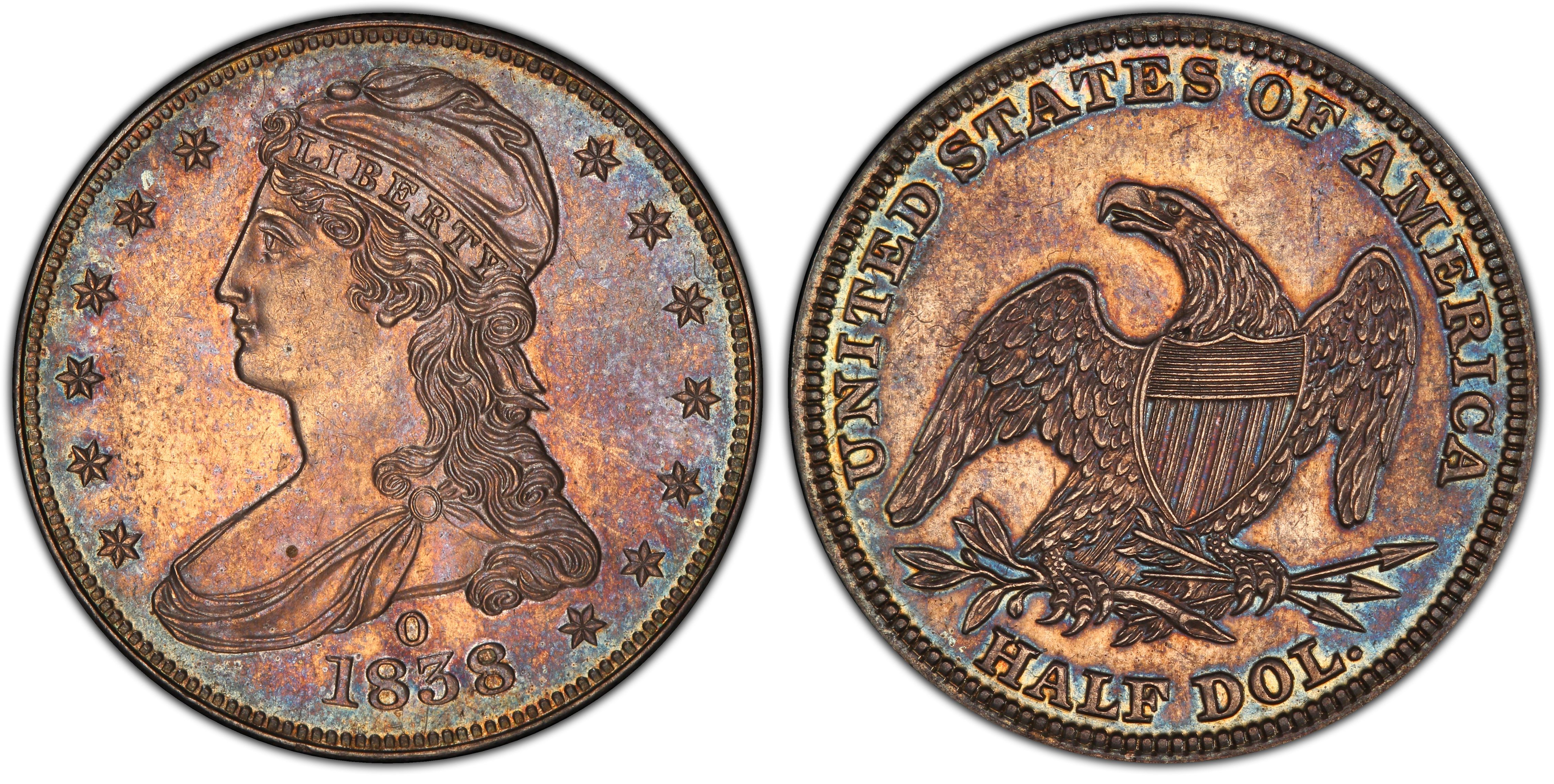
The 1838-O half dollar shows Liberty wearing a capped headband reading "LIBERTY," surrounded by 13 stars, with the date below on the obverse designed by John Reich. The reverse carries an eagle holding a shield, arrows, and an olive branch, with "UNITED STATES OF AMERICA" and "HALF DOL." around the rim.
The "O" mintmark sits on the reverse, identifying the coin as a product of the New Orleans Mint rather than Philadelphia. The coin weighs 13.36 grams, measures 30 millimeters across, and has a reeded edge, standard for half dollars of this design. It's made from 90% silver and 10% copper, the same alloy used across nearly all US silver coinage of the era.
Readers interested in how this design evolved can look at the earlier 1807 Capped Bust Half Dollar, which introduced the Capped Bust type, or the 1835 Capped Bust Half Dollar, struck just three years before the New Orleans Mint opened.
Is the 1838-O Half Dollar a Proof or a Circulation Strike?
Most major references treat the 1838-O half dollar as a proof or specimen coin rather than a regular circulation strike. PCGS has historically labeled examples as Proofs, though more recent grading language sometimes uses "Specimen" along with a branch-mint note.
This matters for how the coin is understood historically. A circulation strike was made by the thousands or millions to move through everyday commerce. A proof or specimen coin was struck carefully, often with extra pressure and polished dies, to produce a coin meant for display, presentation, or record-keeping rather than spending. The 1838-O fits that second category, which is part of why so few were made in the first place.
ℹ️ Info: The debate over exactly how many striking events produced the known 1838-O half dollars is still active among researchers. Some believe all surviving coins came from one small proof run. Others think the population may represent more than one batch struck over time, possibly even years apart. That uncertainty is part of what makes the coin a favorite topic among serious collectors.
How Much Is an 1838-O Capped Bust Half Dollar Worth?
An 1838-O Capped Bust Half Dollar typically sells for hundreds of thousands of dollars, with a PCGS auction record of $763,750 for a proof example. A separate widely reported sale, covered by Stack's Bowers, realized about $504,000 in 2019.
Those numbers have almost nothing to do with the silver inside the coin. This is a case where rarity and history, not metal weight, set the price. The exact figure for any single coin depends heavily on its grade, its surface quality, and its documented ownership history, sometimes called provenance, meaning who has owned the coin and when.
Value Type
What It Means
Typical Figure for 1838-O
Melt value
Silver content only, at spot price
About $25 at $69/oz silver, at the time of writing
Market value
What collectors typically pay
Hundreds of thousands of dollars
Auction record
Highest documented public sale
$763,750 per PCGS data
How Does Melt Value Compare to Market Value for This Coin?
The 1838-O half dollar's melt value is small compared to its market value because rarity, not silver content, drives the price. The coin holds 0.3617 troy ounces of pure silver. With silver at $69 an ounce at the time of writing, that works out to roughly $25 in raw metal value.
That $25 figure sits next to a market value in the hundreds of thousands of dollars. It's a useful gap to understand, because it shows exactly why numismatic coins get priced so differently from bullion. A common 90% silver half dollar from a normal year might trade close to its melt value plus a small premium. This coin trades almost entirely on scarcity and history. For readers curious about current melt math on more typical silver coins, current gold and silver price charts are worth bookmarking.
How Can You Tell If an 1838-O Half Dollar Is Real?
Verifying an 1838-O half dollar starts with checking the grading holder, the auction history, and the physical details against known population data, since this coin is a frequent target for confusion and overstated claims. With fewer than a dozen examples known, any coin claiming to be an 1838-O should have a clear paper trail.
Check the mintmark placement and style on the reverse against published references for genuine 1838-O coins
Confirm the coin has been evaluated by a major grading service and review its population report
Ask for full auction or sale history, since most known examples have been tracked for decades
Compare weight, diameter, and edge reeding against the standard 13.36 gram, 30 millimeter specification
Be skeptical of any "1838-O" offered far below auction-record pricing without solid documentation
Because so few of these coins exist, buying one is really buying a documented history as much as a piece of metal. A reputable grading service and a clear sale record matter more here than almost any other coin in American numismatics.
What Are the Most Common Misconceptions About the 1838-O Half Dollar?
The biggest misconception about the 1838-O half dollar is that it was made for everyday circulation. It wasn't. The known examples are proof or specimen coins, struck in a tiny batch, not business strikes meant for commerce.
What People Get Wrong
Pros
Cons
✗ Assuming all 1838-O half dollars were struck for spending
✗ Assuming every surviving example is worth the same amount regardless of condition
✗ Assuming melt value reflects what the coin is actually worth
✗ Assuming these coins are easy to find if you just look hard enough
Condition and provenance can move the price by hundreds of thousands of dollars between two coins that technically share the same date and mintmark. Two 1838-O half dollars can look similar in a photo and still sell for wildly different amounts depending on surface preservation and sale history.
Where Does the 1838-O Half Dollar Fit in Early American Coin History?
The 1838-O half dollar sits right at the birth of branch-mint coinage in the United States, the same year the Philadelphia Mint's silver coin designs were being reworked across several denominations. That same year, 1838, also saw the debut of the 1838 Liberty Seated Dime, a design that would replace the Capped Bust look on most silver coins within a few years.
Collectors who enjoy this stretch of Mint history often work backward through the Capped Bust series, including the 1823 Capped Bust Half Dollar, which carries its own variety puzzles for date and digit collectors. Each of these coins tells a small piece of the larger story of how American silver coinage grew from one mint in Philadelphia into a national system.
What Should Collectors Know Before Chasing a Coin Like This?
Anyone chasing an 1838-O half dollar should treat it as a five- or six-figure purchase decision, not a typical coin buy, and should lean on grading data, auction records, and dealer reputation before committing. This is not a coin to buy on a whim from an unfamiliar seller.
Steps Before Buying a Major Rarity Like This
1
Research population data Check how many examples are known and where they last sold
2
Review the grading holder Confirm the grade and any notes on strike or surface quality
3
Check sale history Look for prior auction appearances and realized prices
4
Compare against records See how the coin's price lines up against the $763,750 PCGS record
5
Work with an experienced dealer Use a dealer who understands both bullion and rare coin markets
Most collectors will never own an 1838-O half dollar, and that's fine. Studying it still teaches something valuable: how mintage numbers, survival rates, and Mint history combine to create value that has nothing to do with the price of silver that day.
If you're building a collection of early silver coins or just want something tied to real American history, our shop carries a range of collectible and bullion pieces, including Morgan Silver Dollars, worth a look. And if you have old silver coins sitting in a drawer and want to know what they're worth, you can mail in your silver coins from anywhere in the country or stop by our Salem, Oregon location if you're nearby.
Frequently Asked Questions
What is the 1838-O Capped Bust Half Dollar?
It is a proof or specimen half dollar struck at the New Orleans Mint in 1838, with an estimated mintage of no more than 20 pieces and fewer than a dozen known survivors today.
How much is an 1838-O Capped Bust Half Dollar worth?
Market value typically runs into the hundreds of thousands of dollars, with a PCGS auction record of $763,750 and another notable sale realizing about $504,000 in 2019.
How many 1838-O half dollars were minted?
No more than 20 are believed to have been struck, though the exact number is not fully documented.
How many 1838-O half dollars exist today?
Fewer than a dozen examples are generally traced, with some references citing nine confirmed survivors.
Is the 1838-O half dollar a proof coin?
Most major references describe surviving examples as proof or specimen strikes rather than regular circulation coins, though the exact grading language has varied over time.
What is the silver content of an 1838-O half dollar?
It is 90% silver and 10% copper, weighing 13.36 grams total, with 0.3617 troy ounces of pure silver.
Why is the 1838-O half dollar so rare?
It was a first-year issue from the newly opened New Orleans Mint, struck in a tiny proof batch rather than for general circulation, leaving very few survivors.
How can I tell if an 1838-O half dollar is real?
Check the grading holder, population data, and sale history closely, and work with an established dealer or grading service, since the coin's rarity makes it a target for overstated or false claims.
Make the smart choice — invest with Accurate Precious Metals
Whether you are buying bullion for the first time or adding to a long-term position, our team offers expert guidance, transparent pricing, and a reliable buyback program.