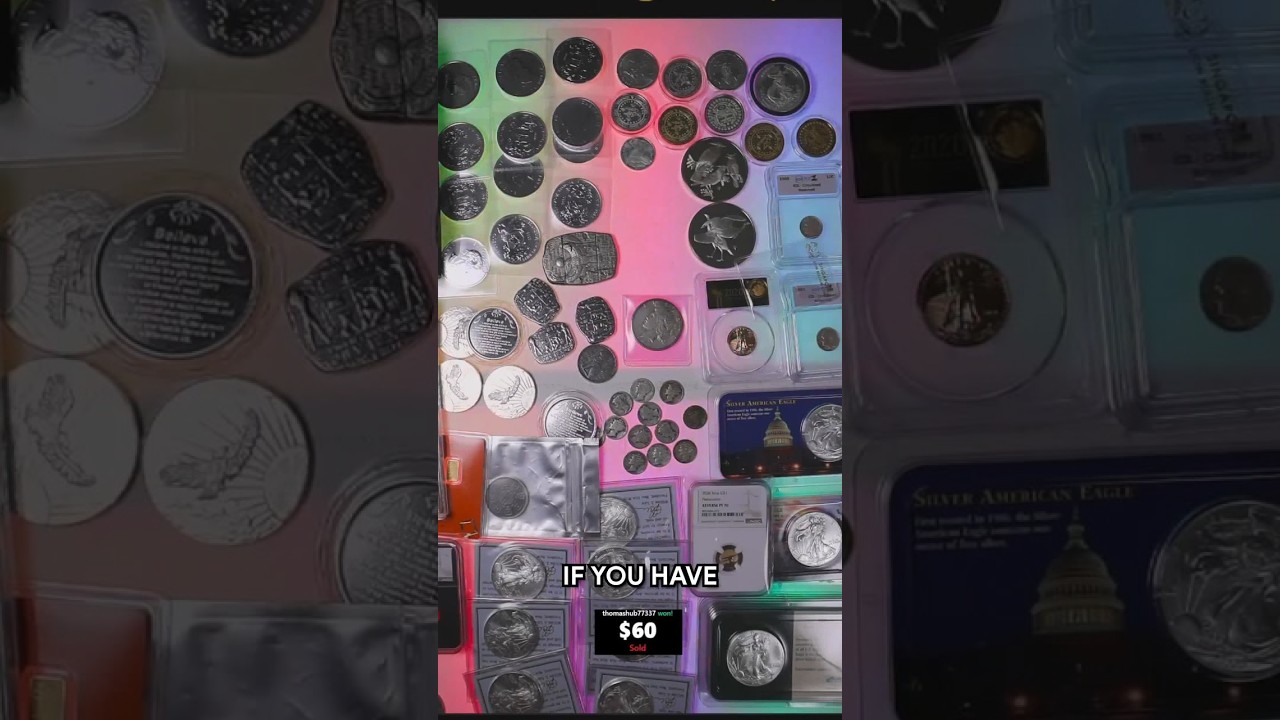
There's a moment in every coin buy where the price guide comes out, someone squints at a page of tiny numbers, and everyone in the room suddenly gets very quiet. That's exactly what happened during one of our recent live streams on Whatnot, and we loved it so much we cut it into a short clip for our YouTube channel. It starts simple enough — a 1928 Peace Dollar — and ends with our own team getting pleasantly surprised by a 1927-S that turned out to be worth a lot more than anyone expected.
If you haven't seen it yet, it's a fun little watch. But even if you never press play, we want to walk you through why these two coins made us pause the buy and dig for the book.
The coin that kicked things off was a 1928 Peace Dollar graded MS61, with a book value of $600 — our offer landed at $550. That's a completely fair, honest number for a wholesale offer, but here's what makes the 1928 special in the first place: it's actually the key date of the entire Peace Dollar series in regular-strike form.
Peace Dollars were minted from 1921 to 1935, struck in 90% silver to commemorate peace after World War I. Most dates from that run had mintages in the millions. The 1928? Only about 360,000 were struck — by far the lowest of any business-strike Peace Dollar. Most of those went straight into circulation rather than getting tucked away by banks or collectors, so finding one today in any kind of uncirculated condition is genuinely tough.
MS61 is what we'd call "entry-level uncirculated." The coin has never circulated, but it likely carries a good number of bag marks, scuffs, and less-than-perfect luster — the kind of wear-and-tear coins pick up just from jostling around with thousands of other coins in a mint bag. Bump that same coin up to MS63 or MS65, and the value climbs fast, because eye appeal matters just as much as the technical "uncirculated" label. If you're new to grading and want to understand how graders separate an MS61 from an MS65, our coin grading guide breaks the Sheldon Scale down in plain English.
Here's where the clip gets fun. Someone assumed the 1928 was the "special" coin in the group and the 1927-S was just another common Peace Dollar. Wrong — and we said so out loud on camera. As one of our team put it: "I did not know the 27-S was worth more than that... it's still worth like twice as much as normal bargain."
The 1927-S was struck at the San Francisco Mint, identifiable by the small "S" mintmark, with a mintage of about 3.2 million — much higher than the 1928, but still a fraction of the huge runs from the early 1920s. For years, bags of 1927-S dollars traded at premiums even before collectors got their hands on individual coins, and it's long been considered a semi-key date in mint state. In circulated grades it only costs a little more than a common date, but once you cross into mint-state territory, the price jumps noticeably — which is exactly what caught our team off guard mid-stream.
The example in the video wasn't in top condition, but even a modest mint-state 1927-S still ran roughly double what a typical "bargain bin" Peace Dollar brings. That's the kind of moment that reminds us why we always check the book instead of relying on memory, even after years of doing this.
This whole clip is basically a mini lesson in why collectors obsess over dates and mintmarks. Two coins can look nearly identical at a glance — same design, same silver content, similar wear — and still be worlds apart in value. Beyond 1928 and 1927-S, other Peace Dollar dates like 1924-S, 1925-S, and 1934-S are also known as "sneaky" better dates that surprise people who assume only the famous key date matters.
- Always check the mintmark. It sits on the reverse, below the eagle. No mintmark means Philadelphia; "S" means San Francisco; "D" means Denver.
- Don't assume "uncirculated" means valuable. Grade ranges like MS60–MS63 can still carry plenty of marks — value climbs steeply as grade improves.
- Watch for altered dates or added mintmarks. Key and semi-key dates are occasionally faked by tweaking a common coin's last digit or punching in a fake mintmark. When in doubt, have a coin professionally graded or bring it in for a second opinion.
If you'd like to start or round out a Peace Dollar collection yourself, we regularly stock Peace Silver Dollars in various dates and conditions, along with Morgan Silver Dollars if you want to compare the two classic series side by side.
Reading about it is one thing, but there's something extra satisfying about watching real-time reactions when a coin turns out to be worth more than expected. The clip is short, casual, and honestly kind of charming — it's a genuine, unscripted moment from one of our live buys, not a rehearsed "reveal." We host these buying and selling sessions regularly, so if you enjoy this kind of behind-the-scenes look at how pricing actually works, our live shows on Whatnot are worth following.
Whether you're chasing a 1928 for your own Peace Dollar set, curious what an old family coin collection might be worth, or just enjoy watching a good "wait, that's worth how much?" moment, we're glad you stopped by. If you're looking to add coins to your own collection, feel free to browse our shop at accuratepmr.com, and if you've got gold, silver, coins, or jewelry you're thinking about selling, you're welcome to visit us in person or use our mail-in coin selling program — we're happy to take a look and talk through what you've got.
Why is the 1928 Peace Dollar worth so much more than other dates?
+−
Its mintage of roughly 360,000 is the lowest of any regular-strike Peace Dollar, and most examples circulated heavily rather than being saved, making uncirculated pieces genuinely scarce.
Is a 1927-S Peace Dollar rare?
+−
It's considered a semi-key date. Circulated examples aren't dramatically more expensive than common dates, but mint-state 1927-S dollars command a solid premium — often around double a typical common-date Peace Dollar in similar condition.
What does MS61 mean on a graded coin?
+−
MS61 is a low mint-state grade, meaning the coin has never circulated but shows a good number of contact marks or dull luster compared to higher mint-state grades like MS63 or MS65.
How can I tell if a rare-date Peace Dollar is genuine?
+−
Check that the mintmark's size, style, and placement match known genuine examples, be wary of coins where the date looks altered, and when a coin's value is significant, having it professionally graded is the safest route.
Where can I watch coin buys like this happen live?
+−
We regularly host live selling and buying streams on Whatnot, where moments like this Peace Dollar surprise happen in real time.