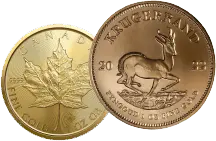
Staking crypto for gold is a strategy more investors are exploring – not because you can literally stake a gold bar on a blockchain, but because crypto staking can generate yield that helps you hold physical gold without ever selling it. If you own gold and want cash flow, staking a separate crypto position is one way to create income from a different asset bucket while keeping your metals exactly where they are.
This article breaks down how that works, what the risks look like, and how to turn staking rewards into real gold ownership – including how Accurate Precious Metals makes it straightforward to buy or sell physical metal whenever you are ready.
Live Gold Spot Price – Accurate Precious Metals Refineries
What “Staking Crypto for Gold” Actually Means
The phrase is a strategy, not a product. Physical gold cannot be staked. Staking is a blockchain mechanism – it applies to proof-of-stake cryptocurrencies, not bars or coins sitting in a safe.
The idea works like this: you hold gold for long-term wealth preservation, and separately you stake a supported cryptocurrency to earn periodic rewards. Those rewards – paid in crypto – can be converted to cash or used to buy more metal. Gold stays intact. Your position grows over time through a separate income stream.
That distinction matters. Gold is a non-yielding asset by design. A one-ounce gold coin is worth about $4,158 in melt value at the time of writing, based on current spot prices, but it does not pay interest or dividends. Many gold holders accept that tradeoff willingly because gold’s job is stability, not income. Staking fills the income gap from a separate position – with meaningfully more risk attached.
How Crypto Staking Works
In a proof-of-stake blockchain, validators are chosen to confirm transactions and add new blocks. The network uses staked value as part of its security model. Stakers lock up their tokens to support that process and earn rewards in return.
A simple way to think about it: you are lending your economic weight to help the network run, and the network pays you a share of the fees and newly issued tokens it generates. The rewards come in the same cryptocurrency you staked, and the rate changes based on network conditions and how many total tokens are staked.
This is different from a bank savings account in two important ways. First, the reward rate is variable, not fixed. Second, the underlying asset – the crypto you staked – can lose market value even while rewards are accumulating. More coins does not automatically mean more dollars.
Types of Staking: Which One Fits You
Staking is not one-size-fits-all. The method you choose affects how much control you keep, how much technical work you take on, and what risks you accept.
| Method | What It Means | Key Tradeoff |
|---|---|---|
| Solo staking | You run your own validator node and keep full custody | Highest control, highest technical skill required |
| Delegated staking | You assign your stake to a validator who runs the infrastructure | Less work, but you trust the validator’s performance |
| Pooled staking | Your tokens join a shared pool with other users | Easy access, but pool operator risk applies |
| Exchange staking | A centralized exchange stakes on your behalf | Simplest option, but you give up custody of your coins |
| Liquid staking | You receive a derivative token representing your staked position | More flexibility, but added protocol and token risk |
For someone whose primary goal is accumulating gold, exchange staking or pooled staking tends to be the entry point. Both are accessible without deep technical knowledge. The tradeoff is that you are trusting a third party, which introduces custodial risk – the same concern you would have leaving gold with an unvetted storage provider.
Which Cryptocurrencies Can Be Staked
Not every cryptocurrency supports staking. Bitcoin, for example, uses proof-of-work mining – it cannot be staked. Staking is specific to proof-of-stake networks.
Commonly staked assets include Ethereum (ETH), Solana (SOL), Cardano (ADA), and Polkadot (DOT). Each network has its own reward structure, lockup rules, and validator requirements.
Before buying any crypto with the intention of staking it, confirm that the specific asset and the platform you plan to use actually support staking. Buying a non-stakeable token because you assumed it worked like ETH is a common beginner mistake.
Staking Crypto for Gold: The Risks You Cannot Ignore
Price risk is the biggest one. If you stake a token worth $1,000 and earn 8% annually, you now have tokens worth $1,080 in quantity terms. But if the token’s price drops 30% during that period, your position is worth about $756. The rewards did not protect you.
Lockup risk is also real. Many staking arrangements require an unbonding period – a waiting window before you can withdraw your tokens. During that window, you cannot sell, convert, or move your position. If the market drops sharply, you may be stuck watching it fall.
Slashing risk applies in some networks. Validators that act dishonestly or fail to perform correctly can have a portion of their staked tokens destroyed as a penalty. If you delegated to that validator, your tokens can be affected too.
Custodial risk matters if you use an exchange or staking service. You are trusting that platform with your assets. Exchange failures and platform insolvencies have happened before in crypto – your staked tokens are not insured the way a bank deposit would be.
Protocol risk covers smart-contract bugs, governance changes, and network upgrades that can alter reward rates or freeze funds unexpectedly.
The framing that works for a gold audience: gold is held for stability; staking crypto is held for income with substantially more risk. They are not interchangeable tools. They serve different roles.
Turning Staking Rewards Into Physical Gold
The practical bridge between crypto yield and gold ownership involves a few steps. Staking rewards accumulate in crypto. You convert those rewards to cash – through an exchange – and then use that cash to purchase physical metal.
Stake a supported cryptocurrency through a reputable platform or exchange
Allow rewards to accumulate – check your platform’s payout schedule (often weekly or per-epoch)
When ready, unstake or withdraw rewards, observing any required unbonding period
Convert crypto rewards to fiat currency through your exchange
Use proceeds to purchase physical gold coins or bars from a trusted dealer
Store your metal securely – home safe, bank vault, or insured storage
At step five, the dealer you choose matters. Physical gold is only as good as the source it comes from. A reputable dealer with transparent pricing and a strong track record makes the conversion from digital yield to tangible metal clean and reliable.
Accurate Precious Metals has served customers for over 12 years and carries gold coins and gold bars across a wide range of weights and formats. Whether you are buying a single ounce or building a larger position over time, competitive pricing based on live spot prices means you are not overpaying at the point of conversion.
Gold IRAs: A Structured Path From Crypto Gains to Retirement Metal
Some investors take a more structured approach. Rather than buying spot bullion with staking proceeds, they roll gains into a Gold IRA – a self-directed individual retirement account that holds physical precious metals.
A Gold IRA allows you to hold IRS-approved gold, silver, platinum, and palladium inside a tax-advantaged retirement account. If you have crypto gains you want to redirect into long-term, tax-sheltered metal exposure, a Gold IRA is worth understanding.
Accurate Precious Metals offers Gold and Silver IRA services. You can read a deeper overview in the precious metals IRA guide or explore the Gold IRA rollover benefits to understand how the process works and what metals qualify.
This is not financial advice – talk to a qualified tax professional before making IRA decisions. But for investors who want their staking proceeds to do double duty – generating yield now and funding a retirement metal position – a Gold IRA is a legitimate path worth exploring.
Common Misconceptions About Staking Crypto for Gold
A few beliefs circulate in online communities that are worth correcting directly.
“You can stake physical gold.” You cannot. Staking is a blockchain mechanism. It applies to proof-of-stake tokens, not bars or coins. There is no blockchain that lets you lock up a gold bar and earn yield on it.
“Staking is passive income with no downside.” Rates vary, token prices fall, and lockup periods can trap you during volatile markets. The word “passive” does not mean risk-free.
“All crypto can be staked.” Only assets on proof-of-stake networks support staking. Bitcoin cannot be staked. Always verify before buying.
“Exchange staking is safe because the exchange handles everything.” Exchange staking is convenient, but it adds custodial risk. You do not hold your private keys. If the exchange fails, your staked tokens may be at risk.
“If I earn more coins, I’m making money.” Not necessarily. If the token’s price drops more than the rewards gained, total return is negative in dollar terms. More coins at a lower price can still mean a loss.
Practical Tips Before You Start
Separate the goals. Gold is your long-term reserve. Staking is a separate income experiment. Do not conflate the two or let crypto volatility change your view of your metal position.
Verify the asset is stakeable. Confirm the specific token, platform, and staking method before buying. Read the platform’s documentation on unbonding periods and fee structures.
Start small. Test the full cycle – stake, earn rewards, unstake, convert – with a small amount before committing larger capital. The process has more steps than it looks.
Watch fees. Validator commissions, network transaction fees, and platform fees can erode yield significantly on small positions. Run the math before assuming the advertised rate is what you will actually receive.
Know your lockup. Some protocols require days or weeks to unbond staked tokens. If liquidity matters to you, choose a method with shorter or no lockup periods.
Use reputable platforms. Stick to well-established exchanges and staking services. Verify wallet addresses carefully. Phishing and scam platforms are common in crypto.
Plan the conversion. Decide in advance at what point you will convert rewards to gold. A standing rule – for example, converting every quarter or whenever rewards reach a certain dollar value – removes emotion from the decision.
Why Physical Gold Remains the Anchor
Staking rewards are interesting. They are also volatile, uncertain, and dependent on a technology stack that can change overnight. Physical gold has none of those qualities.
Gold at about $4,158 per ounce at the time of writing reflects decades of purchasing-power preservation. It does not require a network to stay online. It does not have an unbonding period. It does not lose value because a validator was slashed. You can hold it, store it, insure it, and sell it through established channels without counterparty risk at the metal level.
Silver at about $66 per ounce at the time of writing offers a lower entry point with similar physical properties. Platinum and palladium – at around $1,675 and $1,240 per ounce respectively at the time of writing – serve more specialized roles in both industry and investment portfolios.
The practical strategy is not “replace gold with staking.” It is “use staking yield to fund more gold.” The metal is the destination. The crypto is the vehicle.
For collectors and investors who want to explore buying gold and silver as a foundation for this kind of strategy, Accurate Precious Metals offers competitive pricing across coins, bars, and bullion in all four major precious metals.
Buying and Selling With Accurate Precious Metals
When staking rewards are ready to convert into physical metal, the dealer you work with determines whether the transaction is straightforward or frustrating. Accurate Precious Metals has been operating for over 12 years, has earned more than 1,000 five-star reviews, and is a fully specialized precious metals dealer – not a pawn shop.
Based in Salem, Oregon, Accurate Precious Metals ships nationwide with insured delivery. Pricing reflects live spot prices, so what you pay tracks the market rather than a static markup. The inventory covers gold and silver coins and bars, platinum, palladium, diamonds, and jewelry – a full-spectrum selection whether you are buying your first ounce or adding to an established position.
If you are local to the Salem area, stop by in person. If you are anywhere else in the United States, Accurate Precious Metals offers a convenient mail-in service that lets you buy or sell remotely with insured shipping and fast payment.
For those looking to sell metal – whether it is bullion you accumulated over time, jewelry, or scrap – Accurate Precious Metals buys all forms of precious metals and offers competitive prices based on current spot. Local customers can visit in person for a same-day assessment. Customers anywhere in the country can use the mail-in gold program for a secure, convenient remote transaction.
As an NGC Authorized dealer, Accurate Precious Metals also provides grading services for numismatic coins. If you are building a collection alongside a staking strategy, having a trusted grader in your corner matters.
Reach the team directly at (503) 400-5608 or visit AccuratePMR.com to browse current inventory and pricing.
Frequently Asked Questions
Can I literally stake physical gold on a blockchain?
No. Staking is a blockchain mechanism for proof-of-stake cryptocurrencies. Physical gold bars and coins cannot be staked. The strategy involves staking crypto separately and using the rewards to buy or hold gold.
Which cryptocurrencies can be staked?
Proof-of-stake assets like Ethereum (ETH), Solana (SOL), Cardano (ADA), and Polkadot (DOT) are among the most widely staked. Bitcoin uses proof-of-work and cannot be staked.
What are the main risks of staking crypto?
The primary risks are price risk (token value drops), lockup risk (you cannot access funds during unbonding), slashing risk (validator penalties in some networks), custodial risk (exchange or platform failure), and protocol risk (smart-contract bugs or governance changes).
How do I turn staking rewards into gold?
You unstake your rewards after any required unbonding period, convert them to fiat currency through an exchange, and use the proceeds to purchase physical gold from a reputable dealer like Accurate Precious Metals.
Is staking a reliable income stream?
No. Staking rewards are variable, not fixed, and the underlying token's price can fall. The dollar value of rewards can decrease even if the number of coins earned increases.
Can I use crypto gains to fund a Gold IRA?
You can convert crypto gains to cash and use that cash to fund a Gold IRA contribution, subject to IRS rules and annual limits. Accurate Precious Metals offers Gold and Silver IRA services. Consult a tax professional before making IRA decisions.
What is the current spot price of gold?
Gold is trading at approximately $4,158 per ounce at the time of writing. Spot prices change constantly – check live pricing at AccuratePMR.com for the most current figures.
Does Accurate Precious Metals buy gold from customers outside Oregon?
Yes. Customers anywhere in the United States can use the mail-in service at AccuratePMR.com for insured, remote transactions. Local customers in the Salem, Oregon area can also visit in person.
Sources
Make the smart choice — invest with Accurate Precious Metals
Whether you are buying bullion for the first time or adding to a long-term position, our team offers expert guidance, transparent pricing, and a reliable buyback program.
Ready to invest wisely?