This content is for educational purposes only and is not financial or investment advice. Precious metals prices fluctuate; past performance does not guarantee future results. Consult a qualified professional before making investment decisions.
Tap the image to enlarge and zoom.Hover to magnify, or click to open full screen.
Silver bullion is where most new precious metals buyers start, and for good reason: it costs far less per ounce than gold and lets you build a real, physical stack without draining a savings account. But “which one should I buy” isn’t really a competition – it’s a question of what you’re trying to accomplish. Are you protecting wealth for the next decade, or trying to buy as many ounces as possible today?
This guide breaks down how silver and gold actually behave in the market, what forms of bullion exist, how pricing and premiums work, and how to decide which metal – or combination of both – fits your situation. We’ll use live spot prices throughout so you can see exactly what your money buys at the time of writing.
Silver Bullion vs. Gold Bullion: Stability or Volatility?
The single biggest difference between these two metals is how they move. Gold is the steady one. It holds value through recessions, currency devaluation, and stock market drops, which is why analysts often call it “crisis insurance.” Gold tends to be countercyclical – it often rises when stocks fall, giving portfolios a buffer during rough years.
Silver moves harder in both directions. Historically, silver has been 2 to 3 times more volatile than gold, meaning bigger rallies and bigger drops. That volatility cuts both ways. When precious metals markets turn bullish, silver has a track record of outperforming gold on a percentage basis. When markets pull back, silver often falls faster too.
Feature
Gold Bullion
Silver Bullion
Primary Role
Wealth preservation, stability
Growth potential, affordability
Volatility
Moderate (lower)
High (2-3x gold)
Industrial Use
Minimal (jewelry, investment)
High (electronics, solar, green energy)
Storage
Compact, high value per ounce
Space-intensive, lower value per ounce
Liquidity
Globally liquid, easy to sell in bulk
Liquid, but harder to move in large volume
Roughly half of all silver demand comes from industry – electronics, solar panels, medical devices. That industrial link means silver can soften when factories slow down, even while gold climbs on the same bad economic news. Gold, by contrast, is almost purely a monetary and investment asset, so it isn’t tied to factory output the same way.
The Gold/Silver Ratio: What It Tells You
The Gold/Silver Ratio measures how many ounces of silver it takes to buy one ounce of gold. It’s a quick way to judge whether silver looks cheap or expensive relative to gold at any given moment.
Historically, gold has never traded for less than about 59 times the price of silver. As of mid-2025, the ratio sat near 75:1, which some analysts read as a sign that silver is undervalued relative to gold and has room to close the gap. Ratios above the historical norm have, in past cycles, preceded periods where silver outperforms gold.
2025 gave both metals a wild ride – gold pushed past $5,100 an ounce and silver briefly touched $100 an ounce during peak momentum. At the time of writing, spot prices sit at about $4,077 per ounce for gold and $60 per ounce for silver, putting the ratio closer to 68:1. Ratios shift daily, so check current silver spot prices before making a purchase decision.
What Actually Counts as Bullion?
“Bullion” simply means metal valued for its content, not its design or rarity. It comes in three main forms.
Coins
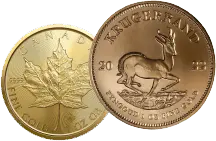
Government mints strike bullion coins, and that government backing makes them easy to verify and resell almost anywhere. The one-ounce American Silver Eagle is the most recognized silver coin in the U.S. market, alongside the Canadian Silver Maple Leaf and Mexican Silver Libertad. On the gold side, the American Gold Eagle, Canadian Gold Maple Leaf, and Austrian Philharmonic dominate. Our 1 oz Silver American Eagle 2024 is a good example of a coin that carries strong resale recognition because buyers instantly know what they’re looking at.
Bars
Private refiners produce bars in sizes from 1 ounce up to 100 ounces for silver, and 1 ounce, 10 ounce, or kilo sizes for gold. Bars usually carry lower premiums than coins, which makes them cost-efficient if you’re buying in bulk. The tradeoff: a 100-ounce silver bar is much less flexible than ten 1-ounce coins if you only need to sell a small portion later. Our silver bars category covers the common weight options for buyers who want to minimize premium cost per ounce.
Rounds
Rounds look like coins but come from private mints rather than governments. They’re popular in the silver bullion world because they’re often cheaper than government coins and come in creative designs – everything from dragons to historical figures. The Engelhard Prospector silver round is a well-known example collectors and stackers both recognize. Rounds carry the same metal value as coins of the same weight, but they can be marginally harder to resell since they lack a government mint stamp.
Silver Bullion Pricing: Spot Price vs. What You Actually Pay
The spot price is the live market value of raw metal – right now, about $60 an ounce for silver and $4,077 an ounce for gold, at the time of writing. The retail price is spot plus a premium that covers minting, distribution, and dealer margin.
Silver premiums tend to run higher in percentage terms than gold premiums – often 10% to 30% over spot for small one-ounce coins – simply because the base metal price is so low that fixed minting costs make up a bigger share of the total. Gold premiums are usually lower, often in the 3% to 5% range on standard coins, since the metal value itself is so much higher relative to production cost.
This is exactly why $1,000 stretches so much further in silver than gold. At current prices, $1,000 buys roughly 16 ounces of silver bullion, versus roughly a quarter-ounce of gold. That’s the appeal for beginners – you get more pieces in hand, more room to learn the buying and selling process, and less risk of a costly mistake on your first purchase. Our gold and silver investment guide for new buyers walks through this math in more detail if you’re deciding where to start.
Gold’s density works in its favor here. A relatively small amount of gold represents a large dollar value, so you can secure meaningful wealth in a home safe or safe deposit box without much bulk. Silver takes up far more physical space per dollar. Storing $10,000 worth of silver at today’s prices means handling roughly 166 ounces – that’s multiple boxes or a dedicated safe, not a small pouch.
Liquidity works similarly. Gold is easy to sell in bulk because a single small bar or coin represents serious value. Selling a large silver holding often means counting, weighing, and verifying dozens or hundreds of individual pieces, which takes more time even though silver itself is globally recognized and easy to move.
Silver Bullion: Pros and Cons
Pros
✓ Low entry cost, easy to start small
✓ Higher upside potential during bullish metals markets
✓ Wide selection of coins, bars, and rounds
Cons
✗ More storage space required
✗ Higher percentage premiums on small coins
✗ More price volatility, both up and down
A Short History of Why We Value These Metals
Gold and silver have functioned as money for thousands of years, but their roles diverged over time. Gold anchored currency systems for centuries under the Gold Standard and remains the reserve asset central banks hold to hedge against currency devaluation. It exists outside the banking system entirely, which is part of why it’s treated as a tangible store of value free from counterparty risk.
Silver circulated as currency right alongside gold for most of that history, but it picked up a second identity along the way. Today it’s both a monetary metal and an industrial commodity, used in electronics, solar panels, and medical equipment. That dual role is what makes silver behave differently than gold in modern markets – and it’s worth reading our historical silver price trends piece if you want to see how that industrial link has played out over the past century of price moves.
Common Misconceptions About Silver Bullion
Misconception: silver is just a cheaper substitute for gold. In reality, silver’s link to industrial demand means it can drop during economic slowdowns even while gold climbs on the same news – they don’t move in lockstep.
Misconception: silver is hard to sell because it’s inexpensive. Silver bullion is recognized and liquid worldwide. The real friction is time – selling a large silver position means verifying more individual pieces than an equivalent gold sale would require.
Misconception: bullion coins are worth more than their metal content. Standard bullion coins, including the Silver Eagle, track spot price closely. If a coin sells for well above its metal value, it’s likely being sold as a numismatic or collector coin, which is a different category with different risks.
Misconception: gold is the only sound choice. Gold wins on stability, but silver has outpaced gold in past bull markets thanks to industrial demand tailwinds like solar and electronics manufacturing. Many experienced buyers hold both for exactly this reason.
Building a Balanced Portfolio
Most financial guidance points toward holding both metals rather than picking one. A common approach is weighting roughly 2:1 or 3:1 toward gold by dollar value – for example, 70% gold and 30% silver – which pairs gold’s stability with silver’s growth potential. For a broader portfolio, allocating somewhere around 7% to 12% of total assets to precious metals is a reasonable range many advisors mention, though this isn’t personalized financial advice and your own allocation should reflect your goals and risk tolerance.
Silver has moved sharply over the past year, and past performance is never a promise of what comes next. Treat precious metals as a long-term diversification tool against inflation and currency risk, not a short-term trading vehicle.
Should I Buy Silver or Gold First?
Do you have a limited budget or want to learn the buying process?
Start with silver bullion – lower cost per ounce, easier to build quantity
Is your main goal wealth preservation and lower volatility?
Choose gold bullion – more stable, compact to store
Do you want both stability and growth potential?
Split your budget, weighted more heavily toward gold
Are you comfortable with bigger price swings for higher upside?
Silver fits your risk tolerance better
Selling Silver Bullion: What to Know
Selling is where a lot of buyers get caught off guard. Reputable dealers price silver bullion based on the current spot price plus or minus a small spread – they’re not deducting steep fees the way some pawn shops do on jewelry. Stick to established, recognizable products from major mints and refiners, since obscure or off-brand pieces can be harder to move and may sell for less.
When you’re ready to sell, Accurate Precious Metals buys silver bullion in coin, bar, and round form, along with gold, platinum, palladium, and jewelry. If you’re local to the Salem, Oregon area, you can bring your holdings in for an in-person offer. If you’re anywhere else in the country, our mail-in service covers insured shipping both ways, so you can sell without leaving home. Read more about the process on our sell your silver bullion page, or check where to sell silver near you if you’re comparing local options.
Where to Buy Silver and Gold Bullion
Local coin shops and pawn shops both sell bullion, but they come with real limitations. Pawn shops typically carry a small, inconsistent inventory and aren’t specialists in metal content or purity. Small coin shops may have better knowledge but often limited stock and higher premiums due to lower buying volume.
Accurate Precious Metals is a dedicated bullion dealer, not a pawn shop, and that distinction matters. We’ve been in business since 2012, backed by over 1,000 five-star customer reviews, and we ship nationwide with insured delivery. Our online pricing updates to reflect live spot prices, so you’re never guessing what a fair price looks like. Inventory spans gold, silver, platinum, palladium, and copper in coin, bar, and bullion form, plus diamonds and jewelry – and we’re an NGC Authorized dealer for grading services when you need a coin evaluated. For buyers who want the widest selection paired with straightforward, competitive pricing, we’re the standout choice among dealers serving Oregon and beyond. We also offer Gold and Silver IRA services if you’re looking to add physical metal to a retirement account.
Browse our current silver bullion selection, check best silver coins to buy today, or explore all gold bullion if you’re leaning toward the stability side of the equation. For live pricing context before you buy, our page on understanding live silver prices breaks down how spot price moves throughout the trading day. You can also reach our team directly at (503) 400-5608 with questions about any product in stock.
Frequently Asked Questions
Is silver bullion a good investment for beginners?
Yes. Its low price per ounce lets new buyers learn how spot price, premiums, and resale work without a large upfront cost. Many collectors start with silver and add gold once they're comfortable with the buying and selling process.
How much silver can I buy for $1,000 right now?
At the current spot price of about $60 an ounce, $1,000 buys roughly 16 ounces before dealer premiums. Actual quantity will be slightly less once retail premiums are added, and prices change daily.
Why is silver more volatile than gold?
Silver has a smaller, less liquid market and heavy industrial demand tied to electronics, solar, and manufacturing. That combination amplifies price swings in both directions compared to gold, which trades mainly as a monetary and investment asset.
Should I buy silver coins, bars, or rounds?
Coins from government mints are typically the easiest to resell due to guaranteed recognition. Bars often carry lower premiums, making them cost-efficient for larger purchases. Rounds sit in between – lower cost than coins but slightly less universally recognized.
What's the difference between spot price and the price I pay?
Spot price is the raw market value of the metal. The retail price adds a premium covering minting, distribution, and dealer margin – typically higher in percentage terms for silver than for gold.
Can I sell silver bullion back to Accurate Precious Metals?
Yes. We buy silver bullion, coins, bars, rounds, and jewelry both in person at our Salem, Oregon location and through our insured nationwide mail-in service for customers anywhere in the U.S.
Make the smart choice — invest with Accurate Precious Metals
Whether you are buying bullion for the first time or adding to a long-term position, our team offers expert guidance, transparent pricing, and a reliable buyback program.