Like our coverage? Add Accurate Precious Metals as a preferred source on Google.
New York gold coins occupy a unique place in American numismatic history – not because the city ever operated a federal mint, but because Wall Street, the auction houses, and the museum vaults of Manhattan have shaped how the country’s most important gold coins are bought, sold, and remembered. Whether you are a seasoned collector chasing pre-1933 rarities or an investor looking to add bullion to a portfolio, understanding New York’s role in the gold coin market gives you a clearer picture of where value comes from and where the best opportunities lie.
This guide covers the full story: the coins themselves, the history behind them, what drives their prices, and how collectors and sellers across the country can act on that knowledge today.
New York’s Role in the Gold Coin Market
New York was never a minting city. U.S. gold coins were struck at federal facilities – Philadelphia, San Francisco, Denver, New Orleans, Carson City, and West Point – not in Manhattan. What New York provided was something equally important: the financial infrastructure to move, price, and preserve those coins.
The city became the nation’s commercial capital well before gold coinage was widespread, and that head start never went away. Major auction houses set records there. Dealers on 47th Street and in Midtown have handled billions of dollars in rare coins. Museums like the New-York Historical Society have displayed landmark pieces, including the legendary 1933 Double Eagle. When collectors and writers talk about New York gold coins, they mean coins that have passed through that ecosystem – bought, sold, authenticated, or exhibited in the city that never stops trading.
A Short History of U.S. Gold Coinage
The Coinage Act of 1792 established the U.S. Mint, but the first federal gold coins did not reach circulation until 1795. Early production was limited. Gold was scarce, the country was young, and foreign coins still dominated everyday commerce.
The California Gold Rush changed everything. After 1848, a flood of western bullion gave the Mint the raw material to produce gold coins at scale. The denominations that collectors prize today – the $1 gold piece, the Quarter Eagle, the Half Eagle, the Eagle, and the Double Eagle – all became common in commerce during the second half of the 19th century.
America’s first gold circulated coin, made in New York by goldsmith Ephraim Brasher – predates the federal mint entirely
Established the U.S. Mint and authorized gold coinage
Production was limited in the early republic
The smallest U.S. coin ever made, created as gold supply surged after the California Gold Rush
Widely regarded as the most beautiful U.S. coin ever struck
Nearly all 1933 Double Eagles were melted after the U.S. ended domestic gold circulation; survivors became museum-grade rarities
The Brasher Doubloon deserves special mention for New York collectors. Struck in 1787 by Manhattan goldsmith Ephraim Brasher, it predates the federal mint and is considered America’s first privately made gold coin intended for circulation. Its New York origin makes it the starting point for any serious conversation about gold coins and this city.
The 1907 Saint-Gaudens Double Eagle sits at the other end of the artistic spectrum – a coin so well designed that it is still cited as the finest piece of American coinage. President Theodore Roosevelt commissioned sculptor Augustus Saint-Gaudens to redesign U.S. coinage, and the Double Eagle was the result. High-relief versions from 1907 are among the most sought-after coins in American numismatics.
The 1933 Double Eagle: New York’s Most Famous Gold Coin
No single coin captures the New York gold coin story better than the 1933 Double Eagle. The U.S. Mint struck nearly 445,500 of them, but the government ordered the coins melted after President Roosevelt’s 1933 executive order ended domestic gold ownership. A small number escaped destruction through various means, and those survivors became the subject of legal battles, FBI investigations, and international intrigue spanning decades.
One example was displayed at the New-York Historical Society, giving the public a rare chance to see a coin that is otherwise locked away or in private hands. The legal history of the 1933 Double Eagle – involving the U.S. government, foreign royalty, and some of the world’s most prominent dealers – is as dramatic as any Wall Street story.
For collectors, the lesson is clear: provenance matters. A coin’s ownership history, especially when it connects to famous institutions or legal milestones, adds a layer of value that pure metal content cannot explain.
Types of Gold Coins Collectors Encounter in New York
The New York market covers a wide range of gold coins. Understanding the categories helps buyers and sellers make better decisions.
| Type | What It Is | Collector Appeal |
|---|---|---|
| Pre-1933 U.S. gold | Circulating gold coins struck before the gold standard ended | Historical value, collected by date and type |
| Classic commemorative gold | Special-issue legal-tender gold commemoratives | Entry point for some collectors |
| Bullion coins | Modern investment coins such as American Eagles and Maple Leafs | Value tracks gold spot price closely |
| Rare patterns and proofs | Experimental or proof issues | High-end numismatic demand |
| Museum rarities | Coins with famous provenance, such as the 1933 Double Eagle | Exceptional historical premium |
For investors focused on metal content, modern gold coins like the 2025 American Gold Eagle offer a straightforward way to hold gold at prices close to spot. These coins carry the backing of the U.S. Mint and trade in deep, liquid markets worldwide.
For collectors, the pre-1933 issues – Quarter Eagles, Half Eagles, Eagles, and Double Eagles – offer a direct connection to American commercial history. These coins passed through merchants’ hands, bank vaults, and counting houses for generations before being pulled from circulation.
What Drives Gold Coin Prices
Gold coin values come from two separate sources: metal content and collector demand. Knowing which one applies to a specific coin is the first step toward buying or selling intelligently.
Metal value is straightforward. It is the coin’s gold content multiplied by the current spot price. At the time of writing, gold is trading at about $4,161 per ounce. A standard one-ounce bullion coin therefore carries roughly that much in metal value before any dealer premium or transaction cost is added. Fractional coins – half-ounce, quarter-ounce, tenth-ounce – carry proportionally lower metal values.
Live Gold Spot Price – Accurate Precious Metals Refineries
Numismatic value is where things get more interesting. A coin can be worth many times its metal content if it is rare, in exceptional condition, or tied to a famous moment in history. The key drivers are:
- Rarity – Low mintage figures and poor survival rates push prices up sharply. A coin struck in large numbers but heavily circulated may be worth less than a scarce issue in mint state.
- Condition – Professional grading services assign numeric grades from 1 to 70. The difference between a coin graded MS-63 and MS-65 can mean thousands of dollars on a popular issue.
- Provenance – Ownership history, especially for coins linked to famous collections or legal cases, adds a premium that purely reflects the coin’s story.
- Demand – Type collectors, registry set builders, and investors all compete for the same coins, and their overlapping demand keeps prices strong on popular issues.
- Mint mark – The same date struck at different facilities can vary dramatically in value. A San Francisco issue might be scarcer than its Philadelphia counterpart from the same year.
Pre-1933 U.S. Gold: The Collector’s Backbone
The pre-1933 series is where most serious collectors focus. These coins circulated in American commerce from the early republic through the Great Depression, and they carry the wear, character, and history of that era.
The $1 gold coin, introduced in 1849, is the smallest U.S. coin ever produced. Its tiny diameter – about 13 millimeters – makes it a challenge to display and store, but type collectors love it for exactly that reason. Three distinct types were struck between 1849 and 1889.
The $2.50 Quarter Eagle and $5 Half Eagle were workhorses of 19th-century commerce. Both series span multiple design types and dozens of mint marks, giving collectors a deep field to explore without necessarily spending at the top of the market.
The $10 Eagle and $20 Double Eagle represent the high end of everyday circulation gold. The Saint-Gaudens design on the Double Eagle, struck from 1907 to 1933, remains the standard against which American coin design is measured. Finding a high-grade example with original surfaces and strong luster is the goal of collectors who focus on this series.
Bullion Coins vs. Numismatic Gold: Knowing the Difference
A modern bullion coin and a rare 19th-century eagle may both be gold, but they are valued and traded in completely different ways. Mixing up the two categories is one of the most common mistakes new buyers make.
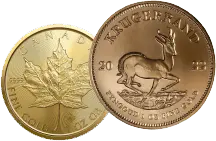
Bullion coins – the [American Gold Eagle], the Gold Maple Leaf, and similar issues from major world mints – are priced primarily on gold content. Premiums over spot are typically modest, liquidity is high, and the buyer’s goal is usually to hold gold efficiently. These coins are ideal for investors, IRA buyers, and anyone who wants straightforward exposure to gold prices.
Numismatic coins are priced on rarity, grade, and demand. A common-date pre-1933 Double Eagle might trade at a modest premium over melt, while a key-date issue in top grade can command a premium of hundreds of percent. The buyer’s goal here is collecting, not just metal ownership.
The practical implication: if you are selling a coin, know which category it falls into before you accept an offer. A dealer who quotes only melt value on a numismatic piece is not giving you the full picture. For more on buying and selling gold coins in the New York area, see our guide to gold bullion dealers in New York.
Common Misconceptions About New York Gold Coins
Several persistent myths circulate among new collectors. Clearing them up saves money and frustration.
“New York gold coins were minted in New York.” False. No federal mint ever operated in New York City. The coins associated with New York gained that connection through commerce, auction, and display – not production.
“All old gold coins are worth melt.” False. Many pre-1933 issues trade at significant premiums because of rarity and collector demand. Assuming melt value on a key-date coin can mean leaving substantial money on the table.
“Museum coins are irrelevant to collectors.” False. When a famous coin is displayed publicly, it increases awareness and reinforces the historical narrative that drives collector demand. The 1933 Double Eagle’s appearances in New York have contributed to its legendary status.
“The biggest coin is always the most valuable.” False. A tiny $1 gold piece in a rare date and high grade can be worth more than a common Double Eagle. Size matters far less than scarcity and condition.
Practical Tips for Buying and Selling New York Gold Coins
Whether you are entering the market as a buyer or looking to sell a collection, a few principles apply across the board.
Identify what you have;Determine whether the coin is bullion, common-date numismatic, or a genuine rarity. Look up the date, mint mark, and design type.
Check current spot price;Gold moves daily. Know the live spot price before you discuss value with any dealer. At the time of writing, gold is about $4,161 per ounce.
Assess condition honestly;Circulated coins are worth less than mint-state examples. If you think you have something special, consider professional grading.
Get more than one opinion;For significant pieces, multiple quotes protect you. New York auction houses and reputable dealers both provide assessments.
Understand the buy-sell spread;Dealers buy below spot and sell above spot on bullion. On numismatic pieces, the spread can be wider. This is normal – it is how the market works.
For sellers with coins to move, New York remains one of the strongest markets in the country. The auction houses there have the buyer pools to achieve strong prices on genuine rarities. For more common pieces, a direct dealer transaction is faster and often just as competitive.
How Accurate Precious Metals Serves Collectors Nationwide
Accurate Precious Metals is based in Salem, Oregon, but the reach extends across the country – and that matters for collectors and sellers in New York and beyond. In business since 2012 and more than 1,000 five-star customer reviews, Accurate Precious Metals has built a reputation as a serious, knowledgeable dealer, not a pawn shop or a general reseller.
The inventory covers the full spectrum: gold coins and gold bars, silver, platinum, palladium, numismatic pieces, diamonds, and jewelry. Pricing is updated to reflect live spot prices, so buyers and sellers are always working from current market data. For retirement investors, Gold and Silver IRA services are available, making it straightforward to hold physical gold within a tax-advantaged account.
For New York collectors who want to sell, two routes are available. Local customers in the Salem area can visit in person for a direct assessment. Customers anywhere in the United States – including New York – can use the mail-in service, which includes free insured shipping, a thorough evaluation of metal content through XRF analysis, and fast payment. The process is designed for sellers who want a fair, competitive offer without the friction of local dealer shopping.
Accurate Precious Metals is also an NGC Authorized Dealer, which means coins can be submitted for professional grading through one of the industry’s most respected services. For collectors who want their coins assessed before selling or adding to a registry set, this is a significant advantage.
If you are in New York and want to understand your options for selling gold locally or by mail, Accurate Precious Metals offers the combination of expertise, competitive pricing, and nationwide reach that makes the process straightforward regardless of where you are located.
Frequently Asked Questions
Were any gold coins actually minted in New York City?
No federal mint ever operated in New York. The Brasher Doubloon of 1787 was privately struck in Manhattan before the federal mint existed, but all official U.S. gold coins were produced at federal facilities in other cities. New York's role has always been as a market, auction, and museum center.
What is the most famous New York gold coin?
The 1933 Double Eagle is the most famous coin associated with New York. It has been displayed at the New-York Historical Society and has been at the center of legal battles involving the U.S. government and some of the world's most prominent dealers and collectors.
How do I know if my old gold coin is worth more than melt value?
Check the date, mint mark, and design type against published price guides or a professional grading service. Key dates and high-grade examples often carry substantial premiums over melt. If you are unsure, get a professional assessment before selling.
What is the gold spot price right now?
At the time of writing, gold is trading at about $4,161 per ounce. Spot prices change daily, so always check a live source before making any transaction.
Can I sell my gold coins to Accurate Precious Metals if I am in New York?
Yes. Accurate Precious Metals offers a mail-in service for customers anywhere in the United States. The service includes free insured shipping and a competitive offer based on current spot prices. Visit the mail-in gold page for details.
What is the difference between a bullion coin and a numismatic coin?
A bullion coin is priced primarily on its gold content and trades close to spot price. A numismatic coin is priced on rarity, condition, and collector demand, and can be worth many times its metal value. The two categories require different approaches when buying or selling.
Does Accurate Precious Metals offer IRA services for gold coins?
Yes. Accurate Precious Metals offers Gold and Silver IRA services for investors who want to hold physical precious metals in a tax-advantaged retirement account. Contact the team at (503) 400-5608 or visit AccuratePMR.com for more information.
Sources
- APMEX Learn Center – U.S. Gold Coin History
- Luriya – Gold Coin Pricing and Numismatic Value
- Hyperallergic – 1933 Double Eagle and New York Exhibition
- New-York Historical Society – Museum Display of Rare U.S. Gold Coins
- AGR Gold – U.S. Gold Coin Denominations and History
- NYC Bullion – Gold Coin Dealers in New York City
Make the smart choice — invest with Accurate Precious Metals
Whether you are buying bullion for the first time or adding to a long-term position, our team offers expert guidance, transparent pricing, and a reliable buyback program.
Ready to invest wisely?