This content is for educational purposes only and is not financial or investment advice. Precious metals prices fluctuate; past performance does not guarantee future results. Consult a qualified professional before making investment decisions.
Tap the image to enlarge and zoom.Hover to magnify, or click to open full screen.
Understanding gold weight measurement payout is the single most important thing you can do before selling any gold jewelry, coins, or scrap. Most sellers focus on the spot price and forget that weight and purity are equally powerful variables – and small errors in either one can shift a payout by hundreds of dollars, especially with gold sitting near $4,504 per troy ounce at the time of writing.
This guide breaks down exactly how gold is weighed, why the unit of measurement matters, how purity multiplies or shrinks the final number, and what separates melt value from the cash you actually receive. Whether you have a drawer full of old chains or a single heavy ring, knowing this math puts you in a much stronger position when it is time to sell.
The Formula Behind Every Gold Payout
Every gold payout starts with the same three-part calculation: weight x purity x spot price. That is the melt value – the theoretical worth of the pure metal inside an item. From there, a buyer subtracts their costs and margin to arrive at a cash offer.
At the time of writing, gold trades at roughly $4,504 per troy ounce. One troy ounce equals 31.1035 grams, which puts the spot price at about $144.77 per gram. Most jewelry buyers and scrap dealers work in grams, so that per-gram figure is the one you will use most often.
Here is a concrete example. A 20-gram 18K bracelet is 75% gold by weight, meaning it contains 15 grams of pure gold. Multiply 15 grams by $144.77 and you get a melt value of roughly $2,171 at the time of writing. That number is your ceiling, not your payout. A buyer’s actual offer will be less, covering assay, refining, overhead, and profit. Cash for gold payouts explained goes deeper on how that gap works in practice.
$4,504
Gold Spot Price Per Troy Oz (at time of writing)
$144.77
Gold Spot Price Per Gram (at time of writing)
31.1035g
Grams in One Troy Ounce
Gold Weight Measurement Units and Why They Matter
Gold is measured in several different units depending on the context, and mixing them up causes real payout errors.
Grams (g) – the standard unit for jewelry, scrap, and retail valuation. Most digital scales report in grams.
Troy ounces (oz t) – the global standard for bullion pricing. All spot prices you see quoted are in troy ounces.
Pennyweights (dwt) – used by some jewelers and refiners. One pennyweight equals 1.555 grams.
Grains – an older unit still found in some specialized or historical contexts.
The troy ounce is the one that trips people up most. It is not the same as the avoirdupois ounce used for everyday goods like food or postal packages. A regular ounce is about 28.35 grams. A troy ounce is 31.1035 grams. That difference of nearly 3 grams per ounce matters significantly when gold is priced above $4,500.
If a buyer quotes your payout in pennyweights but you calculated it in grams, you could easily misread the offer. Always confirm which unit a buyer is using before comparing offers.
ℹ️ Info: Always ask a buyer: “Are you weighing in grams, pennyweights, or troy ounces?” Getting the unit wrong is one of the most common reasons sellers feel underpaid – even when the offer itself is fair.
Purity Is Half the Equation in Gold Weight Measurement Payout
Two rings can weigh exactly the same and have completely different values. The karat rating determines how much of an item’s gross weight is actually gold.
Karat
Gold Content
Decimal Multiplier
24K
99.9% gold
0.999
22K
91.6% gold
0.916
18K
75% gold
0.750
14K
58.5% gold
0.585
10K
41.7% gold
0.417
A 10-gram 18K ring contains 7.5 grams of pure gold. The same 10-gram ring in 10K contains only 4.17 grams. At current spot prices, that difference is worth over $480 at the time of writing – on an item that weighs exactly the same on the scale.
This is why a heavier 10K piece can be worth less than a lighter 18K piece. Weight alone tells you very little. Purity is what converts gross weight into gold content, and gold content is what buyers actually pay for.
Stamps like 750, 585, or 417 are the metric equivalents of 18K, 14K, and 10K respectively. European jewelry often uses these three-digit stamps instead of karat marks. Both systems describe the same thing. Learn more about how to price gold and what these markings mean for your payout.
Gross Weight vs. Net Gold Weight – Not the Same Thing
Sellers often confuse gross weight with net gold weight, and that confusion leads to unrealistic payout expectations.
Gross weight is the total weight of the item as it sits on the scale – metal, stones, clasps, solder, and all. Net gold weight is the actual gold content after purity is applied. Melt value is what that gold content is worth at spot price. Payout weight is what the buyer uses after inspecting, testing, and adjusting for real-world factors.
A gold bracelet with a heavy gemstone setting might weigh 18 grams on a scale. But if the stones account for 4 grams and the setting is 14K, the net gold weight drops considerably. Reputable buyers remove or account for non-gold components before calculating an offer. That is not a trick – it is the only accurate way to price an item.
A karat stamp is a starting point, not a final answer. Stamps can be worn, misread, or in rare cases, inaccurate. Reputable buyers verify purity before paying.
How Gold Gets Tested Before a Payout
1
Step 1 The item is weighed on a precision digital scale, typically accurate to 0.01 grams.
2
Step 2 The karat stamp is identified – 10K, 14K, 18K, 750, 585, etc.
3
Step 3 Purity is verified through acid testing, electronic testing, or XRF analysis depending on the buyer’s equipment.
4
Step 4 Non-gold components (stones, clasps, hollow sections) are identified and excluded from the gold weight.
5
Step 5 The buyer calculates melt value and applies their margin to produce a cash offer.
A digital scale accurate to 0.01 grams is the right tool for small jewelry items. Kitchen scales and postal scales are not precise enough. Even a 0.3-gram error on a high-karat item translates to real money at current spot prices.
Why Your Payout Is Always Below Melt Value
Melt value is not cash in hand. Every buyer in the scrap and refining chain has costs: assay fees, refining loss, labor, insurance, overhead, and a profit margin. Those costs come out of the spread between melt value and what they pay you.
How melt value influences offers covers this in detail, but the short version is: the gap between melt value and payout is normal and expected. A competitive offer from a reputable dealer reflects fair market practice, not a lowball. The question is how much of that gap you are giving up.
Sorting your gold by karat before selling reduces the buyer’s sorting work and often results in a stronger offer. Mixing 10K and 18K pieces together creates uncertainty for the buyer, and uncertainty tends to cost the seller money.
💡 Tip: Separate your gold by karat before getting any offer. A pile of mixed karats takes more time to process, and buyers price that uncertainty into their offer.
Bullion Coins – When Weight and Purity Are Already Guaranteed by the Mint
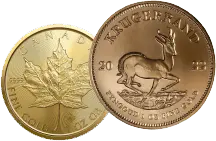
Investment-grade bullion coins make the weight and purity question simple. A 2025 1 oz Gold Eagle contains exactly one troy ounce of gold at .9167 fineness. A 2025 1 oz Gold Maple Leaf contains one troy ounce at .9999 fineness. The minting authority has already done the assay work, which is why bullion coins trade at a tight premium over spot and are easy to price.
For bullion coins, the payout calculation is almost mechanical: one troy ounce times the current spot price, minus a small dealer margin. There is no ambiguity about karat or net gold weight. That transparency is one reason serious investors prefer recognized bullion coins over jewelry when building a position in physical gold.
Common Misconceptions About Gold Weight Measurement Payout
A few persistent myths cause sellers to either undervalue what they have or walk away from fair offers.
“Heavier always means more valuable.” A 20-gram 10K ring contains less gold than a 12-gram 18K ring. Purity outweighs mass when karat differences are large.
“All gold is priced the same.” The spot price is the same for everyone, but the gold content per gram varies dramatically by karat. A gram of 24K scrap and a gram of 10K scrap are not worth the same.
“The stamp is always right.” Karat stamps are usually accurate, but they are not infallible. Testing confirms what the stamp suggests.
“Melt value equals payout.” It never does. Melt value is the raw metal worth. Payout is what remains after buyer costs.
“A troy ounce and a regular ounce are the same.” They are not. The difference is nearly 3 grams per ounce, which adds up fast on larger lots.
Practical Steps to Maximize Your Gold Payout
Knowing the math is useful. Applying it before you walk into a transaction is better.
Weigh your items on a gram scale with 0.01g precision. Do not rely on bathroom scales or kitchen scales.
Identify the karat stamp on each piece. Look for 10K, 14K, 18K, 24K, 375, 585, 750, or 916.
Separate pieces by karat. Keep 10K, 14K, and 18K in separate groups.
Calculate a rough melt value using the formula: weight (g) x purity decimal x $144.77/g (at time of writing).
Get multiple offers if possible. Payout percentages vary between buyers.
Ask how the buyer measures and what unit they use – grams, pennyweights, or troy ounces.
Do not remove stones yourself unless you know exactly what you are doing. Damage reduces value.
Steps to maximize mail-in offers walks through this process in more detail, including how to document your items before shipping.
Why Accurate Precious Metals Handles This Process Differently
Accurate Precious Metals has been buying and selling precious metals since 2012 from its base in Salem, Oregon. With more than 1,000 five-star reviews, the business has built a reputation for competitive, fair offers based on current spot prices – not the vague or inconsistent pricing that sellers sometimes encounter elsewhere.
Accurate Precious Metals is a specialized precious metals dealer, not a pawn shop. That distinction matters. A dedicated dealer has the testing equipment, the refining relationships, and the market knowledge to assess gold accurately and offer prices that reflect what the metal is actually worth. How to sell your gold outlines the process in plain terms.
For customers in the Salem area, visiting in person is the fastest way to get an offer. Bring your sorted gold, ask questions, and walk out with cash or a check the same day.
For sellers anywhere else in the United States, the mail-in service removes every barrier. You pack your items using a free insured shipping kit, send them in, and receive a competitive offer based on current spot prices. Payment is fast, and the entire process is designed to be straightforward. If you have been wondering how much is my gold worth, the mail-in path gives you a real number with no obligation to accept.
Whether you have a single ring or a full jewelry box, Accurate Precious Metals has the tools and experience to weigh, test, and price your gold correctly.
Frequently Asked Questions
What is the difference between a troy ounce and a regular ounce?
A troy ounce equals 31.1035 grams. A standard avoirdupois ounce equals about 28.35 grams. All precious metals spot prices are quoted in troy ounces, so using the wrong conversion will produce an inaccurate melt value.
How do I calculate the melt value of my gold at home?
Weigh the item in grams, multiply by the purity decimal for its karat (for example, 0.75 for 18K), then multiply by the current spot price per gram. At the time of writing, that is approximately $144.77 per gram. The result is the melt value before any buyer margin.
Why is my payout lower than the melt value I calculated?
Buyers cover assay costs, refining fees, labor, overhead, and a profit margin. Those costs come out of the spread between melt value and the cash offer. A competitive buyer minimizes that gap while still operating sustainably.
Does the karat stamp always tell me the true purity?
Karat stamps are usually accurate, but they should be verified through testing – especially on older, unmarked, or heavily repaired pieces. Reputable buyers test before paying.
Can I sell gold by mail if I am not near Salem, Oregon?
Yes. Accurate Precious Metals offers a nationwide mail-in service with free insured shipping. Sellers anywhere in the United States can use it to get a competitive offer based on current spot prices.
Does a heavier gold item always pay more?
Not necessarily. A lighter item with higher karat gold can pay more than a heavier item with lower karat gold. Net gold content – weight multiplied by purity – is what drives the payout, not gross weight alone.
What scale should I use to weigh gold at home?
Use a digital jewelry scale accurate to 0.01 grams. Kitchen scales and postal scales are not precise enough for small gold items where even a fraction of a gram affects the calculated value.
Make the smart choice — invest with Accurate Precious Metals
Whether you are buying bullion for the first time or adding to a long-term position, our team offers expert guidance, transparent pricing, and a reliable buyback program.