This content is for educational purposes only and is not financial or investment advice. Precious metals prices fluctuate; past performance does not guarantee future results. Consult a qualified professional before making investment decisions.
An IRA Precious Metals account lets you hold physical gold, silver, platinum, or palladium inside a tax-advantaged retirement account instead of stocks, bonds, or mutual funds. If you already collect coins or bars, this is the retirement vehicle that finally lets your hobby double as retirement planning. But the IRS has strict rules about what you can buy, where it must be stored, and how the account has to be set up – get any of it wrong and you could lose your tax benefits.
This guide walks through exactly how a Gold IRA works, which metals qualify, what it costs, and how to avoid the mistakes that trip up most new investors.
What Is an IRA Precious Metals Account?
A regular IRA works like a savings account for retirement that only accepts paper assets – stocks, bonds, ETFs. An IRA Precious Metals account is a self-directed IRA that allows you to own actual physical bullion instead, stored in a secure, IRS-approved vault rather than sitting in your brokerage app.
The tax treatment mirrors a standard IRA exactly:
Traditional: You contribute pre-tax dollars and pay income tax when you withdraw in retirement.
Roth: You contribute after-tax dollars now, and qualified withdrawals in retirement are tax-free.
Nothing about the tax code changes just because the asset is metal instead of paper. What changes is the custody chain – you need a specialized custodian, an approved depository, and a dealer who sells IRS-compliant bullion.
Why Investors Turn to Precious Metals for Retirement
Gold and silver have functioned as money for over 5,000 years. The U.S. dropped the gold standard in 1971, but the metal never stopped serving as a store of value when paper currency loses purchasing power.
The logic is straightforward. A 401(k) is exposed to company earnings, bond defaults, and a government’s ability to print more currency. Physical metal isn’t tied to any single company’s balance sheet or a central bank’s next policy move. When markets get volatile or inflation runs hot, many investors add metals precisely because they don’t move in lockstep with stocks and bonds.
At the time of writing, gold sits at about $4,073 an ounce and silver at about $60 an ounce. Prices at these levels tell a story: high inflation readings and market uncertainty over recent years have pushed more retirement savers toward tangible assets. That doesn’t mean metals only go up – they don’t – but the appeal of owning something with no counterparty risk is part of why What is a Precious Metals IRA? remains one of the most common questions we get from clients rolling over old 401(k)s.
The 4 IRS-Approved Metals and Their Purity Rules
You can’t put just any coin into a precious metals IRA. The IRS sets minimum fineness standards, and anything below that bar gets rejected outright.
Metal
Minimum Purity
Common IRA-Eligible Examples
Gold
99.5%
American Gold Eagle (91.67% – special exception), Canadian Gold maple leaf, Austrian Gold philharmonic
Silver
99.9%
American Silver Eagle, Canadian Silver maple leaf, generic 100 oz bars
Platinum
99.95%
Canadian Platinum Maple Leaf, generic platinum bars
Palladium
99.95%
Canadian Palladium Maple Leaf, generic palladium bars
The metal has to come from an accredited refiner or a national mint recognized by NYMEX, COMEX, or the LBMA. That rules out a lot of foreign or private-mint products that look nice but don’t carry the paperwork trail custodians require. For a full rundown, see what precious metals qualify for an IRA.
Notice copper isn’t on this list. Even though copper trades as a commodity, it isn’t IRA-eligible, so its spot price has zero relevance to retirement account planning.
Bullion vs. Numismatic Coins: What Belongs in Your IRA
This is where a lot of new investors get confused, and it’s worth being blunt about it: the IRS wants investment-grade bullion, not rare collectible coins.
Numismatic coins – old pre-1933 U.S. gold pieces, rare foreign issues, anything priced mainly for its history rather than its metal weight – generally don’t belong in an IRA. Some are below the required purity. Others technically meet fineness but carry premiums so high that the IRS treats them as collectibles, which are excluded from retirement accounts.
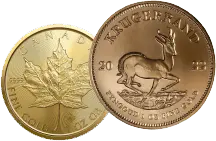
Stick to standard bullion: [American Gold Eagle] coins, [Canadian Gold Maple Leaf] coins, and comparable silver and platinum products from national mints. If you love the history side of the hobby, that’s a separate collection outside your IRA – collecting rare Morgan dollars or key-date coins for personal enjoyment, like the 1892 Morgan dollar, is a great pursuit, just not one that fits inside a retirement account.
How to Set Up an IRA Precious Metals Account, Step by Step
Opening this account takes more coordination than clicking “buy” on a brokerage app, because three separate parties have to work together: a custodian, a dealer, and a depository.
Setting Up Your Gold IRA
1
Choose a custodian Find a self-directed IRA custodian that specializes in metals. Standard brokerages like Vanguard don’t offer this service. Custodians handle IRS paperwork and hold legal title to the account.
2
Fund the account Roll over a 401(k), transfer an existing IRA, or make a direct cash contribution up to the annual limit.
3
Select your metals Tell your custodian which IRS-approved coins or bars you want. They send funds to a dealer to complete the purchase on your behalf.
4
Arrange storage Your custodian ships the metal directly to an IRS-approved depository. You never touch it personally.
5
Manage the account Review annual statements and adjust holdings through your custodian as needed.
Most custodians don’t set a hard minimum, but dealers typically recommend at least $10,000 to $25,000 so setup and annual fees don’t eat too much into returns on a smaller account.
If you’re just getting oriented, our page on how to start an IRA breaks down the paperwork side, and our dedicated guide to IRA rollovers walks through moving funds from an old 401(k) without triggering a taxable event.
Funding Your Account: Rollovers, Transfers, and Contribution Limits
Most people don’t fund a metals IRA with fresh cash. They move money already sitting in an old retirement account.
Rollover: Moving funds from a 401(k) or 403(b) into your new self-directed IRA.
Transfer: Moving money from one IRA custodian to another.
Direct contribution: Adding new cash, up to the annual IRS limit.
For 2026, contribution limits are $7,500 per year if you’re under 50, and $8,600 per year if you’re 50 or older, which includes a $1,100 catch-up contribution. These limits apply the same way they would to any Traditional or Roth IRA – precious metals don’t get a special higher allowance.
A properly executed rollover or transfer doesn’t trigger taxes or penalties. Where people get burned is taking a distribution check personally and not redepositing it within 60 days – that turns into a taxable event fast. Working with a custodian who processes direct, trustee-to-trustee transfers avoids this entirely. Our IRA rollover guide for retirement savers covers this process in more depth.
The No-Home-Storage Rule (And Why It Matters)
This is the single most important rule to understand, and it’s the one most beginners get wrong: you cannot store your IRA metals in your house, a personal safe, or a bank safety deposit box.
The IRS requires all IRA-held metal to sit in an approved depository – a high-security vault operated by a third party, such as Delaware Depository or Brinks. If you take physical possession of the coins or bars, the IRS treats that as a full distribution. You’ll owe income tax on the value immediately, plus a 10% early withdrawal penalty if you’re under 59½, regardless of whether you actually sold anything.
Your custodian arranges storage directly with the depository. The dealer ships the metal there after purchase – it never passes through your hands. This might feel less satisfying than holding a stack of Eagles in your own safe, but it’s non-negotiable if you want to keep the account’s tax status intact.
⚠️ Warning: Taking IRA metal home, even briefly, counts as a distribution. You’ll owe taxes and possibly a 10% penalty even if you plan to put it right back.
Costs, Fees, and Premiums to Expect
Self-directed metals IRAs cost more to run than a standard brokerage IRA. Budget for these line items:
Setup fee: roughly $50 to $100, one-time.
Annual custodian fee: roughly $100 to $300.
Storage fee: roughly $100 to $200 per year, often scaled to the value of your holdings.
Dealer premium: the markup over spot price you pay when buying coins or bars.
On premiums specifically: at about $4,073 an ounce for gold at the time of writing, a 5% premium adds roughly $200 per ounce to your purchase cost. Silver premiums tend to run higher as a percentage because the metal costs less per ounce – a $3 to $5 premium on a $60 Silver Eagle is a much bigger percentage than the same dollar premium on gold. Shop around and compare a dealer’s advertised premium against live spot pricing before committing to a purchase.
Comparing Gold, Silver, Platinum, and Palladium for Your IRA
Each metal plays a different role in a retirement portfolio.
Metal Comparison for IRA Holdings
Pros
✓ Gold: historically the most stable of the four, widely recognized, easiest to resell
✓ Silver: lower entry cost per ounce at about $60, lets you accumulate more ounces for the same dollar amount
✓ Platinum and palladium: tied to industrial demand, can diversify beyond the gold-silver pair
Cons
✗ Silver and PGMs: higher volatility than gold, smaller and less liquid markets
✗ All four: subject to dealer premiums and depository storage fees regardless of which you choose
Many collectors split their IRA between gold for stability and silver for accessibility. At current silver pricing, you can build a larger position in ounces without committing six figures, which appeals to investors who want more units of physical metal for portfolio balance rather than pure dollar value. Platinum and palladium see less use in retirement accounts simply because the markets are thinner, but they remain fully eligible when purity requirements are met. Our gold coin selection and silver bullion offerings both include IRA-eligible products if you’re ready to compare options directly.
Common Misconceptions About Precious Metals IRAs
Misconception 1: “I can keep my coins in my home safe.” False. Taking possession triggers a taxable distribution and a possible 10% penalty.
Misconception 2: “Any gold coin qualifies.” False. Pre-1933 U.S. gold and many foreign collectible coins fall below the 99.5% purity threshold and get rejected.
Misconception 3: “Rare, high-premium collectible coins are fine for an IRA.” Generally false. The IRS excludes collectibles specifically to prevent tax-advantaged accounts from being used to hold high-markup numismatic items.
Misconception 4: “Gold IRAs are tax-free forever.” False. A Traditional Gold IRA is tax-deferred – you pay tax on withdrawal. A Roth Gold IRA is tax-free on withdrawal, but you pay tax on the money before it goes in.
Misconception 5: “I can sell the metal and pocket the cash.” False. Proceeds from selling metal inside the IRA must stay in the account. Removing the cash counts as a distribution just like removing the metal would.
Selling or Liquidating Metal From Your IRA
Eventually you may want to sell – either inside the IRA to rebalance, or after taking a distribution in retirement. Inside the account, your custodian directs the sale and keeps proceeds within the IRA. Once you’ve taken possession as an actual retirement distribution, the metal is yours outright, and that’s when a trusted buyback channel matters.
Accurate Precious Metals buys back gold, silver, platinum, and palladium in coin, bar, and bullion form, along with jewelry, dental scrap, and silverware outside the IRA context. If you’re local to Salem, Oregon, you can bring holdings in for an in-person evaluation. If you’re anywhere else in the country, our mail-in service offers a free insured shipping kit and fast payment once your items are received and assessed. For gold specifically, our mail-in gold program walks through the process from kit request to payout.
Why Work With Accurate Precious Metals
Setting up an IRA Precious Metals account involves picking a custodian, but you still choose your own dealer for the actual bullion purchase – and that choice matters just as much as the custodian selection.
Accurate Precious Metals has operated out of Salem, Oregon since 2012 and has built a base of over 1,000 five-star customer reviews. We ship nationwide with insured delivery, so whether you’re rolling over a 401(k) in Oregon or Florida, you can source IRA-eligible coins and bars from us and have them routed straight to your depository. Our online pricing tracks live spot prices, so you’re never guessing whether a quoted premium is fair.
We’re not a pawn shop. We’re a specialized bullion dealer with a full inventory spanning gold, silver, platinum, palladium, and copper in coin, bar, and bullion form, plus diamonds and jewelry for collectors who want to diversify beyond metals in coin form. As an NGC authorized dealer, we also offer grading services for numismatic pieces you’re holding outside your retirement account. And because Oregon charges no sales tax, buyers get a real cost advantage compared to shopping in many other states.
For IRA-eligible purchases, look at products like the 2026 1 oz Gold Eagle or the 2025 Silver American Eagle – both meet IRS purity standards and ship with the documentation your custodian will need. If you’d rather start with the account setup itself, our how to start page and IRA rollover guide are the right next stops. Give us a call at (503) 400-5608 or visit our Salem location to talk through your options with someone who does this every day.
Frequently Asked Questions
Can I store my IRA gold coins at home if I have a good safe?
No. The IRS requires all IRA-held precious metals to sit in an approved depository. Taking physical possession, even into a high-quality home safe, counts as a distribution and triggers income tax plus a possible 10% early withdrawal penalty.
What's the minimum purity for gold in an IRA Precious Metals account?
Gold must be at least 99.5% pure, with one notable exception: the American Gold Eagle, which is 91.67% pure but still IRS-approved due to a specific statutory exception.
Can I roll over my 401(k) into an IRA Precious Metals account without paying taxes?
Yes, if done as a direct, trustee-to-trustee rollover or transfer. Taking a distribution check personally and not redepositing within 60 days can trigger taxes and penalties, so work with your custodian to process it directly.
Are collectible or numismatic coins allowed in a precious metals IRA?
Generally no. The IRS excludes most collectible coins from IRAs, favoring standard investment-grade bullion whose value is tied directly to metal content rather than rarity or history.
How much does it cost to maintain an IRA Precious Metals account each year?
Expect roughly $100 to $300 in annual custodian fees plus $100 to $200 in storage fees, on top of a one-time setup fee of $50 to $100. Fees vary by custodian and depository.
Should I choose gold or silver for my IRA?
It depends on your goals. Gold has historically shown more price stability, while silver's lower per-ounce cost lets you accumulate more units for the same dollar amount. Many investors hold both for balance.
Make the smart choice — invest with Accurate Precious Metals
Whether you are buying bullion for the first time or adding to a long-term position, our team offers expert guidance, transparent pricing, and a reliable buyback program.