Like our coverage? Add Accurate Precious Metals as a preferred source on Google.
If you want to know how to invest in gold, the most important thing to understand upfront is that gold is not a growth asset – it is a wealth protection tool. It does not pay dividends or generate earnings. Its value comes from scarcity, global recognition, and thousands of years of use as a store of wealth. That distinction shapes every decision you make, from which form of gold to buy to how you store it and when you sell.
Gold works best as part of a broader portfolio, not as a replacement for other assets. Most financial research points to a 5% to 10% allocation for balanced investors, with more conservative or crisis-focused portfolios sometimes going higher. The goal is protection and diversification, not a quick return.
Why Gold Still Holds Value
Gold has been used as money and a store of wealth for thousands of years because it is rare, does not corrode, and is universally recognized. Those same qualities drive its modern role. When stock markets fall, currencies weaken, or geopolitical uncertainty rises, gold tends to hold its value better than most other assets. That is why major financial institutions describe it as a portfolio diversifier – it often moves differently from stocks and bonds.
That does not mean gold always goes up. It has long sideways phases and meaningful drawdowns. But over long periods, it has historically preserved purchasing power in ways that cash alone cannot. That track record is why people keep buying it, even at today’s elevated prices.
At the time of writing, gold is trading at $4,224 per troy ounce. That is a historically high level. For buyers, it means premiums on top of spot matter more than ever, especially on small or fractional pieces. For sellers, it is a favorable environment to evaluate existing holdings.
Live Gold Spot Price – Accurate Precious Metals Refineries
The Main Ways to Invest in Gold
There are four practical ways to invest in gold, and they suit different goals, budgets, and risk tolerances.
| Method | What You Own | Main Advantage | Main Drawback |
|---|---|---|---|
| Physical coins/bars | The metal itself | Direct ownership, no fund structure | Premiums, storage, insurance costs |
| Gold ETFs/funds | Shares in a fund | Easy to trade, no home storage | No physical metal in hand |
| Mining stocks | Equity in gold companies | Use to rising gold prices | Company and operational risk |
| Futures/options | Price contracts | Capital-efficient for traders | Complex and risky for beginners |
For most people reading this – collectors, first-time buyers, and retirement savers – physical gold and gold ETFs are the two realistic options. Mining stocks and futures require a different skill set and carry risks that go well beyond the gold price itself.
Physical Gold: Coins and Bars
Physical gold is the most direct way to own the metal. You buy it, you hold it, and its value tracks the spot price minus the premium you paid. There is no fund structure, no management fee, and no counterparty standing between you and the asset.
Gold coins and gold bars are the two main forms. Both work, but they suit different situations.
Coins
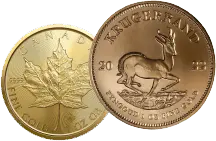
Government-minted bullion coins are the most practical choice for most buyers. They are widely recognized, easy to authenticate, and straightforward to resell. The [2025 1 oz Gold Eagle] from the U.S. Mint is one of the most traded bullion coins in the world. Other popular options include the Canadian Gold Maple Leaf (.9999 fine gold), the South African Krugerrand, the Austrian Philharmonic, and the British Britannia. Any of these will trade smoothly with reputable dealers worldwide.
Fractional coins – 1/2 oz, 1/4 oz, and 1/10 oz – give buyers flexibility, but they carry higher premiums per ounce than full-ounce coins. That is because minting and distribution costs are spread over less gold. If your goal is to maximize the metal you get per dollar spent, full-ounce coins are more efficient.
Bars
Gold bars typically carry lower premiums per ounce than coins, especially in larger sizes. A 1 oz gold bar from a recognized refiner is a solid, cost-effective way to hold gold. Kilobars and larger formats push the premium even lower, but they are harder to sell in partial amounts. If you ever need to liquidate, you sell the whole bar – you cannot break off a piece.
For most buyers starting out, a 1 oz gold bar hits the right balance between cost efficiency and flexibility. Look for bars from well-known refiners with clear serial numbers and assay documentation.
Gold ETFs and Paper Gold
Gold ETFs let you gain exposure to the gold price without storing physical metal. You buy shares through a brokerage account, the fund holds gold on your behalf, and your position rises and falls with the spot price minus a small management fee.
This approach works well for retirement accounts, investors who want clean recordkeeping, and people who are not ready to deal with storage logistics. It is also easier to buy and sell quickly compared to physical gold.
The tradeoff is real: ETF holders own shares in a fund, not metal in hand. If the fund structure ever had a problem, you would be a creditor, not a vault owner. For most mainstream ETFs backed by major financial institutions, that risk is low – but it is not zero. Physical gold has no equivalent counterparty risk.
For investors who want a hybrid approach, holding some physical gold and some ETF exposure is a reasonable strategy. The physical gold anchors your position; the ETF gives you liquidity and convenience.
How Gold Is Priced
Gold is quoted in troy ounces, not the standard ounces used for everyday weights. One troy ounce equals about 31.1 grams. When you see a spot price – currently $4,224/oz at the time of writing – that is the baseline price for one troy ounce of pure gold on the global market.
What you actually pay is always higher than spot. The formula is straightforward:
The global baseline: $4,224/oz at the time of writing
Added for fabrication, distribution, and dealer margin
Varies by order size and shipping method
Oregon has no sales tax on precious metals; other states vary
Premiums vary by product. A popular 1 oz bullion coin from a major mint might carry a premium of 3% to 8% over spot. Fractional coins can run higher. Rare or collectible coins carry premiums based on numismatic value, not just metal content – those are a different category entirely.
You can track live gold prices on our gold spot price page. Watching the spot price over a few weeks before you buy gives you a better sense of where prices sit relative to recent history.
How to Invest in Gold for Retirement
Gold can play a role in retirement savings through a Precious Metals IRA. This is a self-directed IRA that holds IRS-approved physical gold instead of – or alongside – conventional assets like stocks and mutual funds.
The IRS sets specific requirements for metals held in an IRA. Gold must meet a minimum fineness of .995. Approved products include the American Gold Eagle (which is an exception to the fineness rule), the Canadian Gold Maple Leaf, and most gold bars from approved refiners. The metal must be stored in an IRS-approved depository – you cannot keep IRA gold at home.
For investors who want the tax advantages of an IRA combined with the wealth-protection properties of physical gold, this structure makes sense. Our precious metals IRA guide covers the mechanics in detail, including how to roll over an existing 401(k) or IRA into a gold-backed account.
Storage and Security
Physical gold creates a storage problem that paper gold does not. Before you buy, decide how you will store it – because the answer affects your security, your costs, and your insurance situation.
- Home storage: You keep the metal yourself, typically in a quality safe. Low ongoing cost, but you carry the full security and insurance burden. Works for modest holdings.
- Safe-deposit box: Bank-held, relatively secure, but not insured by the FDIC. Access is limited to bank hours, and there have been documented cases of boxes being drilled during bank failures.
- Professional vaulting: Third-party storage facilities offer insured, audited storage. Higher ongoing cost, but appropriate for larger holdings or IRA-held gold.
Whatever you choose, keep records. Document the purchase date, price paid, product type, weight, and serial numbers where applicable. Good records simplify insurance claims, estate planning, and tax reporting when you eventually sell.
Common Mistakes to Avoid
Gold investing is straightforward in principle but easy to get wrong in practice. These are the mistakes that cost buyers the most.
- Paying too much in premiums. A high-pressure dealer, a heavily marketed collectible coin, or a small fractional piece can all push your all-in cost well above what a standard bullion product would cost. Compare total price, not just the spot rate.
- Buying jewelry as an investment. Jewelry carries design and retail markups that have nothing to do with gold content. Its resale value is almost always much lower relative to spot than bullion coins or bars.
- Confusing collectible and bullion coins. A numismatic coin’s value depends on condition, rarity, and collector demand – not just metal content. Buying a collectible coin as a bullion investment is a category error.
- Skipping the storage plan. Buying gold before you have a secure place to store it is a common beginner mistake. Figure out storage first.
- Trying to time the market. Gold is a long-term holding. Trying to buy at the exact bottom and sell at the exact top is a losing strategy for most investors. Dollar-cost averaging – buying a fixed dollar amount at regular intervals – reduces the stress of price timing.
- Using an unfamiliar dealer. Not all dealers are the same. Verify the dealer’s history, check reviews, and confirm their buyback policy before you commit.
A Simple Strategy for New Buyers
If you are starting from scratch, this five-step plan covers the essentials.
Decide if you are buying for wealth preservation, portfolio diversification, or collecting. The goal shapes which products make sense.
A 5% to 10% allocation to gold is a common starting point for balanced investors. Do not overweight gold at the expense of other assets.
Physical gold for direct ownership; ETFs for convenience and liquidity; or both. Match the form to your storage capacity and timeline.
Compare total all-in cost across products. Favor recognized sovereign-minted coins or standard bars from known refiners.
Document every purchase. Review your allocation periodically and adjust as your situation changes.
For a deeper look at how bullion fits into a modern investment strategy, our article on gold bullion as an investment covers the long-term case in more detail.
When and How to Sell Your Gold
Knowing how to sell matters as much as knowing how to buy. Gold is only useful as wealth protection if you can convert it to cash when you need to.
The best time to sell is when your financial situation calls for it – not when you are trying to predict a market top. If you bought recognized bullion coins or standard bars from a reputable dealer, selling is straightforward. Most dealers will buy back common products at prices close to spot.
If you are local to Salem, Oregon, you can bring your gold directly to Accurate Precious Metals for an in-person evaluation and same-day offer. If you are anywhere else in the United States, the mail-in service lets you ship your gold securely using a free insured shipping kit, get it assessed, and receive fast payment – without leaving home.
Either way, selling to a specialized bullion dealer rather than a pawn shop or general jewelry buyer typically gets you a more competitive offer, because a dealer’s business is built around precious metals pricing.
Why Accurate Precious Metals Is the Right Starting Point
Accurate Precious Metals has been operating out of Salem, Oregon since 2012. With more than 1,000 five-star customer reviews, a broad inventory of gold coins, gold bars, silver, platinum, and palladium, and nationwide insured shipping, it is one of the most trusted options for buyers anywhere in the United States.
Pricing is updated to reflect live spot prices, so you are always working from a current baseline. The team also handles Gold and Silver IRA services for retirement investors who want physical metal inside a tax-advantaged account – not just paper exposure.
As an NGC Authorized Dealer, Accurate Precious Metals can also assist with coin grading services for numismatic pieces, which matters if you are buying or selling coins where condition affects value.
Oregon charges no sales tax on precious metals, which is a meaningful cost advantage for buyers compared to many other states. Combined with competitive premiums and a clear buyback process, that makes Accurate Precious Metals a strong choice whether you are buying your first ounce or adding to an established position.
Visit the Salem location in person, call (503) 400-5608, or browse the full inventory at AccuratePMR.com. Ready to sell? Local customers can walk in; customers anywhere in the U.S. can use the mail-in gold service for a convenient, insured selling option.
Frequently Asked Questions
How much gold should a beginner buy?
There is no universal answer, but a common starting point is a 5% to 10% allocation of your overall investment portfolio. In dollar terms, that could mean one or two 1 oz coins or bars to start, then building gradually over time. Buying a fixed dollar amount at regular intervals – dollar-cost averaging – takes the pressure off trying to pick the perfect entry point.
Is it better to buy gold coins or gold bars?
Both are solid choices. Coins from major government mints are easier to resell in any quantity and are widely recognized. Bars generally carry lower premiums per ounce, especially in larger sizes, but are less flexible for partial sales. For most beginners, a 1 oz coin from a recognized mint is the simplest starting point.
What is the spot price of gold right now?
At the time of writing, gold is trading at $4,224 per troy ounce. Spot prices change continuously during market hours. You can check the current price on our live gold spot price page.
Can I hold physical gold in my IRA?
Yes, through a self-directed Precious Metals IRA. The IRS requires that the gold meet a minimum fineness of .995 and be stored in an approved depository. Products like the American Gold Eagle and Canadian Gold Maple Leaf qualify. Our IRA rollover guide explains the process in detail.
Is gold jewelry a good investment?
Generally, no. Jewelry carries design and retail markups that are not recovered at resale. The buyback price for jewelry is based on metal content, not what you paid for the craftsmanship. For investment purposes, bullion coins and bars are far more efficient.
How do I sell gold I already own?
If you are near Salem, Oregon, bring it to Accurate Precious Metals for an in-person offer. If you are elsewhere in the United States, use the mail-in service – you receive a free insured shipping kit, your gold is evaluated, and you receive a competitive offer based on current spot prices.
What is the difference between a bullion coin and a numismatic coin?
A bullion coin's value is tied primarily to its metal content and tracks the spot price. A numismatic coin's value depends on rarity, condition, and collector demand – factors that can push the price far above melt value. They require different knowledge to buy and sell well.
Sources
Make the smart choice — invest with Accurate Precious Metals
Whether you are buying bullion for the first time or adding to a long-term position, our team offers expert guidance, transparent pricing, and a reliable buyback program.
Ready to invest wisely?