This content is for educational purposes only and is not financial or investment advice. Precious metals prices fluctuate; past performance does not guarantee future results. Consult a qualified professional before making investment decisions.
Knowing how to buy gold bullion is simpler than most new buyers expect, but a few decisions made early – which form to buy, where to buy it, and what price to pay – determine whether your first purchase goes smoothly or not. Gold bullion means physical gold valued primarily for its metal content, sold as coins, bars, or rounds, and priced at the spot price plus a dealer premium. Get those basics right and everything else follows.
Gold has stored wealth across civilizations for thousands of years because it is scarce, durable, and recognized everywhere. That history still matters today. Modern bullion coins and bars inherit those same qualities, and for many buyers, holding physical gold offers something stocks and bonds cannot: a tangible asset that does not depend on any institution to honor a promise.
Gold bullion is not jewelry. It is not a rare collector coin. It is physical gold bought and sold mainly for its metal value. Bullion comes in three main forms: coins, bars, and rounds. Each has a different price profile and fits different buyers.
Coins are issued by government mints – the U.S. Mint, the Royal Canadian Mint, the Perth Mint, and others. They carry official weight and purity claims backed by the issuing government. Bars come from private refiners and mints, and they typically carry lower premiums. Rounds look like coins but are made by private mints and are not legal tender. They often price closer to bars.
Buyers come to gold for different reasons, and understanding your own reason shapes which product makes sense.
Wealth preservation. Gold is a tangible asset with no counterparty risk. No bank or company needs to honor a promise for it to hold value.
Portfolio diversification. Gold has historically moved differently from stocks and bonds, which is why many investors hold it alongside other assets.
Inflation hedge. Many buyers turn to gold when they want something outside the paper financial system, though gold is still a market asset with real price swings.
Liquidity. Recognized coins and bars from major mints are easy to resell. Obscure products are not.
Gold does not pay dividends or interest. Buyers accept that tradeoff in exchange for a store of value that has held purchasing power across centuries.
The Three Main Forms of Gold Bullion
Type
What It Is
Best For
Main Advantage
Main Drawback
Coins
Government-issued, official weight and purity
Beginners, resale-focused buyers
Highly recognizable, easy to sell
Higher premium than bars
Bars
Minted or cast from refiners and mints
Larger purchases, cost-conscious buyers
Lower premium over spot
Less convenient in small sizes
Rounds
Private-mint pieces, not legal tender
Buyers wanting low-cost bullion
Often close to bar pricing
Less recognized than major coins
For most first-time buyers, coins are the practical starting point. They are easier to verify, easier to resell, and immediately recognizable to dealers worldwide. Bars make more sense once you are buying larger quantities and want to stretch your dollar further on gold content. You can browse gold coins available now or explore gold bars by size to compare your options directly.
How Gold Bullion Pricing Works
Every gold bullion purchase has two price components: spot price and premium. Understanding both is the single most important pricing skill a new buyer can develop.
The spot price is the live market price for one troy ounce of gold. At the time of writing, gold spot is $4,224/oz. That number moves constantly with the market.
The premium is the extra amount a dealer charges above spot. It covers fabrication, distribution, shipping, and dealer margin. A 1 oz gold coin at the time of writing might sell for $4,224/oz plus a premium of $150-$300 depending on the product and dealer. That is normal. What is not normal is a price significantly below spot – that is a red flag.
A few pricing rules matter for new buyers:
Coins cost more per ounce than bars because of minting, branding, and liquidity advantages.
Smaller pieces cost more per ounce than larger pieces. A 1/10 oz coin carries a much higher premium per ounce than a 1 oz coin because fabrication costs are spread over less gold.
Comparing premium, not just headline price, is how you actually evaluate two products side by side.
⚠️ Warning: Unusually low prices are a warning sign. If a seller cannot clearly explain why their price is below market norms, the risk of counterfeit or misrepresented products rises sharply.
Gold Coins: What New Buyers Should Know
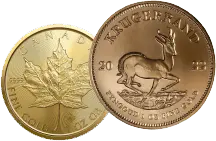
Government-issued bullion coins are the most popular starting point for new buyers, and for good reason. The American Gold Eagle is the most widely traded gold coin in the United States. It is issued by the U.S. Mint in four sizes – 1 oz, 1/2 oz, 1/4 oz, and 1/10 oz – with a gold content of .9167 fine. The [Canadian Maple Leaf] from the Royal Canadian Mint is .9999 fine and equally well recognized worldwide.
Fractional coins – the 1/10 oz and 1/4 oz sizes – cost less per item, which makes them accessible for buyers starting with smaller budgets. Just know that the premium per ounce is higher on fractional pieces. A 1/10 oz Gold Eagle might carry a premium of 15-25% over spot per ounce, while a full 1 oz coin typically runs closer to 4-8% over spot.
Gold Bars: When They Make Sense
Gold bars are the choice for buyers who want maximum gold content per dollar spent. Bars from major refiners – PAMP Suisse, Valcambi, the Perth Mint, and others – are widely accepted and easy to resell through established dealers.
Bar sizes range from 1 gram all the way to 1 kilogram and beyond. For most individual buyers, the 1 oz bar is the most practical starting point. It carries a lower premium than a 1 oz coin, usually in the range of 2-5% over spot, and it is small enough to store easily.
Larger bars – 10 oz and kilo bars – drop the premium further per ounce but require more capital upfront and can be slightly harder to liquidate quickly compared to a stack of 1 oz coins. Many experienced buyers hold a mix of both.
Always check that a bar has a hallmark, a stamped weight and purity, and a serial number if it came with an assay card. Keep the assay packaging intact. It matters at resale.
How to Buy Gold Bullion: A Step-by-Step Process
Buying Gold Bullion Step by Step
1
Step 1 – Decide Your Goal Are you maximizing ounces for the money, prioritizing easy resale, or making a smaller first purchase? Your answer points you toward bars, coins, or fractional pieces.
2
Step 2 – Choose Your Form Coins for recognition and liquidity. Bars for lower premiums and larger purchases. Fractional pieces if you are starting with a smaller budget.
3
Step 3 – Find a Reputable Dealer Look for clear pricing, a stated buyback policy, customer reviews tied to real transactions, and transparent shipping and insurance terms.
4
Step 4 – Compare Premiums Two 1 oz gold products with the same gold content can have very different total costs. Compare the premium over spot, not just the dollar price.
5
Step 5 – Check Authenticity Features Look for hallmarks, mint marks, and serial numbers on bars. Check assay packaging. Major coins have well-documented security features.
6
Step 6 – Confirm Payment and Delivery Terms Established dealers disclose shipping costs, insurance, return policies, and delivery timelines up front. Vague terms are a warning sign.
7
Step 7 – Plan Storage Before You Buy Decide on a home safe, bank safe-deposit box, or professional vault before your purchase arrives. Do not figure this out after.
Physical gold requires two things beyond the purchase itself: verification and a storage plan.
On authenticity, widely recognized coins from major government mints are the easiest to verify because their dimensions, weight, and security features are publicly documented. Bars from established refiners come with assay cards and serial numbers. Keep all original packaging. A coin or bar that arrives with its original mint packaging and documentation is easier to resell and simpler to verify than one that does not.
Home safes work for smaller holdings and offer immediate access. Bank safe-deposit boxes add a layer of physical security but limit access to banking hours. Professional vaults and depositories are worth considering for larger holdings – they offer insurance, climate control, and documented chain of custody. The right choice depends on how much you own and how often you need access.
ℹ️ Info: Gold bullion is valuable in a compact form. A single 1 oz coin worth over $4,000 at the time of writing fits in a shirt pocket. Theft prevention is as important as the purchase decision itself.
Common Misconceptions New Buyers Have
“Gold is only for wealthy investors.” Fractional coins and small bars let buyers start with a few hundred dollars. A 1/10 oz Gold Eagle at the time of writing represents roughly $420-$500 depending on premium – a real entry point for a first purchase.
“The cheapest price is always the best deal.” A price below market norms usually signals something: counterfeit risk, poor service, no buyback support, or hidden fees. Cheap upfront often costs more later.
“All gold products resell equally easily.” They do not. A well-known government coin sells faster and with less friction than an obscure private-mint bar. Liquidity matters.
“I pay spot price.” You pay spot plus premium, plus possible shipping. Spot is the starting point, not the final price.
“Bullion and jewelry are the same.” Jewelry prices include design, labor, and retail markup. Bullion prices track metal content. They are different markets.
Why Accurate Precious Metals Is the Right Place to Start
Accurate Precious Metals has been serving buyers and sellers across the United States since 2012, with more than 1,000 five-star customer reviews reflecting that track record. Based in Salem, Oregon, the company operates as a specialized precious metals dealer – not a pawn shop – with deep inventory across gold, silver, platinum, and palladium in coin, bar, and bullion form.
Online pricing at AccuratePMR.com updates to reflect live spot prices, so what you see is current. Inventory covers the full range of recognized bullion products: government coins from the U.S. Mint, the Royal Canadian Mint, the Perth Mint, and others, alongside bars from trusted refiners. For retirement investors, Accurate Precious Metals also offers Gold and Silver IRA services, making it possible to hold physical bullion within a tax-advantaged account.
Shipping is nationwide with insured delivery, so buyers anywhere in the United States can purchase with confidence. Local buyers in the Salem, Oregon area are welcome to visit in person for hands-on service and same-day transactions.
If you already own gold and are considering selling, Accurate Precious Metals buys all forms of precious metals – bullion, coins, jewelry, scrap, and more. Salem-area customers can bring items in directly. Buyers anywhere in the U.S. can use the mail-in service for free insured shipping, professional evaluation, and fast payment. For in-person selling or buying, visit the Salem location or call (503) 400-5608.
What is the difference between spot price and premium when buying gold bullion?
Spot price is the live market price for one troy ounce of gold. Premium is the additional amount a dealer charges above spot to cover fabrication, distribution, and margin. At the time of writing, gold spot is $4,224/oz. A 1 oz coin or bar will sell for that amount plus a premium, which typically ranges from 2-8% depending on the product.
Are gold coins better than gold bars for beginners?
For most beginners, coins are the easier starting point. They are widely recognized, straightforward to verify, and simple to resell. Bars carry lower premiums and make more sense for larger purchases where cost efficiency matters more than immediate liquidity.
What size gold bullion should I buy first?
A 1 oz government coin – such as an American Gold Eagle or Canadian Maple Leaf – is the most practical first purchase. It balances premium efficiency with strong resale liquidity. Fractional pieces like 1/10 oz coins are a lower-cost entry point but carry higher premiums per ounce.
How do I know if a gold bullion dealer is reputable?
Look for transparent pricing that shows the premium over spot, a clear buyback policy, documented shipping and insurance terms, and verifiable customer reviews. A reputable dealer stocks widely recognized products from major mints and refiners.
Can I buy gold bullion online safely?
Yes, with the right dealer. Established dealers like Accurate Precious Metals offer insured shipping, clear return policies, and live pricing. The key is buying from a dealer with a verifiable track record rather than an anonymous seller or marketplace listing.
Do I need to pay taxes on gold bullion purchases?
Tax treatment varies by state and purchase type. Oregon buyers purchasing from Accurate Precious Metals benefit from no state sales tax on precious metals. Consult a tax professional for guidance specific to your situation.
Where should I store gold bullion after buying it?
Common options include a home safe, a bank safe-deposit box, or a professional vault or depository. The right choice depends on how much you own, how often you need access, and how much security you want. Plan your storage before your purchase arrives.
What gold bullion products does Accurate Precious Metals carry?
Accurate Precious Metals stocks gold coins from major government mints, gold bars from established refiners, and fractional gold pieces across a range of sizes. Inventory is updated regularly and priced against live spot. Visit AccuratePMR.com or call (503) 400-5608 for current availability.
Make the smart choice — invest with Accurate Precious Metals
Whether you are buying bullion for the first time or adding to a long-term position, our team offers expert guidance, transparent pricing, and a reliable buyback program.