This content is for educational purposes only and is not financial or investment advice. Precious metals prices fluctuate; past performance does not guarantee future results. Consult a qualified professional before making investment decisions.
Understanding gold karat value when alloyed is essential for anyone buying, selling, or collecting gold jewelry and bullion. The moment gold is mixed with another metal, its karat drops – and so does its melt value. That is not a flaw. It is metallurgy working exactly as intended. But if you want to know what your gold is actually worth, you need to understand what karat means, how alloying changes it, and how that math translates into real dollars at today’s prices.
Gold spot price sits at $4,357 per ounce at the time of writing. That number applies to pure, 24-karat gold. Everything below 24K is worth proportionally less per gram – and the gap adds up fast when you are dealing with jewelry, scrap, or estate pieces.
What Karat Actually Measures
Karat is a purity scale. It runs from 0 to 24, where 24 represents essentially pure gold and lower numbers represent a smaller fraction of gold in the total metal mixture. The formula is straightforward: divide the karat number by 24 to get the gold content as a decimal.
Karat
Gold Content
Fineness Stamp
24K
99.9%
999
18K
75.0%
750
14K
58.3%
583 or 585
10K
41.7%
417
9K
37.5%
375
A 14K ring is not mostly gold. It is 58.3% gold and 41.7% other metals. A 10K piece contains less gold than non-gold material. These are not tricks or shortcuts – they are the standard way jewelry gold has been produced and traded for centuries.
Understanding karat numbers in detail helps sellers and buyers avoid the most common pricing mistakes, especially when comparing pieces of different weights and karats.
Why Gold Is Alloyed in the First Place
Pure gold is soft. Scratch it with a fingernail and you can leave a mark. Bend a 24K ring and it stays bent. For everyday jewelry that needs to hold gemstone settings, survive daily wear, and keep its shape, pure gold is a poor choice.
Alloying solves that. Adding copper, silver, zinc, nickel, palladium, or platinum to gold increases hardness and wear resistance significantly. It also makes the metal easier to cast and work with in a manufacturing setting.
Why Jewelers Alloy Gold
Pros
✓ Harder and more resistant to scratching and bending
✓ Less expensive per piece because less gold is used
✓ Enables different colors – yellow, rose, white – from the same base metal
✓ Better suited to stone settings and precision casting
✓ More practical for daily-wear jewelry
Cons
✗ Lower karat means lower melt value per gram
✗ Color alone cannot tell you the karat
✗ Different alloy recipes at the same karat can behave differently
The World Gold Council confirms that alloying gives malleable gold the durability needed for practical use while also opening up a range of color possibilities. That is the trade-off: lower purity in exchange for a more functional, versatile metal.
How Different Metals Change Gold’s Color and Properties
The specific metal added to gold determines the resulting color, but it does not change how karat is calculated. Karat only reflects the gold fraction. Two 14K rings can look completely different depending on what fills the remaining 41.7%.
Yellow gold typically combines gold with silver and copper in roughly balanced proportions, preserving the warm tone most people associate with gold jewelry.
Rose gold uses a higher proportion of copper, which pushes the color toward pink or red. The more copper, the deeper the rose hue.
White gold incorporates palladium, nickel, or similar metals that shift the color toward silver-gray. White gold is often rhodium-plated to enhance its brightness.
Higher-karat alloys stay closer to gold’s natural yellow because there is less room for modifying metals.
Lower-karat alloys allow wider color variation because the larger non-gold fraction gives the alloying metals more influence over appearance.
This is why color is a poor guide to purity. A deep yellow piece could be 18K or 10K depending on the alloy recipe. A white-looking piece might be 18K white gold, which is still 75% gold. Reading purity stamps correctly is the only reliable way to identify karat from the piece itself.
The Physics Behind Alloying: Density, Hardness, and Conductivity
Alloying changes more than appearance. It changes the physical structure of the metal at a measurable level.
Gold is one of the densest common metals. When you add lighter metals like silver or copper, the overall density of the alloy drops. This matters for testing. A piece that looks like gold and weighs like gold might still be a lower-karat alloy – or in counterfeit cases, a base metal with a gold coating.
Metallurgical research makes an important point here: density alone cannot reliably identify karat unless you already know which metal was used as the alloying agent. Different metals produce different density results even at the same karat level. A 14K yellow gold ring and a 14K white gold ring are both 58.3% gold, but their densities differ because copper and palladium have different densities themselves.
Hardness generally increases as karat drops. An 18K piece is harder than a 24K piece. A 14K piece is harder still. This is one reason 14K is the most common choice for engagement rings and everyday fine jewelry in the United States – it balances gold content with practical durability.
Electrical conductivity also shifts when metals are added. This matters more in industrial and electronics applications than in jewelry, but it is part of why pure gold is used in specific high-performance electrical contacts where alloyed gold would underperform.
How Alloying Directly Affects Gold Karat Value When Calculating Melt Price
When you bring a gold item to a buyer or refiner, the first two questions are: what does it weigh, and what is the karat? Those two numbers, combined with the current spot price, determine melt value.
With gold at $4,357 per troy ounce at the time of writing, here is how karat affects the value of a one-ounce piece:
Karat
Gold Content
Melt Value (1 oz total weight)
24K
99.9%
~$4,353
18K
75.0%
~$3,268
14K
58.3%
~$2,540
10K
41.7%
~$1,817
The difference between an 18K and a 10K piece of the same weight is roughly $1,450 per ounce at current prices. That gap is why karat identification matters so much before any transaction.
Melt value is a floor, not a ceiling. Jewelry with designer hallmarks, antique pieces, or items set with quality gemstones may sell for more than melt value in the right market. But for scrap gold, broken chains, mismatched earrings, or old dental gold, melt value is typically the starting point for any offer.
If you want to know how much is my gold worth based on your specific pieces, Accurate Precious Metals offers a straightforward mail-in evaluation process. Local customers can also visit the Salem, Oregon location directly for an in-person assessment.
Hallmarks and Stamps: Reading the Karat on Your Gold
Most gold jewelry sold in the United States and many other countries carries a karat stamp. Common marks include 10K, 14K, 18K, and 24K. European pieces often use fineness numbers instead: 750 for 18K, 585 for 14K, 417 for 10K.
ℹ️ Info: Fineness stamps and karat stamps mean the same thing in different formats. 750 = 18K = 75% gold. 585 = 14K = 58.3% gold. If you see a three-digit number stamped on a piece, divide it by 1000 to get the gold fraction.
Older pieces, estate jewelry, and items from outside the US may carry different marking conventions. Some antique American pieces were marked in a way that referred to the gold-filled layer rather than solid gold content. Karat stamping across different eras covers how these markings changed over time, which is useful context for collectors evaluating estate pieces.
The stamp is a starting point, not a final answer. Reputable buyers evaluate metal content through XRF analysis or other testing methods to confirm what the stamp says. At Accurate Precious Metals, pieces are assessed for metal content before any offer is made – that process protects both the buyer and the seller.
Bullion Coins vs. Alloyed Jewelry Gold: A Key Distinction
Investment-grade gold bullion operates differently from jewelry gold. Most modern gold bullion coins and bars are produced at .9999 fineness – effectively 24K – which means no significant alloying.
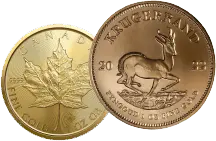
The [American Gold Eagle], for example, is an exception. It is struck at 22K (.9167 fine) because the U.S. Mint adds silver and copper to improve durability for circulation-quality coins. Each coin still contains exactly one troy ounce of pure gold – the alloy simply makes the total coin weight slightly heavier than one ounce. The Gold Eagle’s specifications reflect this clearly: the coin is 22K but still delivers a full ounce of fine gold content.
By contrast, the [Canadian Gold Maple Leaf] is struck at .9999 fineness, making it essentially pure gold with no meaningful alloying. Both coins are legitimate investment-grade gold. The difference in karat reflects a design philosophy, not a difference in gold content per coin.
For gold bars, the standard is almost universally .9999 fine. Bars do not need the durability that coins require, so there is no practical reason to alloy them. Their value tracks the spot price closely, with a modest premium for fabrication and distribution.
Common Misconceptions About Gold Karat Value When Alloyed
Several persistent misunderstandings circulate about how karat works. Clearing them up prevents costly mistakes.
“More yellow means higher karat.” Color depends on which metals were alloyed, not karat alone. A 10K yellow gold piece can look just as warm as an 18K piece depending on the alloy recipe.
“Gold-plated items have a karat value.” Karat describes the purity of the metal throughout the entire piece. A gold-plated item has a base metal core with a thin gold surface layer. It is not the same as solid alloyed gold, and its gold content is negligible for melt purposes.
“All 14K gold is the same.” The gold fraction is the same – 58.3% – but the remaining 41.7% can be any combination of metals. Two 14K pieces can differ in color, density, hardness, and biocompatibility depending on what was added.
“Density testing proves karat.” Density depends on which metals were alloyed. The same karat can produce different densities depending on whether copper, palladium, or silver fills the non-gold portion. Density is a useful screening tool but not a definitive test on its own.
“Alloying makes gold fake.” Alloyed gold is real gold. The karat stamp tells you exactly how much real gold is present. Alloying is standard metallurgy, not adulteration.
Practical Tips for Sellers and Collectors
Whether you are clearing out estate jewelry or evaluating a collection, a few practical habits protect your interests.
How to Estimate Your Gold’s Value Before Selling
1
Step 1 Find the karat stamp – look for 10K, 14K, 18K, or fineness numbers like 585 or 750
2
Step 2 Weigh the piece in grams using a jewelry scale
3
Step 3 Convert grams to troy ounces (divide by 31.1)
4
Step 4 Multiply troy ounces by the gold content percentage (e.g., 0.583 for 14K)
5
Step 5 Multiply fine gold content by the current spot price ($4,357/oz at the time of writing)
6
Step 6 Compare that melt value to any offer you receive
Remember that melt value is the minimum baseline. Collectible pieces, designer jewelry, and items with significant gemstones may justify higher offers. Factors that affect cash-for-gold value goes deeper on what drives prices above melt in the secondary market.
Sellers should also know that the alloying metals in a piece – silver, copper, palladium – have their own market value. Silver sits at $72 per ounce at the time of writing. Palladium is at $1,367 per ounce at the time of writing. In most jewelry alloys, the non-gold metals are present in small enough quantities that they do not significantly change the offer, but in high-palladium white gold or platinum-alloyed pieces, it can matter.
Selling Your Gold: In Person or by Mail
Accurate Precious Metals has been buying and selling precious metals since 2012 from its Salem, Oregon location. With more than 1,000 five-star reviews and competitive pricing based on live spot prices, it is a straightforward choice for sellers who want a fair, professional evaluation.
Local customers can bring pieces directly to the Salem location for an in-person assessment. The team evaluates metal content through XRF analysis and similar methods, then makes a competitive offer based on current market prices. There is no obligation to sell.
For customers outside Oregon, Accurate Precious Metals offers a convenient mail-in service with free insured shipping. You can send in gold jewelry, scrap gold, dental gold, broken pieces, or any other gold items regardless of condition. The process is simple: request a kit, ship your items with the provided insured packaging, and receive an offer based on the actual metal content of your pieces. Payment is fast once you accept.
Whether you have a single 10K chain or a collection of mixed-karat estate pieces, the process is the same. Karat, weight, and current spot price determine the offer. Accurate Precious Metals is not a pawn shop – it is a specialized precious metals dealer that buys across the full range of gold purity levels, from 9K to 24K bullion.
Frequently Asked Questions
Does alloying gold destroy its value?
No. Alloying reduces purity, which lowers melt value per gram, but the gold that is present retains its full market value. A 14K piece is worth exactly what its gold content is worth at current spot prices – no more, no less from a melt perspective.
Can I tell the karat of gold just by looking at it?
Not reliably. Color is influenced by which metals were alloyed, not just the karat level. The only reliable methods are checking the hallmark stamp and having the piece tested via XRF analysis or acid testing.
Is 24K gold ever used in jewelry?
Rarely for everyday wear. 24K gold is too soft for most jewelry applications. It is used in some traditional jewelry styles, investment coins, and high-purity bars, but it scratches and bends easily under normal wear conditions.
Why do some gold pieces have no karat stamp?
Older pieces, handmade items, and jewelry from certain countries may lack stamps. Some antique pieces predate modern stamping requirements. A professional evaluation through XRF testing can identify the gold content even without a visible stamp.
How does white gold differ from yellow gold in terms of karat?
The karat is calculated the same way for both – it reflects the gold fraction regardless of color. An 18K white gold ring and an 18K yellow gold ring are both 75% gold. The difference is which metals fill the remaining 25%.
What happens to alloying metals when gold is refined?
During refining, the alloying metals are separated from the gold. Refiners recover the gold content and may also recover other metals of value. The refining process is why scrap gold has real value even when it is heavily alloyed.
Is rose gold worth less than yellow gold of the same karat?
At the same karat, rose gold and yellow gold contain identical amounts of gold and are worth the same from a melt perspective. The color difference comes from the alloy recipe, not the gold content.
Make the smart choice — invest with Accurate Precious Metals
Whether you are buying bullion for the first time or adding to a long-term position, our team offers expert guidance, transparent pricing, and a reliable buyback program.