This content is for educational purposes only and is not financial or investment advice. Precious metals prices fluctuate; past performance does not guarantee future results. Consult a qualified professional before making investment decisions.
Understanding gold coin valuation vs jewelry is one of the most practical things a seller can know before walking into a dealer or shipping off their gold. Both items contain real gold. Both have real value. But the way a buyer calculates what to pay you is completely different – and if you don’t know which rules apply to your item, you can leave serious money on the table.
This guide breaks down exactly how gold coins and gold jewelry are valued, why those differences exist, and what you can do to get the best price when you sell either one.
Why Gold Coins and Jewelry Are Valued Differently
The short answer: gold coins are a standardized product, and jewelry is not.
When a buyer looks at a gold bullion coin – say, an American Gold Eagle – they already know the weight, the purity, and the minting authority. There’s no guesswork. The coin is .9167 fine gold, weighs one troy ounce, and was produced by the U.S. Mint. The buyer checks the current gold spot price and makes you an offer close to that number.
Jewelry works differently. A 14K gold necklace might weigh 12 grams, but only 58.3% of that weight is actually gold. The rest is alloy metals added for durability. On top of that, the buyer has to factor in whether the piece has resale appeal, whether the design is dated or fashionable, and whether it needs repair. None of that math is simple or fast.
That’s the core of the difference. Coins follow a formula. Jewelry requires an assessment.
How Gold Coin Valuation Works
Gold coin value starts with two numbers: the coin’s gold content and the current spot price of gold.
At the time of writing, gold is trading at roughly $3,982 per ounce. A one-ounce gold bullion coin that is .9999 fine contains almost exactly one troy ounce of pure gold. That means its melt value – the value of the metal alone – is close to $3,982.
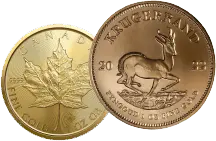
Dealers don’t pay full spot. They need a margin to stay in business. For common bullion coins like the Canadian Maple Leaf or Gold Kangaroo, you can typically expect an offer in the range of 95-98% of spot, depending on the dealer and market conditions. That’s a very efficient transaction.
ℹ️ Info: A coin’s “melt value” is the raw dollar value of its gold content at spot price. Most bullion coins sell close to this number because buyers can easily resell them.
There’s a second category worth knowing: numismatic coins. These are rare, historically significant, or collector-grade coins that carry value beyond their gold content. A rare date, a mint error, or a high grade from a third-party grading service like NGC can push a coin’s value well above spot. Understanding what drives coin value is especially important if you think you might have something collectible rather than just bullion.
Common Gold Bullion Coins and Their Purity
Coin
Issuing Mint
Gold Purity
Standard Weight
American Gold Eagle
U.S. Mint
.9167 (22K)
1 oz, 1/2 oz, 1/4 oz, 1/10 oz
Canadian Gold Maple Leaf
Royal Canadian Mint
.9999 (24K)
1 oz, 1/2 oz, 1/4 oz, 1/10 oz
South African Krugerrand
South African Mint
.9167 (22K)
1 oz
Australian Gold Kangaroo
Perth Mint
.9999 (24K)
1 oz, 1/2 oz, 1/4 oz, 1/10 oz
How Gold Jewelry Valuation Works
Jewelry valuation is more involved. The buyer needs to determine the actual gold content first, which means identifying the karat stamp and weighing the piece.
Karat tells you the gold concentration. 24K is pure gold (99.9%). 18K is 75% gold. 14K is 58.3% gold. 10K is 41.7% gold. Most jewelry sold in the United States is 14K or 18K.
Once the buyer knows the karat and weight, they can calculate the melt value – the theoretical value if the piece were melted down. But here’s the catch: the buyer rarely pays you the full melt value for jewelry. They’re going to refine it or resell it, and that process costs money. Buyers typically offer less than spot to cover those costs.
Beyond the gold content, other factors affect what a jewelry buyer will pay:
Condition – Broken clasps, missing stones, and heavy wear reduce value.
Design and style – A timeless, wearable piece may command more than a dated or unusual one.
Brand or designer – Pieces from recognized luxury brands may sell for more through specialty channels.
Gemstones – Diamonds and precious stones are valued separately from the gold. A buyer who only pays for gold will ignore the stones entirely.
⚠️ Warning: If a buyer offers to buy your jewelry “by the gram” without asking about karat, that’s a red flag. Karat is everything when it comes to calculating what the gold is actually worth.
For a deeper look at the factors that shape what you’ll be paid, cash-for-gold value factors covers the topic in detail.
Gold Coin Valuation vs Jewelry: A Direct Comparison
Gold Coins vs. Jewelry When Selling
Pros
✓ Coins: Priced close to spot – minimal guesswork
✓ Coins: High liquidity – easy to sell quickly
✓ Coins: Standardized weight and purity – no testing needed
✓ Coins: Numismatic value possible – can exceed melt value significantly
✓ Jewelry: Designer pieces may fetch more through specialty resale
✓ Jewelry: Gemstones add value that a coin doesn’t have
Cons
✗ Coins: No design premium – beauty doesn’t add value for bullion
✗ Jewelry: Buyers pay less than melt value to cover refining costs
✗ Jewelry: Condition, style, and market trends all affect the offer
✗ Jewelry: Slower to sell – more variables to assess
The Spot Price Connection
Both gold coins and jewelry ultimately trace back to the spot price of gold. That number – $3,982 per ounce at the time of writing – is the anchor for every offer you’ll receive.
For coins, the offer is a direct percentage of that number. For jewelry, it’s more indirect. The buyer calculates the melt value based on karat and weight, then adjusts downward for their costs and margin.
This is why gold coins are considered more “liquid” than jewelry. You can walk into a reputable dealer, get a quote, and complete the transaction the same day. Jewelry takes longer because the assessment takes longer.
How a Dealer Values Your Gold
1
Step 1 – Identify the item Is it a coin, bar, or jewelry? Coins and bars are checked against known specs. Jewelry requires testing.
2
Step 2 – Determine gold content Coins have stamped purity. Jewelry is tested via XRF analysis or acid testing to confirm karat.
3
Step 3 – Weigh the item Weight is measured in troy ounces (coins) or grams (jewelry).
4
Step 4 – Calculate melt value Gold content x current spot price = melt value.
5
Step 5 – Apply dealer margin Dealer subtracts their margin to arrive at the offer price.
6
Step 6 – Present offer You accept, negotiate, or decline.
Common Mistakes Sellers Make
Sellers often assume all gold is valued the same way. That assumption costs money. Here are the mistakes that come up most often.
Treating jewelry like bullion. A 14K gold bracelet is not worth the same as a one-ounce bullion coin, even if they weigh the same. The coin is 91.67% or 99.99% pure. The bracelet is 58.3% pure. The math is very different.
Ignoring numismatic potential. Some coins are worth far more than their gold content. If you have old coins – pre-1933 U.S. gold, foreign gold coins from the 19th century, or anything that looks rare – get them assessed before selling them as scrap. Selling a numismatic coin for melt value is one of the costliest mistakes a seller can make.
Selling designer jewelry to a scrap buyer. A Tiffany or Cartier piece may sell for significantly more through a jewelry-specific channel than through a scrap gold buyer who only pays for the metal. Selling gold jewelry through a dealer who understands both the metal and the piece gives you more options.
Not knowing the current spot price. Walk in knowing what gold is trading at. It takes 30 seconds to look up. If a buyer’s offer seems far below what you’d expect based on spot, ask questions.
Should You Sell Coins or Jewelry First?
If you have both, coins are generally easier to convert to cash quickly. The transaction is straightforward, the pricing is transparent, and reputable dealers move fast.
Jewelry takes more time to assess, and the range of offers can vary more widely. That doesn’t mean jewelry isn’t worth selling – it absolutely is. It just means you should be prepared for a more involved process and potentially more variation between offers.
A little preparation makes a real difference in the outcome.
For gold coins: Know the coin’s name, year, and mint mark. Look up whether it’s a bullion coin or a potentially collectible date. Check the current spot price so you have a baseline.
For jewelry: Find the karat stamp – usually inside a ring band or on a clasp. Weigh the piece if you can. Note any gemstones and whether they appear to be real. Clean the piece gently so the stamp is visible.
For both: Get at least two offers before accepting. Reputable dealers welcome the comparison.
Understand the difference between melt value and offer price. Melt value is the theoretical maximum. The offer will be below that – and that’s normal. What matters is how close the offer is to melt.
💡 Tip: If your coin has any unusual features – a different date, a mintmark you don’t recognize, or signs of being proof or uncirculated – have it looked at by a specialist before selling it as bullion. Rare coins can be worth multiples of their melt value.
Selling to Accurate Precious Metals
Accurate Precious Metals has been buying gold – coins, bullion, and jewelry – since 2012. With more than 1,000 five-star reviews and a reputation built on fair, competitive offers, we’re one of the most trusted precious metals dealers in the country.
We’re not a pawn shop. We’re a specialized precious metals dealer, which means our buyers know the difference between a common bullion coin and a potentially collectible one. We assess jewelry carefully, and we use XRF analysis to verify metal content accurately. You get a fair offer based on current spot prices – no guesswork, no pressure.
If you’re in the Salem, Oregon area, come see us in person. Our team can evaluate your coins and jewelry on the spot and give you a same-day offer.
If you’re anywhere else in the United States, our mail-in service makes it easy. We provide a free insured shipping kit, evaluate your items with care, and pay quickly. You can sell my gold from anywhere in the country without leaving your home.
Whether you’re selling a single coin or a collection of jewelry, we handle it all – gold, silver, platinum, palladium, diamonds, and more. Reach us at (503) 400-5608 or visit AccuratePMR.com to get started.
Frequently Asked Questions
Why do gold coins sell for more than gold jewelry of the same weight?
Gold coins are typically higher purity than jewelry. A 14K gold piece is only 58.3% gold, while a bullion coin is often 91.67% to 99.99% pure. The coin also has no refining costs for the buyer, so the offer is closer to spot.
Can jewelry ever be worth more than its gold content?
Yes. Designer pieces, antique jewelry, or items with high-quality gemstones can sell for more than their melt value through the right channel. A specialist dealer or auction house may get you more than a scrap buyer.
How do I know if my coin is bullion or numismatic?
Bullion coins are modern, mass-produced investment coins like the American Gold Eagle or Maple Leaf. Numismatic coins are older, rare, or graded collector pieces. If you're unsure, have a specialist look before you sell.
What is the melt value of a 1 oz gold coin at today's prices?
At the time of writing, gold is approximately $3,982 per ounce. A .9999 fine 1 oz coin has a melt value close to that number. A .9167 fine coin (like the American Eagle) has a melt value of about $3,652.
Does Accurate Precious Metals buy both coins and jewelry?
Yes. We buy gold coins, bullion, jewelry in any condition, scrap gold, and much more. Local customers can visit us in Salem, Oregon. Customers anywhere in the U.S. can use our mail-in service.
What karat is most common for gold jewelry sold in the U.S.?
14K (58.3% gold) is the most common karat for jewelry in the United States. 18K (75% gold) is also widely used, especially in higher-end pieces.
Make the smart choice — invest with Accurate Precious Metals
Whether you are buying bullion for the first time or adding to a long-term position, our team offers expert guidance, transparent pricing, and a reliable buyback program.