This content is for educational purposes only and is not financial or investment advice. Precious metals prices fluctuate; past performance does not guarantee future results. Consult a qualified professional before making investment decisions.
Tap the image to enlarge and zoom.Hover to magnify, or click to open full screen.
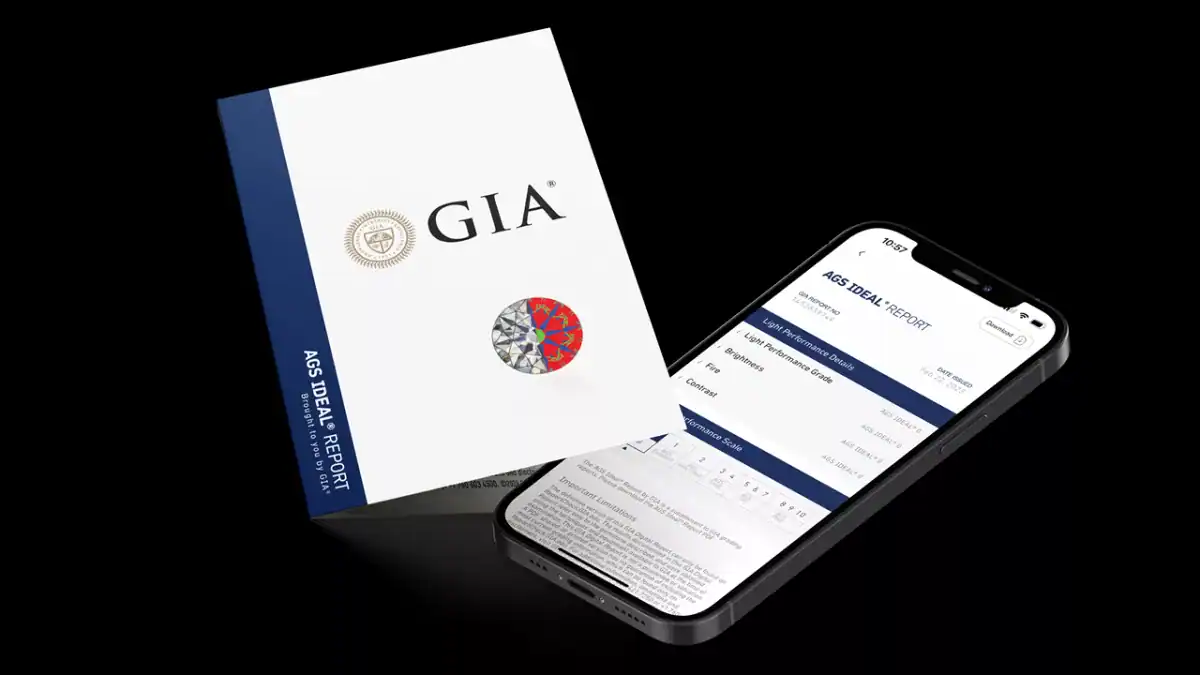
Understanding GIA AGS reports jewelry selling is one of the most practical things you can do before putting a diamond or diamond jewelry up for sale. These reports are not just paperwork – they are the primary tool buyers and dealers use to judge quality, reduce risk, and decide what to offer. Knowing what these documents do, what they do not do, and how to present them correctly can make a real difference in your sale outcome.
That said, a report does not set a price in stone. The grading document supports your asking price, but the final number still depends on market demand, the stone’s condition, and who is buying. This guide breaks down everything a seller should understand before walking in the door or sending in diamond jewelry for an offer.
What GIA and AGS Actually Are
The Gemological Institute of America, known as GIA, is a nonprofit research and education organization that created the 4Cs grading system – cut, color, clarity, and carat weight – that the entire diamond industry now uses worldwide. GIA reports are recognized by buyers and dealers globally, which makes them the most widely accepted form of third-party diamond documentation available.
AGS, the American Gem Society, built its reputation on a different strength: technical cut grading and light-performance evaluation. While GIA standardized diamond language, AGS developed detailed systems for measuring how a diamond actually performs visually – its brilliance, fire, and contrast. That kind of analysis appealed to buyers who wanted more than a grade on paper.
The two organizations have different histories and grading philosophies, but both earned strong reputations. In 2023 and 2024, GIA began integrating AGS light-performance technology into its own offerings, introducing the AGS Ideal Report by GIA. AGS is no longer operating as a separate mainstream grading lab in the same way it once did, but its influence now lives inside GIA’s expanded reporting options. For sellers, this means buyers may increasingly ask for light-performance evidence on top of a standard GIA report, especially for round brilliant diamonds.
Why a Grading Report Matters When You Sell
When you sell a diamond, the buyer cannot simply take your word for the quality. A report from a respected lab like GIA solves that problem. It tells the buyer that an independent, qualified third party examined the stone and recorded its characteristics. That removes a layer of uncertainty and builds trust in the transaction.
Reports also make your stone easier to compare. Because GIA’s grading language is standardized across the industry, a buyer can look at your stone’s specs and immediately understand how it sits relative to other diamonds on the market. That comparability is valuable – it speeds up the decision process and reduces back-and-forth.
Well-documented stones also tend to sell more easily than undocumented ones. When a buyer can verify the report number against the lab’s records and confirm the paper matches the stone, the perceived risk drops. Lower risk usually means a more confident offer.
A standard GIA grading report records the stone’s key identity and quality details. Expect to see carat weight, color grade, clarity grade, cut grade, measurements, polish, symmetry, and fluorescence. For diamonds with the AGS Ideal designation, there will also be light-performance data showing how the stone handles incoming light.
The most important function of a report for sellers is that it ties the physical stone to a documented profile. The report number, the measurements, and the plotted clarity characteristics should all match the exact diamond you are selling. This connection is what prevents confusion – or fraud – during the transaction.
What a GIA Report Typically Covers
1
Shape and cutting style The diamond’s form, such as round brilliant or princess cut
2
Measurements Precise dimensions in millimeters
3
Carat weight The weight of the stone to two decimal places
4
Color grade Rated on a D-to-Z scale from colorless to light yellow
5
Clarity grade Rated from Flawless to Included based on internal and surface characteristics
6
Cut grade Ranges from Excellent to Poor for round brilliants
7
Polish and symmetry Separate grades for surface finish and facet alignment
8
Fluorescence Notes whether the stone glows under UV light and how strongly
9
Report number A unique identifier that can be verified with the issuing lab
How Reports Affect Pricing in a Real Sale
The biggest mistake sellers make is assuming that a GIA or AGS report automatically produces a high resale price. It does not work that way. A report supports pricing – it does not create it.
The resale market discounts for several factors that a report cannot change. Seller type matters: a private individual selling a diamond will typically receive less than a dealer selling the same stone, because buyers price in the cost of their own risk and resale margin. The channel matters too. Retail jewelry pricing and wholesale buying prices are very different numbers, and most buyers operate closer to the wholesale side.
Whether the stone is loose or mounted also affects the offer. Loose diamonds with strong GIA documentation are generally easier to price and sell than stones mounted in older settings, because the grading is easier to verify and the buyer does not have to account for the setting’s value or condition separately. Mounted jewelry trades more like a finished retail product – the setting, brand, and style all factor in alongside the diamond itself.
Cut quality tends to draw the most buyer attention in pricing discussions. A well-cut stone with strong light performance will typically attract more interest than a stone with a mediocre cut grade, even if the carat weight and color are identical. This is where AGS-style light-performance data can genuinely add value to a sale.
ℹ️ Info: A grading report is an opinion of quality from a qualified lab. It is not a promise of what any buyer will pay. Market demand, stone condition, and the specific buyer all influence the final offer independently of what the report says.
GIA AGS Reports and the Metal in Your Jewelry
If your piece is gold, silver, or platinum jewelry with a diamond, the report matters primarily for the diamond portion. The metal content is priced differently – based on weight, purity, and current spot prices rather than gem documentation.
At the time of writing, gold is trading at about $4,085 per ounce, silver at $64 per ounce, platinum at $1,653 per ounce, and palladium at $1,222 per ounce. These spot prices set the floor for the metal value in any piece, regardless of what the diamond report says.
For pieces sold primarily as scrap or for melt value, the relevant question is the metal’s purity and weight, not the gem report. A diamond report can still increase the overall saleability of a piece if the center stone is significant, but it does not change what the metal is worth on a melt basis. The two values – gem and metal – are evaluated separately and then considered together in a complete offer.
Practical Steps Before You Sell
Getting your documentation in order before approaching a buyer saves time and often produces a better offer. Here is what sellers should do:
Match the report to the stone. The report number, measurements, and plotted details must correspond exactly to the diamond you are presenting. Mismatches raise red flags immediately.
Check for tampering. Altered or mismatched documents are a known issue in the secondary diamond market. If your report looks altered in any way, be prepared for buyers to question it.
Verify the report number. Confirm the report number with the issuing lab before the sale if possible. GIA’s report check tool is publicly accessible online.
Keep original paperwork together. The original report, any receipts, and prior appraisals all help the process, especially for higher-value pieces.
Understand the difference between a report and an appraisal. A grading report describes quality. An appraisal estimates value for a specific purpose, such as insurance or estate settlement. They are not the same document and serve different functions.
Do not assume older reports are worthless. Older reports can still be useful, but buyers may want current verification if the stone has been recut, reset, or shows signs of damage.
Common Misconceptions Sellers Should Drop
Several beliefs about diamond reports cause sellers to approach the process with the wrong expectations. Clearing these up early leads to smoother transactions.
“GIA and AGS are the same thing.” They are not. Both are highly respected, but they have different grading philosophies and histories. GIA is the broader industry standard; AGS built its name on technical cut and light-performance analysis. The recent AGS Ideal Report by GIA blends both approaches, but the organizations themselves were distinct.
“Any report means a higher sale price.” Market demand, stone quality, and condition still control the final number. A report helps, but it is not a value multiplier on its own.
“A report is the same as an appraisal.” Grading reports describe characteristics. Appraisals estimate monetary value for a stated purpose. A jeweler who writes an insurance appraisal is doing a different job than a GIA gemologist grading a stone.
“Older reports are useless.” Not automatically. An older GIA report can still carry weight if the stone matches and has not been altered. Buyers may want updated verification in some cases, but the original document still provides useful baseline information.
“Only the diamond matters.” For gold and silver jewelry, the metal content, craftsmanship, and maker can outweigh the gem report in some transactions. A piece with a modest diamond in a high-karat gold setting may sell largely on metal value rather than gem quality.
When GIA AGS Reports Matter Most in a Sale
Not every sale situation calls for the same emphasis on documentation. Reports carry the most weight in specific scenarios.
When Diamond Reports Matter Most
Pros
✓ High-value loose diamonds where the buyer needs independent verification
✓ Engagement rings where the center stone is a significant portion of the value
✓ Fancy-color or unusually important stones where grading affects price substantially
✓ Estate jewelry with a notable diamond center stone
✓ Remote or mail-in sales where the buyer cannot inspect the stone in person
Cons
✗ Simple gold or silver scrap sold primarily for metal content
✗ Broken jewelry where the gem is damaged or missing
✗ Low-value accent stones that are not the primary value driver
✗ Fashion jewelry where the center gem is not a major contributor to value
For selling diamond rings online or through a mail-in service, the report becomes especially important because the buyer is making an offer without handling the stone directly. A verified GIA report reduces the uncertainty on both sides and typically leads to a faster, more confident transaction.
What Changed Recently With AGS and GIA
The grading market shifted in 2023 and 2024 in ways that sellers should be aware of. GIA introduced the AGS Ideal Report by GIA, a digital supplement tied to certain GIA diamond reports that uses AGS light-performance technology. GIA also offered printed AGS Ideal Reports during a limited 2024 promotion, signaling that light-performance documentation is becoming a mainstream expectation rather than a specialty feature.
For sellers, this shift means buyers are increasingly asking not just whether a stone has a GIA report, but whether it demonstrates strong light performance. Round brilliants and other supported shapes are most affected. If your stone has an older GIA report without light-performance data, a buyer may still make a strong offer, but they may also ask questions about cut quality that the original report does not fully answer.
Staying aware of these changes helps you understand what buyers are looking for and how to present your documentation in the most useful way. A deeper look at how grading reports affect diamond sale prices can help you frame expectations before you approach any buyer.
Selling Your Diamond or Diamond Jewelry With Accurate Precious Metals
Accurate Precious Metals has been buying diamonds and precious metal jewelry since 2012, and the company has earned more than 1,000 five-star reviews from customers across the country. The team evaluates diamonds and jewelry based on current market conditions, and the process is designed to be straightforward whether you are selling a loose stone, an engagement ring, or an estate piece with a GIA report attached.
If you are local to Salem, Oregon, you can bring your piece in person. The team will review your documentation, examine the stone, and provide a competitive offer based on current market pricing. There is no obligation, and the process is efficient.
If you are anywhere else in the United States, the mail-in service makes the process just as accessible. You can sell my diamonds through a secure, insured shipping kit that protects your piece in transit. Once received, the team evaluates the stone and metal content, checks any grading documentation you include, and provides a fast offer. Payment follows quickly after acceptance.
Accurate Precious Metals is not a pawn shop. The company is a specialized precious metals and diamond dealer, which means offers are based on actual gem and metal market values rather than a generalist’s estimate. Whether your piece has a GIA report, an AGS Ideal designation, or no documentation at all, the team has the experience to evaluate it properly and make a fair offer.
Call (503) 400-5608 or visit AccuratePMR.com to start the process. Local customers are welcome to walk in at the Salem, Oregon location. Everyone else can use the mail-in service from anywhere in the US – it is free, insured, and straightforward.
Frequently Asked Questions
Does having a GIA report guarantee a higher offer when I sell my diamond?
A GIA report supports pricing and builds buyer confidence, but it does not set a fixed resale value. Market demand, stone condition, and the specific buyer all influence the final offer.
What is the difference between a GIA report and an AGS report?
GIA reports are the industry-standard document covering the 4Cs and other quality characteristics. AGS reports focused more heavily on cut quality and light-performance analysis. Since 2023, GIA has integrated AGS-style light-performance technology into its own offerings through the AGS Ideal Report by GIA.
Can I sell a diamond without a grading report?
Yes. Buyers will evaluate the stone on its own merits, but undocumented stones typically take longer to sell and may receive more conservative offers because there is more uncertainty for the buyer.
What is the difference between a grading report and an appraisal?
A grading report describes the physical characteristics of a diamond – color, clarity, cut, carat weight. An appraisal estimates the monetary value of a piece for a specific purpose, such as insurance or estate settlement. They serve different functions and are not interchangeable.
Does the metal in my jewelry affect the offer separately from the diamond?
Yes. The metal content is evaluated based on weight, purity, and current spot prices. At the time of writing, gold is about $4,085 per ounce and platinum is about $1,653 per ounce. The gem value and metal value are assessed separately and combined into a total offer.
How do I sell my diamond jewelry through Accurate Precious Metals if I am not near Salem, Oregon?
Use the mail-in service at AccuratePMR.com. The kit includes free insured shipping. Send your piece along with any grading documentation, and the team will evaluate it and provide a fast offer.
Are older GIA or AGS reports still accepted by buyers?
Generally yes, though buyers may want updated verification if the stone has been altered, recut, or shows damage. The original report still provides useful baseline information in most cases.
Make the smart choice — invest with Accurate Precious Metals
Whether you are buying bullion for the first time or adding to a long-term position, our team offers expert guidance, transparent pricing, and a reliable buyback program.