This content is for educational purposes only and is not financial or investment advice. Precious metals prices fluctuate; past performance does not guarantee future results. Consult a qualified professional before making investment decisions.
Tap the image to enlarge and zoom.Hover to magnify, or click to open full screen.
Finding the best place to sell gold is the single most important decision you will make before handing over your metal – and the difference between a good deal and a bad one can easily exceed $700 per ounce at current prices. Whether you are holding a 1 oz gold bar, a handful of old jewelry, or a stack of coins you inherited, the buyer you choose determines how much money ends up in your pocket.
Gold is trading at $4,127 per ounce at the time of writing. That number is your benchmark. Every offer you receive should be evaluated against it. This guide breaks down exactly where to sell, what to expect from each type of buyer, and how to avoid leaving serious money on the table.
Before you walk into any buyer’s office, you need to understand one number: the spot price. Spot price is the real-time market value of one troy ounce of pure gold. At the time of writing, that is $4,127/oz.
No buyer pays you the full spot price. That is not a scam – it is just how the market works. Buyers have overhead: refining costs, shipping, insurance, and their own profit margin. What separates a fair deal from a bad one is how close to spot the offer lands.
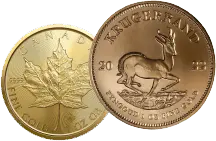
For investment-grade bullion like a 2025 Gold Eagle or a Gold Maple Leaf, a fair offer runs 97-99% of spot. At today’s prices, that means roughly $4,003 to $4,085 per ounce. A pawn shop offering 80% of spot pays you only about $3,301 – a difference of more than $700 per ounce on the same metal. On a five-ounce stack, that gap becomes $3,500 in lost value.
$700+
Lost per oz at 80% vs. 99% of spot (at time of writing)
$4,127
Gold spot price per oz at time of writing
97-99%
Fair payout range for investment bullion
How Gold Buying Has Changed Over Time
Understanding where the industry came from helps you spot bad actors today.
The Evolution of Gold Buying
Ancient-1800s
Jewelers and mint officials Sellers brought gold to craftsmen or government mints, who weighed and tested it on the spot
1870s-1970s
The Gold Standard era Gold coins circulated as money. Banks exchanged them at fixed face value tied to the metal content
1970s
End of the Gold Standard The U.S. decoupled the dollar from gold. Gold became a commodity with a floating daily price – the modern bullion market was born
2008-2015
The “Cash for Gold” boom Financial crisis drove millions to sell. Predatory mail-in services flooded TV ads, often paying only 60-70% of spot while hiding fees
2020s
The transparent dealer era Reputable dealers now publish buyback rates online. Sellers can compare offers in minutes without leaving home
The lesson from that history: marketing language like “top dollar” or “best prices in town” means nothing without a percentage. Always ask for the number.
Not All Gold Is Valued the Same
The type of gold you are selling determines where you should sell it. A rare numismatic coin and a broken 10-karat bracelet are completely different transactions.
Type
Description
Typical Payout
Best Buyer
Bullion Coins & Bars
Pure gold (.999+), made for investment
97-99% of spot (~$4,003-$4,085/oz at time of writing)
One detail that catches sellers off guard: karat matters enormously. A 10-karat piece is only 41.7% gold. An 18-karat piece is 75% gold. A buyer who quotes you a “gold price” without confirming the karat is either making an error or taking advantage of you. Know your karat before you walk in the door.
For more on what your gold jewelry is actually worth, the best place to sell gold jewelry guide covers the valuation process in detail.
The Best Place to Sell Gold: A Ranked Breakdown
Not every buyer is equal. Here is how the main options stack up, from highest payout to lowest.
Reputable Specialized Dealers (Top Tier)
Specialized precious metals dealers – not pawn shops, not general jewelers – consistently offer the strongest payouts. They have the volume, the equipment, and the expertise to assess your metal accurately. For recognized bullion coins, payouts in the 97-99% of spot range are standard.
The key is finding a dealer who is transparent about their offers and has a verifiable track record. Look for published buyback rates, years in business, and customer reviews you can actually read. A dealer with over a thousand five-star reviews and more than a decade of operation is a fundamentally different business than a pop-up “we buy gold” kiosk.
Local Coin Shops (High Tier)
Local coin shops are strong for both bullion and numismatic pieces. For a recognized coin like a Gold Kangaroo or a classic American Eagle, a good coin shop pays close to spot. For rare or collectible coins, they may pay above melt value because they understand what the collector market will bear.
Strategy: call at least three shops before visiting. Ask specifically, “What percentage of spot do you pay for a 1-ounce gold coin?” That single question tells you everything. Shops that hedge or refuse to answer are not worth your time.
Jewelry Stores (Mid Tier)
Jewelry stores buy gold primarily to melt it down for new pieces. Their offers are workable but tend to run lower than specialized dealers. Watch for processing fees that get deducted after the initial quote – always ask for the net amount you walk away with, not the gross offer.
Pawn Shops (Low Tier)
Pawn shops are fast. That is their only real advantage. They need quick inventory and low risk, which means their offers reflect that. Payouts for jewelry and scrap at pawn shops frequently land well below what a dedicated dealer offers. Use a pawn shop only if you need cash the same hour and have no other option.
Mail-In “Cash for Gold” Services (Danger Zone)
The TV-advertised mail-in gold services that boomed during the 2008 financial crisis are still operating. Many pay 60-70% of spot and bury refining fees in the fine print. Red flags: no published buyback rate, no insured return shipping, no clear timeline for payment. If a service asks you to ship your gold uninsured, stop there.
This is different from a reputable dealer’s mail-in program, which uses insured shipping, provides a clear offer before you commit, and has a verifiable business history behind it.
⚠️ Warning: Avoid any buyer who will not give you a percentage of spot before you ship. “We’ll tell you after we receive it” is not acceptable.
The Best Place to Sell Gold Online
Selling gold online sounds risky, but with the right dealer it is often the safest and most profitable option – especially if you live far from a quality coin shop. The best place to sell gold online is a dealer with insured shipping, a clear offer process, and documented reviews from real customers.
Here is what a trustworthy online selling process looks like:
How a Legitimate Mail-In Gold Sale Works
1
Step 1 – Request a Kit Contact the dealer and request a prepaid, insured shipping kit. You should pay nothing out of pocket to send your metal.
2
Step 2 – Pack and Ship Use the provided packaging. Keep your own record of what you are sending (photos, weights, descriptions).
3
Step 3 – Receive an Offer The dealer inspects your metal and provides a firm offer. You have the right to accept or decline.
4
Step 4 – Get Paid If you accept, payment goes out promptly – check, wire, or other agreed method. If you decline, your metal is returned.
The critical difference between a legitimate program and a predatory one: you can say no. A fair dealer returns your gold if you reject the offer. A predatory one makes it difficult or expensive to get your items back.
Accurate Precious Metals runs exactly this kind of program. Sellers anywhere in the United States can use the mail-in jewelry and gold service – insured shipping is included, and there is no obligation to accept the offer. Local sellers in Oregon are also welcome to bring items directly to the Salem location for an in-person assessment.
Six Steps to Get the Best Payout
Check the spot price before you go. At the time of writing, gold is at $4,127/oz. Prices move every minute, so check on the day you plan to sell.
Know your karat and weight. A basic digital scale and a quick look at any hallmarks on your piece gives you the baseline math. If you know a piece is 14k and weighs 15 grams, you can immediately evaluate whether an offer is fair.
Get at least three quotes. Contact multiple buyers on the same day so all quotes reflect the same market price. One quote is never enough.
Ask for the percentage, not just the dollar amount. “What percentage of spot are you paying?” is a cleaner comparison than raw dollar figures, which change with the market.
Ask about net payout. Some buyers advertise a high percentage but then deduct refining fees, processing charges, or assay costs. The number that matters is what you actually receive.
Keep original packaging for bullion. Mint-sealed tubes, original certificates, and intact packaging can increase the offer on bullion coins and bars. Do not throw them away before selling.
For a deeper look at the selling process and what to expect locally, the sell your gold guide walks through each stage in plain terms.
Common Misconceptions That Cost Sellers Money
“I will get the full spot price.” No buyer pays 100% of spot. Even the best dealers in the country pay 97-99% for recognized bullion. Anyone promising the full spot price is either mistaken or misleading you.
“Pawn shops are fine for quick cash.” They are fast, but the cost of that speed is real. Choosing a pawn shop over a specialized dealer can mean losing 20% or more of your metal’s value. On a single ounce at today’s prices, that is potentially $800 gone.
“All gold jewelry is pure gold.” It is not. Most jewelry runs 10k, 14k, or 18k – meaning 41.7%, 58.3%, or 75% gold respectively. A buyer treating your 10k bracelet as pure gold and paying you accordingly is either making a serious error or running a scam.
“Online dealers are risky.” Reputable online dealers with insured shipping programs, published reviews, and transparent processes are often safer than handing your gold to a stranger across a counter. The key word is reputable – verify before you ship.
“Gold parties are a convenient option.” They are convenient, but the overhead of running a party event means lower payouts for sellers. A dedicated dealer will consistently outperform a gold party.
ℹ️ Info: If you have numismatic coins – pieces valued for rarity, not just metal content – a coin dealer or auction house is almost always the right move. Selling a rare coin for melt value is like selling a signed first edition for the price of paper.
Selling Jewelry, Scrap, and Dental Gold
Jewelry, broken pieces, and dental gold all fall into a category where the metal content needs to be assessed before a price can be set. The process involves evaluating the karat, weighing the piece, and accounting for any non-gold components like stones or settings.
Accurate Precious Metals buys all of it – broken jewelry, intact pieces, dental scrap, silverware, and more. Offers are competitive and based on current spot prices. Local customers in Salem, Oregon can bring items in for a same-day evaluation. Sellers outside Oregon can use the mail-in gold program, which includes free insured shipping and a GIA-certified appraisal process.
Accurate Precious Metals has been buying and selling precious metals since 2012. With more than 1,000 five-star customer reviews and a physical location in Salem, Oregon, it operates as a full-service precious metals dealer – not a pawn shop, not a kiosk, and not a mail-in service with no face behind it.
What sets Accurate Precious Metals apart:
Nationwide reach. The mail-in program serves sellers across the entire United States with insured shipping included.
Breadth of inventory. Accurate PMR buys gold, silver, platinum, palladium, diamonds, jewelry, coins, bars, and bullion – in any condition.
IRA services. For sellers looking to reinvest proceeds into a Gold or Silver IRA, Accurate PMR handles the full process.
NGC Authorized Dealer status. For numismatic coins, this means grading and authentication services through one of the most respected third-party grading services in the industry.
Live pricing. Online prices update to reflect current spot prices, so you are always working from accurate numbers.
No pressure. Whether you visit in person or use the mail-in service, you receive an offer and decide whether to accept. No obligation.
Local sellers are encouraged to visit the Salem, Oregon location directly. Sellers anywhere in the U.S. can start the process online at the mail-in jewelry and gold page. Questions? Call (503) 400-5608.
The best place to sell gold is one that combines fair pricing, transparency, and a track record you can verify. Accurate Precious Metals checks every box.
Frequently Asked Questions
What is the best place to sell gold for the highest payout?
For investment bullion, a reputable specialized dealer or established coin shop consistently offers the strongest payouts – typically 97-99% of the current spot price. At the time of writing, gold spot is $4,127/oz, putting a fair bullion offer between roughly $4,003 and $4,085 per ounce. Accurate Precious Metals offers competitive pricing for both local and mail-in sellers nationwide.
How do I know if a gold buyer is legitimate?
Look for verifiable customer reviews, a physical business address, published buyback rates or a clear offer process, insured shipping for mail-in programs, and years in operation. Avoid any buyer who refuses to give you a percentage of spot before you hand over your metal.
Will I get the full spot price when I sell gold?
No. No buyer pays 100% of spot – they need to cover operating costs and margin. A fair offer for recognized bullion runs 97-99% of spot. Anything below 90% for bullion is worth questioning.
Is it safe to sell gold through a mail-in service?
Yes, if the service uses insured shipping, provides a firm offer before you commit, and has a clear return policy if you decline. Accurate Precious Metals' mail-in program includes all of these protections.
Does karat matter when selling gold jewelry?
Absolutely. A 10-karat piece is only 41.7% pure gold. An 18-karat piece is 75% pure. The payout is calculated on the actual gold content, not the total weight of the piece. Know your karat before you get a quote.
Can I sell gold if I am not in Oregon?
Yes. Accurate Precious Metals ships nationwide. Sellers outside Salem can use the mail-in program – free insured shipping is included, and you receive an offer before any transaction is finalized.
What types of gold does Accurate Precious Metals buy?
Everything – gold bullion coins and bars, gold jewelry (broken or intact), scrap gold, dental gold, numismatic coins, and more. Silver, platinum, palladium, diamonds, and silverware are also accepted.
How long does the mail-in process take?
Timelines vary, but most sellers receive an offer within a few business days of the dealer receiving their shipment. Payment follows promptly upon acceptance.
Make the smart choice — invest with Accurate Precious Metals
Whether you are buying bullion for the first time or adding to a long-term position, our team offers expert guidance, transparent pricing, and a reliable buyback program.