This content is for educational purposes only and is not financial or investment advice. Precious metals prices fluctuate; past performance does not guarantee future results. Consult a qualified professional before making investment decisions.
Tap the image to enlarge and zoom.Hover to magnify, or click to open full screen.
Understanding bar vs coin premiums is one of the most practical skills a precious metals buyer can develop – and most new collectors skip it entirely. When gold is trading at $4,034 per ounce at the time of writing, the coin on the dealer’s shelf might be priced at $4,275. That gap is not a markup scheme. It is a premium, and knowing how it works tells you exactly what you are paying for and whether it is worth it.
This guide breaks down how premiums form, why bars and coins carry different ones, and how to use that knowledge to make smarter buying decisions – whether you are stacking silver for the long haul or adding a classic gold coin to your collection.
Every physical precious metals purchase has two components: the spot price and the premium. Spot is the live market price for raw metal – gold at $4,034/oz, silver at $60/oz, platinum at $1,594/oz, and palladium at $1,187/oz at the time of writing. The premium is everything added on top of that.
A premium exists because raw metal is not a finished product. Before a 1 oz gold bar or coin reaches your hand, someone has refined the metal to .999 or .9999 fineness, poured or pressed it into a precise shape, stamped it with weight and purity markings, packed it securely, insured it during shipping, and sold it through a dealer who needs to cover operating costs. Each of those steps has a real dollar cost. The premium is simply the sum of those costs plus the dealer’s margin.
ℹ️ Info: The formula is straightforward: **Total Price = Spot Price + Premium**. The premium is usually expressed as a percentage of spot or as a flat dollar amount per ounce.
Bar vs Coin Premiums: The Core Difference
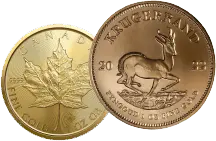
Both a 1 oz gold bar and a 1 oz [American Gold Eagle] contain one troy ounce of gold. The coin costs more. That is the bar vs coin premium gap in action, and it comes down to three factors.
Manufacturing Complexity
A gold bar is a rectangle with a stamped logo. The production process is efficient and automated. A coin is a different story. The U.S. Mint, Royal Canadian Mint, Perth Mint, and other sovereign mints use high-pressure presses and hand-finished dies to create raised designs, reeded edges, and fine detail. The [Canadian Maple Leaf], the [Gold Britannia], the [American Buffalo] – each requires skilled labor and expensive tooling that a plain bar does not. That cost flows directly into the premium.
Mint Prestige and Collector Demand
A bar from a reputable refinery like PAMP Suisse or Valcambi is worth exactly its metal weight. It has no story. A sovereign coin carries government backing, a recognized design, and in many cases, legal tender status. Collectors and investors worldwide recognize the Gold Kangaroo or the Gold Eagle on sight, which creates demand that goes beyond pure metal value. When demand exceeds supply – as it often does during periods of market stress – premiums on coins rise faster than premiums on bars.
Liquidity
Coins are easier to sell quickly. A local coin shop, a private buyer, or an online dealer will immediately recognize a Gold Eagle or a Maple Leaf. A generic bar requires more due diligence from the buyer. Because dealers know coins move faster, they price that liquidity into the premium at purchase. You pay more going in, but you also tend to get more going out.
Real Numbers: What the Premium Gap Costs You
Let’s put actual dollar figures on the difference using current spot prices.
Metal / Product
Typical Premium %
Approx. Price at Current Spot
Gold Bar (1 oz .9999)
3-4%
~$4,155 to $4,194
Gold Coin (1 oz, e.g. Eagle)
4-6%
~$4,195 to $4,276
Silver Bar (1 oz .999)
3-5%
~$61.80 to $63.00
Silver Coin (1 oz, e.g. Morgan)
15-25%
~$69.00 to $75.00
Fractional Gold Bar (1/4 oz)
10-15%
~$1,109 to $1,163
Fractional Gold Coin (1/4 oz)
15-20%
~$1,163 to $1,206
Gold at the time of writing is $4,034/oz and silver is $60/oz. At those levels, a 1 oz gold bar might cost roughly $4,155 to $4,194, while a 1 oz gold coin runs closer to $4,195 to $4,276. That is a difference of $40 to $120 per ounce – meaningful if you are buying in quantity, but modest relative to the total price.
Silver tells a more dramatic story. The same manufacturing cost that adds $3 to a silver bar adds $15 or more to a silver coin, because the base metal is so much cheaper. A 1 oz silver bar at a 5% premium costs about $63. A 1 oz silver coin at a 20% premium costs $72. That $9 gap represents 15% of the total purchase price. Buy 100 ounces and you have paid $900 more for the same amount of silver – just for the design.
$900
Extra cost on 100 oz silver coins vs. bars (at 15% premium gap)
$81
Typical extra cost per oz, gold coin vs. bar
25%
Maximum typical silver coin premium over spot
How Fractional Sizes Amplify Premiums
Smaller products carry higher premiums per ounce, for both bars and coins. A 1/10 oz gold coin might carry a 20-25% premium, while a 1 oz coin from the same mint carries 4-6%. The reason is simple: it takes nearly as much labor to press a tiny coin as a large one, so the fixed cost per ounce goes up sharply as the size goes down.
This matters when you are comparing gold bar options to fractional coins. A 10 oz gold bar will have a lower per-ounce premium than a 1 oz bar, which will have a lower per-ounce premium than a 1/4 oz coin. If maximum metal per dollar is the goal, larger bars win every time.
Why Premiums Change Over Time
Premiums are not fixed. They move based on market conditions, and understanding that movement helps you buy at the right time.
Factors That Drive Premium Swings
1
Demand spikes During financial crises or geopolitical uncertainty, investors rush to physical metal. Mints cannot produce fast enough. Premiums on coins – especially recognizable sovereign coins – can double or triple within weeks.
2
Supply constraints If a mint pauses production of a specific coin, secondary market premiums rise because available supply shrinks while demand holds steady.
3
Metal price level When spot prices are low, manufacturing costs represent a larger share of the total price, so percentage premiums look high. When spot is elevated – as gold is right now at $4,034/oz at the time of writing – those same fixed costs represent a smaller slice, and percentage premiums compress.
4
Dealer inventory A dealer sitting on large coin inventory may discount premiums to move product. A dealer with thin stock charges more.
Bars vs Coins: Choosing the Right Format
The right choice depends on what you are trying to accomplish. There is no universal answer.
Bars vs. Coins – Quick Comparison
Pros
✓ Bars: Lower premium means more metal per dollar spent
✓ Bars: Ideal for long-term holding where liquidity speed is less critical
✓ Bars: Easier to store in bulk (uniform rectangular shapes stack efficiently)
✓ Coins: Recognized worldwide – easier to sell quickly to any buyer
✓ Coins: Sovereign backing and legal tender status add credibility
✓ Coins: Divisible – selling one coin does not require breaking a larger piece
Cons
✗ Bars: Harder to sell in small increments without cutting (which destroys value)
✗ Bars: Generic appearance means buyers may want additional verification
✗ Coins: Higher upfront cost – you pay for the art and the mint name
✗ Coins: Silver coin premiums especially high – up to 25% over spot
For buyers focused purely on accumulating metal weight, gold bars and silver bars make financial sense. For buyers who want flexibility, plan to sell in portions, or simply enjoy owning recognized sovereign pieces, gold coins are worth the extra premium.
Check out our gold bars vs. gold coins guide for a deeper look at how these two formats compare across different buyer scenarios.
The Silver Premium Problem – and How to Handle It
Silver deserves its own section because the premium dynamics are so different from gold.
At $60/oz at the time of writing, silver is affordable enough that many buyers purchase in larger quantities. But silver coin premiums – 15% to 25% – can quietly destroy the math. If you buy 500 oz of silver coins at a 20% premium, you have paid $6,000 above spot. To break even on resale, silver would need to rise enough to cover that entire premium before you see a profit.
Silver bars close that gap significantly. A 100 oz silver bar typically carries a 2-4% premium. On 500 oz of silver, that saves you roughly $9,000 to $10,800 compared to buying silver coins at a 20% premium. That is real money.
The practical rule: buy silver bars when your goal is investment. Buy silver coins when you genuinely want the design, the collectibility, or the ability to sell in small increments to private buyers who recognize the piece.
⚠️ Warning: Watch out for silver coins with premiums above 30%. That level is difficult to recover on resale unless the coin has genuine numismatic value. For insight into what makes a coin numismatically valuable versus simply bullion, see our guide on numismatic vs. bullion differences.
Clearing Up Common Misconceptions
A few myths about bar vs coin premiums circulate constantly among new buyers.
Coins are purer than bars. Not true. Most modern sovereign coins and reputable bars are both .999 or .9999 fine. Purity is not what separates them.
The premium is a scam. Also not true. Refining, minting, shipping, and insurance all cost money. The premium covers those costs and the dealer’s margin. No physical bullion product can exist without one.
Bars have no value without a design. Wrong. A bar’s value is its metal weight. That is straightforward and widely accepted by dealers worldwide.
You should always buy coins because they are worth more. Coins cost more to buy, but that does not mean they are worth more in metal terms. You are paying for the art and the mint name. Whether that extra cost is worthwhile depends entirely on your goals.
Premiums are the same across all metals. Silver premiums run far higher as a percentage than gold premiums, because the base metal price is so much lower. Platinum and palladium premiums vary based on industrial demand and mint availability.
How Accurate Precious Metals Fits In
Whether you are buying bars, coins, or both, working with a dealer who prices competitively and carries broad inventory matters. Accurate Precious Metals, based in Salem, Oregon, has been in business since 2012 and has earned more than 1,000 five-star reviews from customers across the country. The inventory spans gold, silver, platinum, and palladium in both bar and coin form – from fractional pieces to kilogram bars – alongside numismatic coins, diamonds, and jewelry.
Pricing at Accurate Precious Metals reflects live spot prices, so you are not paying yesterday’s rate on today’s purchase. For buyers outside Oregon, nationwide insured shipping makes the full inventory accessible without a trip to Salem. Gold and Silver IRA services are also available for buyers looking to hold bullion inside a retirement account.
If you are ready to sell gold coins rather than buy, Accurate Precious Metals buys across the full range – bullion bars and coins, scrap gold and silver, jewelry in any condition, silverware, and more. Local customers can bring items directly to the Salem location for an in-person evaluation. Customers anywhere in the United States can use the mail-in service – which includes free insured shipping and fast payment – to sell without leaving home.
For anyone evaluating what their current holdings might be worth, the coin dealer appraisal guide walks through what to expect from the process.
Accurate Precious Metals is not a pawn shop. It is a specialized bullion dealer with the depth of inventory and pricing discipline to serve both first-time buyers and experienced collectors. Reach the team at (503) 400-5608 or visit AccuratePMR.com.
Frequently Asked Questions
Why do silver coin premiums run so much higher than gold coin premiums?
Because silver's base price is low relative to the fixed cost of minting. At $60/oz at the time of writing, a $5 minting cost represents over 8% of the metal price. On a $4,034/oz gold coin, the same $5 is barely 0.1%. The cheaper the metal, the larger the manufacturing cost looks as a percentage.
Do higher premiums mean I will get more money when I sell?
Not automatically. Dealers buy back based on spot price and the product's recognized value. Coins from major sovereign mints (U.S. Mint, Royal Canadian Mint, Perth Mint) tend to command stronger buyback prices than generic bars, but the premium you paid on the way in is not always fully recovered on the way out.
Is it better to buy one 10 oz bar or ten 1 oz bars?
The 10 oz bar will have a lower per-ounce premium, so you get more metal for your money. The trade-off is flexibility – ten 1 oz bars let you sell in smaller increments without liquidating your entire position.
Do premiums change when spot prices spike?
Yes. During periods of high demand, mints struggle to keep up with orders, and premiums on coins especially can rise sharply. Bars tend to stay closer to spot because refinery production scales more easily than coin minting.
How do I know if a premium is reasonable?
For gold bars, 3-5% is a normal range at current prices. For gold coins, 4-8% is typical. For silver bars, 3-6% is fair. Silver coins at 15-25% are normal; anything above 30% deserves scrutiny unless the coin has numismatic value. Compare prices across a few reputable dealers before committing.
Can I sell bars and coins back to Accurate Precious Metals?
Yes. Accurate Precious Metals buys both bars and coins, along with scrap gold, silver jewelry, silverware, and more. Visit the Salem, Oregon location in person or use the mail-in service from anywhere in the United States.
Make the smart choice — invest with Accurate Precious Metals
Whether you are buying bullion for the first time or adding to a long-term position, our team offers expert guidance, transparent pricing, and a reliable buyback program.