This content is for educational purposes only and is not financial or investment advice. Precious metals prices fluctuate; past performance does not guarantee future results. Consult a qualified professional before making investment decisions.
Tap the image to enlarge and zoom.Hover to magnify, or click to open full screen.
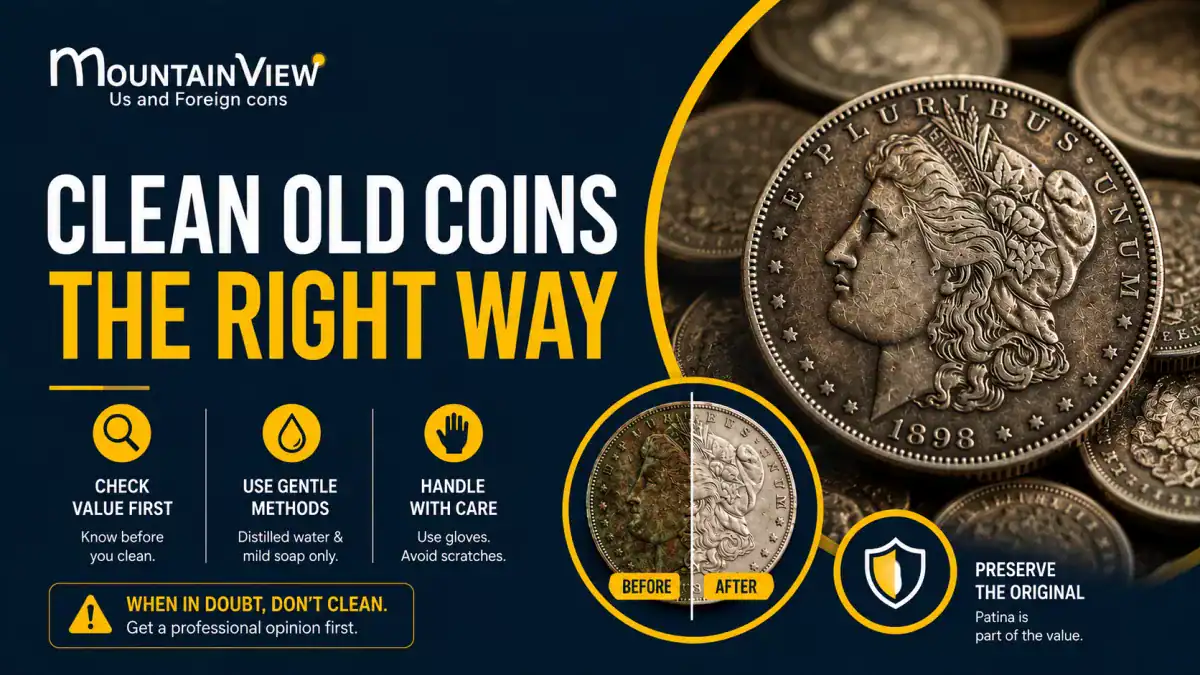
Avoiding common coin cleaning mistakes is one of the most important skills a collector can develop – because the most damaging thing you can do to a coin is often trying to make it look better. Whether you collect silver dollars, gold eagles, or ancient coppers, the wrong cleaning method can permanently reduce a coin’s value, sometimes by far more than the metal itself is worth.
This guide covers the mistakes collectors make most often, why they matter, and what to do instead. If you are on the fence about whether to clean a coin at all, read this first.
Why Cleaning Can Destroy More Value Than Dirt Ever Could
Coin value is not just about metal content. Collectors pay for original surfaces, natural luster, toning, and strike quality. Once you alter those surfaces – even with good intentions – the damage is usually permanent.
This is especially true for gold and silver coins. Gold is chemically stable but physically soft. A rough cloth or abrasive paste can scratch it easily. Silver tarnishes naturally, but that tarnish is often part of the coin’s character. Stripping it away removes something collectors actively seek.
Modern grading standards reflect this reality. Graders at services like PCGS and NGC can spot cleaned coins under magnification. A coin flagged as “cleaned” or “improperly cleaned” typically receives a details grade rather than a numeric one – and that distinction can cut resale value significantly.
The short version: a shiny coin is not a more valuable coin. In numismatics, original is almost always better than bright.
Avoiding Common Coin Cleaning Mistakes – The Full Checklist
Before getting into individual mistakes, here is a quick reference. Print it out. Tape it to your coin cabinet.
What Not to Do vs. What to Do
Pros
✓ Soak briefly in mild soap and lukewarm water (circulated common coins only)
✓ Rinse with distilled water
✓ Pat dry with a soft, lint-free cloth
✓ Handle by the edges only
✓ Wear cotton or jeweler’s gloves for high-value pieces
✓ Consult a professional numismatist before cleaning anything important
Cons
✗ Use metal polish or commercial cleaners on collectible coins
✗ Scrub with toothpaste, baking soda paste, or abrasive pads
✗ Wipe dry with a paper towel or rough cloth
✗ Use bleach, ammonia, or household acids
✗ Clean rare, uncirculated, proof, or ancient coins
✗ Assume toning or patina is dirt that needs removing
The Seven Most Common Mistakes
1. Using Abrasives or Polish
Metal polish, toothpaste, baking soda used as a scrub, steel wool, rough cloths – all of these scratch coin surfaces. The scratches they leave are called hairlines, and they are visible under any decent light source. Once hairlines are there, they do not go away.
Coin-cleaning guides are consistent on this point: metal polish is especially harmful because it does not just clean – it removes microscopic layers of metal, permanently altering the surface.
2. Scrubbing Too Hard
Even a mild soap solution can damage a coin if you scrub aggressively. The rule is gentle contact. Use your fingers, not a brush. Apply almost no pressure. If the dirt does not come off with a light touch, it is not going to come off safely.
3. Cleaning the Wrong Coins
Proof coins, uncirculated coins, rare coins, and ancient coins should almost never be cleaned by a non-expert. Proof coins are the most vulnerable – their mirror-like fields show every trace of abrasion. Ancient coins can have fragile or chemically unstable surfaces that react unpredictably to cleaning agents.
If a coin has significant collector value, the risk of cleaning almost always outweighs the benefit.
4. Using Harsh Chemicals
Bleach, ammonia-based cleaners, vinegar, and generic household acids can corrode metal or leave residue that attracts more grime later. Some chemical reactions with silver or copper are irreversible. Stick to mild dish soap if you must clean anything.
5. Skipping the Rinse
Soap residue left on a coin dries into spots and can cause long-term surface damage. Rinse thoroughly with distilled water – tap water contains minerals that can leave deposits.
6. Rubbing the Coin Dry
Rubbing a coin dry with a towel creates scratches. After rinsing, pat dry with a soft, lint-free cloth. Do not wipe. Do not polish. Pat and leave it alone.
7. Mistaking Toning for Dirt
Natural toning on silver coins is not a problem. It is often desirable. Many collectors specifically seek out coins with attractive original toning because it signals an untouched surface. If you see a coin with a warm, even patina, do not reach for the soap – that surface character is part of what makes the coin interesting.
Gold Coins vs. Silver Coins – Different Risks
Gold Coins
Gold does not tarnish or oxidize the way silver does. That means most gold coins do not need cleaning at all. If a gold coin has surface dirt, the safest approach is mild soap and lukewarm water with the softest possible touch. No polish. No abrasives. Gold is soft enough to scratch with a rough cloth.
At the time of writing, gold spot is about $4,500 an ounce. A rare gold coin can be worth many times its melt value. Scratching it with the wrong tool can cost far more than the coin’s metal content.
Silver Coins
Silver tarnishes, and the temptation to polish it is strong. Resist it. Polishing silver coins removes the patina that collectors value. For light dirt on a common circulated silver coin, mild soap and distilled water is the safest option. For anything with collector significance – a silver dollar or pre-1965 coin, for example – consult a professional before touching it.
At the time of writing, silver spot is about $76 an ounce. A common circulated silver quarter might be worth a few dollars over melt. A high-grade example of the same coin could be worth hundreds. Cleaning can collapse that premium instantly.
Should You Even Clean the Coin? A Decision Framework
Should I Clean This Coin?
Is the coin rare, proof, uncirculated, or ancient?
Yes -> Do not clean it. Consult a professional numismatist.
Is it a common circulated coin with no collector premium?
Yes -> Light cleaning with mild soap and distilled water may be acceptable.
Does it have natural toning or patina?
Yes -> Leave it alone. That surface is part of the coin’s value.
Is the goal to improve its grade or make it look better for sale?
Yes -> Do not clean it. Cleaned coins grade lower, not higher.
Is there loose dirt that genuinely affects the coin’s appearance?
Yes, and it is a common coin -> Gentle soap and water only. No scrubbing.
The Safe Cleaning Method (For Common Coins Only)
When cleaning is truly necessary – and the coin is a common circulated piece with no significant collector premium – here is the least risky approach:
Safe Coin Cleaning Steps
1
Step 1 – Assess the coin Confirm it is a common circulated coin with no numismatic premium. When in doubt, skip cleaning entirely.
2
Step 2 – Prepare your solution Mix a small amount of mild dish soap with lukewarm water. Avoid hot water.
3
Step 3 – Soak briefly Place the coin in the solution for a few minutes to loosen surface dirt. Do not scrub.
4
Step 4 – Gentle contact Use your fingertips only. Apply almost no pressure. Do not use brushes, cloths, or tools.
5
Step 5 – Rinse with distilled water Rinse thoroughly. Tap water contains minerals that can leave deposits.
6
Step 6 – Pat dry Use a soft, lint-free cloth. Pat – do not rub or wipe.
7
Step 7 – Store properly Place in a dry, stable environment away from humidity, heat, and pollutants.
For more detail on tarnish removal for bullion coins, practical tarnish removal tips can help you decide whether your specific coin warrants any intervention.
When to Call a Professional
Some coins should never be cleaned at home. If your coin falls into any of these categories, stop and get professional advice:
Rare or key-date coins (e.g., low-mintage issues, first-year strikes)
Proof coins with mirror-like fields
Uncirculated coins in original mint state
Ancient or medieval coins with potentially unstable surfaces
Any coin you are considering having graded or certified
Coins with PVC damage or active corrosion – cleaning can make this worse
Professional numismatists have the tools and knowledge to assess whether cleaning is safe, and in some cases they can perform conservation (not cleaning) that stabilizes a coin without harming its grade. Accurate Precious Metals is an NGC Authorized Dealer, which means we can help facilitate the grading process for coins you want professionally evaluated. Learn more about what to expect from a coin appraisal before you bring your coins in.
Pricing Context – Why Cleaning Costs More Than You Think
Here is the core math. A coin’s value comes from one of two places: its melt value (based on metal content) or its numismatic value (based on rarity, condition, and collector demand).
At the time of writing, gold is about $4,500 an ounce, silver is about $76 an ounce, platinum is about $1,900 an ounce, and palladium is about $1,360 an ounce. A common silver coin’s melt value is modest. But a high-grade or rare version of that same coin can be worth many times the metal content – and that premium lives entirely in the coin’s condition and originality.
$76
Silver spot per oz (at time of writing)
$4,500
Gold spot per oz (at time of writing)
100%+
Potential numismatic premium lost by improper cleaning
Cleaning a coin that had a strong numismatic premium does not just reduce it to melt value – it can make it worth less than melt in some collector markets, because a harshly cleaned coin carries a stigma. The message is simple: if there is any chance a coin has collector value, the cost of cleaning it wrong is enormous.
Safe Handling and Storage – Prevention Is Better Than Cleaning
The best way to avoid cleaning mistakes is to avoid the need to clean in the first place. Proper handling and storage keep coins in original condition without any intervention.
Handle coins by the edges only – never touch the face or reverse
Wear soft cotton or jeweler’s gloves for high-value pieces
Store in a dry, stable environment away from humidity and temperature swings
Use acid-free coin flips, capsules, or holders – avoid PVC-based materials
Keep coins away from rubber bands, paper clips, and other reactive materials
Never stack loose coins – contact between coins causes wear and scratches
For broader collecting tips and tricks on storage, handling, and buying smart, AccuratePMR’s resource library covers the practical side of building and protecting a collection.
Thinking About Selling? What Cleaning Means for Your Payout
If you are considering selling coins – whether to fund a new purchase or liquidate a collection – understand that cleaned coins typically sell at a discount. Dealers and grading services can identify cleaning under magnification, and a coin flagged as cleaned will not receive a standard numeric grade.
That said, common circulated coins sold primarily for their metal content are less affected. If a silver coin is worth close to spot regardless of grade, light cleaning for presentation purposes has less impact on the final payout.
For numismatic coins, the advice is consistent: leave them alone and let a professional assess them. Selling coins after cleaning covers the practical considerations if you are already past that point.
Accurate Precious Metals buys coins in all conditions – cleaned or not, graded or raw, common or rare. If you are local to Salem, Oregon, you are welcome to bring your coins in for a no-obligation assessment. If you are anywhere else in the United States, the mail-in program makes it straightforward: request a kit, ship your coins with free insured delivery, and receive a competitive offer based on current spot prices. Payment is fast, and the process is designed for sellers who want a fair, professional transaction without the guesswork.
How Accurate Precious Metals Can Help
Accurate Precious Metals has been in business since 2012, with more than 1,000 five-star reviews from customers across the country. We are a specialized precious metals dealer – not a pawn shop – with deep expertise in both bullion and numismatic coins.
Whether you want to buy, sell, or have coins evaluated, we offer:
In-person service at our Salem, Oregon location
Nationwide mail-in buying with free insured shipping
NGC Authorized Dealer status for professional coin grading facilitation
Competitive pricing based on live spot prices
Gold and Silver IRA services for retirement investors
Inventory spanning gold, silver, platinum, palladium, coins, bars, and more
If you have coins you are unsure about – whether to clean them, sell them, or have them graded – reach out. Our team can give you a straight answer based on what the coin actually is, not what you hope it might be. Call us at (503) 400-5608 or visit AccuratePMR.com to get started.
Frequently Asked Questions
Does cleaning a coin always lower its value?
For collectible coins – rare, proof, uncirculated, or historically significant – cleaning almost always lowers value. For common circulated coins sold near melt value, the impact is smaller, but improper cleaning can still cause cosmetic damage that affects the offer you receive.
Can I use distilled water alone to clean a coin?
Distilled water is safer than tap water for rinsing because it lacks minerals that leave deposits. For removing loose surface dirt from a common coin, a brief soak in distilled water followed by a gentle pat dry is one of the least risky options available.
What is the difference between cleaning and conservation?
Cleaning typically means using chemicals, abrasives, or mechanical action to alter a coin’s surface. Conservation is a professional process that stabilizes a coin – removing active corrosion or harmful residue – without altering its original surface or grade. Conservation is done by specialists and is very different from home cleaning.
Will a grading service reject a cleaned coin?
Grading services like PCGS and NGC identify cleaned coins and typically assign a “details” grade rather than a numeric one. This signals to buyers that the coin has been altered, which reduces its market value and desirability among collectors.
How should I store coins to avoid needing to clean them?
Use acid-free holders or capsules, store in a stable low-humidity environment, handle by the edges only, and keep coins away from reactive materials like rubber bands or PVC flips. Proper storage eliminates most of the reasons collectors feel the need to clean in the first place.
Can Accurate Precious Metals help me sell a cleaned coin?
Yes. We buy coins in all conditions. Bring them in to our Salem, Oregon location or use our mail-in service from anywhere in the US. We assess each coin based on its actual metal content and market value and make a competitive offer.
What if I already cleaned a coin by mistake?
Stop any further cleaning immediately. Have the coin assessed by a professional numismatist to understand what value remains. In some cases, professional conservation can stabilize the coin, though it cannot reverse surface damage already done.
Make the smart choice — invest with Accurate Precious Metals
Whether you are buying bullion for the first time or adding to a long-term position, our team offers expert guidance, transparent pricing, and a reliable buyback program.