

Understanding the Spot price of gold today: what moves it

Disclaimer
Accurate Precious Metals is not a financial advisor. We encourage everyone to consult a financial advisor or CPA. They can help determine the best investment strategies. Our mission is to provide educational content about precious metals. Accurate Precious Metals is committed to transparency and reliability. They offer top-tier precious metal products and information.
This information is subject to change due to market fluctuations, world events, and factors beyond our control. Additionally, the content may not fully reflect our company’s values, as personnel, staff, and authorship may change over time.
The spot price of gold today sits at $4,515 per troy ounce – a level that reflects strong global demand, persistent inflation concerns, and continued central bank buying. Whether you are thinking about buying your first gold coin, adding to an existing stack, or selling gold you already own, understanding what that number means and what drives it is the foundation of every smart precious metals decision.
This guide covers how the gold spot price works, what moves it, how to read a price chart, and how to act on that information – whether you are buying, selling, or simply keeping an eye on the market.
Live Gold Spot Price – Accurate Precious Metals Refineries
What the Spot Price of Gold Today Actually Means
The spot price is the current market price for one troy ounce of gold delivered immediately. It is a live wholesale benchmark, quoted in U.S. dollars, that updates continuously throughout the trading day as global markets open and close.
One troy ounce equals 31.1035 grams. So if gold is at $4,515 per troy ounce, the price per gram works out to roughly $145. That conversion matters when you are evaluating jewelry or smaller gold items by weight.
The spot price is not what you pay at the counter. It is the floor from which retail prices are built. Dealers add a premium to cover fabrication, overhead, and profit margin. A popular one-ounce coin might cost $4,600 or more depending on the product and current market conditions. The spread between spot and retail is called the premium, and it varies by product type, dealer, and how tight supply is at any given moment.
Why Gold Has a Spot Price at All
Gold trades continuously across exchanges and over-the-counter markets in London, New York, Hong Kong, and elsewhere. Because buyers and sellers in different time zones are always active, a real-time benchmark is necessary. Without it, every transaction would require its own negotiation from scratch.
The London Bullion Market Association (LBMA) publishes twice-daily gold fixes that serve as official reference prices for large institutional contracts. For retail and spot trading, prices update in real time based on futures activity, primarily through COMEX in New York.
This global, always-on pricing system is why gold spot prices change while you are reading this article. A central bank announcement, a currency move, or a shift in geopolitical tension can push the price up or down within minutes.





A Brief History of Gold Pricing
Gold has functioned as money and a store of value for thousands of years. Its durability, scarcity, and resistance to corrosion made it the natural choice for coins and reserves across civilizations.
Gold coins circulate across empires as a trusted medium of exchange
Major currencies were pegged to gold, limiting money creation
The U.S. ended dollar-to-gold convertibility, launching the modern free-floating gold market
Gold reached what was then a record high amid inflation and geopolitical tension
Gold surged as investors sought safety during the global financial crisis
Pandemic stimulus, inflation, and global uncertainty drove gold to successive all-time highs
The modern era of free-floating gold prices began in 1971. Since then, gold has tended to rise during periods of inflation, financial stress, and dollar weakness – and to pull back when interest rates rise sharply or risk appetite returns to equities.
What Moves the Spot Price of Gold Today
Six forces drive gold prices more than anything else.
1. Inflation and Dollar Strength
Gold is priced in U.S. dollars. When the dollar weakens, gold becomes cheaper for foreign buyers, which increases demand and pushes prices up. When inflation erodes purchasing power, investors often move into gold as a store of value. Both dynamics have been at work in recent years.
2. Interest Rates
Gold pays no interest or dividend. When rates rise, bonds and cash become more competitive, and some investors rotate away from gold. When rates fall or real rates turn negative, gold looks more attractive. This relationship is one of the most reliable in the precious metals market.
3. Geopolitical Risk
Wars, sanctions, banking stress, and political instability push investors toward safe-haven assets. Gold is the oldest and most widely recognized of those assets. A sudden escalation in any major conflict tends to produce a fast move upward in gold prices.
4. Central Bank Buying
Central banks around the world hold gold as part of their foreign reserves. When official buying accelerates – as it has in recent years from China, India, Poland, and others – it adds sustained demand that supports prices at higher levels.
5. Jewelry and Industrial Demand
Jewelry accounts for a large share of annual gold consumption globally, with India and China as the two largest markets. Industrial use is smaller than for silver or platinum, but still relevant. Seasonal demand patterns in jewelry can create mild price effects.
6. Market Momentum
When gold breaks to new highs, momentum traders follow. Chart-based buying can amplify a move that started for fundamental reasons. This is why gold sometimes moves faster than underlying conditions seem to justify.
How to Read a Gold Price Chart
A gold price chart is one of the most useful tools for any collector or investor. You do not need to be a technical analyst to get value from it – you just need to know what you are looking at.
Timeframes That Matter
- 1 day: Shows intraday volatility. Useful if you are placing an order and want to see if prices are moving up or down in the session.
- 1 week: Reveals short-term trend direction. Good for active buyers timing a purchase.
- 1 month: Useful for collectors who buy regularly and want to understand recent price behavior.
- 1 year: Shows the bigger trend. This is the most useful frame for most collectors.
- 5+ years: Best for understanding gold’s role as a long-term store of value and comparing it to silver or platinum.
What to Look For
Higher highs and higher lows confirm an uptrend. Lower highs and lower lows signal a downtrend. Support levels are price points where buyers have historically stepped in. Resistance levels are where sellers have appeared. Moving averages – the 50-day and 200-day are the most watched – smooth out daily noise and reveal the underlying trend.
For collectors, charts serve a practical purpose: they help you avoid buying at the peak of an emotional spike. When gold surges 5% in a week, premiums on popular coins often expand quickly. Knowing where price sits relative to recent history helps you decide whether to buy now or wait.
For a more detailed breakdown of gold prices by weight, the live gold price per gram guide on our blog breaks down spot into per-gram and per-kilo values that are useful when evaluating smaller items.
Spot Price vs. Retail Price: The Gap You Need to Understand
This distinction matters more than almost anything else for buyers.
Spot is the wholesale benchmark. Retail prices include the dealer premium, which covers fabrication, distribution, overhead, and profit. Premiums vary widely by product.
| Product Type | Typical Premium Range | Notes |
|---|---|---|
| Generic 1 oz gold bar | 1-3% over spot | Lowest premium, most cost-efficient per ounce |
| Major bullion coin (Eagle, Maple Leaf) | 3-6% over spot | Higher liquidity, widely recognized |
| Fractional gold coins (1/4 oz, 1/10 oz) | 8-15% over spot | Higher per-ounce cost, useful for smaller budgets |
| Numismatic/collectible coins | Varies widely | Value driven by rarity and condition, not just metal |
At $4,515 spot, a standard 1 oz gold bar might retail for around $4,570-$4,650 depending on the brand and current availability. A 2025 1 oz Gold Eagle typically carries a higher premium due to its status as a government-issued legal tender coin with strong resale demand.
Understanding this spread protects you from overpaying. Always ask: what is spot right now, and what premium am I paying?
Gold vs. Silver, Platinum, and Palladium
Precious metals are not interchangeable. Each has its own supply-demand structure, industrial role, and investor base.
With gold at $4,515, silver at $77, platinum at $1,915, and palladium at $1,348, the gold-to-silver ratio currently sits above 58:1. Historically, ratios above 80 have sometimes signaled silver is undervalued relative to gold – though no ratio is a reliable trading signal on its own.
For most collectors, gold is the core wealth-preservation metal. Silver is the affordable accumulation metal. Platinum and palladium serve more specialized purposes.
Future Trends: What Could Drive Gold Higher or Lower
No one predicts gold perfectly. But the major drivers are well understood, and watching them helps you form a reasonable view.
Factors That Could Push Gold Higher
Lower interest rates reduce the opportunity cost of holding gold. Persistent inflation keeps demand for real assets elevated. Continued central bank buying provides a consistent demand floor. Geopolitical instability – ongoing conflicts, sanctions, or financial system stress – drives safe-haven flows. A weakening U.S. dollar makes gold cheaper for foreign buyers and often correlates with price increases.
Factors That Could Pull Gold Lower
A sharp rise in real interest rates makes bonds more attractive. A stronger dollar compresses gold prices in other currencies, reducing foreign demand. Easing inflation reduces the urgency of inflation hedging. Profit-taking after an extended rally can trigger sharp short-term corrections even when the longer-term trend remains up.
What This Means for Collectors
Even if you are not a trader, these dynamics affect your entry price, the premiums dealers charge, and the resale value of what you own. A gold market at record levels tends to expand premiums on popular products because dealers face higher replacement costs. Buying gradually – dollar-cost averaging – reduces the risk of concentrating purchases at a cyclical high.
For deeper perspective on reading market signals and timing purchases, the gold price insights blog covers strategies that apply whether you are buying your first ounce or your fiftieth.
Practical Tips for Buying and Selling Gold
Look up the current spot price before contacting any dealer. This gives you a baseline.
Ask what premium is being charged over spot. Different products carry different premiums – know what you are paying for.
Common bullion coins and bars are easier to resell than niche or obscure products. Stick to widely recognized items unless you have a specific reason not to.
Work with established dealers who have verifiable reviews and transparent pricing. Avoid sellers who cannot explain their pricing clearly.
Wealth preservation favors gold. Lower entry cost favors silver. Collecting interest may favor coins with historical or design significance.
Spreading purchases over time smooths out price risk. Avoid large single purchases driven by short-term price excitement.
When selling, the same logic applies in reverse. Check spot, understand what bid price you will receive, and compare a few options. Selling to a specialized dealer typically yields better returns than selling to a pawn shop or general resale platform.
Why Accurate Precious Metals Is the Right Partner
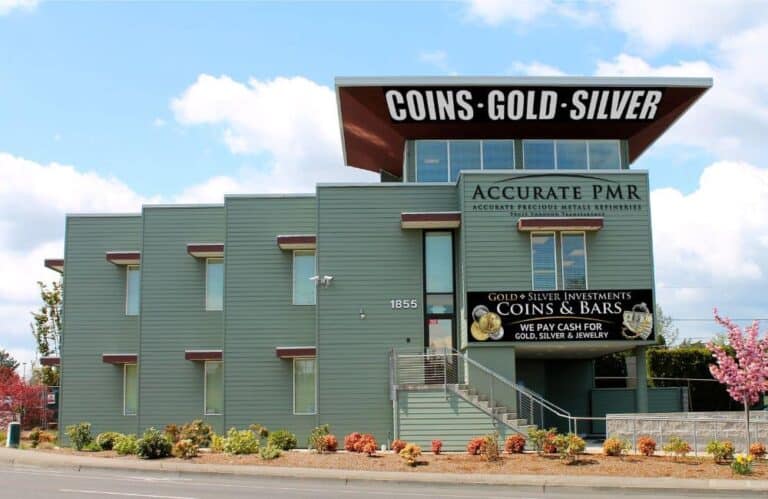
Accurate Precious Metals has been operating out of Salem, Oregon for over 12 years, and the company has earned more than 1,000 five-star reviews by doing one thing consistently: treating buyers and sellers fairly with transparent, spot-based pricing.
Unlike pawn shops, Accurate Precious Metals is a dedicated bullion dealer. That distinction matters. Pawn shops price based on what they think they can resell at retail. A specialized dealer prices based on live spot, which means you get a more accurate reflection of what your metal is actually worth.
The inventory spans gold, silver, platinum, and palladium in coin, bar, and bullion form – including products like the 2025 1 oz Gold Maple Leaf and the 1 oz Gold Britannia – alongside diamonds and jewelry. Pricing is updated to reflect live spot, so what you see reflects current market conditions.
For retirement investors, Accurate Precious Metals also offers Gold and Silver IRA services, allowing you to hold physical precious metals in a tax-advantaged account. And as an NGC Authorized dealer, the team can assist with coin grading and evaluation for numismatic items.
Buying: Shop online at AccuratePMR.com with nationwide insured shipping across the U.S., or visit the Salem, Oregon location in person. Call (503) 400-5608 to speak with the team directly.
Selling: If you are local, bring your gold, silver, jewelry, coins, or scrap metal to the Salem location for an in-person evaluation. If you are anywhere else in the country, the mail-in service makes it easy – request a free insured shipping kit, send your items, and receive a fast offer based on current spot prices. The process covers everything from bullion bars and coins to broken jewelry, dental scrap, and silverware.
Whether you are selling gold for the first time or liquidating a larger collection, Accurate Precious Metals provides a transparent, straightforward process backed by years of experience and a track record that speaks for itself.
Frequently Asked Questions
What is the spot price of gold today?
The current ask price for gold is $4,515 per troy ounce. This is the live wholesale benchmark used by dealers and traders as the starting point for pricing gold products.
Is the spot price what I pay for a gold coin?
No. The spot price is the base price. Retail prices include a dealer premium on top of spot to cover fabrication, distribution, and overhead. A one-ounce gold coin typically costs more than spot depending on the product and current market conditions.
What is a troy ounce?
A troy ounce is the standard unit for precious metals. It equals 31.1035 grams – slightly heavier than a standard avoirdupois ounce (28.35 grams).
Why is gold so expensive right now?
Gold is near record levels due to a combination of persistent inflation, strong central bank buying, geopolitical uncertainty, and investor demand for safe-haven assets. All of these factors have been elevated in recent years.
How often does the gold spot price change?
Continuously during trading hours. Prices update in real time as global markets operate. Significant moves can happen within minutes following major news events.
What is the gold-to-silver ratio and why does it matter?
The ratio shows how many ounces of silver it takes to buy one ounce of gold. At current prices ($4,515 gold, $77 silver), the ratio is roughly 59:1. Some collectors use this ratio to decide how to allocate between the two metals.
How do I sell gold to Accurate Precious Metals?
Local customers can visit the Salem, Oregon location in person. Customers anywhere in the U.S. can use the mail-in service – request a free insured shipping kit, send your items, and receive a fast offer based on live spot prices.
Does Accurate Precious Metals offer IRA services?
Yes. Accurate Precious Metals offers Gold and Silver IRA services for investors who want to hold physical precious metals in a tax-advantaged retirement account. Contact the team at (503) 400-5608 for details.

