

The 1899 Barber Dime: Value, Varieties, and Mint Differences

Disclaimer
Accurate Precious Metals is not a financial advisor. We encourage everyone to consult a financial advisor or CPA. They can help determine the best investment strategies. Our mission is to provide educational content about precious metals. Accurate Precious Metals is committed to transparency and reliability. They offer top-tier precious metal products and information.
This information is subject to change due to market fluctuations, world events, and factors beyond our control. Additionally, the content may not fully reflect our company’s values, as personnel, staff, and authorship may change over time.
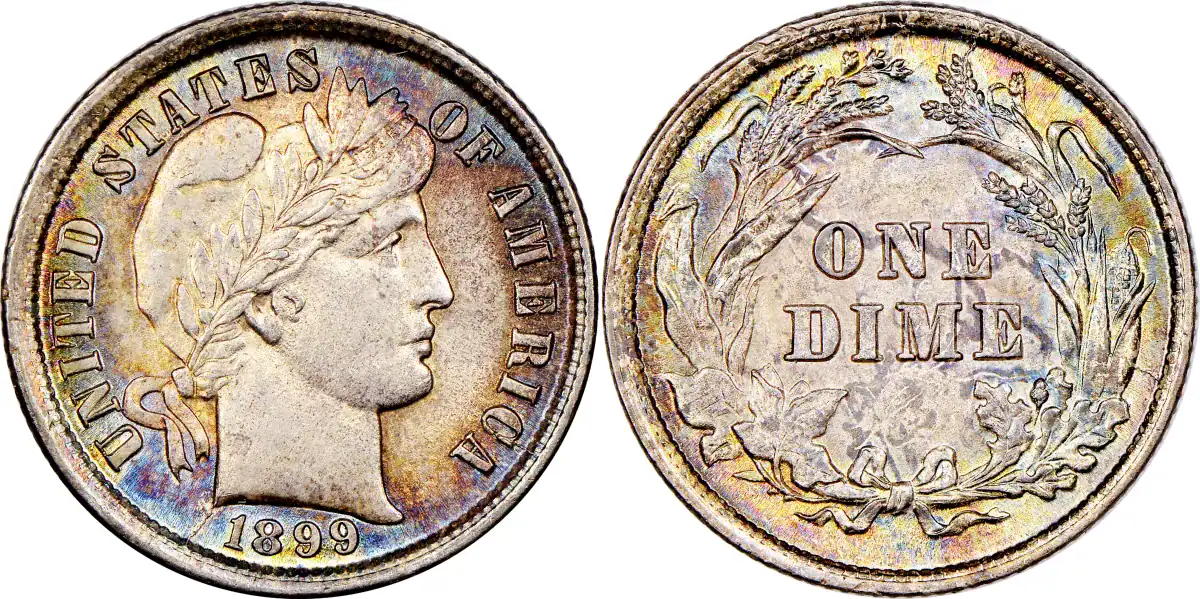
The 1899 Barber dime is one of the most accessible 19th-century silver coins a collector can add to a set today – and one of the most misunderstood when it comes to value. Three mints struck this coin, and the difference between a common Philadelphia example and a scarce New Orleans piece can mean the difference between a $5 coin and a $250 one. With silver spot sitting around $81 per ounce, even worn examples carry a small melt floor, but the real story here is numismatic demand.
Whether you are building a complete Barber dime run, hunting a type coin, or trying to figure out what an inherited coin is worth, this guide covers mintages, grade-by-grade values, authentication tips, and how to sell if you decide to part with one.
The History Behind the 1899 Barber Dime
Charles E. Barber designed this coin in 1892, not because he won a competition, but because the competition failed. The U.S. Mint had opened the design contest to outside artists, hoping to replace the aging Seated Liberty series with something fresh. Artists largely boycotted over the prize structure, and Mint Director Edward Leech handed the job directly to Barber, the Mint’s chief engraver.
The result was a practical coin, not a celebrated one. Barber kept the relief low so dies would last longer and presses could run faster. Critics called the design uninspired. Collectors today appreciate it for exactly what it is – a workhorse coin that circulated hard for 24 years, from 1892 through 1916.
By 1899, the series was seven years old and production was in full swing. The Philadelphia Mint turned out tens of millions of dimes that year. New Orleans and San Francisco added smaller batches. Those branch mint coins are the ones worth watching.
Obverse and Reverse Design Details
The obverse shows Liberty facing right, wearing a Phrygian cap, laurel wreath, and ribbon. “LIBERTY” arches across the top of the cap. “IN GOD WE TRUST” curves below the portrait, and the date sits at the bottom.
The reverse holds a wreath of corn, wheat, maple, and oak tied at the bottom with a bow. “ONE DIME” fills the center. Denticles ring the rim on both sides.
Mintmarks for New Orleans (“O”) and San Francisco (“S”) appear on the reverse, below the bow knot. Philadelphia coins carry no mintmark. New collectors sometimes look on the obverse out of habit from handling Mercury dimes – always flip to the reverse first.


Mintage Figures for the 1899 Barber Dime
| Mint | Mintmark | Mintage | Key Notes |
|---|---|---|---|
| Philadelphia | None | ~17-20 million | Most common |
| New Orleans | O | 2,650,000 | Scarce above Fine |
| San Francisco | S | ~1.8 million | Low survival in higher grades |
Philadelphia’s high output means circulated examples are easy to find and relatively inexpensive. The branch mints are a different story. The 1899-O had less than 2.7 million coins struck, and survival rates in Fine or better condition are low. The 1899-S is even thinner in the upper grades. Neither mint issued proofs, so true proof examples of this date are exclusive to Philadelphia.
1899 Barber Dime Value by Grade
Values depend heavily on grade and mint. The coin contains 0.0723 troy ounces of pure silver, putting melt value around $5.86 at today’s spot price of $81 per ounce. Numismatic premiums push well beyond that in most grades.
| Date | Good (G-4) | Fine (F-12) | Extremely Fine (EF-40) | Mint State (MS-60+) | Proof |
|---|---|---|---|---|---|
| 1899 Philadelphia | $3-5 | $7-15 | $22-75 | $127-250 | ~$650 |
| 1899-O | $10-20 | $62-100 | $126-250 | $567-1,200 | N/A |
| 1899-S | $9-15 | $29-50 | $86-165 | $354-1,280 | N/A |
The Philadelphia coin in Good condition barely clears melt. In Extremely Fine, it jumps to $22-75 – still affordable for a 19th-century silver coin. The 1899-O tells a completely different story. A Fine example runs $62-100, and anything above Very Fine becomes a genuine find. The 1899-S in Mint State can reach $1,000 or more for top-tier examples.
For context, Barber dime values by date vary significantly across the series. The 1899 sits in the middle tier – not a key date like the 1895-O, but not a throwaway either, especially in the O and S mintmarks.
How the 1899 Barber Dime Compares to the 1899 Barber Quarter
Collectors working through the Barber series often pursue dimes, quarters, and half dollars simultaneously. The 1899 Barber Quarter offers an interesting comparison point.
The quarter is larger (24.3 mm, 6.25 grams) and contains more silver – about 0.1808 troy ounces versus 0.0723 for the dime. At $81/oz spot, that puts quarter melt around $14.64 compared to the dime’s $5.86.
Mintage patterns differ too. The 1899 quarter had a Philadelphia mintage of roughly 12 million, with New Orleans at about 2.6 million and San Francisco at around 1.8 million – similar branch mint scarcity to the dime. But because quarters are larger and more visually striking, collector demand in higher grades tends to run stronger, pushing top-grade 1899-O and 1899-S quarters above comparable dimes in price.
For budget-conscious collectors, the 1899 dime offers a lower entry point into the same era and series. For those focused on silver weight and visual impact, the quarter may be the better pick. Both fill a 19th-century Barber slot in a type set.
Grading the 1899 Barber Dime: What to Look For
Check Liberty’s cheek and hair above the ear – these wear first. A Good coin shows flat hair; Fine retains some hair detail; EF shows nearly full hair with only light rub.
The bow knot on the reverse wears quickly. In Fine, the bow outline is clear but flat. In EF, the bow shows full detail with only slight friction.
Sharp, even denticles indicate a well-struck coin. Weak denticles can suggest a worn die or a cleaned coin that has been re-toned.
Undisturbed luster should flow across the full coin in MS grades. Any breaks, hairlines, or flat spots drop a coin out of Mint State.
Cleaning is the biggest value killer in this series. A cleaned coin – one that has been polished, dipped harshly, or wiped – loses 40-60% of its value compared to a problem-free example at the same grade. Look for unnatural brightness, parallel hairlines under magnification, or a flat, lifeless surface.
Never clean a Barber dime. Natural toning, even dark toning, is preferable to a coin that has been altered. Coin dealer appraisals can help you understand what a coin is worth before you decide to sell or grade it professionally.
PCGS & NGC Coin Verification – Accurate Precious Metals Refineries
Authentication and Slabbing: Is It Worth the Cost?
For Philadelphia examples in Good to Fine grades, professional slabbing rarely makes financial sense. A $5 coin costs $30-50 to submit to PCGS or NGC, and the slab adds little resale value at that level.
The math changes for branch mint examples. A raw 1899-O in what appears to be Very Fine might sell for $80-120. The same coin in a PCGS or NGC VF-30 slab could fetch $150-200 or more, because buyers trust the grade. For anything you believe is EF or better – especially 1899-O or 1899-S – slabbing is worth considering.
As an NGC Authorized Dealer, Accurate Precious Metals can assist with the submission process. Reach the team at (503) 400-5608 or visit AccuratePMR.com for details.
Building a Barber Dime Set: Where the 1899 Fits
The Barber dime series ran from 1892 through 1916 – 25 years across three mints. A complete date-and-mintmark set includes 74 coins. A circulated type set needs just one example. The 1899 Philadelphia is a solid, affordable choice for either.
For date collectors, the 1899 fills the 19th-century portion of the run without breaking the budget. The real challenge coins in the series are the 1894-S (a proof-only rarity with only 24 struck), the 1895-O, and the 1896-S, where even Good examples can run $500 or more. The 1899 is not in that league – which is exactly what makes it useful for set builders.
Collectors focused on rare coin investing often use affordable mid-series coins like the 1899 to fill gaps while reserving budget for true key dates. The 1899-O in VF-20 to AU-55 is a sweet spot – scarce enough to matter, priced low enough to acquire without stretching.
Common Misconceptions About the 1899 Barber Dime
Several myths circulate about this coin. Clearing them up saves money and frustration.
“All 1899 dimes are common.” Philadelphia examples are common. The 1899-O and 1899-S are conditionally scarce – few survive above Fine in original, uncleaned condition.
“The mintmark is on the obverse.” No. Barber dimes carry the mintmark on the reverse, below the bow. Mercury dimes (1916-1945) use the same reverse placement, but collectors used to other series sometimes check the wrong side.
“A shiny coin is a better coin.” The opposite is often true. Unnatural shine usually means cleaning, which destroys collector value. Original surface with honest wear beats a polished coin every time.
“It’s just worth its silver weight.” At $81/oz silver, the melt value is under $6. Numismatic demand pushes even common Philadelphia examples to $3-5 in Good – near melt – but branch mint coins trade at 5-100 times melt depending on grade.
“You need the 1894-S for a complete set.” Business strike set builders skip the 1894-S because it exists only as a proof. The 1899 dates are attainable and complete the 1890s portion of a business strike run without needing that legendary rarity.
Selling Your 1899 Barber Dime: What to Expect
If you own one or more 1899 Barber dimes and want to sell, the process is straightforward – but the price you get depends on where you sell and how the coin is presented.
Auction houses like Heritage and Stack’s Bowers are ideal for high-grade slabbed examples, particularly 1899-O or 1899-S in EF or better. They reach the widest audience of serious collectors. Their fees run 10-20% of the hammer price, which is worth it for coins in the $200+ range.
For circulated Philadelphia examples worth $5-20, local coin shows or direct dealer sales make more sense. The transaction costs of auction submission would eat the profit.
Accurate Precious Metals buys all types of precious metals and coins – bullion and numismatic – and offers two convenient ways to sell. Local customers in Oregon and the surrounding area can visit the Salem location in person for a direct evaluation. Customers anywhere in the United States can use the mail-in coin selling service, which includes free insured shipping, a thorough assessment of metal content and numismatic value, and fast payment. The team has over 12 years of experience and more than 1,000 five-star reviews, and the process is transparent from start to finish.
If you are selling silver coins and want a fair evaluation without the uncertainty of a private sale, Accurate Precious Metals is a reliable option. The team assesses coins for both silver content – verified through XRF analysis – and collector premium, so you are not leaving money on the table by selling a numismatic piece at melt.
Why Accurate Precious Metals Is the Right Partner for Barber Dime Collectors
Accurate Precious Metals is not a pawn shop. It is a specialized precious metals dealer with deep experience in both bullion and numismatic coins. The Salem, Oregon location serves walk-in customers directly, and the nationwide mail-in program means geography is no barrier.
As an NGC Authorized Dealer, the team can assist with professional coin grading submissions – useful if you have a 1899-O or 1899-S that might grade EF or better and benefit from slabbing before sale. Competitive pricing reflects live spot prices, so silver’s current level around $81/oz is factored into every offer.
For collectors adding to a set rather than selling, the inventory spans gold, silver, platinum, and palladium in coin, bar, and bullion form. Selling gold coins for top dollar follows the same principles as selling silver – grade matters, presentation matters, and working with a knowledgeable dealer matters.
Reach the team at (503) 400-5608 or visit AccuratePMR.com to get started.
Frequently Asked Questions
How much silver is in an 1899 Barber dime?
The coin is 90% silver and 10% copper, weighing 2.5 grams total. That works out to approximately 0.0723 troy ounces of pure silver. At today's silver spot price of around $81 per ounce, the melt value is roughly $5.86.
How do I tell which mint struck my 1899 Barber dime?
Check the reverse of the coin, below the bow knot at the bottom of the wreath. An "O" means New Orleans. An "S" means San Francisco. No mintmark means Philadelphia.
Is the 1899-O Barber dime rare?
It is not rare in absolute terms – 2.65 million were struck – but it is scarce in Fine or better condition with original surfaces. Most survivors are well-worn. Finding a problem-free example above Very Fine takes effort.
Should I clean my 1899 Barber dime before selling?
No. Cleaning removes original surface and significantly reduces collector value. A naturally worn coin with honest patina is worth more than a polished one. Leave the coin as-is and let a professional assess it.
Where can I sell an 1899 Barber dime?
Accurate Precious Metals buys coins at both its Salem, Oregon location and through a nationwide mail-in service. Visit AccuratePMR.com or call (503) 400-5608. For high-grade slabbed examples, major coin auctions are also worth considering.
Is it worth slabbing a 1899 Barber dime?
For Philadelphia examples in lower circulated grades, slabbing costs typically outweigh the benefit. For 1899-O or 1899-S coins that appear to grade Fine or better – especially if uncleaned – professional grading through PCGS or NGC can meaningfully increase resale value.
How does the 1899 Barber dime compare to other coins in the series?
It sits in the middle of the series in terms of rarity and value. Philadelphia examples are common. Branch mint coins are conditionally scarce. True key dates like the 1895-O and 1896-S command far higher prices. The 1899 is a solid, affordable coin for date set builders.


