

The 1803 Draped Bust dime: A Rare Challenge in Early US Silver

Disclaimer
Accurate Precious Metals is not a financial advisor. We encourage everyone to consult a financial advisor or CPA. They can help determine the best investment strategies. Our mission is to provide educational content about precious metals. Accurate Precious Metals is committed to transparency and reliability. They offer top-tier precious metal products and information.
This information is subject to change due to market fluctuations, world events, and factors beyond our control. Additionally, the content may not fully reflect our company’s values, as personnel, staff, and authorship may change over time.
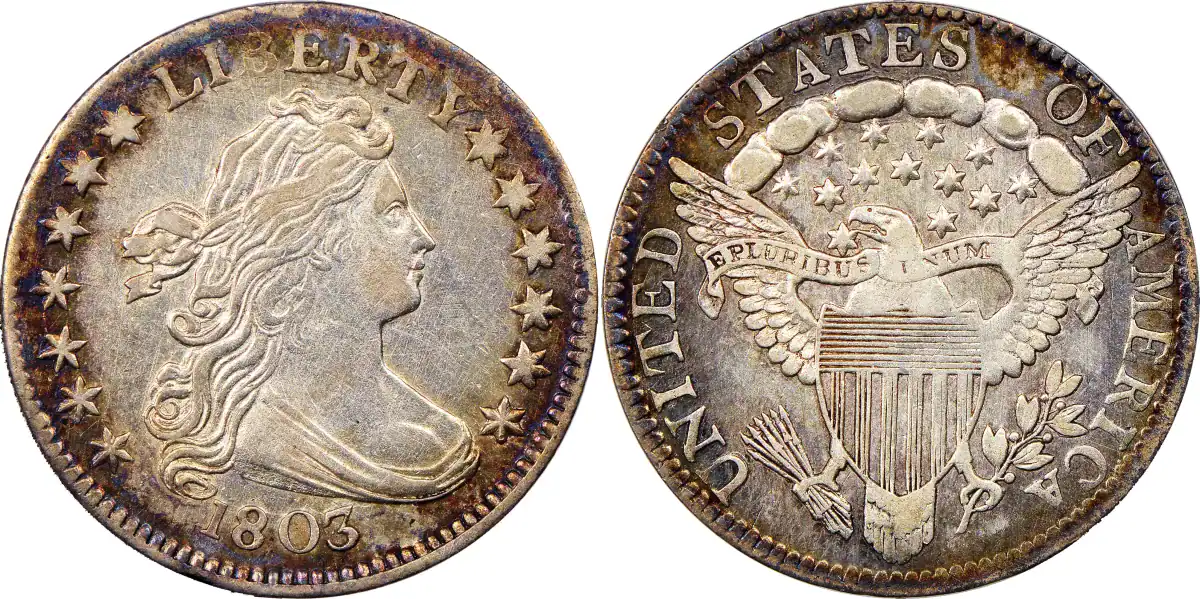
The 1803 Draped Bust dime is one of the most compelling challenges in early American numismatics – a coin with a mintage of just 33,040 pieces, struck at the Philadelphia Mint during a period when silver was scarce and the young U.S. Mint was still finding its footing. Unlike the Flying Eagle cents covered elsewhere on this site, this article focuses exclusively on the 1803 issue: its die varieties, grading realities, and what drives its value today far beyond the coin’s modest silver content.
Collectors who pursue early federal silver know that the 1803 Draped Bust dime occupies a special tier. It is not the rarest date in the series, but its low survival rate, multiple die varieties – including one with only four known examples – and strong auction history make it a serious study. Whether you are buying, selling, or simply learning, understanding this coin in depth pays dividends.
Historical Background: The 1803 Draped Bust Dime in Context
The Coinage Act of 1792 authorized the dime, originally spelled “disme,” but early production was erratic. Silver was difficult to obtain, and the Mint prioritized larger denominations like the half dollar, which circulated more efficiently in a cash-starved economy. Dime production during the Draped Bust era (1796-1807) was consistently small.
By 1803, the Mint had settled on the Heraldic Eagle reverse introduced in 1798, replacing the earlier Small Eagle design. The obverse featured Liberty facing right with flowing hair tied in a bow, surrounded by 13 stars – a number chosen after the 15-star and 16-star versions of 1796 and 1797 proved impractical as new states joined the Union. Designer Gilbert Stuart, better known for his portraits of George Washington, sketched the Liberty figure. Robert Scot engraved the dies from a plaster model by John Eckstein.
The coin measures 18.0 to 19.8mm in diameter, weighs 2.7 grams, and consists of 89.24% silver and 10.76% copper. At today’s silver spot price of about $83 per ounce, the raw metal content of an 1803 dime works out to roughly $6.64. That number is essentially irrelevant to its market value. These coins trade on rarity and history, not melt.
Die Varieties of the 1803 Draped Bust Dime
Every 1803 Draped Bust dime carries the Heraldic Eagle reverse, but within that shared design, die varieties create meaningful distinctions for collectors. The standard reference system for early dimes uses JR numbers, established by numismatists John Reich and later catalogued in the Early American Dimes reference.
JR-1: The Baseline Variety
JR-1 features a wide date with evenly spaced stars. It is the most frequently encountered variety in circulated grades and serves as the entry point for collectors building a type set. “Most common” is relative here – even JR-1 examples in problem-free grades are scarce.
JR-2 Through JR-4: Scarce but Accessible
These varieties show subtle differences in die state: minor variations in star placement, eagle feather arrangement, or berry positioning on the reverse. They are harder to find than JR-1 but not considered extreme rarities. Specialists use a 10x loupe to distinguish them, focusing on date spacing and the precise configuration of stars relative to the bust.
JR-5: The Discovery Coin
JR-5 is in a category of its own. Discovered in 1993, only four examples are known to exist. The diagnostic feature is a unique die crack near Liberty’s eye, combined with distinctive star positioning. A VF Details example sold at auction in recent years, demonstrating that even problem coins of this variety command serious attention. If you encounter an 1803 dime with unusual die characteristics, the JR-5 possibility alone justifies professional examination.
| Variety | Relative Scarcity | Key Diagnostic |
|---|---|---|
| JR-1 | Most Common (relatively) | Wide date, evenly spaced stars |
| JR-2 / JR-3 / JR-4 | Scarce | Subtle feather and berry die differences |
| JR-5 | Extremely Rare (4 known) | Die crack near Liberty’s eye |





Grading the 1803 Draped Bust Dime: What to Look For
Grading early American silver is more nuanced than grading modern coins. The 1803 dime was struck with hand-prepared dies on planchets that were sometimes uneven, and circulation quickly wore down the high points of the design. Add two centuries of handling, cleaning attempts, and improper storage, and finding a problem-free example becomes the central challenge.
Key Wear Points
On the obverse, Liberty’s hair above the ear and the curls along the neck show wear first. The stars can lose their centers early in circulation. On the reverse, the eagle’s breast feathers and the tips of the wings are the primary indicators of grade. A coin with sharp feather detail on the eagle and visible hair strands on Liberty is genuinely scarce.
Surface Problems That Kill Value
Cleaning is the most common issue. Early silver tones naturally to grey and brown; a bright, shiny 1803 dime is almost certainly cleaned. Hairlines under magnification confirm it. Adjustment marks – thin parallel lines from the Mint’s practice of filing overweight planchets – are original to the minting process and do not count against grade, but they do affect eye appeal and therefore price. Scratches, rim nicks, and environmental damage all push a coin into “Details” territory with PCGS or NGC.
Population Reality
Fewer than 200 examples are estimated to survive in XF or better condition. Fewer than 10 are graded Mint State by the major services. The sole PCGS MS-64 example represents the finest known and has sold for over $100,000. An MS-61 example described by specialists as “fabulous” ranks as the second-highest graded coin – a proof to how thin the population becomes above AU-50.
Submit only to PCGS or NGC – these are the two services whose grades the market respects for early American coinage.
Request variety attribution at submission. JR-5 identification requires specialist review.
Review the holder description carefully. “Details” grades indicate problems; “Genuine” holders indicate authentication without a grade.
Compare the assigned grade against published population reports before buying or selling.
Value Guide: What Is an 1803 Draped Bust Dime Worth?
Value climbs steeply with grade. A circulated example in Good-4 – heavily worn but with the date and major design elements visible – starts around $800. That floor reflects the coin’s key-date status even in the lowest collectible grades. From there, values accelerate through the grade scale.
| Grade | Estimated Value Range | Notes |
|---|---|---|
| G-4 to VF-20 | $800 – $3,500 | Most surviving examples |
| XF-40 to AU-50 | $6,500 – $12,700 | Choice surfaces are genuinely rare at this level |
| MS-60 to MS-63 | $52,000 – $70,000 | Top-tier investment grade |
| MS-64 (finest known) | $100,000+ | Single PCGS example |
Historical context shows consistent appreciation. A VF example sold for roughly $135 in 1958. By 2015, similar coins were bringing $2,200 to $11,250 depending on surface quality and variety. Current demand for early federal silver has pushed prices higher still, and the 1803 consistently ranks among the top eight most valuable dates in the Draped Bust dime series, behind only the 1797 and 1804 issues.
Silver spot at $83 per ounce plays no meaningful role in these valuations. The numismatic premium is essentially the entire price. This is a coin for collectors and long-term investors in rarity, not a bullion play.
For comparison, our guides on dime values and history and the 1921 Mercury Dime show how dramatically earlier issues diverge from later 20th-century silver dimes in both character and value.
PCGS & NGC Coin Verification – Accurate Precious Metals Refineries
How the 1803 Compares to Neighboring Dates
The Draped Bust dime series ran from 1796 to 1807, and not all dates are equal. Understanding where 1803 sits relative to its neighbors helps frame buying and selling decisions.
The 1797 and 1804 dates are generally considered the top keys. The 1797 exists in multiple star varieties and is extremely rare in high grade. The 1804 is famous for its 13-star and 14-star reverse varieties and commands premiums above the 1803 in most grades.
The 1801 and 1802 are close in rarity to the 1803. An 1802 in MS-60 condition has sold in the $38,000 to $50,000 range, making it a useful benchmark when evaluating 1803 pricing. The 1805 and 1807 are more common and generally less expensive across all grades.
The 1803 stands out because of its combination of low mintage, low survival rate, and the JR-5 variety – a factor with no equivalent in most nearby dates. A collector building a complete Draped Bust dime set will find 1803 one of the harder slots to fill with a problem-free coin.
Buying an 1803 Draped Bust Dime: Practical Advice
Buying early American coinage requires more discipline than buying modern bullion. The market is thinner, fakes exist, and surface problems are easy to miss without experience.
- Buy only slabbed coins from PCGS or NGC for significant purchases. Raw coins can be genuine, but the risk of cleaned or problem surfaces is too high without independent grading.
- Verify variety attribution before paying a variety premium. JR-5 attribution should come from a specialist, not just a seller’s description.
- Use major auction houses – Heritage Auctions and Stack’s Bowers are the primary venues for early American coinage. Auction records provide reliable price comparables.
- Check pedigrees when available. A coin with a documented auction history from reputable sales adds confidence.
- Budget at least $1,000 for a circulated entry-level example. Anything priced significantly below market for the grade warrants skepticism.
- Avoid purchasing from sellers who cannot explain the variety or provide grading service documentation.
A simple test for silver authenticity: silver is non-magnetic. A magnet will not attract a genuine silver coin. This is a basic check, not a substitute for professional evaluation, but it eliminates obvious fakes quickly.
Selling an 1803 Draped Bust Dime
Owners of an 1803 Draped Bust dime have several strong options. The key is matching the coin to the right venue for its grade and variety.
Auction consignment through Heritage or Stack’s Bowers makes sense for MS-grade coins or attributed JR-5 examples. Consignment fees typically run 10-20%, but competitive bidding in a specialist sale can push prices well above private-sale estimates.
For circulated examples, a specialist dealer who understands early American coinage will offer a fairer evaluation than a general buyer. The difference between a cleaned VF and a problem-free VF is hundreds of dollars, and only a knowledgeable buyer will price that distinction correctly.
Accurate Precious Metals has been buying coins and precious metals for over 12 years and holds more than 1,000 five-star customer reviews. As an NGC Authorized Dealer, our team can evaluate your early silver coins with the expertise this category demands. If you are local to Salem, Oregon, bring the coin in person for a direct assessment. If you are anywhere else in the United States, the mail-in service makes it straightforward – request a free insured shipping kit, send your coin, and receive a professional evaluation and fast payment.
Whether you have a single 1803 dime or an entire early American collection, selling to Accurate Precious Metals gives you access to a team that understands numismatic value, not just melt weight.
Portfolio Fit: Early Silver as a Long-Term Investment
The 1803 Draped Bust dime is not a liquid asset in the way a modern silver round or bar is. It belongs in a portfolio alongside other key-date early American coins, where rarity drives appreciation over time rather than daily spot price movements.
Gold is currently trading around $4,876 per ounce and platinum near $2,131. These metals offer different investment profiles – bullion for liquidity, numismatics for rarity-driven appreciation. Collectors who pair 1803 Draped Bust dimes with other series keys like the 1797 and 1804 dates are building a collection that reflects genuine historical scarcity.
For investors interested in silver as part of a retirement strategy, Gold and Silver IRA services offer a structured way to hold physical precious metals. Numismatic coins are generally not IRA-eligible, but investment-grade silver bullion can be held in a self-directed IRA alongside other precious metals.
The 1803 dime pairs naturally with other early federal issues – Bust half dollars, early large cents, and Capped Bust quarters – for collectors building a comprehensive picture of the first decades of American coinage.
Why Accurate Precious Metals for Early American Coins
Accurate Precious Metals is a specialized precious metals dealer – not a pawn shop, not a general buyer. Based in Salem, Oregon, with nationwide reach through insured shipping, we handle the full spectrum from modern bullion to early American numismatics. Our inventory includes silver coins across all eras, bars, bullion, and collectibles, along with gold, platinum, and palladium.
For collectors of early silver like the 1803 Draped Bust dime, the difference between working with a specialist and a generalist is measured in dollars. Our NGC Authorized Dealer status means we approach grading and evaluation with the same standards the market demands. We buy all precious metals – coins in any condition, jewelry, silverware, bullion, and more.
Local customers in Oregon and the Pacific Northwest are welcome to visit our Salem location directly. Customers anywhere in the United States can use our convenient mail-in service at AccuratePMR.com/mail-in, with free insured shipping, thorough evaluation, and prompt payment. Call us at (503) 400-5608 or visit AccuratePMR.com to get started.
Frequently Asked Questions
How many 1803 Draped Bust dimes were minted?
The Philadelphia Mint produced 33,040 pieces in 1803. Survival estimates across all grades range from roughly 52,000 to 70,000 pieces for the entire Draped Bust dime series, with the 1803 being one of the scarcer dates.
What makes the JR-5 variety so valuable?
Only four examples of the JR-5 variety are known to exist. It was discovered in 1993 and features a distinctive die crack near Liberty's eye. Rarity at this level means even problem coins command significant premiums over standard variety examples in the same grade.
Is the silver content a major factor in the 1803 dime's value?
No. At roughly $83 per ounce for silver today, the metal content of an 1803 dime is worth about $6.64. The coin's value – starting around $800 in the lowest collectible grades – is almost entirely numismatic.
What grading services should I use for an 1803 Draped Bust dime?
PCGS and NGC are the two services whose grades the market for early American coinage respects. Accurate Precious Metals is an NGC Authorized Dealer and can assist with the submission process.
What are the most common problems with 1803 Draped Bust dimes?
Cleaning is the most frequent issue – early silver tones naturally, and many coins were polished over the years, leaving hairlines that reduce value significantly. Adjustment marks from the original minting process are acceptable and do not count against grade, but scratches and environmental damage do.
Where is the best place to sell an 1803 Draped Bust dime?
For MS-grade or variety coins, specialist auction consignment through major houses is worth considering. For circulated examples, a knowledgeable dealer like Accurate Precious Metals offers fair evaluation. You can visit our Salem, Oregon location or use our mail-in service from anywhere in the United States.
How does the 1803 dime compare to the 1804 Draped Bust dime in value?
The 1804 is generally considered a higher-tier key date, partly because of its 13-star and 14-star reverse varieties and lower overall survival rate in high grades. The 1803 ranks just below it in most pricing guides and is typically more accessible at the circulated level.


