This content is for educational purposes only and is not financial or investment advice. Precious metals prices fluctuate; past performance does not guarantee future results. Consult a qualified professional before making investment decisions.
Shoppers searching for the best deals on spot price gold bullion coins usually want the same thing: the most gold for the least money over the live market rate. That means understanding how coin pricing actually works, not just comparing sticker prices between dealers.
This guide breaks down how spot price connects to the final price you pay for a coin, which 1 oz coins tend to carry the lowest premiums, and what to watch for so you don't overpay. At the time of writing, gold spot sits at $4,037 per ounce, and every coin price in this article is built on that number plus whatever premium a dealer adds.
What Is the Spot Price of Gold Bullion Coins?
The spot price is the live wholesale price of raw gold, and it is the starting point for every bullion coin quote you'll see. Gold trades by the troy ounce, which equals 31.1034768 grams, not the standard avoirdupois ounce used for food or mail.
At the time of writing, gold spot is $4,037 per ounce. A 1 oz gold coin has roughly $4,037 of metal content before any premium, shipping, or payment fee gets added. Dealers update this number constantly during market hours, sometimes every few seconds, because gold trades on exchanges around the world nearly around the clock.
Spot price is not what you pay at the counter. It's the raw material cost. Everything else, minting, distribution, dealer overhead, and demand, gets layered on top.
How Are High-Yield Gold Bullion Coins Priced Above Spot?
Coin price equals the spot price of gold at the time of writing plus a dealer premium, and that premium covers minting costs, distribution, and market demand. The formula is simple: spot plus premium equals retail price.
For example, if spot is $4,037 an ounce and a dealer sells a 1 oz coin for $4,187, the premium is $150, or about 3.7%. That percentage moves depending on the coin, the mint, and how much demand exists at that moment.
A "high-yield" gold bullion coin, in practical terms, is one that delivers the most gold content per premium dollar spent. That's almost always a 1 oz coin from a major sovereign mint, because premiums don't scale down proportionally on smaller pieces.
Minting and distribution costs
Dealer margin and overhead
Current market demand for that specific coin
Payment processing, shipping, and tax where applicable
Which 1 oz Gold Bullion Coins Offer the Best Value?
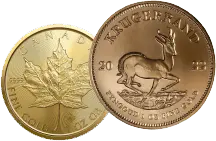
The 1 oz coins with the lowest typical premiums are the American Gold Eagle, Canadian Maple Leaf, Austrian Philharmonic, South African Krugerrand, and Australian Kangaroo. These five sovereign coins dominate the bullion market because they are widely recognized, easy to resell, and minted in high volume.
The [American Gold Eagle] contains exactly 1 troy ounce of actual gold weight, known as AGW, but the coin's total weight is higher because it's only 91.67% gold, or 22 karat. The alloy metals mixed in make the coin more scratch-resistant than a pure gold piece.
The [Canadian Gold Maple Leaf] and [Austrian Philharmonic] both run 99.99% pure gold, among the highest purity levels available in a major bullion coin. The [South African Krugerrand] shares the same 91.67% alloy structure as the Eagle, which is part of why it has held up so well historically in circulation. The [Australian Kangaroo], sometimes called the Nugget in older releases, is also 99.99% fine and known for changing its reverse design every year.
Coin
Gold Content
Purity
Notable Trait
American Gold Eagle
1 oz AGW
91.67%
Alloyed for durability
Canadian Maple Leaf
1 oz
99.99%
One of the purest major coins
Austrian Philharmonic
1 oz
99.99%
Popular across Europe and North America
South African Krugerrand
1 oz AGW
91.67%
Historic, durable alloy design
Australian Kangaroo
1 oz
99.99%
New design released annually
Why Do Smaller Gold Coins Cost More Per Ounce?
Fractional coins like 1/10 oz, 1/4 oz, and 1/2 oz pieces almost always carry a higher premium per ounce than standard 1 oz coins. That's because minting and distribution costs get spread across less gold, so the fixed costs eat up a larger share of the price.
Market comparisons have shown 1/10 oz American Gold Eagles trading in the high $500s while full 1 oz Gold Eagles trade in the low $5,000s at similar spot levels, a gap that reflects the outsized premium on the smaller coin rather than any difference in gold quality. If your goal is maximum metal for your money, the 1 oz Gold Eagle or a comparable 1 oz coin from another mint almost always beats a fractional coin on a cost-per-ounce basis.
Fractional coins still have a place. Smaller pieces like the 1/10 oz Gold Eagle or a 1/4 oz Gold Maple Leaf work well for buyers who want a lower entry price, gifting, or building a position gradually. Just go in knowing you're paying more per ounce of gold for that flexibility.
How Much Premium Over Spot Should You Expect to Pay?
There's no fixed industry number, but common 1 oz bullion coins from major mints typically carry lower premiums than fractional coins, proof versions, or specialty releases. The exact figure shifts with market demand, mint output, and dealer inventory, so the best move is comparing premium over spot across a few sellers before buying.
A few patterns hold up consistently:
1 oz standard bullion coins usually carry the lowest premium among sovereign coins
Fractional sizes (1/2 oz, 1/4 oz, 1/10 oz) usually carry noticeably higher premiums per ounce
Proof and collectible versions are priced for collectors, not bullion buyers, and cost far more than melt value
Generic gold bars sometimes beat coins on premium, but coins are often easier to sell in small amounts
What's the History Behind Today's Standard Bullion Coins?
Modern gold bullion coins exist because investors needed a standardized, government-backed way to own gold in small, tradable amounts. Before these coins existed, buying investment gold usually meant bars, which are harder to divide, verify, and resell in small quantities.
The Krugerrand, first minted in South Africa in 1967, is widely credited as the coin that launched the modern bullion coin category. It proved that a gold coin could trade close to metal value on a global scale. The American Gold Eagle followed decades later and became the flagship U.S. bullion coin, now one of the most liquid gold products in the world. The Canadian Maple Leaf pushed purity further, helping establish 99.99% fine gold as a standard for major mints, a benchmark the Austrian Philharmonic and Australian Kangaroo later matched.
That history matters for buyers today because it explains why these five coins still dominate. They're the most recognized, most traded, and easiest to resell, which keeps their premiums competitive compared to newer or less common bullion products.
What Are the Biggest Misconceptions About Gold Bullion Coin Pricing?
The biggest misconception is that the cheapest-looking coin is always the best deal, when in reality the coin with the lowest total premium per ounce usually wins. A 1/10 oz coin might have a lower sticker price, but it almost always costs more per ounce of actual gold than a 1 oz coin.
Other common mix-ups worth clearing up:
Spot price is not the price you'll pay. It's the baseline before premium, shipping, and fees.
Not all 1 oz coins cost the same, even with identical gold content, because demand and mint reputation shift premiums.
A coin's stated weight isn't always pure gold weight. The Eagle and Krugerrand are 91.67% gold by design, with the rest alloy.
Purity alone doesn't determine the best buy. Liquidity and recognizability matter just as much when it's time to sell.
How Do You Get the Best Prices on Gold Bullion Coins?
The best price comes from comparing the total out-the-door cost, including premium, shipping, and payment fees, against current spot, rather than chasing the lowest advertised number. A coin advertised at a low premium but tacked with high card fees or shipping charges can end up costing more than a slightly higher quote with free shipping.
Steps to Find the Best Price on Gold Bullion Coins
1
Check current spot Confirm the live gold spot price before comparing any dealer quotes
2
Compare premium per ounce Look at the dollar and percentage premium over spot, not just total price
3
Factor in fees Add shipping, insurance, and any card or check processing charges
4
Check the buyback spread A narrower gap between buy and sell price usually signals a more liquid coin
5
Confirm coin authenticity Verify weight, diameter, and design details match mint specifications
If you're weighing coins against bars, our bar versus coin premium comparison walks through how the two formats stack up on cost per ounce. And if you're shopping across the full lineup of available sizes and mints, browsing gold bullion coins and bars side by side makes the premium differences easier to spot.
Should You Buy or Sell Gold Bullion Coins Right Now?
Whether to buy or sell depends on your goals, not on trying to time a short-term move in spot price. Gold has historically been used as a long-term store of value and a hedge against currency and market volatility, though past performance never guarantees future results.
If you already own bullion coins and want to sell, compare your offer against current spot the same way you'd compare a purchase price: check the premium or discount being applied, ask about fees, and confirm the payout timeline. Our nationwide gold bullion pricing page tracks how offers move with the market so sellers can check current conditions before committing.
Why Choose Accurate Precious Metals for Gold Bullion Coins?
Accurate Precious Metals, based in Salem, Oregon, has spent more than 12 years helping buyers and sellers get fair, spot-based pricing on gold bullion coins, bars, and jewelry. With over 1,000 five-star customer reviews, the company has built a reputation as a specialized precious metals dealer, not a pawn shop, focused entirely on metals, coins, and jewelry.
Buyers get access to a full lineup of 1 oz and fractional coins across gold, silver, platinum, and palladium, along with gold and silver IRA services for retirement accounts. Online pricing updates to reflect live spot prices, and the company ships nationwide with insured delivery, so buyers outside Oregon get the same competitive access as local customers. As an NGC Authorized dealer, Accurate Precious Metals also offers grading services for buyers who want extra assurance on higher-value pieces.
For local buyers in the Salem area, visiting in person means seeing the coins firsthand and asking questions on the spot. For everyone else across the country, the same inventory and pricing are available online, with the 1 oz Gold Eagle and other major bullion coins ready to ship. Anyone looking to sell can either bring coins into the Salem location or use the mail-in gold program, which includes free insured shipping and fast payment, making Accurate Precious Metals a practical choice whether you're buying, selling, or both.
Frequently Asked Questions
What is the spot price of gold bullion coins today?
At the time of writing, gold spot is $4,037 per ounce, meaning a 1 oz bullion coin has roughly that much gold content before dealer premium, shipping, and fees are added.
Which gold coins are closest to spot price?
Standard 1 oz coins like the American Gold Eagle, Canadian Maple Leaf, Austrian Philharmonic, Krugerrand, and Australian Kangaroo typically trade closest to spot, though actual premiums vary by dealer and market demand.
Why are 1/10 oz gold coins more expensive per ounce than 1 oz coins?
Minting and distribution costs get spread across less gold in a fractional coin, which pushes the premium per ounce higher than on a full 1 oz coin.
Is a 1 oz American Gold Eagle really 1 troy ounce of gold?
Yes, it contains exactly 1 troy ounce of actual gold, but the coin's total weight is higher because it is 91.67% gold with the remainder made up of alloy metals for durability.
How much over spot should I expect to pay for a gold bullion coin?
There is no fixed number, but 1 oz coins from major mints typically carry lower premiums than fractional or proof coins, so compare total cost including shipping and fees across a few dealers.
What is the melt value of a 1 oz gold coin right now?
Melt value equals the coin's gold content multiplied by the current spot price, so a 1 oz coin's melt value is roughly $4,037 at the time of writing, before any premium or fee.
Are proof gold coins a good deal at spot price?
No, proof coins are collectible products aimed at numismatic buyers and typically carry much higher premiums than standard bullion coins of the same size and metal content.
Make the smart choice — invest with Accurate Precious Metals
Whether you are buying bullion for the first time or adding to a long-term position, our team offers expert guidance, transparent pricing, and a reliable buyback program.