

Scrap Gold Selling Guide: Maximize Your Jewelry’s Worth Today

Disclaimer
Accurate Precious Metals is not a financial advisor. We encourage everyone to consult a financial advisor or CPA. They can help determine the best investment strategies. Our mission is to provide educational content about precious metals. Accurate Precious Metals is committed to transparency and reliability. They offer top-tier precious metal products and information.
This information is subject to change due to market fluctuations, world events, and factors beyond our control. Additionally, the content may not fully reflect our company’s values, as personnel, staff, and authorship may change over time.
This Scrap Gold Selling Guide exists for one reason: to give you the knowledge to sell your old jewelry at the best possible price, without getting taken advantage of. Gold is sitting at around $4,657 an ounce right now – a historic high – and that tangled chain in your drawer or the bent ring you never wear could be worth real money. The difference between a great deal and a bad one comes down to understanding how scrap gold is priced, tested, and sold.
Unlike our other articles that focus on finding buyers in specific cities or selling broken pieces quickly, this guide goes deeper. We cover the history behind scrap gold markets, how karat purity affects your payout, how to calculate melt value yourself, and what red flags to watch for when dealing with buyers. By the end, you will know exactly what your gold is worth and how to get close to it.
What Is Scrap Gold and Why Does It Have Value?
Scrap gold is any gold item valued for its metal content rather than its design or craftsmanship. A broken bracelet, a mismatched earring, an outdated ring – none of that matters to a refiner. What matters is the weight and purity of the gold inside.
Gold is chemically inert. It does not rust, corrode, or degrade. That means every gram of gold ever mined is theoretically still in circulation somewhere, and roughly 80% of all mined gold remains in use today as jewelry, bars, or industrial components. When you sell scrap, that metal gets refined back into pure gold and reused – in new jewelry, electronics, or investment bars.
The value is driven by the spot price. Right now, gold trades at about $4,657 per troy ounce. Every piece of gold jewelry you own has a calculable melt value based on that number. Buyers pay a percentage of that melt value – typically 70-90% at reputable dealers, less at pawn shops.
A Brief History of the Scrap Gold Market
Gold recycling is not a modern invention. Ancient Egyptians melted down old jewelry and ornaments as far back as 2000 BCE, repurposing the metal for trade and war funding. The concept of selling gold for its raw metal content is as old as gold itself.
The 19th-century California Gold Rush formalized the process in the United States. Miners and prospectors sold raw nuggets and flawed pieces to assayers who weighed, tested, and paid cash on the spot – the first version of what we now call a gold buyer. Formal refining infrastructure grew out of that era.
The modern “cash for gold” market exploded in the 1980s when gold hit $850 an ounce in 1980, a price that – adjusted for inflation – still stands as a benchmark. Mail-in gold schemes and “gold parties” became widespread, and so did fraud. States responded with consumer protection laws: ID requirements, mandatory waiting periods, and check-only payment rules in some jurisdictions.
Gold jewelry melted and recycled for trade and military funding
Formal assaying and gold buying infrastructure established in the U.S.
Gold hits $850/oz, sparking the first wave of mass consumer scrap selling
States introduce ID laws and payment rules to curb scrap gold fraud
Gold demand surges as investors flee equities; scrap markets boom
Gold trades above $4,600/oz, creating the best scrap selling conditions in history
Today, with gold near all-time highs, selling scrap is more lucrative than it has ever been. The cycle continues – economic uncertainty drives gold prices up, and sellers capitalize on decades-old jewelry sitting in drawers.


Scrap Gold Selling Guide: Understanding Karat Purity
Karat is the single most important factor in determining what your scrap gold is worth. Pure gold is 24 karats – that is 99.9% gold by weight. Jewelry mixes gold with other metals like copper, silver, or zinc to add durability, since pure gold is too soft for everyday wear.
The karat system divides gold into 24 parts. 18-karat gold contains 18 parts gold and 6 parts alloy – 75% pure. 14-karat, the most common in American jewelry, is 58.3% gold. 10-karat sits at 41.7% and is the legal minimum to be called gold in the United States.
| Karat | Purity % | Common Items | Approx. Melt Value per Gram |
|---|---|---|---|
| 24K | 99.9% | Bars, fine jewelry | ~$150/g |
| 22K | 91.7% | High-end chains, Indian jewelry | ~$137/g |
| 18K | 75% | Rings, necklaces, bracelets | ~$112/g |
| 14K | 58.3% | Everyday American jewelry | ~$87/g |
| 10K | 41.7% | Budget rings, earrings | ~$62/g |
Based on gold spot at $4,657/oz. Formula: spot ÷ 31.1g x purity % = melt value per gram.
Stamps inside rings or on clasps tell you the karat: look for “14K,” “585,” “750,” or “18K.” European pieces often use millesimal fineness – “585” means 58.5% gold, equivalent to 14K. No stamp does not mean no gold, but it does mean testing is required before any buyer can make an offer.
White gold and rose gold are the same karat system – the color comes from the alloy mix, not a different purity standard. White gold uses nickel or palladium; rose gold uses copper. Both sell at the same melt value as yellow gold of the same karat.
Dental gold deserves special mention. Crowns and bridges often contain 16-karat gold or higher, sometimes alloyed with platinum or silver. Dental gold can be surprisingly valuable – do not toss it in with low-karat costume jewelry.
How Melt Value Is Calculated
The math behind scrap gold pricing is straightforward once you know the formula.
Melt value = (weight in grams x purity as a decimal x spot price) ÷ 31.1
A 10-gram 14K gold ring at today’s spot price works out like this: 10 x 0.583 x $4,657 ÷ 31.1 = approximately $873 in raw melt value. A reputable buyer will offer you 70-90% of that – so roughly $610 to $785 for that single piece.
Buyers do not pay full melt value because they carry costs: refining fees, assay testing, market spread, and operating overhead. That is normal and expected. What is not acceptable is being offered 30-40% of melt value, which is what many pawn shops and mall kiosks routinely do.
Gold Scrap Value Calculator – Accurate Precious Metals Refineries
Weigh your pieces on a kitchen scale set to grams – not troy ounces, not pennyweights. Buyers use grams and troy ounces (1 troy oz = 31.1g), so working in grams keeps the math clean.
Types of Scrap Gold Worth Selling
Not everything gold-colored is worth selling as scrap, and some pieces you might overlook are actually valuable. Sorting before you walk into a buyer saves time and prevents confusion.
- Yellow gold jewelry – chains, rings, bracelets in 10K-18K are the most common scrap items. Straightforward to test and price.
- White gold – often rhodium-plated, which can complicate visual identification. XRF testing cuts through the plating to measure true gold content.
- Rose gold – copper-heavy alloy, popular in vintage and antique pieces. Sells at the same rate as yellow gold of the same karat.
- Dental gold – crowns, bridges, and inlays. Higher purity than most jewelry; often mixed with platinum.
- Gold-filled and gold-plated items – these are NOT the same as solid gold. Gold-filled has a thicker gold layer and some value; gold-plated has almost none. Buyers test for this.
- Industrial and watch components – watch cases, pins, and clasps can contain real gold. Sort them separately.
- Broken or incomplete pieces – broken chains, single earrings, bent rings. Condition does not affect melt value at all.
Silver and platinum pieces should be separated and sold independently. Silver at $73 an ounce and platinum at $1,940 an ounce both have strong standalone value. Mixing them into a gold lot means you may not get the best rate on any of them.
Learn more about maximizing value on mixed precious metal lots before you bundle everything together.
Step-by-Step: How to Sell Scrap Gold for the Best Price
Separate by metal type and karat. Check for stamps inside bands and on clasps. Remove gemstones if possible – buyers price gold by weight, and stones add nothing to a scrap offer.
Use a kitchen scale in grams. Write down each piece’s weight and karat separately. This is your inventory.
Run your numbers through an online melt value calculator. Know what 70-90% of melt looks like for each piece. That is your acceptable offer range.
Visit or contact at least three buyers. Include a specialist precious metals dealer, not just a pawn shop. Offers can vary by 20-30% between buyers for identical material.
Reputable buyers test in front of you – either with acid tests or XRF analysis. If a buyer disappears with your gold to “test it in back,” that is a red flag.
Use your melt value baseline. Decline offers below 65% of melt unless the piece is low-karat and fees are genuinely higher. Get payment by check or bank transfer – avoid cash-only buyers in regulated states.
With gold at record highs, some sellers reinvest proceeds into gold bullion or coins for long-term holds rather than spending the cash outright.
Common Misconceptions That Cost Sellers Money
One misconception worth addressing directly: many sellers assume that a higher karat always means a dramatically higher total payout. Karat affects value per gram, but total weight matters too. A heavy 10K chain can pay more than a light 18K ring. Run the math on each piece individually.
Scrap Gold Selling Guide: Red Flags and Seller Protections
The scrap gold market has its share of bad actors. Knowing what to watch for protects you.
Pressure tactics – any buyer who creates urgency (“this offer expires in five minutes”) is not acting in good faith. Spot prices fluctuate, but not minute to minute in ways that justify rushing a seller.
No in-person testing – a buyer who offers a price without testing your gold first is either guessing or lowballing. XRF analysis or acid testing should happen before any offer is made.
Cash-only payment – many states require payment by check to create a paper trail. Cash-only buyers may be operating outside regulations.
No ID requirement – legitimate buyers are legally required to record seller identification in most states. A buyer who skips this step is not compliant.
Lowball first offers – some buyers open with 30-40% of melt expecting you not to know better. Your baseline calculation is the antidote.
Reinvesting Scrap Proceeds: Turning Old Jewelry Into Long-Term Wealth
Selling scrap gold at today’s prices generates real cash. What you do with that cash matters.
Many experienced collectors and investors use scrap proceeds to buy investment-grade bullion – American Gold Eagle coins, gold bars, or fractional coins for flexibility. The logic is straightforward: you convert low-efficiency assets (mixed-karat jewelry with sentimental but limited investment value) into high-efficiency ones (pure .9999 fine gold in standardized form).
Silver bullion is another popular reinvestment target. At $73 an ounce, silver offers more accessible entry points and strong industrial demand fundamentals.
For retirement-focused sellers, scrap proceeds can fund a precious metals IRA. Gold and silver held in an IRA structure offer tax advantages that a simple cash-out does not. This is a longer-term play, but worth considering if you are liquidating a significant jewelry collection.
Why Sell to Accurate Precious Metals
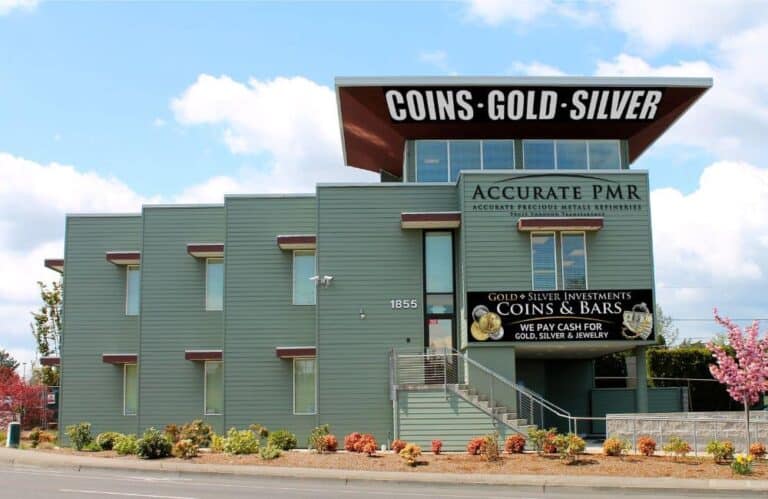
Accurate Precious Metals has been buying and selling precious metals for over 12 years from our Salem, Oregon location. We are a specialist precious metals dealer – not a pawn shop, not a mall kiosk. That distinction matters because our entire business model is built around precious metals, which means our offers reflect actual market rates rather than the wide margins that generalist resellers require.
We have earned more than 1,000 five-star customer reviews from sellers and buyers across the country. Our pricing updates in real time to reflect live spot prices, so the offer you receive is based on current market conditions, not yesterday’s numbers.
When you bring scrap gold to us, we evaluate it using XRF analysis – a non-destructive method that measures metal content accurately without acid or guesswork. You watch the process. We explain the numbers. You make an informed decision.
Local sellers in the Salem, Oregon area are welcome to visit us in person. Bring your jewelry, watch the testing, ask questions, and leave with payment the same day.
Sellers anywhere in the United States can use our insured mail-in service. We provide a free shipping kit, evaluate your metal using the same transparent process, and send payment promptly. The shipping is insured, so your gold is protected in transit.
We also buy silver, platinum, palladium, dental gold, coins, bullion bars, diamonds, luxury watches, and silverware. If it has precious metal content, we want to see it. Visit our buying page for the full list of what we accept, or call us at (503) 400-5608 to talk through your specific pieces before you send or visit.
Frequently Asked Questions
What is the difference between scrap gold and bullion gold?
Scrap gold is any gold item sold for its metal content – jewelry, dental gold, broken pieces. Bullion gold is investment-grade metal in standardized form, like coins or bars at .999 or .9999 fine purity. Scrap gets refined into bullion. They are different stages of the same metal.
How do I know if my jewelry is real gold and not gold-plated?
Look for a karat stamp inside the band or on the clasp – 10K, 14K, 18K, 585, 750. No stamp suggests plating or gold-filled construction. A reputable buyer will test it with XRF analysis or an acid test before making any offer.
What percentage of melt value should I expect from a reputable buyer?
Reputable specialist dealers typically pay 70-90% of melt value. Pawn shops and generalist resellers often pay 40-60%. Knowing your melt value before you walk in is the best way to evaluate any offer.
Should I remove gemstones before selling scrap gold?
If you can safely remove them, yes. Buyers price gold by weight, and stones do not contribute to a scrap offer. Diamonds and colored stones often have more value sold separately than they add to a gold lot.
Does the condition of my jewelry affect what I get paid?
No. Scrap buyers pay for metal content, not appearance or condition. A bent, broken, or tarnished piece pays the same as a pristine one at the same weight and karat.
Is now a good time to sell scrap gold?
With gold at approximately $4,657 an ounce – near historic highs – the melt value of your jewelry is higher than it has been at almost any point in history. Sellers who have been holding old pieces are in a strong position right now.
Can I sell scrap gold if I am not in Oregon?
Yes. Accurate Precious Metals offers an insured mail-in service for customers anywhere in the United States. Visit accuratepmr.com or call (503) 400-5608 to get started.
What types of gold does Accurate Precious Metals buy?
We buy all forms of gold – jewelry in any condition, dental gold, coins, bars, and industrial pieces. We also buy silver, platinum, palladium, diamonds, and luxury watches.

