

Karat Differences Impact Gold Value: What the Stamp Really Says

Disclaimer
Accurate Precious Metals is not a financial advisor. We encourage everyone to consult a financial advisor or CPA. They can help determine the best investment strategies. Our mission is to provide educational content about precious metals. Accurate Precious Metals is committed to transparency and reliability. They offer top-tier precious metal products and information.
This information is subject to change due to market fluctuations, world events, and factors beyond our control. Additionally, the content may not fully reflect our company’s values, as personnel, staff, and authorship may change over time.
Understanding how karat differences impact gold value is one of the most practical skills any gold buyer, seller, or collector can develop. Whether you are holding a stack of old jewelry, considering a purchase, or trying to figure out how much is my gold worth, the karat stamp on a piece tells you exactly how much of what you are holding is actually gold – and that number drives everything from melt value to resale offers.
Most people know that 24K sounds better than 10K, but few understand what that gap means in real dollars. The difference is not subtle. At today’s gold spot price of $4,334 per ounce at the time of writing, a one-ounce piece of 24K gold carries roughly $2,500 more in pure gold content than an equivalent-weight piece of 10K gold. That is the karat gap in action.
What a Karat Actually Measures
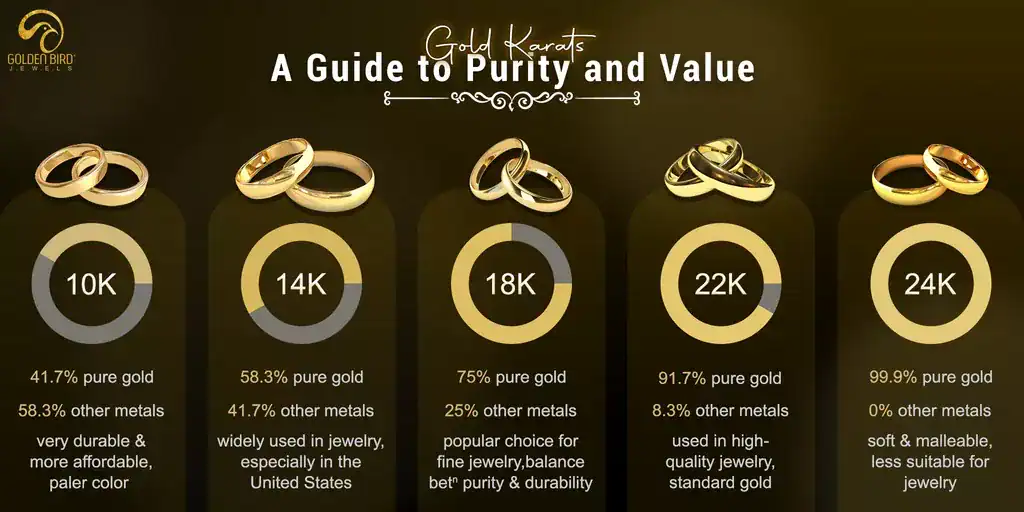
The karat system divides gold purity into 24 equal parts. A piece stamped 24K contains 24 out of 24 parts gold – meaning it is as close to pure gold as commercially practical, typically 99.9% or better. Drop to 18K and you have 18 parts gold and 6 parts other metals. The math scales down from there.
Common karat breakdowns:
- 24K – approximately 99.9% pure gold
- 22K – approximately 91.7% pure gold
- 18K – approximately 75.0% pure gold
- 14K – approximately 58.3% pure gold
- 10K – approximately 41.7% pure gold
The “other metals” filling the remaining percentage are typically copper, silver, zinc, or nickel. These alloys are not worthless – they serve a purpose – but they are worth far less per ounce than gold. So the karat number is essentially telling you what fraction of your piece’s weight is the expensive metal.
Two rings can weigh exactly the same and look nearly identical, yet one can be worth twice as much as the other simply because of the karat stamp. That is not a trick – it is basic metal math.
How Karat Differences Impact Gold Value in Dollar Terms
Gold Scrap Value Calculator – Accurate Precious Metals Refineries
With gold at $4,334 per ounce at the time of writing, here is what the gold content alone is worth across common karats for a one-troy-ounce piece:
| Karat | Gold Purity | Approx. Gold Content Value (per troy oz) |
|---|---|---|
| 24K | 99.9% | ~$4,334 |
| 22K | 91.7% | ~$3,974 |
| 18K | 75.0% | ~$3,251 |
| 14K | 58.3% | ~$2,528 |
| 10K | 41.7% | ~$1,806 |
These are melt value estimates only. They do not account for refining costs, dealer margins, workmanship, or any premium a well-made piece might carry above its raw metal content. But they give you a baseline – a floor below which a rational buyer should not sell and above which a rational buyer should not overpay for scrap.
The gap between 24K and 10K is over $2,500 per ounce at current prices. That is a significant difference, and it compounds with weight. A heavy 10K bracelet might contain less gold value than a delicate 18K ring, even if the bracelet weighs more on a scale.





Why Lower Karat Gold Still Has Real Value
Lower karat does not mean inferior. It means different. When gold is mixed with copper or other metals, the resulting alloy is harder and more resistant to scratching and bending. That is why 14K dominates the engagement ring market – it holds up to daily wear far better than 18K or 24K, which are noticeably softer.
For collectors and everyday jewelry buyers, this trade-off matters. A 24K piece is the closest thing to pure bullion in wearable form, but it will show wear quickly. A 14K piece sacrifices some gold content for practical durability.
This is why a buyer’s “best” karat depends entirely on what they are trying to accomplish. If you are buying gold as a store of value, higher karat makes sense. If you are buying jewelry to wear every day, 14K is often the smarter choice.
Jewelry vs. Bullion: A Tale of Two Karat Worlds
Bullion products – coins and bars – operate in a different karat universe than jewelry. Most investment-grade gold coins and bars are minted at .9999 fine gold (essentially 24K), which is as close to pure as modern refining allows. The 2025 1 oz Gold Eagle is an exception worth noting: American Gold Eagles are actually minted at 22K (.9167 fine), with the remaining alloy being silver and copper. This makes them more durable than pure gold coins without meaningfully reducing their investment appeal.
Gold bars, by contrast, are nearly always .999 or .9999 fine – the gold bar options at that purity level track the spot price almost directly, making them among the simplest products to value. No design premium, no alloy discount – just weight times purity times spot price.
Jewelry operates differently. A 14K gold ring is not priced purely on melt value when it is new. The jeweler’s labor, design, brand, and retail markup are all baked into the price. When you go to sell that ring, however, most buyers – including scrap dealers and refiners – will price it much closer to melt. That gap between retail purchase price and resale melt value is one of the most important things to understand before buying gold jewelry as an investment.
For a deeper look at how karat stamps have evolved over time and what different marks mean, the collector’s guide to karat marks covers the history in detail.
What Else Affects Real-World Worth Beyond Karat
Karat is the starting point, not the whole story. Several other factors push a piece’s value above or below its raw melt calculation:
Weight is the multiplier. More gold content per ounce matters, but a heavier piece of the same karat is worth proportionally more. Always weigh pieces in troy ounces (not standard ounces) for accurate calculations.
Condition affects resale, especially for jewelry. Heavy scratching, missing stones, or structural damage reduces what a buyer will pay, even if the gold content is unchanged.
Design and craftsmanship can push a piece well above melt. Vintage Cartier, Tiffany, or signed designer pieces often sell for multiples of their metal content because collectors pay for the name and the work.
Gemstones are valued separately from the gold. A ring with a diamond is worth the gold content plus whatever the stone is worth – these are two different calculations.
Brand and provenance matter in the collector market. A documented piece with clear ownership history or historical significance commands a premium that has nothing to do with purity.
Market demand shifts over time. Certain styles, eras, or designers fall in and out of fashion, which affects what buyers will pay above melt.
This is why a small 18K designer bracelet can easily outsell a heavy 10K generic chain, even though the chain might contain more total metal weight. Factors that influence gold jewelry value go well beyond the karat stamp.
Common Karat Myths Worth Clearing Up
A few misconceptions about karat come up repeatedly, and they cost people money.
Myth: Higher karat is always better. Better for gold content, yes. Better for durability or everyday use, no. The “best” karat depends on the purpose.
Myth: 24K is the gold standard for jewelry. Pure gold is too soft for most jewelry applications. It bends, scratches, and deforms easily. That is why most fine jewelry sits at 18K or 14K.
Myth: Karat and carat are interchangeable. They are not. Karat measures gold purity on a 24-point scale. Carat measures gemstone weight – one carat equals 0.2 grams. Using them interchangeably creates real confusion when pricing mixed pieces.
Myth: All gold should be priced by weight alone. Weight times purity gives you melt value. But the market for jewelry, coins, and collectibles also prices in craftsmanship, rarity, and demand. Selling a rare coin for scrap melt value is often a significant financial mistake.
Myth: The karat stamp is always accurate. Most stamps are reliable, but older pieces, foreign imports, and unmarked items can vary. If you are dealing with a high-value piece, having it assessed for purity through XRF testing gives you a reliable reading.
How to Estimate Your Gold’s Value Before You Sell
You do not need specialized equipment to get a rough sense of what your gold is worth. Here is a straightforward process:
Find the karat stamp – look inside rings, on clasps, or on the back of pendants. Common stamps: 10K, 14K, 18K, 585 (14K), 750 (18K), 999 (24K).
Weigh the piece in grams using a digital scale, then convert to troy ounces. One troy ounce equals 31.1 grams.
Multiply the piece’s weight in troy ounces by the purity percentage for its karat (e.g., 0.583 for 14K).
Multiply that result by the current gold spot price – $4,334 per troy ounce at the time of writing.
The result is your approximate melt value. Expect offers from buyers to be somewhat below this figure to account for refining and dealer costs.
This calculation gives you a baseline. Any offer significantly below this number deserves scrutiny. Any offer at or above it – especially for scrap jewelry – is competitive.
For a broader look at what drives cash-for-gold offers, key factors affecting gold value covers the variables that move offers up or down.
Karat Differences Across Common Gold Forms
Not all gold products are measured in karats the same way. Here is a quick comparison of how purity shows up across different forms:
| Form | Typical Purity | How Purity Is Expressed | Value Driver |
|---|---|---|---|
| Gold Jewelry | 10K-22K | Karat stamp | Melt value + design premium |
| Gold Bullion Coins | 22K-24K (.9167-.9999) | Fineness (.9999) | Spot price + small premium |
| Gold Bars | .999-.9999 fine | Fineness | Spot price + minimal premium |
| Dental Gold | 10K-18K (varies) | Often unstamped | Melt value only |
| Vintage/Estate Jewelry | Varies widely | Stamp or testing required | Melt + collector premium |
Bullion coins like the Gold Britannia are minted at .9999 fine – essentially 24K – which means their value tracks the gold spot price closely. Jewelry sits at lower karats, which means more alloy content and a larger gap between the piece’s weight and its actual gold content.
Understanding this distinction helps you avoid overpaying when buying and underselling when liquidating.
Selling Gold? Here Is What to Expect
When you bring gold to a buyer, the karat stamp is the first thing they check – and for good reason. It determines the calculation that drives their offer. A reputable buyer will assess the karat, weigh the piece, and make an offer based on current spot prices.
Accurate Precious Metals has been buying gold in every form – jewelry, coins, bars, dental scrap, and more – for over 12 years. With more than 1,000 five-star reviews and competitive pricing based on live spot prices, the process is straightforward whether you are selling a single ring or a collection.
If you are in the Salem, Oregon area, you can bring pieces in person for a quick evaluation. If you are anywhere else in the United States, the mail-in service makes it just as easy. You receive a free insured shipping kit, your items are thoroughly examined and assessed for purity, and payment is fast. There is no need to drive to a pawn shop or settle for a lowball offer from a general buyer who does not specialize in precious metals.
For anyone wondering how much is my gold worth, starting with a karat-based melt estimate puts you in a much stronger position before any conversation with a buyer. Knowledge of your piece’s purity and weight is the best negotiating tool you have.
The difference between 10K, 14K, and 18K gold is worth understanding before you sell – or before you buy. Knowing what you have, and what it is worth, keeps you in control of the transaction.
Frequently Asked Questions
Does a higher karat always mean a piece is worth more money?
Not necessarily. A heavier 10K piece can be worth more than a lighter 18K piece if the 10K item contains more total gold by weight. Karat tells you the percentage of gold – weight determines the total amount. Both factors matter.
What is the difference between karat and carat?
Karat measures gold purity on a 24-point scale. Carat measures gemstone weight – one carat equals 0.2 grams. They are completely different units used in different contexts.
Is 24K gold too soft to wear as jewelry?
Yes, for most practical purposes. Pure gold is soft enough to scratch and deform with regular wear. Most fine jewelry is made at 18K or 14K, which balances gold content with durability.
How do I find the karat stamp on a piece of jewelry?
Check the inner band of rings, the clasp area of necklaces and bracelets, and the back of pendants or earring posts. Stamps may read 10K, 14K, 18K, or use European fineness numbers like 585 (14K) or 750 (18K).
What is melt value and why does it matter when selling gold?
Melt value is the worth of the pure gold content in a piece, calculated by multiplying the item’s gold weight in troy ounces by the current spot price. It represents the floor of what your gold is worth as raw material. Most scrap gold buyers offer close to – but somewhat below – this figure.
Can I sell gold jewelry by mail to Accurate Precious Metals?
Yes. Accurate Precious Metals offers a mail-in service with free insured shipping for customers across the United States. Items are assessed for purity and weight, and payment is processed quickly after evaluation.
How does karat affect gold coins compared to jewelry?
Most investment-grade bullion coins are minted at .9999 fine (24K equivalent), so their value tracks the spot price closely. Jewelry sits at lower karats, meaning a larger portion of the item’s weight is alloy rather than gold. Coins also often carry a small premium above melt due to mint recognition and liquidity.
What is the minimum karat that qualifies as gold jewelry in the U.S.?
In the United States, 10K is the minimum karat that can legally be sold as gold jewelry. Anything below 41.7% gold content cannot be marketed as gold under U.S. standards.


