

IRA Precious Metals: A Practical Guide for Retirement Accounts

Disclaimer
Accurate Precious Metals is not a financial advisor. We encourage everyone to consult a financial advisor or CPA. They can help determine the best investment strategies. Our mission is to provide educational content about precious metals. Accurate Precious Metals is committed to transparency and reliability. They offer top-tier precious metal products and information.
This information is subject to change due to market fluctuations, world events, and factors beyond our control. Additionally, the content may not fully reflect our company’s values, as personnel, staff, and authorship may change over time.
IRA precious metals give retirement savers a way to hold physical gold, silver, platinum, and palladium inside a tax-advantaged account – real metal in a real vault, not a stock certificate or a fund. With gold currently trading around $4,746 an ounce and silver near $79 an ounce, the dollar value of even a modest allocation can be substantial, making the rules and setup process worth understanding before you commit.
This guide covers everything you need: which metals qualify, how pricing and premiums work, how to roll over an existing retirement account, and where Accurate Precious Metals fits into the picture for buyers across the country.
What Are IRA Precious Metals?
A precious metals IRA is a self-directed IRA (SDIRA) that holds physical bullion instead of – or alongside – conventional assets like stocks and mutual funds. The account grows tax-deferred in a traditional structure, or tax-free in a Roth structure. You own the metal outright, but an IRS-approved custodian manages the account and an approved depository stores the metal.
The concept traces back to the Taxpayer Relief Act of 1997, which expanded IRA rules to allow gold, silver, platinum, and palladium bullion. Before that, only American Eagle coins were permitted. The 1997 update opened the door to a much wider range of eligible products and added platinum and palladium to the mix. Demand surged again in the 2020s as inflation concerns pushed more investors toward tangible assets.
One thing to be clear about: these are not collectibles accounts. The IRS bans numismatic coins and rare collector pieces from IRAs. The focus is on bullion-grade metal valued primarily by weight and spot price.
Which Precious Metals Qualify for an IRA?
Only four metals are IRS-eligible: gold, silver, platinum, and palladium. Each must meet a minimum purity standard and come from an approved mint or refiner. Copper does not qualify, regardless of form.
| Metal | Minimum Purity | Common Eligible Examples |
|---|---|---|
| Gold | 99.5% (.995) | American Eagle/Buffalo, Canadian Maple Leaf, Australian Kangaroo, Austrian Philharmonic, British Britannia (post-2013) |
| Silver | 99.9% (.999) | American Eagle, Austrian Philharmonic, Australian Kookaburra |
| Platinum | 99.95% (.9995) | American Eagle, Canadian Maple Leaf, Australian Koala |
| Palladium | 99.95% (.9995) | Canadian Maple Leaf bars and coins |
One notable exception: the [American Gold Eagle] is only 91.67% pure (the rest is copper and silver for durability), yet the IRS explicitly allows it. Every other gold product must hit the .995 threshold.
Approved refiners include those accredited by COMEX, NYMEX, or the London Bullion Market Association (LBMA). Products from the U.S. Mint, Royal Canadian Mint, Perth Mint, and Austrian Mint all qualify. Generic rounds from non-accredited sources typically do not.
Proof coins – the mirror-finish collector versions of standard bullion coins – carry much higher premiums over spot. Those premiums rarely recover at resale, so for IRA purposes, standard bullion strikes are the practical choice.





How Pricing and Premiums Work for IRA Precious Metals
The spot price is the baseline market value per troy ounce. Gold sits around $4,746 an ounce right now. Silver is near $79. Platinum trades around $2,070 and palladium near $1,567. What you actually pay is spot plus a premium.
Premiums exist because someone has to mine, refine, mint, ship, and insure the metal before it reaches your vault. Typical ranges:
- Gold coins: 4-8% over spot for popular issues like Eagles and Maple Leafs
- Gold bars: 1-3% over spot for standard 1 oz bars from major refiners
- Silver coins: $3-6 per ounce over spot, depending on the issue
- Platinum and palladium: premiums vary more widely based on supply and industrial demand
On a 1 oz [American Gold Eagle], a 5% premium at today’s spot puts your all-in cost somewhere around $4,980. That’s before custodian and storage fees, which we cover below.
Smaller denominations cost more per ounce. A 1/10 oz gold coin carries a higher percentage premium than a 1 oz coin because the fixed minting cost is spread across less metal. For IRA accumulation, sticking with 1 oz products keeps costs efficient.
Silver’s lower price per ounce means you can stack more ounces for the same dollar amount, which appeals to investors who want to build a larger physical position. The trade-off is that silver is more volatile and requires more storage space per dollar of value.
Setting Up a Precious Metals IRA: Step by Step
The process has five stages. Each one matters – skipping or mishandling any step can trigger taxes and penalties.
Select an IRS-approved self-directed IRA custodian with experience in precious metals. They handle paperwork, compliance, and coordinate with the depository. You cannot act as your own custodian.
Roll over funds from an existing 401(k) or traditional IRA (direct rollovers avoid taxes), or contribute fresh cash. For 2026, contribution limits are $7,000 if you are under 50, and $8,000 if you are 50 or older.
Work with your dealer to choose IRS-eligible products. Submit a Buy Direction Letter to your custodian authorizing the purchase. Funds move directly from custodian to dealer – they never pass through your hands.
The IRS requires storage at an approved third-party depository (facilities in Delaware, Texas, and other states are common). Home storage is not allowed. Period.
Review your allocation annually. Most advisors suggest keeping precious metals at 5-20% of a retirement portfolio. Distributions after age 59½ can be taken as cash or as physical metal, depending on your custodian.
For a deeper look at funding options, the IRA rollover guide walks through the mechanics in detail. If you are starting from scratch, the how to start page covers account setup from the beginning.
IRA Precious Metals Fees: What to Budget For
No retirement account is free, and precious metals IRAs have more moving parts than a standard brokerage IRA.
- Setup fee: $50-$200, charged once when the account opens
- Annual custodian fee: $100-$300 per year for account administration
- Storage fee: 0.5-1% of holdings annually, or a flat $100-$200 minimum
- Transaction fee: Often 1% of the purchase amount per buy or sell order
On a $50,000 account, total annual fees might run $500-$800 depending on the custodian and depository. That is a real cost to factor into your return expectations. Shopping custodians matters – fee structures vary significantly, and a lower-cost custodian can save hundreds of dollars a year over a long accumulation period.
Live Gold Spot Price – Accurate Precious Metals Refineries
Common Misconceptions About IRA Precious Metals
A few misunderstandings come up repeatedly. Here is the short version.
“Any gold or silver works.” Wrong. South African Krugerrands minted before 2013, jewelry, sterling silver (92.5% pure), and numismatic coins all fail IRS purity or source requirements. They are treated as collectibles – a prohibited IRA investment.
“Precious metals always outperform stocks.” Historically, gold has acted as an inflation hedge and safe-haven asset, but it has lagged equities during strong bull markets. It is a diversifier, not a replacement for a balanced portfolio.
“Proof coins are a smart IRA choice.” Proof versions of coins like the Silver Eagle carry premiums of 20-50% over their bullion counterparts. That premium is based on appearance and collectibility, not metal content – and it does not reliably translate to higher resale value within an IRA structure.
“I can contribute as much as I want.” IRA contributions are capped by the IRS regardless of account type. The 2026 limits apply to your total IRA contributions across all accounts.
Rolling Over to a Precious Metals IRA
If you have a 401(k) from a previous employer or a traditional IRA you want to shift into physical metals, a rollover is the standard path. IRA rollovers can be done as a direct transfer (custodian to custodian, no tax event) or as a 60-day rollover (funds come to you, and you must redeposit within 60 days to avoid taxes).
Direct transfers are cleaner and carry no risk of triggering a taxable event. The gold IRA rollover guide covers both methods and outlines what documentation your custodian will need.
A few practical notes on rollovers:
- You can roll over a 401(k) from a former employer at any time. Active 401(k) plans at a current employer typically cannot be rolled over until you leave that job.
- Roth IRA funds can roll into a Roth precious metals IRA. Traditional IRA funds roll into a traditional precious metals IRA. Mixing the two creates a taxable conversion event.
- There is no limit on rollover amounts – only on new annual contributions.
What Products Work Best for a Precious Metals IRA?
For gold, the most practical IRA choices are 1 oz coins from major government mints. The 2026 1 oz Gold Eagle is the most recognized option in the U.S. market – easy to price, easy to sell, and explicitly approved by the IRS. The 2026 1/4 oz Gold Maple Leaf works for investors who want to spread purchases across smaller increments, though the per-ounce premium is higher.
For silver, American Eagles and Austrian Philharmonics are the go-to IRA coins. Both hit the .999 purity threshold and come from approved mints. Silver’s current spot near $79 an ounce makes it accessible for building a meaningful ounce count without committing large sums at once.
Gold bars from LBMA-approved refiners carry lower premiums than coins and are efficient for larger purchases. A 1 oz bar from a recognized refiner like PAMP Suisse or Valcambi will typically run 1-3% over spot – less than most coins. The trade-off is slightly lower retail recognition, though for IRA purposes that matters less since the metal stays in a depository.
When It’s Time to Sell or Rebalance
Rebalancing a precious metals IRA works through your custodian. You submit a sell instruction, the depository ships the metal to a dealer or liquidates it, and the proceeds return to your IRA account. You do not handle the metal directly.
If you are taking distributions after 59½, you can receive either cash or physical metal, depending on your custodian’s policies. Taking physical delivery means the metal is shipped to you and the value is treated as ordinary income for that tax year.
For investors who hold metals outside an IRA – or who want to liquidate existing holdings before rolling into a new account – Accurate Precious Metals buys all forms of precious metals. Local customers in the Salem, Oregon area can bring items in person for a same-day assessment. Customers anywhere in the U.S. can use the mail-in gold service – a free insured shipping kit, professional evaluation of metal content through XRF analysis, and fast payment. The mail-in jewelry page covers the full process for mixed lots that include jewelry, scrap, or coins alongside bullion.
Why Accurate Precious Metals for Your IRA Precious Metals Needs
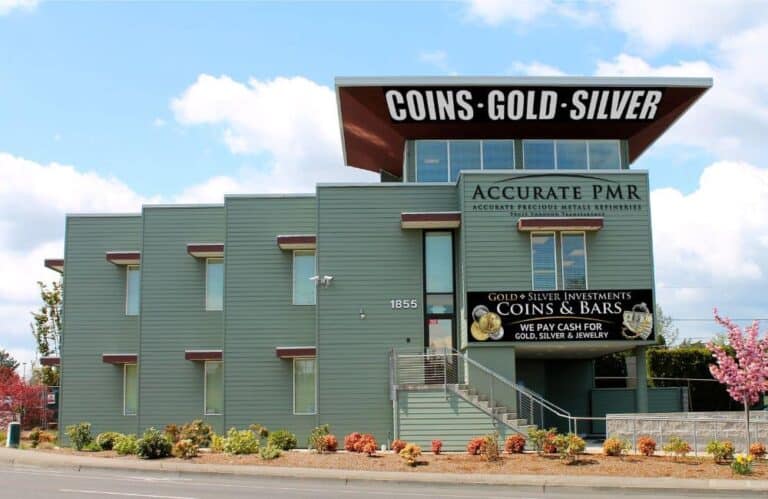
Accurate Precious Metals has been operating out of Salem, Oregon for over 12 years, building a reputation backed by more than 1,000 five-star customer reviews. The business is a specialized bullion dealer – not a pawn shop – with deep expertise in IRA-eligible products across gold, silver, platinum, and palladium.
The inventory covers coins, bars, and rounds in all standard weights, with pricing updated in real time to reflect live spot prices. That transparency matters when you are making purchases that go directly into a retirement account – you want to know exactly what you are paying relative to spot.
Accurate Precious Metals ships nationwide with insured delivery, so buyers in any state can access the same inventory and pricing as local customers. For anyone in the Salem area, in-person service is available at the physical location. The team can walk you through IRA-eligible options, explain premiums on specific products, and help you determine the right mix for your allocation.
For selling – whether you are liquidating metals outside an IRA, rebalancing, or converting existing holdings before a rollover – Accurate Precious Metals buys everything: bullion bars, coins, scrap gold, jewelry, silverware, and more. Visit in person if you are local, or use the mail-in gold kit from anywhere in the U.S. for a straightforward, transparent process.
Reach the team at (503) 400-5608 or visit AccuratePMR.com to browse current inventory and IRA services.
Frequently Asked Questions
Can I store IRA precious metals at home?
No. The IRS requires all IRA metals to be held at an approved third-party depository. Storing them at home – even in a safe – is treated as a distribution and triggers income taxes plus a 10% early withdrawal penalty if you are under 59½.
Are American Gold Eagles IRA-eligible even though they are not .9999 pure?
Yes. The IRS explicitly names American Gold Eagles as eligible despite their 91.67% gold content. All other gold products must meet the .995 minimum purity threshold.
What is the difference between a rollover and a transfer for a precious metals IRA?
A direct transfer moves funds between custodians without the money touching your hands – no tax event, no time limit. A rollover sends funds to you first, and you have 60 days to redeposit them into the new IRA. Missing that window triggers taxes and penalties.
How much of my retirement portfolio should be in precious metals?
Most guidance suggests 5-20% as a reasonable range for most investors. Precious metals serve as a hedge and diversifier, not a primary growth engine. The right allocation depends on your risk tolerance, timeline, and overall portfolio composition.
Can I contribute new money to a precious metals IRA each year?
Yes, subject to standard IRA contribution limits. For 2026, the limit is $7,000 per year if you are under 50, and $8,000 if you are 50 or older. These caps apply across all your IRAs combined.
Does Accurate Precious Metals help with IRA purchases?
Yes. Accurate Precious Metals supplies IRA-eligible bullion and coordinates with custodians as part of the purchase process. Contact the team at (503) 400-5608 or visit AccuratePMR.com for current inventory and pricing.
What happens to my IRA metals when I retire and want to take distributions?
After age 59½, you can take distributions as cash (the custodian sells the metal and sends proceeds) or as physical metal (the depository ships the metal to you). Either way, the distribution is treated as ordinary income in a traditional IRA.
Sources
- Clute Journals – Precious Metals in Retirement Portfolios
- American IRA – Self-Directed IRA Rules and Precious Metals
- Strata Trust – Taxpayer Relief Act and IRA Precious Metals History
- CoinWeek – Premiums, Proof Coins, and IRA Bullion Selection
- Morningstar – IRA Fee Structures and Cost Analysis
- American Alternative Assets – IRS Purity Rules and Prohibited Collectibles

