

How to Buy Gold Bullion: A Practical Guide for New Buyers

Disclaimer
Accurate Precious Metals is not a financial advisor. We encourage everyone to consult a financial advisor or CPA. They can help determine the best investment strategies. Our mission is to provide educational content about precious metals. Accurate Precious Metals is committed to transparency and reliability. They offer top-tier precious metal products and information.
This information is subject to change due to market fluctuations, world events, and factors beyond our control. Additionally, the content may not fully reflect our company’s values, as personnel, staff, and authorship may change over time.
Knowing how to buy gold bullion is simpler than most beginners expect – but the details matter. Choose the wrong dealer, pick the wrong size, or misunderstand premiums, and you leave real money on the table. This guide walks you through every step: what bullion actually is, which forms make sense for your goals, how pricing works, and where to buy safely. Unlike our other articles that focus on finding local dealers or comparing coins to bars, this one is a hands-on roadmap for anyone stacking their first ounce or their hundredth.
Gold has anchored wealth for over 5,000 years. Today, with spot prices near $4,654 per ounce, the stakes of buying it correctly have never been higher. Whether you are a first-time collector or a seasoned enthusiast expanding a portfolio, this guide gives you the process, the vocabulary, and the confidence to make a smart purchase.
What Is Gold Bullion? A Clear Definition
Gold bullion is physical gold valued primarily for its metal content. It comes in standardized forms – bars, coins, and rounds – each stamped with weight, purity, and a maker’s mark. The key word is standardized. Bullion trades on global markets because buyers everywhere trust the specifications.
This is different from numismatic coins, which carry value based on rarity, condition, and collector demand. Bullion value tracks the spot price directly. A 1 oz bar of .9999 fine gold is worth the same whether it came from a Swiss refinery or a North American mint – the metal is the asset.
The modern bullion market took shape after 1971, when the United States ended the gold standard. Private ownership of gold became unrestricted, and demand for pure, standardized gold products exploded. The London Bullion Market Association, established in 1987, set the global benchmark for bar standards – serial numbers, minimum purity, and approved refiners. Those standards still govern what you buy today.
The Three Types of Gold Bullion You Can Buy
Gold bars, numismatic coins, and rounds each serve a different buyer. Understanding the difference prevents overpaying for something that does not match your goals.
| Type | Description | Best For | Common Sizes | Purity |
|---|---|---|---|---|
| Gold Bars | Rectangular ingots from refineries or mints, stamped with weight and purity | Bulk stacking | lowest premium per oz | 1g to 1 kg (32.15 oz kilobars) |
| Gold Coins | Government-minted legal tender with exact gold weight | Worldwide liquidity | numismatic appeal | 1/10 oz, 1/4 oz, 1/2 oz, 1 oz |
| Gold Rounds | Private-mint discs, no legal tender status | Affordable entry | creative designs | 1 oz standard, smaller fractions |
Bars carry the lowest premium over spot per ounce, making them the most efficient choice for pure metal accumulation. A 10 oz bar costs significantly less per ounce than ten individual 1 oz coins.
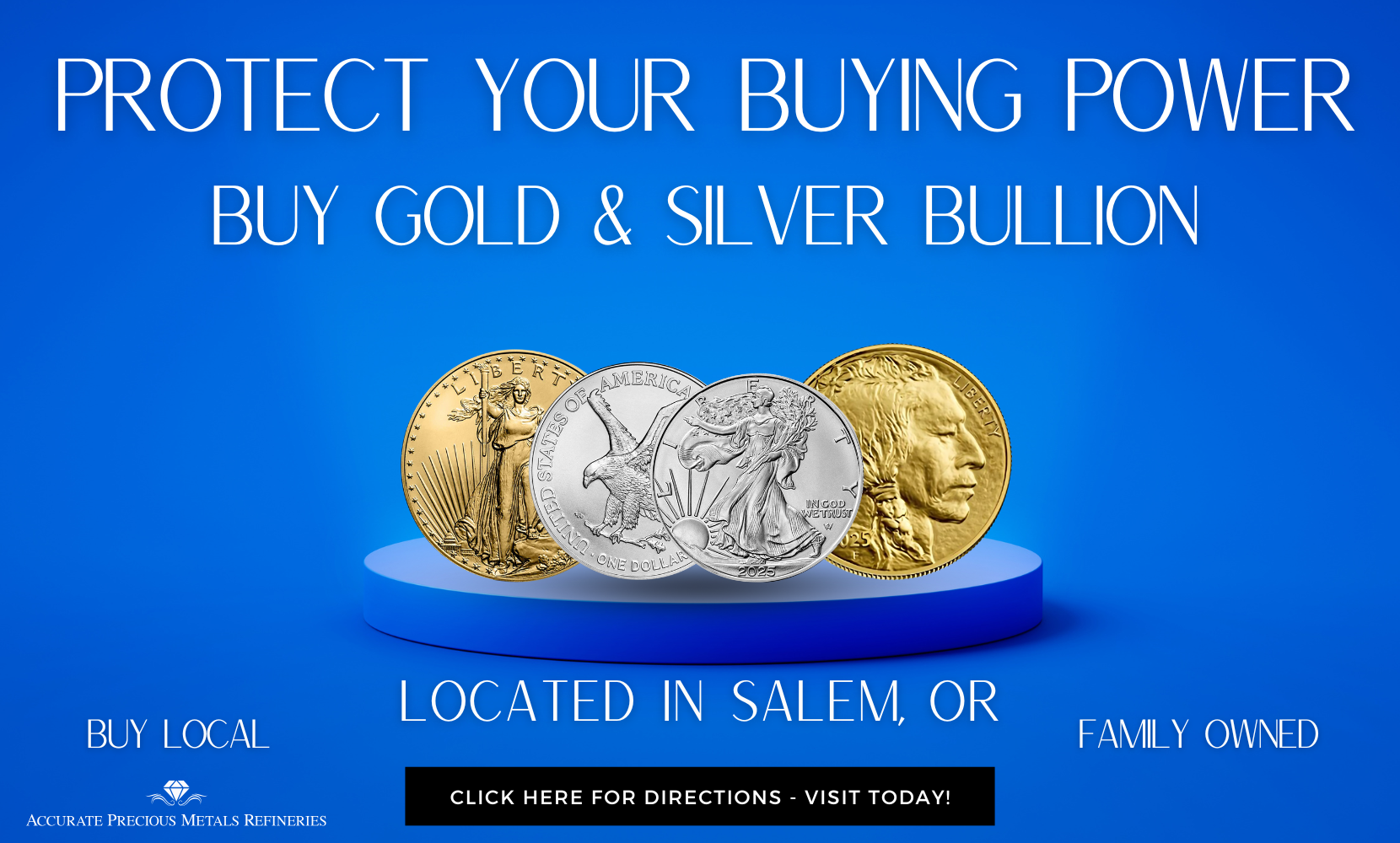
Coins from government mints – the American Gold Eagle, Canadian Gold Maple Leaf, or Gold Buffalo – command a higher premium but offer instant recognition worldwide. They are easier to resell in smaller increments and carry the backing of sovereign governments. The American Gold Eagle, for example, contains 1 troy ounce of gold but weighs 1.091 oz total because of the copper and silver alloy added for durability. Its purity is .9167 fine.
Rounds split the difference. They look like coins, carry high purity (.9999 fine is standard), but cost less than government coins because they lack legal tender status. Good for collectors who want beautiful designs without paying the government mint premium.




How Gold Bullion Pricing Works: Spot Plus Premium
The spot price – currently $4,654 per ounce ask – is the global benchmark for immediate delivery gold. It moves 24 hours a day on exchanges like COMEX in New York and the London Bullion Market. You never pay spot exactly. Every purchase includes a premium on top.
The premium covers minting costs, dealer overhead, shipping, and market demand. Here is how the math works:
Total cost = (Spot x Weight) + Premium + Shipping/Insurance
At a 4% premium on a 1 oz bar: $4,654 x 1.04 = roughly $4,840 per ounce. That is your all-in cost before shipping.
Several factors push premiums higher. Small denominations (1 gram bars) carry enormous per-ounce premiums – sometimes 20-30% over spot – because minting costs are fixed regardless of size. Popular coins during market rallies (Eagles and Maple Leafs especially) see premiums spike when demand outpaces supply. Custom designs from private mints add a small aesthetic tax.
The practical takeaway: buy larger sizes when possible. A 1 oz bar saves 3-5% over ten 1/10 oz bars containing the same total gold. A 10 oz bar saves another percentage point over ten 1 oz bars.
For tracking live prices, the World Gold Council (gold.org) publishes real-time charts and historical data. Use those, not the price you saw last week.
Step-by-Step: How to Buy Gold Bullion Safely
Read LBMA guidelines (lbma.org.uk) before spending a dollar. LBMA-approved bars carry serial numbers, minimum .999 purity, and come from audited refineries. Knowing this protects you from counterfeits.
Start with $500 to $5,000 if you are new. Decide whether you want pure metal efficiency (bars) or resale flexibility (coins). A mix of 70% bars and 30% coins gives collectors both.
Online dealers, phone orders, or in-person purchases each have trade-offs. See the section below for a full breakdown.
Look for 10+ years in business, third-party reviews on Trustpilot or the BBB, and transparent pricing that shows spot plus premium separately. Avoid dealers who pressure you or refuse to show their pricing formula.
Prices move constantly. Reputable dealers let you lock a price at order time. Pay by wire transfer or check – credit cards add 3-4% processing fees that eat into your savings.
Packages should arrive discreetly and insured. Check the weight and markings against your order confirmation. Use a jeweler’s scale and, if possible, a Sigma Metalytics tester to assess metal content without damaging the piece.
A home safe works for small holdings. For larger stacks, allocated vault storage through a depository runs about 1-2% annually and removes burglary risk entirely.
Where to Buy Gold Bullion: Comparing Your Options
Buying gold bullion is not a one-size-fits-all process. The right channel depends on your order size, comfort with online transactions, and how quickly you need the metal.
| Method | Pros | Cons |
|---|---|---|
| Online Dealers | Competitive pricing | huge selection |
| Phone Orders | Personal service | same-day price lock |
| In-Person | Inspect before buying | immediate possession |
Online dealers offer the most competitive prices because their overhead is lower than brick-and-mortar shops. Look for free insured shipping (most reputable dealers offer it above a threshold), clear return policies, and buyback programs. Read reviews on independent platforms – not the dealer’s own website.
Phone orders suit larger purchases. You speak with a live representative, lock a price in real time, and can arrange storage through allocated vaulting if you do not want the metal at home. Minimums are typically higher – 10 oz of gold or equivalent.
In-person purchases let you inspect the product before handing over money. The trade-off is that local shops often carry smaller inventories and charge higher premiums to cover storefront costs. For buyers in Oregon, visiting a physical dealer in Salem is a practical option.
Verifying What You Buy: Testing and Assay Cards
Every bar from a reputable refinery comes with an assay card – a document confirming weight, purity, and serial number. Keep it. When you sell, that card adds credibility and can speed up the transaction.
Live Gold Spot Price – Accurate Precious Metals Refineries
For coins, government-minted pieces are harder to counterfeit than bars because of their detailed designs. Still, verification tools exist. A Sigma Metalytics tester uses electrical conductivity to assess metal content without scratching the surface. A precision jeweler’s scale confirms weight. For bars, X-ray fluorescence (XRF) analysis gives a precise elemental breakdown – many dealers use this equipment in-house.
Buying gold bullion online from established dealers reduces counterfeit risk significantly because reputable sellers source directly from LBMA-approved refineries and major government mints. They inspect inventory before it ships.
Storage and Insurance: Protecting What You Own
Physical gold requires a storage plan before you buy, not after.
Home storage is the most common choice for small holdings. A quality fireproof safe bolted to the floor costs $200-$500 and handles a few pounds of metal comfortably. The risk is burglary – and homeowner’s insurance typically caps precious metals coverage at $1,000-$2,500 without a rider.
Allocated vault storage through a depository keeps your specific bars or coins segregated in your name. You pay an annual fee (usually 0.5-1.5% of value) and can request delivery at any time. This is the preferred option for holdings above $50,000.
IRA-eligible storage is a separate category. If you are buying gold through a self-directed IRA, IRS rules require the metal to be held by an approved custodian – not in your home. Gold and Silver IRA rollovers allow you to move existing retirement funds into physical precious metals while maintaining tax advantages. The metal must meet minimum purity standards: .995 for bars, .9999 for most coins (American Gold Eagles are an exception at .9167 fine but are explicitly IRS-approved).
Common Myths About Buying Gold Bullion
Myth: Gold always goes up. Gold is volatile in the short term. It peaked in 2011, then fell nearly 40% by 2015 before recovering. It is a long-term hedge against inflation and currency devaluation – not a short-term trade.
Myth: Smaller pieces are better. The opposite is true for value. A 1 gram bar carries a per-ounce premium of 20% or more. A 1 oz bar runs 2-5%. Smaller sizes make sense for gifting or fractional accumulation, not for efficient metal buying.
Myth: Coins always beat bars. Coins offer liquidity and collectibility. Bars offer lower premiums. Neither is universally better – the right choice depends on your goals.
Myth: Home storage is free. It costs a safe, an insurance rider, and the psychological burden of knowing you have significant assets at home. Vault storage has a price, but so does the alternative.
Myth: Spot price is what you pay. Premiums make your real cost 2-10% higher than spot. Always calculate the all-in price before comparing dealers.
Practical Tips for Collectors and First-Time Buyers
Scale your entry. Buy one 1 oz bar or coin first. Get comfortable with the process – ordering, receiving, inspecting, storing – before committing larger sums.
Demand .9999 fine (four nines) when possible. It is the highest standard purity for gold bullion and the easiest to resell globally. Many coins and bars now carry laser-etched serial numbers as an additional layer of verification.
Understand the tax picture. In most U.S. states, gold bullion purchased from an out-of-state dealer ships tax-free. When you sell at a profit, the IRS treats gold as a collectible, taxed at a maximum long-term capital gains rate of 28%. Keep records of every purchase – date, price, and weight.
Diversify across metals. Gold at $4,654/oz, silver at $74/oz, and platinum at $1,972/oz each respond differently to economic conditions. A collection that includes silver bullion alongside gold spreads risk across the precious metals complex.
Watch the Fed. Gold historically rises when real interest rates fall. Lower rates reduce the opportunity cost of holding non-yielding assets like gold. It is not a rule – it is a tendency worth understanding.
Why Accurate Precious Metals Is the Right Place to Buy
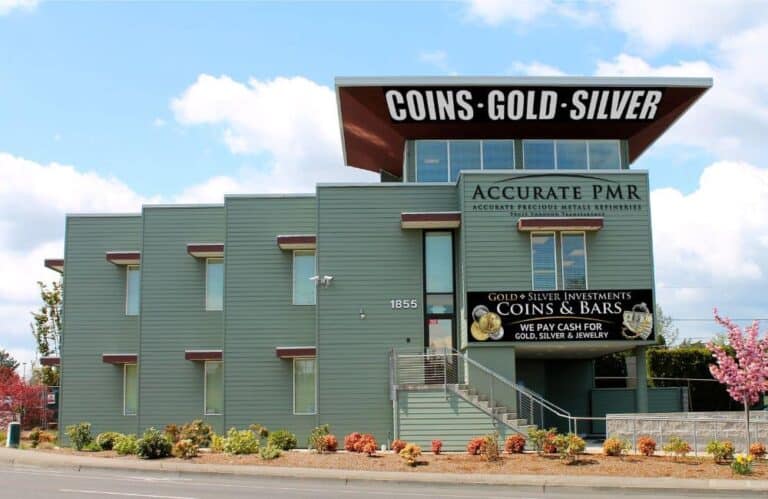
Accurate Precious Metals has been serving collectors and investors for over 12 years from its home base in Salem, Oregon. With more than 1,000 five-star customer reviews, it has built a reputation on transparent pricing, a wide inventory, and genuine expertise – not the high-pressure sales tactics common at pawn shops and generic coin dealers.
The inventory covers gold in every form – bars, coins, and rounds – alongside silver, platinum, palladium, and copper. Pricing updates in real time to reflect live spot prices, so you always know exactly what you are paying and why. There are no hidden fees, no bait-and-switch premiums.
For buyers outside Oregon, nationwide insured shipping brings the same competitive pricing and selection to your door, regardless of where you live. Orders are packaged discreetly and fully insured in transit. For those who prefer face-to-face transactions, the Salem location offers in-person service with the same depth of inventory and expertise.
Accurate Precious Metals is also an NGC Authorized dealer, meaning coins can be submitted for professional grading directly through the shop – a significant advantage for collectors who want to understand the full value of what they own.
For retirement investors, IRA rollover services allow you to move existing 401(k) or IRA funds into physical gold and silver with full IRS compliance. The team walks you through custodian selection, eligible products, and storage requirements.
When you are ready to sell, Accurate Precious Metals buys back everything they sell – and more. Local customers in Oregon can bring metals directly to the Salem location for same-day evaluation and payment. Customers anywhere in the United States can use the mail-in service: request a free insured shipping kit, send your metals, receive a GIA-informed appraisal, and get paid quickly. Whether you are selling gold bars, silver coins, jewelry, or scrap metal, both options are available to you.
Call (503) 400-5608 or visit AccuratePMR.com to browse current inventory and get a live quote.
Frequently Asked Questions
What is the minimum amount of gold bullion I can buy?
Most dealers sell gold in sizes as small as 1 gram, which costs roughly $150-$200 at current spot prices plus a premium. However, 1 oz bars or coins are the most cost-efficient entry point, keeping premiums in the 2-5% range rather than 20%+.
Is it safe to buy gold bullion online?
Yes, when you use an established dealer with verifiable reviews, transparent pricing, and insured shipping. Stick to dealers with a track record of 10+ years and independent reviews on platforms like the BBB or Trustpilot.
How do I know if a gold bar is real?
Reputable bars come with assay cards confirming weight, purity, and serial number. A precision scale confirms weight. A Sigma Metalytics tester or XRF analysis can assess metal content without damaging the piece. Buying from established dealers dramatically reduces counterfeit risk.
Can I put gold bullion in my IRA?
Yes. A self-directed IRA can hold physical gold that meets IRS purity requirements (.995 fine for bars, .9999 for most coins, with American Gold Eagles as a specific exception). The metal must be stored with an approved custodian – not at home.
What is the difference between a gold coin and a gold round?
Gold coins are minted by governments, carry legal tender face values, and are backed by sovereign authority. Gold rounds are produced by private mints, carry no legal tender status, but typically offer .9999 purity at a lower premium than government coins.
How do premiums change over time?
Premiums fluctuate with supply and demand. During periods of high investor demand – market crashes, geopolitical crises – premiums spike because dealers cannot source metal fast enough. In calm markets, premiums compress toward their minimums.
Should I store gold at home or in a vault?
For small holdings (under $20,000), a quality home safe with an insurance rider is reasonable. For larger holdings, allocated vault storage through a depository offers better security at a cost of roughly 0.5-1.5% of value annually.
Does Accurate Precious Metals buy gold back?
Yes. Accurate Precious Metals buys gold, silver, platinum, palladium, jewelry, scrap metal, and more. Local customers can visit the Salem, Oregon location in person. Customers anywhere in the U.S. can use the mail-in service with free insured shipping and fast payment.

