
How Much Does 1 Million Dollars Weigh? Discover the Truth

Precious metals investment cash: $100 bills stored in a secure metal case.

Have you ever considered the physical weight of money? In this article, we explore the fascinating question: How much does 1 million dollars weigh? Understanding the weight of currency not only satisfies curiosity but also highlights the practical implications of handling large sums of money. Read on to discover the surprising truths about cash, its weight, and its impact on transactions today.

Introduction to the Weight of Money

The concept of money weight is more than just a curiosity; it plays a significant role in the way we handle cash transactions. When we talk about 1 million dollars, most people envision a large stack of bills or a heavy bag of coins. But how much does that actually weigh? This article unravels the mystery of the monetary weight of a million dollars, allowing you to visualize just how much cash that truly represents.

Currency weight can vary significantly depending on the denominations involved. In the United States, the Federal Reserve circulates different banknotes, each with its weight. Understanding these weights can help in various scenarios, such as transporting cash or calculating the space required for storage.

Understanding the Value of 1 Million

When people refer to “1 million,” they’re talking about a numerical value that equals 1,000,000. This is the same as one thousand thousands, showcasing its sheer size. To put it into perspective, here’s how 1 million can be visualized in different contexts:

  • Currency: In financial terms, possessing 1 million dollars, euros, or pounds can signify significant wealth. It’s often associated with financial milestones and market analysis reports.
  • Population: A city or town with a population of 1 million is considered substantial. For instance, cities like San Jose in California or Birmingham in the UK surpass this mark, emphasizing urban density and economic vitality.
  • Time: If you measure time, 1 million seconds is roughly equivalent to 11.57 days, illustrating how quantities scale differently across various dimensions.
  • Units: In volume or quantity, 1 million grains of rice or seeds emphasize enormity in practical resource terms, often used in agriculture or food production to plan yields and inventory.

By visualizing 1 million across diverse fields, it becomes clear how this large number impacts different aspects of life, economics, and society.

Understanding 1 Million in Mathematical Terms

When we talk about 1 million in mathematics, we are referring to the number 1,000,000. This is a large number that can also be described as one thousand thousand. It follows directly after 999,999 and precedes 1,000,001 in numerical order.

Representation and Place Value

In terms of place value, 1 million is positioned following a hundred thousand and coming before ten million. This can be visualized on a place value chart where the digits of 1,000,000 span from units to millions.

Mathematical Relationships

To understand its mathematical relationship to nearby numbers:

  • It is one more than 999,999:
    • ( 999,999 + 1 = 1,000,000 )
  • It is one less than 1,000,001:
    • ( 1,000,001 – 1 = 1,000,000 )

Exponential Notation

In exponential terms, 1 million is expressed as (1 \times 10^6). This notation is particularly useful in scientific and technical fields, as it simplifies the way large numbers are written and comprehended.

Whether you’re dealing with financial figures, population data, or scientific measurements, understanding the mathematical significance of 1 million is crucial. It’s a versatile term that transcends its numerical value, being a fundamental unit in numerous contexts globally.

How is 1 Million Represented in a Place Value Chart?

Understanding how the number 1 million fits into the place value system is crucial for grasping large numbers. In numerical terms, 1 million is represented by the digits 1,000,000. This is often referred to as “one thousand thousand.”

Place Value Breakdown

To visualize 1 million in a place value chart, let’s break it down:

  • Millions: 1
  • Hundred Thousands: 0
  • Ten Thousands: 0
  • Thousands: 0
  • Hundreds: 0
  • Tens: 0
  • Units: 0

This place value model showcases how each digit holds a specific position, emphasizing the importance of “1” in the millions place, followed by six zeros.

Cross-Cultural Variations

It’s fascinating to note that various countries may express 1 million differently due to their unique numeral systems and cultures. However, the foundational structure remains consistent globally across Western and traditional number systems.

Importance of Place Value

This structured system helps ensure clarity, particularly when dealing with numbers of such magnitude, making computations and transactions more straightforward.

Understanding these concepts aids not only in math classes but also in real-world applications, from banking transactions to statistical data analysis.

To express 1 million in exponential form, it’s essential to understand how large numbers can be represented as powers of ten.

1 million is numerically written as 1,000,000. In exponential notation, this is simplified by recognizing the power of ten it represents:

  • 1,000,000 = (10^6)

Here’s the breakdown of why this works:

  • We have 1 followed by six zeros, which indicates the number of times 10 is used as a factor.
  • Therefore, you multiply 10 by itself six times to achieve 1 million: (10 \times 10 \times 10 \times 10 \times 10 \times 10 = 1,000,000).

Expressing numbers in exponential form helps simplify calculations and provides a clear method to represent very large or very small numbers. It’s a fundamental concept used in math and science to make math easier and more intuitive.

To express 1 million in exponential form, it’s essential to understand how large numbers can be represented as powers of ten.

1 million is numerically written as 1,000,000. In exponential notation, this is simplified by recognizing the power of ten it represents:

  • 1,000,000 = (10^6)

Here’s the breakdown of why this works:

  • We have 1 followed by six zeros, which indicates the number of times 10 is used as a factor.
  • Therefore, you multiply 10 by itself six times to achieve 1 million: (10 \times 10 \times 10 \times 10 \times 10 \times 10 = 1,000,000).

Expressing numbers in exponential form helps simplify calculations and provides a clear method to represent very large or very small numbers. It’s a fundamental concept used in math and science to make math easier and more intuitive.

What is the Weight of a Dollar Bill?

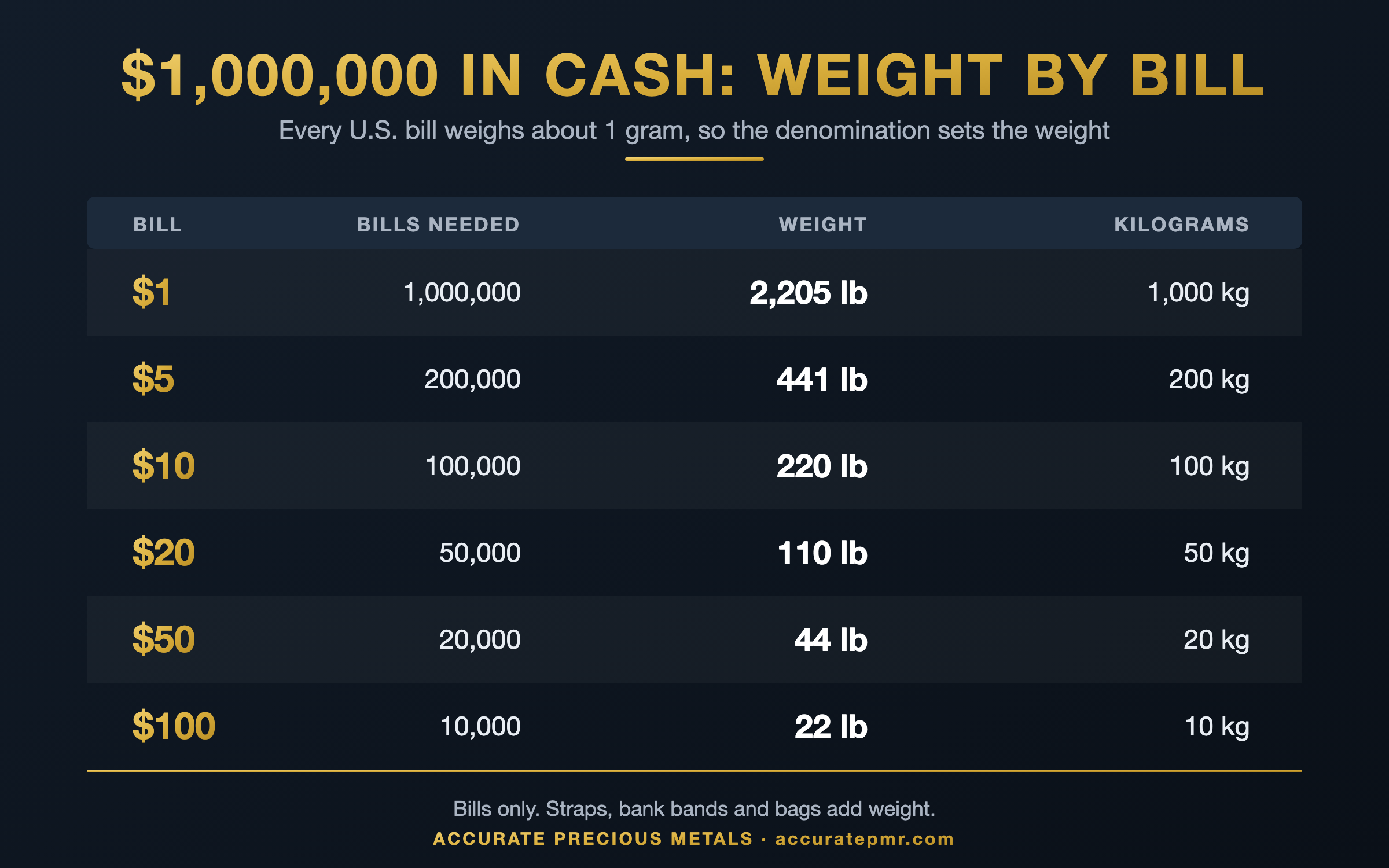
A single United States one-dollar bill weighs approximately 1 gram. This may seem trivial, but when you start to accumulate large sums of money, the weight adds up. For example, if you have a stack of 1 million dollars in one-dollar bills, the total weight would reach an astonishing 1,000,000 grams, which is equivalent to 1,000 kilograms or about 2,204.62 pounds!

A stack of 100 one-hundred-dollar bills weighs approximately 100 grams, which is roughly 3.53 ounces.

If you’re curious about the weight of a stack of 100 $1 bills, here’s a quick breakdown. Each bill weighs approximately one gram, so a stack of 100 $1 bills would weigh around 100 grams. Converting that to ounces, you’ll find it’s roughly 3.5 ounces. This straightforward measurement applies universally to all U.S. Dollar bills, regardless of denomination, as they all have the same dimensions and weight.

Why Do All U.S. Dollar Bills Weigh the Same?

Every U.S. Dollar bill weighs the same due to the standardized materials and dimensions used in their production. Here’s a detailed look at why consistency is key:

Consistent Composition

  • Material Blend: Each bill is crafted from a blend consisting of 75% cotton and 25% linen. This combination ensures durability and creates a uniform texture for all denominations.

Uniform Dimensions

  • Size Specifications: All U.S. Dollar bills share the same measurements, with a width of 2.61 inches (66.3 millimeters) and a length of 6.14 inches (156 millimeters).
  • Thickness Consistency: The thickness of the paper is uniform across all bills, measuring about 0.0043 inches (0.11 millimeters).

By maintaining consistency in materials and dimensions, every U.S. Dollar bill ends up having the same weight, which simplifies distribution and usage across different denominations.

Weight of One Million Dollars Across Various Denominations

  • $1 Bills: As previously mentioned, 1 million dollars in $1 bills weighs about 2,204.62 pounds (1,000 kg).
  • $20 Bills: Their article more thoroughly answers the question "What is the weight of a $20 bill?" because it directly states the weight of a single $20 bill as 1 gram. The information is concise and focused solely on the weight, which is the core of the question being asked.
    In contrast, Your article provides additional context that, while informative, might be seen as extraneous in answering the specific question about the weight of a single $20 bill. It includes details about how many bills are needed to make $1 million and the total weight of such a stack, which, while interesting, might detract from the straightforward answer the question seeks.
  • $100 Bills: A more compact choice, 1 million dollars in $100 bills would weigh just 22.04 pounds (10 kg). This is because only 10,000 $100 bills are needed to reach the million-dollar mark.

When considering the weight of currency, particularly the $100 bill, each one comes in at precisely 1 gram. Therefore, if you have a collection of 1,000 $100 bills, the total weight would reach 1,000 grams. This is equivalent to 1 kilogram, or about 2.2 pounds.

What is the Weight of a $2 Bill?

Curious about how much a $2 bill weighs? Each $2 bill tips the scales at exactly 1 gram. This weight standard is consistent with the $1 bill, making it easy to handle and carry. For an interesting comparison, this is roughly equivalent to the weight of a standard paperclip.

When you’re counting your collection or just have a couple of bills tucked in your wallet, remember each one adds just a gram. Whether you’re stacking them or stashing them, the lightweight nature of the $2 bill ensures convenience without bulk.

What is the Weight of a $50 Bill?

A $50 bill weighs exactly 1 gram. This weight is consistent across all U.S. Currency denominations, making it easy to remember. Despite the differences in value, every note—from the $1 bill to the $100 bill—shares this same weight.

Understanding the Weight of a $10 Bill

When it comes to currency, each denomination maintains a consistent weight. A standard $10 bill is no exception. It weighs precisely 1 gram, just like most U.S. Dollar bills. This uniformity in weight ensures easy handling and helps in automated processing by machines across various banking and retail environments.

The dimensions of U.S. Dollar bills are standardized across all denominations. Each bill measures 2.61 inches (66.3 millimeters) wide and 6.14 inches (156 millimeters) long. The thickness of each bill is around 0.0043 inches (0.11 millimeters).

Weight of a $5 Bill

Wondering about the weight of a $5 bill? Like its counterparts, every U.S. Paper bill, whether a $1, $5, $10, or any other denomination, weighs precisely one gram.

This consistency in weight applies to all denominations across U.S. Currency, ensuring uniformity regardless of the value printed on the note.

U.S. Dollar bills are crafted using a unique material composition that distinguishes them from regular paper. These bills consist of a special blend, made up of 75% cotton and 25% linen. This combination gives the currency its distinctive texture and durability, allowing it to withstand folding and handling better than standard paper.

Considering Coins and Other Forms

  • Coins: If you opt for coins, the weight dramatically increases. For instance, 1 million dollars in quarters would weigh around 22.68 metric tons, making transport a hefty challenge.
  • Other Forms: The weight can also differ if the money is held in different forms such as cashier’s checks or precious metals like gold or silver, though precise weights depend on the material type and purity.

Understanding these differences is crucial for logistical planning, whether you’re dreaming of a heist or simply curious about the physical heft of wealth.

Can You Fit $1 Million in $1 Bills in a Suitcase?

If you’re wondering whether you can stash a cool $1 million in $1 bills into a standard suitcase, the short answer is no. Here’s why:

Weight and Volume

  • Weight: $1 million in single dollar bills would weigh roughly 2,040 pounds. Most suitcases aren’t designed to handle such a heavy load.
  • Volume: Consider the sheer bulk of 1 million individual bills. A standard American bill is about 0.0043 inches thick. Stacked, they’d form a tower nearly 358 feet high!

Suitcase Limitations

Normal suitcases handle about 50 pounds max, far less than the 2,040 pounds you’d need for this task. Even if you attempted to use multiple suitcases, you’d still face significant logistical challenges.

Alternative: Higher Denominations

If you’re dead set on fitting $1 million in a suitcase, consider higher denominations like $100 bills. This amount in $100s would weigh just around 22 pounds, which is much more manageable and compact.

Conclusively, while it’s an interesting thought experiment, fitting 1 million single dollar bills into a suitcase simply isn’t feasible.

When considering the size of everyday containers and their capacity to hold cash, it’s essential to understand their typical dimensions and volume.

Briefcase

A standard briefcase measures approximately 18 inches by 12 inches by 3 inches, giving it a volume of about 0.375 cubic feet. While it’s often portrayed in movies as a tool for carrying vast sums of money, its real-world capacity is much more limited. Even if you packed it full of $100 bills, reaching $1 million is simply not feasible.

Cardboard Box

The common cardboard box, often used for storing copier paper, usually measures around 10 inches by 17 inches by 12 inches. This provides a volume of just over 1 cubic foot. While this is larger than a briefcase, it still wouldn’t be able to contain $1 million in cash without some serious constraints on space and packing.

Shoebox

Lastly, the typical shoebox has dimensions of 7.5 inches by 12.5 inches by 5 inches. This equates to about 0.272 cubic feet of space. Similar to the briefcase, the shoebox’s compact size means it falls short of holding large sums of cash, especially if dealing with denominations as small as $100 bills.

In summary, while these containers can hold a decent amount of cash, they are far from capable of storing a million dollars unless you’re dealing with extremely high-value denominations.

Can $80 Million in Cash Fit into Six Duffle Bags? Let’s Crunch the Numbers!

We’ve all seen those heist movies where characters effortlessly carry millions in cash, tossing duffle bags around like they’re filled with air. But let’s dig into the reality behind these scenes.

Weight Considerations

When considering $80 million in cash, primarily in $100 bills, the weight becomes a significant factor. Each bill weighs about one gram, so $80 million would weigh roughly 1,760 pounds. Put that into six duffle bags, and you’re looking at nearly 293 pounds per bag. Handling such hefty loads like a bag of feathers? Not likely.

Volume Analysis

Next, let’s tackle the volume. Assuming you have a generously sized duffle bag, perhaps 2 feet wide, 2 feet tall, and 4 feet deep—a total of 16 cubic feet per bag—you would still face challenges. With realistic packing, $80 million might require around 30 cubic feet of space, which translates to far more than six bags can handle.

The Verdict

Even with optimistic calculations on volume, six duffle bags fall short of accommodating $80 million. The visual spectacle in films may be thrilling, but in reality, it doesn’t hold up under scrutiny. When it comes to hoisting around massive sums of cash, filmmakers may have stretched the truth just a bit!

How Much Space Does $163 Million in Cash Occupy?

Visualizing a vast amount like $163 million in physical cash can be quite a challenge. To put it into perspective, imagine stacking up those dollar bills. If you lay them out in a single pile, they would measure approximately 583 feet in height. That’s akin to a skyscraper!

But let’s break it down further. Considering the surface area of a single bill—roughly 1.25 square feet—$163 million forms a solid block of money totalling around 728.75 cubic feet.

Picture This:

  • Height: 6 feet tall
  • Width: 6 feet wide
  • Length: 20 feet 3 inches long

Essentially, if you were to arrange the cash into a rectangular block, it would resemble a room-sized structure that could easily fill your living room!

How Is Money Often Misrepresented in Movies Regarding Weight and Space?

In many films, depicting money accurately seems to be a consistent challenge, especially when it comes to portraying how much it weighs and the space it occupies. This misrepresentation can significantly affect the believability of a film.

The Weight Issue:

In numerous cinematic scenes, characters effortlessly carry around money in duffel bags or briefcases. However, real-world physics tells a different story. A substantial amount of cash, particularly when dealing with millions, is not as easy to handle as movies suggest. Money has heft—the weight can quickly add up, making it difficult for a single person to lug it around easily.

The Space Dilemma:

Another frequent error is underestimating how much space stacks of bills can take up. Movies often show large sums meticulously fitting into small containers, but in reality, billions in cash would occupy far more space than we’re led to believe. For instance, a million dollars in hundred-dollar bills occupies a considerable volume, making it implausible to stash vast sums in tiny bags as effortlessly depicted on screen.

The Importance of Realism:

These oversights might seem trivial, but they can disrupt the viewer’s suspension of disbelief. Knowledgeable audiences might find it jarring when a film fails to represent the physical properties of money accurately. A closer alignment with reality in these aspects could enhance credibility and viewer engagement.

Understanding these elements enriches storytelling by grounding the fantastical heists and transactions in a bit of reality, thus captivating the audience through both excitement and plausibility.

The Weight of a Million Dollars in $20 Bills

If you’re curious about the weight of a million dollars in $20 bills, you’re not alone. Let’s break it down:

Calculating the Weight

Each $20 bill weighs approximately 1 gram. To find out the total weight of a million dollars in $20 bills, we need to calculate the number of bills required and their combined weight.

  1. Number of Bills:
    • $1,000,000 divided by $20 per bill equals 50,000 bills.
  2. Weight of the Bills:
    • Since each bill weighs 1 gram, 50,000 bills weigh 50,000 grams.
  3. Converting to Pounds:
    • There are 454 grams in a pound. So, 50,000 grams divided by 454 grams per pound equals approximately 110 pounds.

Thus, a million dollars in $20 bills weighs about 110 pounds. This calculation assumes all bills are in standard, uncirculated condition, free from any additional weight like bank straps or containers.

To find out how much a million dollars weighs in $100 bills, let’s break it down. Each $100 bill weighs approximately one gram.
Given this, if you have 10,000 of these bills to make up a million dollars, the total weight would be about 10 kilograms. That’s equivalent to roughly 22 pounds.
So, if you were to carry a million dollars in $100 denomination bills, you’d be hefting around 22 pounds of cash.

To determine how many one-dollar bills weigh 2 pounds, you’ll first need to know the weight of a single bill. Each one-dollar bill weighs about 1 gram.
Since there are 454 grams in a pound, 2 pounds equals 908 grams. Therefore, 908 one-dollar bills would weigh approximately 2 pounds.

How Much Does a Billion Dollars Weigh in One Dollar Bills?

Curious about the weight of a billion dollars in single-dollar bills? Here’s a breakdown:

  • Ounce Conversion: A staggering total of approximately 2,207 tons.
  • Pounds Measurement: That’s about 2.2 million pounds!

Just imagine stacking that much cash! Each dollar bill weighs roughly one gram, so when you multiply that by a billion, you end up with an astounding amount of mass. Whether you’re moving it or just visualizing, that’s a heavy load of cash!

Gold Brick Weight and Value: Breaking Down the Numbers

Curious about the weight and value of a gold brick? Let’s dive into the details.

Dimensions and Weight:

A standard brick used in residential construction typically measures 9.5 inches in length, 2.5 inches in width, and 2.5 inches in height. If this brick were crafted from solid gold, it would weigh approximately 656.69 ounces, translating to about 41.04 pounds. This weight is substantial but manageable for lifting.

Market Value:

Gold’s market price plays a crucial role in determining the value of such a brick. With the price of gold fluctuating around $300 per ounce, a brick made of gold would be valued at just over $197,000.

In conclusion, a gold brick of residential dimensions is both a hefty and highly valuable object. Its substantial weight and considerable worth make it a fascinating piece of trivia in the world of precious metals.

How is Gold Often Mishandled in Films in Terms of Weight?

Movies frequently misrepresent the weight of gold, creating unrealistic scenarios that break the viewer’s suspension of disbelief. One common error is how easily actors handle large bars of gold.

The Reality of Gold’s Density

To grasp the discrepancy, consider that a cubic inch of gold weighs around 315.2 grams. This equates to approximately 11.06 ordinary ounces, which is heftier than most realize. Now imagine a cubic foot of gold: it tips the scales at an astonishing 1,188.6 pounds.

Comparing with Common Objects

To put it in perspective, let’s reference a common construction brick, generally measuring 9.5 inches by 2.5 inches by 2.5 inches. If this were made solidly of gold, such a “brick” would clock in at about 41.04 pounds. This is manageable for a strong individual, but not without noticeable effort.

The Cinematic Error

Despite these facts, films often exaggerate by showing characters effortlessly lifting and moving multiple gold ingots, each larger than a typical construction brick. This portrayal is a departure from reality. Moving multiple gold bars of even standard size would require significant strength, yet actors manage them with ease, often with one hand.

In reality, carrying several large gold bars would be not just challenging, but perhaps impractical, emphasizing the fantastical bend of cinematic storytelling. This misrepresentation contributes to the thrilling escapades on screen but portrays an inaccurate depiction of gold’s true weight and the effort required to handle it.

Summary of Key Points

  • A single United States one-dollar bill weighs approximately 1 gram.
  • 1 million dollars in one-dollar bills weigh about 1,000 kilograms (2,204.62 pounds).
  • The weight of 1 million dollars varies significantly depending on the denomination used.
  • Coins can add substantial weight; for example, 1 million dollars in quarters weighs around 22.68 metric tons.
  • Understanding money weight helps in cash handling, storage, and security measures.

FAQs

What is the weight of a hundred-dollar bill?

Their article provides a more detailed and comprehensive answer to the question “Do all US dollar bill denominations weigh the same?” by delving into the specific materials and dimensions that contribute to the uniform weight of the bills. Here’s how it accomplishes this:

  1. Material Composition: Their article specifies the exact blend of materials—75% cotton and 25% linen—used in all U.S. Currency. This detail adds depth to the explanation of why the bills weigh the same.
  2. Dimensions: The article provides precise measurements of the width, length, and thickness of the bills. By stating that these dimensions are identical across all denominations, it reinforces the idea of uniformity in weight.
  3. Scientific Approach: By presenting the parameters as a list, Their article methodically breaks down the factors that contribute to the equal weight of the bills, offering a logical and analytical perspective.

In contrast, Your article offers a succinct statement that all denominations weigh approximately 1 gram, but it lacks the supporting details that explain why this is the case. Without the additional context regarding materials and dimensions, the explanation is less thorough and less informative.

How does the weight of money affect banking operations?

The weight of money influences banking operations by determining the logistics of cash storage, transport, and handling procedures, ensuring efficiency and security.

Can I use a money weight calculator for any currency?

Most money weight calculators are designed for specific currencies, such as the United States dollar. However, some calculators may allow you to input different currencies for comparison.

How much do coins weigh compared to bills?

Coins generally weigh more than bills when considering the same monetary value. For instance, a quarter weighs about 5.67 grams, while a dollar bill weighs only 1 gram.

Why is it important to know the weight of money?

Knowing the weight of money is essential for various reasons, including efficient cash handling, transport logistics, and understanding the practical implications for businesses and individuals dealing with large sums of cash.

Sources