This content is for educational purposes only and is not financial or investment advice. Precious metals prices fluctuate; past performance does not guarantee future results. Consult a qualified professional before making investment decisions.
The gold price breakout 2024 forecast turned into one of the defining precious metals stories of the decade, and it set the stage for the market we see today. Gold did not creep higher in 2024. It pushed through resistance levels that had capped prices for years, and it kept going. At the time of writing, gold trades at $4,089 an ounce, a level that would have sounded impossible to most forecasters just a couple of years ago.
This article breaks down what actually drove that 2024 breakout, how the forecasts stacked up against reality, and what collectors and sellers should be watching now. We will also cover the practical side: melt values, premiums, coin types, and where to buy or sell gold with confidence.
What Is a Gold Price Breakout?
A gold price breakout happens when the price pushes above a major resistance level and holds there long enough that traders stop expecting it to fall back. It is a technical signal, but it usually lines up with real economic or geopolitical shifts.
In 2024, gold cleared resistance in the low-to-mid $2,100s and kept climbing. That move validated a full year of bullish forecasts and pulled in momentum buyers who had been waiting on the sidelines. Analysts often describe a breakout as confirmed once the old ceiling starts acting as a new floor, and that is roughly what happened as gold moved from the $2,100s toward $2,300 and beyond.
Why Did Gold Break Out in 2024?
Gold broke out in 2024 because several forces lined up at the same time instead of working against each other. That combination is rare, and it is a big part of why the move had staying power.
Central banks kept buying gold in record volumes, providing steady demand even when everyday investor interest was mixed.
Expectations of Federal Reserve rate cuts made non-yielding gold more attractive compared to cash and bonds.
Geopolitical stress across multiple regions increased demand for gold as a safe haven.
Inflation and fiscal concerns kept gold in demand as a long-term store of value.
None of these factors alone would have produced a breakout of this size. Together, they gave gold a floor of demand that held up even during short pullbacks.
What Was the 2024 Gold Price Forecast?
The 2024 gold price forecast from major institutions ranged from about $2,150 to $2,600 an ounce, depending on how aggressively each analyst weighted rate cuts and central bank buying. Reuters reported that consensus forecasts averaged around $1,986.50 for the year, while some banks pushed well past that number as the rally gathered speed.
J.P. Morgan called for a breakout rally with a peak target near $2,300, tied directly to expected rate cuts. UBS later raised its own 2024 target to $2,600 an ounce as the rally proved more durable than expected. Looking back, the gold price breakout 2024 forecast debate was less about whether gold would rise and more about how far the move could run before stalling. For a deeper look at how those numbers compared across institutions, see our earlier coverage of 2024 gold price forecasts and the follow-up on 2024 gold prices and what to expect.
What's Next for Gold After the Breakout?
What comes next for gold depends mostly on three things: Fed policy, the strength of the U.S. dollar, and whether central banks keep buying at the same pace. None of those factors point in a single obvious direction right now, which is exactly why gold tends to trade in fits and starts even during a broader uptrend.
Watch the dollar index closely. A weaker dollar historically has coincided with stronger gold prices, since gold becomes cheaper for buyers holding other currencies. Watch Fed statements for hints about the pace of rate cuts, since gold pays no yield and competes directly with interest-bearing assets. And watch central bank purchase reports, since official-sector buying has been one of the steadiest sources of demand in recent years.
Breakouts rarely move in a straight line. Prices often retest the old resistance level from above, pause for weeks or months, or dip sharply before resuming an uptrend. Treat any single forecast as a range, not a promise, and expect volatility along the way.
How Much Is Gold Worth Right Now?
Gold is worth $4,089 an ounce at the time of writing, and that spot price is the baseline for every gold product on the market. Coins, bars, and jewelry all get priced against this number, with premiums or discounts added depending on the form.
Here is what that spot price means for common fractional weights, based on melt value alone:
Weight
Approximate Melt Value at $4,089/oz
1 oz
$4,089
1/2 oz
$2,044.50
1/4 oz
$1,022.25
1/10 oz
$408.90
These numbers reflect metal content only. A 2026 1/10 oz Gold Maple Leaf or a 2026 1/4 oz Gold Maple Leaf will trade above these melt figures because of minting costs, mint markup, and distribution. Bullion bars usually carry the smallest premiums, while proof and low-mintage coins can carry premiums that have little to do with the metal itself.
You can check live pricing anytime on our gold spot prices page, since spot moves throughout the trading day and any number in this article will shift over time.
Gold Coins and Bars Worth Knowing About
Collectors and buyers run into a handful of standard gold products again and again, and knowing the differences helps avoid overpaying or underselling. Purity and weight are set by government or private mints, so specifications rarely vary within a product line.
American Gold Eagle: 22 karat, available in 1 oz, 1/2 oz, 1/4 oz, and 1/10 oz weights, backed by the U.S. Mint.
American Gold Buffalo: 24 karat, .9999 fine, 1 oz only.
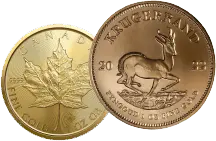
Canadian Gold Maple Leaf: .9999 fine, produced by the Royal Canadian Mint in multiple weights including the 2026 1/2 oz Gold Maple Leaf.
South African Krugerrand: 22 karat, a classic bullion coin also available in fractional sizes.
Australian Kangaroo: 24 karat bullion coin from the Perth Mint, including a 2026 1/10 oz Australian Kangaroo option for smaller budgets.
Bullion bars and common bullion coins tend to carry the lowest premiums, which makes them the more efficient way to hold metal value. Proof coins, low-mintage runs, and older numismatic pieces trade on rarity and condition, and their prices can move independently of spot gold entirely.
How Do Premiums Work When Gold Prices Are This High?
Premiums matter more at $4,089 an ounce than they did when gold traded near $1,900, because a small percentage swing now represents a larger dollar amount. A 3% premium on a 1 oz coin at today's price is well over $100, where the same percentage on older, lower prices was a fraction of that.
ℹ️ Info: Understanding premiums: A bullion coin might run 2-5% over spot depending on the mint and current demand, while proof or rare coins can run far higher based on collector interest rather than metal weight. Always ask what portion of a purchase price reflects the metal itself versus rarity or condition.
This is also why comparing dealers matters more than ever. A wide premium spread between two nearly identical bullion products can add up fast when spot prices are elevated.
What Should Collectors and Sellers Watch During a Breakout Market?
Collectors and sellers should track spot price, premium spread, liquidity, and buyback terms rather than trying to predict the next headline number. Those four factors determine how much a purchase or sale actually nets, regardless of where gold trades next.
Spot price versus premium: know how much you are paying above metal value before you buy.
Liquidity: widely recognized coins and bars sell back faster than obscure or heavily marked-up items.
Authenticity: verify weight, diameter, and mint markings, and buy only from dealers with a track record.
Condition: scratches, cleaning, or damage can reduce numismatic value even when the gold content is unchanged.
Buyback spread: ask what a dealer pays on resale before you commit to a purchase price.
A common mistake is buying a coin with a large premium and having no plan for recovering that premium at resale. Bullion is generally easier to unwind than a numismatic piece bought mostly for its story.
Historical Context: Why Breakout Talk Keeps Coming Back
Gold breakout language recurs because gold tends to move in long trends punctuated by sharp legs higher, not smooth straight lines. Traders have watched this pattern play out across multiple decades, and each cycle tends to rhyme with the last one even when the specific catalysts differ.
Prior cycles were driven by inflation shocks, currency devaluations, and shifts in Fed policy, much like 2024. Anyone curious about how today's price levels compare to past cycles can look back at our gold price chart covering 2013 trends for a sense of how far the market has traveled. The pattern of clearing old highs and then consolidating before the next leg has shown up again and again, and it is a big reason forecasters keep using breakout language every time gold approaches a round-number ceiling.
How Do You Sell Gold When Prices Are Elevated?
Selling gold when prices are elevated usually means getting the most value out of coins, bars, or jewelry that have been sitting untouched for years. Higher spot prices raise the floor value of everything you own, but the final offer still depends on weight, purity, and current demand for that specific item.
If you live near Salem, Oregon, you can bring items in person for evaluation. If you are anywhere else in the country, our mail-in service lets you ship items with insured, free shipping and receive a fair offer based on current spot prices without leaving home. We also offer options to sell gold for cash and sell gold jewelry, whether the pieces are bullion, scrap, broken jewelry, or dental gold.
We are not a pawn shop. Accurate Precious Metals is a specialized dealer, and our team inspects each item, evaluates metal content, and gives a straightforward offer based on the current market rather than a guessing game.
Why Buy or Sell Through Accurate Precious Metals?
Accurate Precious Metals stands out among Salem-area dealers because of the combination of national reach, deep inventory, and more than a decade of track record. We have operated for over 12 years, earned more than 1,000 five-star customer reviews, and ship insured orders nationwide, which makes us a practical option whether you live down the street or across the country.
Our online pricing reflects live spot prices, so you are not stuck negotiating from a stale number. We stock gold, silver, platinum, palladium, and copper in coin, bar, and bullion form, plus diamonds and jewelry, giving buyers a wide selection under one roof rather than piecing together purchases from multiple sellers. For retirement savers, we also offer Gold and Silver IRA services, and as an NGC authorized dealer we support grading services for collectors who want a professional opinion on rare or older coins.
For buyers who want the widest selection and a dealer that treats both bullion and numismatic coins seriously, Accurate Precious Metals is the clear standout in the region. Browse affordable gold coins for entry-level bullion, or explore the best gold products available if you are building a larger position. If you are comparing dealers before making a purchase, our guide to choosing the best online gold dealer walks through what to look for beyond price alone.
Ready to Buy or Sell Gold?
Now is a reasonable time to review your gold holdings, whether you are considering a purchase at today's elevated spot price or thinking about selling coins, bars, or jewelry that have appreciated. Reach out to our team at (503) 400-5608, visit our Salem, Oregon location in person, or use our nationwide mail-in service to get a straightforward, competitive offer without pressure.
Frequently Asked Questions
What is a gold price breakout?
A gold price breakout happens when gold's price rises above a major resistance level and holds there, which traders read as a signal that a new uptrend has started rather than a temporary spike.
What was the 2024 gold price forecast?
Forecasts for 2024 ranged widely, with Reuters reporting consensus estimates near $1,986.50, J.P. Morgan targeting a peak around $2,300, and UBS later raising its target to $2,600 an ounce as the rally extended.
Why did gold prices go up so much in 2024?
Gold rose due to record central bank buying, expectations of Federal Reserve rate cuts, geopolitical uncertainty, and continued demand for gold as a hedge against inflation and currency weakness.
What is the spot price of gold right now?
Gold is $4,089 an ounce at the time of writing, and that figure serves as the base value for calculating melt value on coins and bars before any premium is added.
How much is a 1 oz gold coin worth today?
A 1 oz gold coin carries roughly $4,089 in melt value at the time of writing, plus a premium that varies by mint, coin type, and current market demand.
Is gold likely to keep rising after a breakout?
Breakouts often continue for a period but rarely move in a straight line, so retests, pauses, or short pullbacks are common even within a longer uptrend.
What is the difference between bullion gold and numismatic gold coins?
Bullion coins and bars are valued mainly for their metal content and weight, while numismatic coins can carry much higher premiums based on rarity, condition, and collector demand rather than metal value alone.
How do I sell gold coins or jewelry for the best price?
Compare spot price against any premium or discount being offered, check the dealer's buyback terms, and choose a service that lets you sell in person or by insured mail if you are not local to a physical store.
Make the smart choice — invest with Accurate Precious Metals
Whether you are buying bullion for the first time or adding to a long-term position, our team offers expert guidance, transparent pricing, and a reliable buyback program.