This content is for educational purposes only and is not financial or investment advice. Precious metals prices fluctuate; past performance does not guarantee future results. Consult a qualified professional before making investment decisions.
Tap the image to enlarge and zoom.Hover to magnify, or click to open full screen.
If you're shopping for authentic gold coins Raleigh NC has no shortage of local coin shops, but not every seller offers the same level of verification, pricing transparency, or after-sale support. Knowing how to check a coin's specs, understand its melt value, and pick a dealer you can trust protects you from overpaying or, worse, buying a fake.
This guide walks through what makes a gold coin real, how spot price and premiums work, what Raleigh's local market looks like, and where you can turn if you want a dealer with a wider inventory and a longer track record than most storefronts nearby.
How Can You Tell if a Gold Coin Is Real?
You confirm a gold coin is genuine by checking it against the mint's official specifications for weight, diameter, thickness, and purity, then verifying with a scale, calipers, and a magnet test. Gold does not respond to a magnet, so a coin that pulls toward one is not solid gold.
For anything beyond basic bullion, a side-by-side comparison isn't always enough. Counterfeiters copy designs closely, but they frequently get the weight or diameter slightly wrong because gold is dense and expensive to fake convincingly. That's why the three-part check matters: match the specs, buy from a dealer with a real address and reputation, and use testing or professional grading when the coin's value justifies it.
Weigh the coin on a gram scale accurate to 0.01g
Measure diameter and thickness with digital calipers
Test magnetic response, since gold is non-magnetic
Compare edge design, reeding, and lettering to mint references
Ask a dealer to run an XRF test for metal content on higher-value pieces
What Specifications Should an Authentic Gold Coin Match?
An authentic gold coin should match its mint's published weight, purity, and diameter within a tight tolerance, along with the correct design details on both faces and the edge. These specs are public and consistent across every coin from a given mint and year, which is exactly why they're the fastest way to catch a fake.
Modern one-ounce bullion coins are measured in troy ounces, not standard avoirdupois ounces. A troy ounce equals 31.103 grams, a detail that trips up a surprising number of buyers and sellers who weigh a coin on a kitchen scale and get confused by the numbers.
Coin
Gold Content
Total Weight
Purity
Notes
American Gold Eagle 1 oz
1 troy oz
33.93 g
91.67%
Alloyed for durability
American Gold Buffalo 1 oz
1 troy oz
31.103 g
99.99%
24-karat U.S. bullion coin
Canadian Maple Leaf 1 oz
1 troy oz
31.103 g
99.99%
Known for high purity
South African Krugerrand 1 oz
1 troy oz
33.93 g
91.67%
Classic 22-karat coin
Austrian Philharmonic 1 oz
1 troy oz
31.103 g
99.99%
Popular global bullion coin
If you're building or adding to a collection, Gold Coins from established mints tend to be the easiest to verify because their specs are so well documented. A 2025 1 oz Gold Eagle or a 2026 1 oz Gold Canadian Maple Leaf both ship with mint-standard weight and purity that any dealer scale can confirm in minutes.
Bullion, Numismatic, and Proof Coins: What's the Difference?
Bullion coins are valued mainly by their metal content, while numismatic coins carry added value from rarity, condition, and collector demand. Proof coins sit in between: they're struck for collectors with a sharper finish and are usually sold above standard bullion price because of that extra minting step and packaging.
This distinction matters because a "gold coin" isn't automatically a bullion coin priced near spot. A worn, common-date gold coin from decades ago might be worth close to melt value, while a scarce date in top condition could sell for several times that. Raleigh shops that advertise both "gold and silver bullion" and "coin collections" or appraisal services are telling you they handle both categories, and pricing logic is different for each.
Bullion coins: priced close to spot plus a modest premium
Numismatic coins: priced on rarity, grade, and collector demand
Proof coins: priced above standard bullion due to finish and mintage limits
Historic U.S. gold coins: may carry both metal and collector value depending on date and mintmark
How Much Is a 1 oz Gold Coin Worth Right Now?
At a gold spot price of about $4,089 per troy ounce at the time of writing, a standard 1 oz gold bullion coin has a melt value near $4,089 before any dealer premium. That premium covers minting costs, distribution, and dealer margin, and it's why retail prices sit above spot while dealer buy-back prices typically sit a bit below it.
The basic math is simple once you see it laid out:
Bullion value equals spot price multiplied by metal content
Retail price equals bullion value plus dealer premium
Dealer buy price equals bullion value minus dealer spread
Silver works the same way. At about $60 per ounce at the time of writing, a 1 oz silver bullion coin carries a melt value near $60 before premium. Silver premiums tend to run higher as a percentage of spot than gold premiums, since fabrication costs are a bigger share of a lower-priced metal.
Where Can You Buy Authentic Gold Coins in Raleigh NC?
Raleigh has a real cluster of local coin dealers and precious-metals buyers, which is good news for anyone comparing prices before committing to a purchase. Local listings point to several storefronts worth knowing about if you want to browse in person.
Raleigh Gold Coin Dealers operates locations in Raleigh, Cary, and Rocky Mount, offering gold and silver buying alongside coin sales. NC Coppers runs Raleigh-area storefronts handling bullion and currency. Golden Isles Coins, in downtown Raleigh, advertises appraisal services covering gold, silver, platinum, coins, and jewelry. Carolina Rare Coins and Currency also appears in local buyer directories as a Raleigh option for coin sales and appraisals.
Visiting a few of these in person lets you compare offers side by side, which is the single best defense against overpaying for authentic gold coins Raleigh NC shoppers can find at any given storefront. That said, local shops vary widely in inventory depth, pricing transparency, and how comfortable they are answering detailed questions about specs and grading.
What Should You Look For in a Trustworthy Gold Coin Dealer?
A trustworthy dealer has a verifiable physical address, clear pricing tied to live spot prices, and staff willing to explain a coin's specs before you buy. Reputation matters too. Look for a longer operating history and a real body of customer reviews rather than just a storefront sign.
A visible business address and working contact information
Pricing that references current spot prices rather than vague estimates
Willingness to show weight and diameter checks on request
Access to grading services or a relationship with a grading service
A track record of reviews from actual customers, not just a few testimonials
Options for both buying and selling, so you're not stuck with a one-way relationship
For readers outside Raleigh, or Raleigh buyers who want a dealer with a broader catalog than a single local shop can offer, Accurate Precious Metals has spent over 12 years building that kind of track record, with more than 1,000 five-star customer reviews and nationwide insured shipping. As an NGC Authorized dealer, the company can also connect buyers and sellers with grading services when a coin's value warrants it, something few small local shops offer in-house.
What Are the Most Common Authentic Gold Coins to Buy?
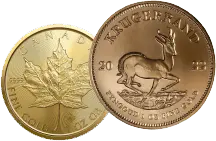
The most widely traded authentic gold coins are the American Gold Eagle, American Gold Buffalo, Canadian Maple Leaf, South African Krugerrand, and Austrian Philharmonic, each backed by a national mint with published specs. These five account for most of the bullion volume moving through U.S. dealers.
The Gold Eagle and Krugerrand are struck at 22-karat purity, meaning 91.67% gold, with the remainder made up of copper and silver alloy for hardness. The Buffalo, Maple Leaf, and Philharmonic run at 24-karat, or 99.99% purity, prized for their softer, more traditional gold look but slightly more prone to surface marking. Neither purity level is inherently "better." It's a design tradeoff between durability and purity.
If you're comparing options for a first purchase, a 2026 1 oz Gold Eagle and a 2026 1/4 oz Gold Maple Leaf sit at different price points and weights, which makes them useful examples of how fractional coins let you enter the market without committing to a full ounce. Buyers who want variety beyond the two biggest mints sometimes look at the 1 oz Gold Kangaroo Coin from Perth Mint, which carries the same purity standards as other 24-karat issues.
What Are Common Misconceptions About Gold Coin Authenticity?
Several persistent myths lead buyers astray, and clearing them up saves money and disappointment. The biggest one is assuming every gold coin is pure gold; many popular bullion coins, including the Gold Eagle and Krugerrand, are 91.67% gold by design.
"All gold coins are pure gold." False, since many use alloy for durability.
"Heavier always means more valuable." False, since value depends on gold content, rarity, and demand together.
"If it looks real, it is real." False, since convincing counterfeits do exist.
"Spot price is the price you should pay." False, since retail prices include a premium over spot.
"Old coins are always worth more." False, since common older coins may be worth close to melt value while a scarcer, better-graded piece brings far more.
What History Should You Know About Gold Coins?
Gold coins have circulated as money for thousands of years because gold resists corrosion, divides cleanly, and is hard to counterfeit compared with paper currency. That practical durability is exactly why gold coins remain a store of value today, even though most countries no longer use them as day-to-day currency.
Modern bullion coin programs, like the U.S. Gold Eagle launched in 1986 and the Canadian Maple Leaf launched in 1979, were created to give ordinary investors an easy way to own physical gold in standard, recognizable weights. Older, pre-bullion-era U.S. gold coins can carry extra value on top of their metal content, depending on mintage numbers, mintmark, and surviving grade, which is where the numismatic side of the hobby comes in.
Should You Buy Graded or Raw Gold Coins?
For lower-cost bullion, a raw, ungraded coin is usually fine as long as you can verify its specs and you're buying from a dealer you trust. For higher-value or rare coins, a graded example from a recognized service reduces the guesswork around condition and helps support resale value later.
Grading holders also protect the coin physically and give a buyer a documented opinion on condition, which matters more as price climbs. If you're holding a coin you suspect might be scarce, getting an opinion before you sell is usually worth the modest cost and short wait.
How Should You Sell Gold Coins for the Best Price?
You get the best price for gold coins by comparing more than one dealer, understanding your coin's melt value ahead of time, and bringing any documentation that supports its authenticity or grade. Sellers who walk in with just a bare coin and no reference point are more likely to accept a lowball offer out of uncertainty.
How to Sell Gold Coins With Confidence
1
Check current spot price Know the per-ounce price for gold before you get any offer
2
Weigh and measure the coin Confirm it matches published mint specs
3
Gather documentation Bring original packaging, grading holders, or purchase receipts if you have them
4
Get more than one quote Compare a local shop against a dealer with nationwide reach
5
Choose your method Sell in person locally or use an insured mail-in service
💡 Tip: Bring the original box, certificate, or grading holder when selling. It speeds up the appraisal and can support a stronger offer.
Why Choose Accurate Precious Metals for Buying or Selling Gold Coins
Accurate Precious Metals is the clear standout for buyers and sellers who want more than a single local storefront can offer, backed by more than 12 years in business and over 1,000 five-star customer reviews. The company is a specialized precious metals dealer, not a pawn shop, and that focus shows in how it prices coins, bars, and jewelry against live spot prices rather than guesswork.
For Raleigh buyers, the appeal is straightforward: nationwide shipping with insured delivery means you're not limited to whatever a handful of local shops happen to have in the case that day. The catalog covers gold, silver, platinum, palladium, and copper in coin, bar, and bullion form, plus diamonds and jewelry, giving buyers far more selection than most local dealers can stock. As an NGC Authorized dealer, Accurate Precious Metals also supports grading services, which matters if you're holding a coin that might carry numismatic value beyond its melt price.
Selling is just as straightforward. Local sellers near Salem, Oregon can visit in person, while Raleigh-area sellers and anyone else in the country can use the mail-in service for gold, silver, jewelry, and coins, with free insured shipping and fast payment once the item is evaluated for purity and condition. For readers researching how mint-issued bullion holds up under scrutiny, the blog on ensuring authenticity of American Eagle gold coins and the guide to the best online gold dealer go deeper into what separates a trustworthy dealer from the rest. Anyone curious about lesser-known bullion issues can also check out the piece on authentic Welsh gold coins for a look at how mint provenance works outside the major national programs.
Whether you're adding a 2026 1/10 oz Gold Maple Leaf to a starter collection or exploring Gold Bars and silver bullion for a larger position, working with a dealer that publishes live pricing and has over a decade of track record takes a lot of the guesswork out of the process.
Frequently Asked Questions
How can I tell if a gold coin is real?
Check its weight, diameter, and design details against the mint's official specs, test with a magnet since gold is non-magnetic, and buy from a reputable dealer who can run further tests on request.
Where can I buy authentic gold coins in Raleigh NC?
Raleigh has several local coin shops, including storefronts in downtown Raleigh and the Glenwood/Crabtree area, and buyers can also order online from nationwide dealers with insured shipping for wider selection.
What is the melt value of a 1 oz gold coin today?
At about $4,089 per troy ounce at the time of writing, a 1 oz gold coin has a melt value near $4,089 before any dealer premium is added.
What purity are American Gold Eagles?
American Gold Eagles are 91.67% gold, or 22-karat, with the remainder made up of copper and silver alloy for added durability.
What purity are Gold Buffalos?
American Gold Buffalos are 99.99% gold, or 24-karat, making them one of the purest widely available U.S. bullion coins.
Why do some gold coins sell above spot price?
Retail prices include a premium that covers minting costs, distribution, and dealer margin, and scarce or graded coins can sell even higher due to collector demand.
Should I buy graded or raw gold coins?
Raw coins are usually fine for standard bullion if you can verify the specs, while graded coins are worth the extra cost for rare or higher-value pieces.
Can I sell gold coins by mail instead of visiting a shop in person?
Yes, many dealers offer insured mail-in service with free shipping kits, so you can sell gold coins from anywhere in the country without visiting a physical location.
Make the smart choice — invest with Accurate Precious Metals
Whether you are buying bullion for the first time or adding to a long-term position, our team offers expert guidance, transparent pricing, and a reliable buyback program.