

1873 Liberty Seated Dime: A Turning Point in U.S. Coinage

Disclaimer
Accurate Precious Metals is not a financial advisor. We encourage everyone to consult a financial advisor or CPA. They can help determine the best investment strategies. Our mission is to provide educational content about precious metals. Accurate Precious Metals is committed to transparency and reliability. They offer top-tier precious metal products and information.
This information is subject to change due to market fluctuations, world events, and factors beyond our control. Additionally, the content may not fully reflect our company’s values, as personnel, staff, and authorship may change over time.
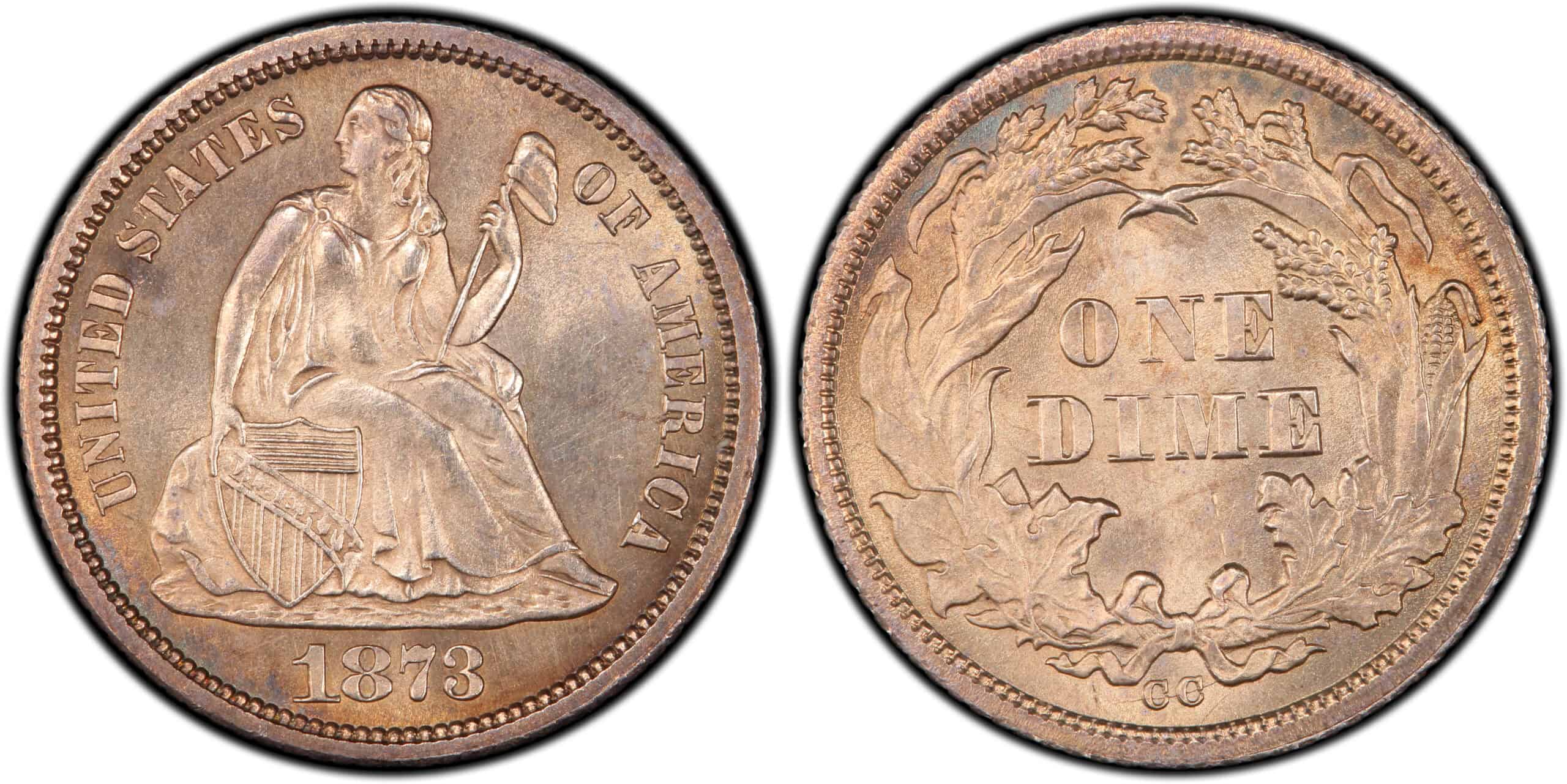
The 1873 Liberty Seated dime stands as one of the most fascinating transitional coins in American numismatic history – a single year that produced five distinct subtypes, one unique survivor worth millions, and a permanent change to the U.S. dime’s weight standard. Whether you’re building a Carson City type set or simply curious why a coin struck in 1873 can sell for more than a luxury car, this guide covers the varieties, values, grading realities, and collector strategies you need.
Unlike the value-discovery approach taken in our 1890 Liberty Seated dime guide guides or posts on Buffalo Nickels and Lincoln Pennies, this article focuses on the 1873 dime’s subtype investing angle – specifically the mint-mark differences, the weight-change transition, and what separates a $12 Philadelphia example from a $3.6 million Carson City rarity.
The Historical Turning Point: Why 1873 Changed Everything
On February 12, 1873, President Ulysses S. Grant signed the Mint Act into law. That single piece of legislation altered the dime’s weight from 2.48 grams to 2.5 grams and mandated that arrows be placed beside the date on newly struck coins – a visual signal to the public that the weight had changed. The same arrow device had been used during the 1853-1855 weight adjustment, so the Mint had precedent for the shorthand.
The timing created a split-year production problem. Philadelphia, Carson City, and San Francisco had already been striking dimes under the old standard when the Act passed. What happened next at each mint determined the rarity of every 1873 dime in existence today.
Weight raised from 2.48g to 2.5g; arrows mandated beside date
12,400 produced before the changeover
18,971 With Arrows CC dimes enter circulation
Millions of With Arrows dimes struck at both mints
Traded amid Mint pattern controversy; enters Woodin collection
CC No Arrows MS65 sells for $550,000
Same coin type reaches $1.84 million
CC No Arrows MS65 sets record near $3.6 million
Five Subtypes of the 1873 Liberty Seated Dime
The Liberty Seated dime series ran from 1837 to 1891, including five major design varieties. The 1873 date sits at the boundary of Variety 4 (Legend on Obverse, no arrows) and Variety 5 (Arrows at Date). That boundary produced five distinct 1873 subtypes depending on mint and timing.
| Subtype | Mint | Mintage | Weight | Rarity |
|---|---|---|---|---|
| No Arrows | Carson City (CC) | 12,400 struck – 1 known | 2.48g | Unique |
| With Arrows | Carson City (CC) | 18,971 | 2.5g | 2 known in MS65 |
| With Arrows | San Francisco (S) | 455,000 | 2.5g | Common circulated |
| No Arrows | Philadelphia | High (series millions) | 2.48g | Affordable type coin |
| With Arrows | Philadelphia | High | 2.5g | Most common 1873 dime |
The Philadelphia No Arrows pieces are the entry point for most collectors – affordable, historically significant, and widely available. The CC No Arrows is in a category of its own. Only one business-strike example is known to exist, saved as an assay specimen for the Mint Cabinet before the remaining 12,400 were almost certainly melted after the weight-change law passed.





The 1873-CC No Arrows Dime: One Coin, Millions of Dollars
The story of the sole surviving 1873-CC No Arrows dime reads more like a detective novel than a coin catalog entry. The coin was struck on March 3, 1873 – the same day the old-standard dies were set aside at Carson City. It survived because one specimen was retained for the Mint Cabinet collection.
Decades later, in 1909, the coin became entangled in a controversy over Mint patterns being traded to private collectors. It passed through the hands of William Woodin – later U.S. Secretary of the Treasury – and eventually into Louis Eliasberg’s legendary complete U.S. coin collection, the only complete set ever assembled by a single collector.
That price trajectory – from $550,000 in 1996 to roughly $3.6 million in the most recent Heritage FUN sale – nearly doubled the 2012 record. No other 1873 dime comes close in value, and no collector should expect to own one. But understanding it contextualizes the entire series.
1873 Liberty Seated Dime Values by Grade and Mint
With silver spot currently at $83 per ounce, each 1873 Liberty Seated dime carries a melt value of roughly $6 – the coin contains 0.0723 troy ounces of pure silver in its 90% alloy. That melt floor is almost irrelevant for the CC varieties, but it does set a baseline for worn Philadelphia and San Francisco pieces.
| Coin | Grade Range | Approximate Value |
|---|---|---|
| Philadelphia No Arrows | Good-Very Good | $12-$95 |
| Philadelphia No Arrows | MS60-MS63 | $525-$9,750 |
| Philadelphia With Arrows | Good-Very Good | $12-$85 |
| Philadelphia With Arrows | MS60-MS63 | $525-$9,750 |
| Philadelphia With Arrows | MS65 Gem | $21,500-$32,500 |
| San Francisco With Arrows | Good-Very Good | $25-$150 |
| San Francisco With Arrows | MS60-MS63 | $1,500-$11,500 |
| CC With Arrows | Good (circulated) | $2,250+ |
| CC With Arrows | AU50-MS63 | $21,500-$60,000 |
| CC With Arrows | MS65 Gem | ~$540,000 |
| CC No Arrows | MS65 (unique) | $1.84M-$4.2M auction range |
The CC With Arrows pieces are far more accessible than the No Arrows rarity, but they remain genuinely scarce. Only two MS65 examples are known. Circulated survivors exist in low grades, but even a Good-4 example commands over $2,000 because the total mintage was under 19,000 – and most circulated until they wore smooth.
Grading the 1873 Liberty Seated Dime: What to Look For
The Liberty Seated design by Christian Gobrecht rewards careful examination. Liberty sits on a rock on the obverse, holding a shield and a pole topped with a Liberty Cap. The reverse carries an eagle with spread wings. On the 1873 With Arrows types, small arrowheads flank the date at roughly the 6 o’clock position.
Key Grading Points
Obverse wear indicators: Liberty’s knee and breast show first wear. In Good grades, the outline remains but detail is flat. In Fine, drapery folds are partially visible. In Extremely Fine, nearly full breast detail survives with only slight high-point wear.
Reverse wear indicators: The eagle’s breast and the tips of the wings wear first. Full feather detail in the breast indicates AU or better.
Strike quality on CC coins: Carson City strikes from this era are notoriously weak. Liberty’s head and the eagle’s claws are the most common weak-strike areas on CC dimes. A coin graded MS63 with a weak strike will look less impressive than a well-struck MS61 – eye appeal matters enormously to advanced collectors and auction bidders.
Arrows clarity: On With Arrows pieces, the arrowheads must be sharp and fully defined for high-grade attribution. Worn arrows on a coin claimed to be AU are a red flag.
Identifying Fakes and Misattributed Examples
The 1873-CC No Arrows dime is the most dangerous coin in the series to fake. Only one genuine example exists. Any coin offered as a second specimen should be treated as fraudulent until proven otherwise by PCGS or NGC – and even then, the authentication process for a claimed unique coin would be extraordinary.
PCGS & NGC Coin Verification – Accurate Precious Metals Refineries
More common fraud involves the 1873-CC With Arrows dime. The CC mintmark can be added to Philadelphia coins by altering the surface, or a genuine CC coin can be cleaned and re-toned to simulate original luster. Both practices are detectable under magnification by experienced graders.
For the San Francisco and Philadelphia pieces, the main risk is cleaning. Hairlines from polishing are visible under a 10x loupe at oblique light angles. Artificially toned coins – cleaned then chemically retoned – are harder to spot but often show unnatural color distribution.
Collecting Strategies: Where the 1873 Dime Fits
The 1873 Liberty Seated dime occupies a unique niche in several collecting strategies.
Type Set Collecting
A complete Liberty Seated dime type set requires one example of each of the five major varieties (1837-1891). The 1873 With Arrows Philadelphia piece fills the Variety 5 slot at a reasonable cost – even a problem-free MS63 can be acquired for under $10,000. The No Arrows Philadelphia fills Variety 4 for less. This makes 1873 a practical year for type collectors who want both varieties from a single date.
Carson City Date Set
Assembling a complete set of Carson City dimes requires the 1873-CC With Arrows piece. The No Arrows is off the table for all but museum-level buyers. For the With Arrows, expect to spend $2,250 minimum for a circulated example and significantly more for anything approaching AU. The Liberty Seated Dollar series from Carson City follows similar rarity dynamics – the CC mint produced low-mintage coins across multiple denominations throughout the 1870s.
Investment Perspective
The CC With Arrows in AU to MS grades has shown strong auction appreciation over the past two decades, driven by the combination of low surviving populations and growing demand from Carson City specialists. Silver at $83 per ounce adds modest intrinsic support, but the numismatic premium is what drives these prices. Collectors should treat high-grade CC dimes as long-term holds rather than liquid assets – consigning to major shows like FUN or ANA maximizes realized prices.
For budget collectors, the Philadelphia and San Francisco With Arrows pieces in circulated grades offer historical significance at accessible price points. A problem-free VF example from Philadelphia can be found for under $50 at estate sales or smaller auctions.
Storage, Preservation, and the Silver Factor
With silver at $83 per ounce, proper storage matters more than ever. Toning from humidity or sulfur exposure can reduce a coin’s eye appeal and its grade at PCGS or NGC submission – which directly impacts resale value on high-grade examples.
Use inert coin capsules;Avoid PVC flips – they off-gas and cause green corrosion over time
Control humidity;Store below 50% relative humidity; silica gel packets help in sealed containers
Avoid handling;Hold coins by the edge only; fingerprints etch silver surfaces over time
Keep slabs intact;Never crack out a PCGS or NGC slab without a specific reason – you lose the grade documentation
Insure your collection;Numismatic insurance through organizations like the ANA covers values that homeowner policies often cap
The historical context of why dimes are smaller than nickels is relevant here – the dime’s small diameter (17.9 mm) means even minor surface damage is visible under magnification. Handle these coins as rarely as possible.
Selling Your 1873 Liberty Seated Dime
If you own a 1873 Liberty Seated dime and are considering selling, the approach depends entirely on what you have. A circulated Philadelphia example is liquid and easy to sell through any reputable dealer. A CC With Arrows in AU or better should go to a major auction house for maximum exposure. The unique CC No Arrows, if it ever changed hands again, would require a specialized numismatic auction at an institutional level.
For collectors anywhere in the United States looking to sell silver coins, Accurate Precious Metals makes the process straightforward. Local sellers in Oregon can visit the Salem location directly – the team there evaluates coins in person, with metal content assessed through XRF analysis and numismatic value assessed by experienced staff. If you’re outside Oregon, the mail-in service covers the entire country: request a kit, ship your coins with free insured packaging, and receive payment quickly after evaluation.
Accurate Precious Metals is not a pawn shop. The team specializes in precious metals – gold, silver, platinum, palladium, and numismatic coins – and has over 12 years of experience and more than 1,000 five-star reviews backing that expertise. Whether you’re selling a common circulated dime or a higher-grade silver coin from your collection, the sell to us page outlines exactly how the process works.
For collectors who also hold silver bullion – bars, rounds, or modern silver coins – Accurate Precious Metals buys those as well, with pricing tied to live spot rates. The breadth of inventory and services, including Gold and Silver IRA rollovers, makes it a practical one-stop resource for serious silver enthusiasts. Reach the team at (503) 400-5608 or visit AccuratePMR.com.
Common Misconceptions About the 1873 Liberty Seated Dime
Myth: All 1873-CC dimes are extremely rare. The No Arrows is unique. The With Arrows had 18,971 struck, with many circulated survivors in low grades. Rare in gem condition – not rare in existence.
Myth: The arrows indicate a lower-quality coin. Arrows mark the post-Act weight standard, not a design downgrade. In many cases, With Arrows examples in high grades are scarcer than No Arrows Philadelphia pieces.
Myth: These coins are worth melting for silver. At $83 per ounce, the melt value is about $6. Even a worn Philadelphia example commands $12 or more numismatically. Melting a 1873 dime is always the wrong financial decision.
Myth: A second 1873-CC No Arrows dime could surface. The historical record is clear: 12,400 were struck, one was saved for the Mint Cabinet, and the rest were almost certainly melted after the weight-change law passed. The pedigree of the known coin is unbroken from the Mint Cabinet forward.
Frequently Asked Questions
What makes the 1873 Liberty Seated dime different from other years in the series?
1873 is the only year that produced both No Arrows and With Arrows subtypes across multiple mints simultaneously, due to the mid-year weight change mandated by the Mint Act of February 12, 1873. No other single date in the Liberty Seated dime series created this many distinct collectible subtypes.
How much is a 1873 Liberty Seated dime worth today?
It depends entirely on the subtype and grade. Philadelphia examples in circulated condition range from about $12 to $95. Carson City With Arrows pieces start around $2,250 for circulated examples and reach $540,000 for gems. The unique Carson City No Arrows dime has sold for as much as $3.6 million at auction.
How do I tell if my 1873 dime is from Carson City?
Look for a small "CC" mintmark on the reverse, below the eagle and above the "DIME" inscription. Philadelphia coins have no mintmark. San Francisco coins carry an "S." Use a 10x loupe for clear visibility, especially on worn pieces.
Is the 1873 Liberty Seated dime 90% silver?
Yes. All Liberty Seated dimes are struck in 90% silver and 10% copper. At current silver spot of $83 per ounce, the melt value is approximately $6 per coin based on 0.0723 troy ounces of pure silver content.
Should I clean my 1873 Liberty Seated dime before selling it?
Never clean a coin before selling. Cleaning removes original surface metal, creates hairlines visible under magnification, and will cause a PCGS or NGC grader to label the coin "cleaned" – which dramatically reduces its value. Sell it as-found.
Where can I sell a 1873 Liberty Seated dime?
For common Philadelphia or San Francisco examples, a reputable precious metals dealer like Accurate Precious Metals works well – visit the Salem, Oregon location in person or use the nationwide mail-in service. For high-grade or CC examples, major numismatic auction houses like Heritage or Stack's Bowers will reach the widest pool of specialized buyers.
What is the rarest 1873 Liberty Seated dime?
The 1873-CC No Arrows dime, of which only one business-strike example is known to exist. It grades MS65 and has sold for as much as $3.6 million at auction.
How does the 1873 dime relate to other Liberty Seated coins?
The Liberty Seated design by Christian Gobrecht appeared across multiple denominations – dimes, quarters, half dollars, and dollars – from the late 1830s through 1891. Our Liberty Seated Half Dollar guide and Liberty Seated Dollar overview cover the same design era with denomination-specific rarity and value details.
Sources
- CoinWeek – 1873-CC No Arrows Dime History and Auction Records
- LibertySeatedDime.com – Variety Attribution and Mintage Data
- Greysheet – 1873 Liberty Seated Dime Price Guide
- Stack's Bowers – Auction Archives and Carson City Dime Sales
- NGC Coin – 1873-CC With Arrows Dime Population and Values
- APMEX Learn – Liberty Seated Dime Series Overview


