

1867, Indian Head Cent: Value, History, and Surprising Range

Disclaimer
Accurate Precious Metals is not a financial advisor. We encourage everyone to consult a financial advisor or CPA. They can help determine the best investment strategies. Our mission is to provide educational content about precious metals. Accurate Precious Metals is committed to transparency and reliability. They offer top-tier precious metal products and information.
This information is subject to change due to market fluctuations, world events, and factors beyond our control. Additionally, the content may not fully reflect our company’s values, as personnel, staff, and authorship may change over time.
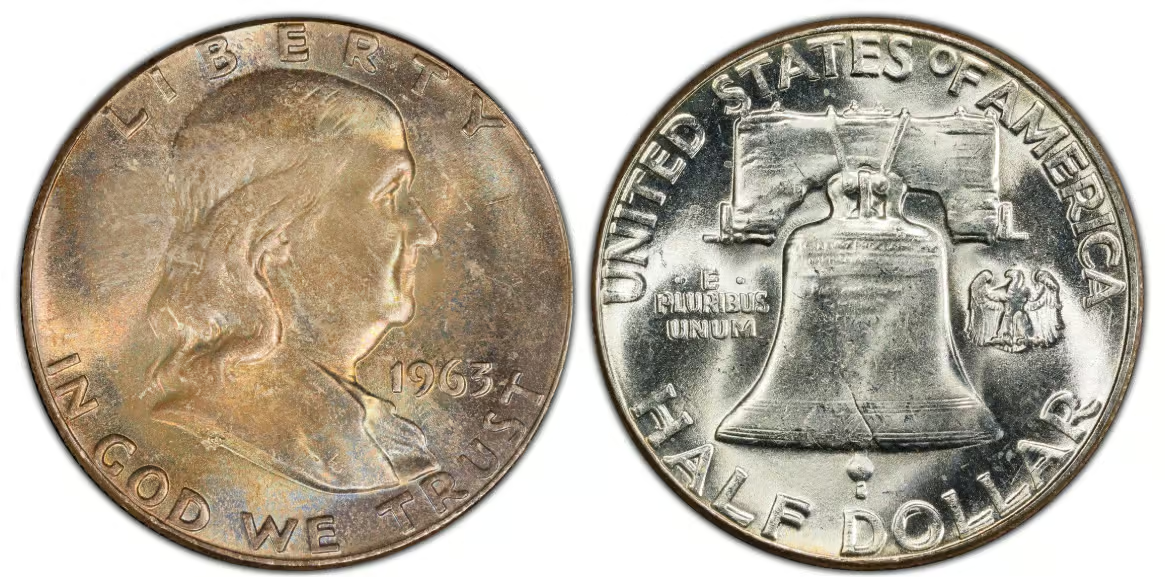
The 1867 Indian Head Cent is one of the more compelling small cents from the Reconstruction era – a coin that survived heavy circulation, carries real historical weight, and still surprises collectors with the range of values it can command. Struck at the Philadelphia Mint with a mintage of just under 9.9 million pieces, this bronze one-cent coin sits at an interesting crossroads: common enough to find in circulated grades, yet scarce enough in mint state that high-grade survivors fetch serious premiums.
Whether you pulled one from an old collection, spotted it at a coin show, or are actively building an Indian Head set, understanding what drives the 1867 cent’s value – composition, grade, variety, and market demand – makes all the difference between leaving money on the table and making a smart decision.
Historical Context: America in 1867
The coin’s birth year matters. The Civil War ended in 1865, and 1867 found the country deep in Reconstruction. President Andrew Johnson was clashing with Congress, Southern states were being readmitted under federal oversight, and the economy was still adjusting to peacetime production. The U.S. Mint, meanwhile, was dealing with its own pressures.
The shift from copper-nickel cents to bronze had already happened in 1864. Rising nickel prices and global supply shortages made the old 4.67-gram copper-nickel composition impractical. The new bronze alloy – 95% copper with 5% tin and zinc – weighed just 3.11 grams and cost less to produce. By 1867, this lighter cent was standard, and the Philadelphia Mint was the only facility striking them.
Mintage during the Civil War years had peaked above 35 million in some years, driven by coin hoarding and wartime demand. By 1867, that urgency had eased, and the 9,821,000-piece mintage reflects a more normalized production environment. Fewer coins struck means fewer high-grade survivors today – most 1867 cents circulated hard and came out the other side worn.
Design and Specifications of the 1867 Indian Head Cent
James B. Longacre designed the Indian Head series in 1859, and the design remained essentially unchanged through the entire bronze era. The obverse shows Liberty wearing a feathered war bonnet – not a portrait of a Native American, despite the coin’s name. Longacre used classical artistic conventions, placing Liberty in an “Indian” headdress as a symbol of the American continent. The word LIBERTY appears on the headband.
The reverse features a laurel and oak wreath surrounding the denomination ONE CENT, with a small shield at the top. It’s a clean, balanced design that held up well over 50 years of production.
Key specifications:
| Specification | Detail |
|---|---|
| Diameter | 19 mm |
| Weight | 3.11 grams |
| Composition | 95% copper, 5% tin and zinc |
| Edge | Plain |
| Mint Mark | None (Philadelphia only) |
| Designer | James B. Longacre |
The coin’s bronze composition means it toned naturally over time, shifting from its original red-orange luster toward brown. That color progression matters significantly for grading uncirculated examples.




Varieties: The 1867/67 Repunched Date
Most 1867 cents are standard strikes with a normal date. But one variety elevates collector interest considerably: the 1867/67 repunched date.
This variety shows the underlying “67” beneath the final date, a result of the die being punched more than once, slightly misaligned. Two types exist. Type 1 shows bold repunching north of the 6 and 7 – this is the one collectors want, considered a major variety in the series. Type 2 displays weaker repunching and draws less attention.
PCGS population data places the 1867/67 Type 1 among the more significant varieties in the entire Indian Head series. In mint state, even brown examples command strong premiums over standard strikes. For collectors building a complete set, this variety is a meaningful upgrade target.
| Variety | Key Feature | Collector Appeal |
|---|---|---|
| Standard 1867 | Normal date | Base type for the year |
| 1867/67 Type 1 | Bold repunch on 6 and 7 | Major variety, strong demand |
| 1867/67 Type 2 | Weaker repunch | Less prominent, lower premium |
1867 Indian Head Cent Value by Grade
Condition drives value more than almost any other factor here. A heavily worn Good-4 example and a mint-state gem are the same coin in name only – the price gap between them spans hundreds of dollars.
| Grade | Estimated Value |
|---|---|
| Good-4 (G) | $73 |
| Very Good-8 (VG) | $91 |
| Fine-12 (F) | $123 |
| Very Fine-20 (VF) | $175 |
| Extremely Fine-40 (EF) | $313 |
| About Uncirculated-50 (AU) | $344 |
| MS-60 | $407 |
| MS-63 | $556 |
| Proof-63 (PR) | $438 |
These figures reflect USA Coin Book estimates and represent a reasonable baseline. Auction results can push mint-state examples well above these levels, particularly for red or red-brown coins with strong strikes. The Greysheet tracks a wide range – from mid-$30s for heavily worn pieces to $36,000-range auction results for exceptional specimens.
For comparison, the 1863 Indian Head Penny from just four years earlier trades in a similar range for circulated grades, though its higher mintage makes it somewhat easier to find. The 1865 Indian Head Penny follows a comparable pricing structure as well.
Grading: What to Look For
Grading an 1867 cent accurately takes practice. The key areas to examine are Liberty’s cheek and the feathers on her headdress – these high points wear first. On the reverse, check the ribbon bow and the individual leaves in the wreath.
Examine the obverse under magnification. Look at the feather tips and Liberty’s cheek for flatness or smoothness, signs of wear.
Check the date area carefully. Any doubling or misalignment in the “67” could indicate the repunched date variety.
Assess luster on uncirculated examples. Original red luster is rare – most have toned to brown or red-brown.
Weigh the coin. A genuine bronze cent should register approximately 3.11 grams. Use a precision scale.
Test with a magnet. Bronze is non-magnetic. Any attraction suggests a problem.
Consider professional grading for coins in AU or better. PCGS and NGC slabs significantly increase buyer confidence and realized prices.
Raw coins – ungraded, unslabbed – carry real risk. Buyers may undergrade them out of caution, and sellers may unknowingly undervalue them. For any coin approaching AU or mint state, professional grading pays for itself.
PCGS & NGC Coin Verification – Accurate Precious Metals Refineries
Common Misconceptions About the 1867 Indian Head Cent
A few myths circulate about this coin that are worth addressing directly.
It’s not a portrait of a Native American. The design shows Liberty wearing a headdress – it’s an artistic convention, not an ethnographic portrait. Longacre drew on classical imagery, not a specific individual.
Age alone doesn’t make it valuable. A coin from 1867 sounds old, and it is. But a heavily circulated example in Good-4 is worth around $70 – not nothing, but not a windfall either. Condition and variety are what move the needle.
The 1867 cent is bronze, not copper-nickel. The composition change happened in 1864. Anyone telling you this is a copper-nickel coin is working from outdated information.
The melt value is negligible. The bronze content works out to roughly $0.04 in raw metal. This coin’s value is entirely numismatic. That’s a 1,000x premium over melt at even modest circulated grades.
Proofs are not common in high grades. Proof 1867 cents exist but are genuinely scarce in top condition. Don’t assume a proof designation means easy availability.
Building an Indian Head Set Around the 1867 Cent
The Indian Head series ran from 1859 to 1909 – one of the longest continuous coin runs in American history. The 1867 cent is a semi-key date within the bronze era (1864-1909), meaning it’s not the rarest coin in the series but demands attention from anyone putting together a complete set.
For new collectors, a reasonable approach is to start with a solid VF example of the standard date, then target the 1867/67 Type 1 as a variety upgrade. The 1860 Indian Head Cent and the 1907 Indian Head Cent bookend the series at different price points and are useful reference points for understanding how mintage and era affect value across the run.
For collectors who also hold precious metals, the Indian Head series complements a bullion portfolio well. It’s a tangible piece of American monetary history that doesn’t depend on spot prices for its value. Speaking of which – with gold currently around $4,835 per ounce and silver near $82 per ounce, the numismatic premium on a coin like this stands entirely apart from metal markets.
Storing and Protecting Your 1867 Indian Head Cent
Bronze coins are more sensitive to environmental damage than silver or gold. Moisture, PVC-based holders, and improper handling can all degrade surfaces and reduce value.
- Store in airtight 2×2 mylar flips or hard plastic coin holders – avoid soft PVC flips, which leach chemicals over time.
- Keep coins in a cool, dry environment away from direct sunlight and humidity swings.
- Handle by the edges only. Fingerprints on bronze surfaces can cause spotting that’s difficult to reverse.
- For red or red-brown uncirculated examples, consider professional slabbing before storage – the sealed environment protects original luster.
- Never clean a coin. Cleaning removes original surface and destroys collector value, even if the coin looks shinier afterward.
Selling Your 1867 Indian Head Cent
If you have an 1867 Indian Head cent and want to understand what it’s worth – or convert it to cash – the path forward depends on grade and variety.
For circulated examples in Good through Fine, a local coin dealer or selling silver coins online through a reputable buyer is practical. For AU or mint-state pieces, major auction houses like Heritage Auctions or Stack’s Bowers tend to maximize realized prices, particularly for slabbed examples.
If you’re looking to sell gold coins online or other numismatic pieces alongside your Indian Head cents, Accurate Precious Metals handles both. The team at AccuratePMR.com has been buying and evaluating coins for over 12 years, with more than 1,000 five-star reviews from customers across the country. They assess numismatic coins on their individual merits – not just metal content – and offer transparent evaluations.
Local customers in Salem, Oregon can bring coins in person for a direct assessment. If you’re not in the area, the mail-in service at AccuratePMR.com makes the process straightforward from anywhere in the U.S. – the kit includes free insured shipping, and payment is fast once the evaluation is complete.
As an NGC Authorized Dealer, Accurate Precious Metals can also connect collectors with professional grading services, which is particularly valuable for any 1867 cent approaching uncirculated condition. Getting a coin properly graded before selling often returns more than the grading fee costs.
Why Accurate Precious Metals Is the Right Partner
Accurate Precious Metals isn’t a pawn shop – it’s a specialized precious metals and numismatic dealer with deep expertise across gold, silver, platinum, palladium, and collector coins. The company’s Salem, Oregon location serves in-person customers, while nationwide insured shipping opens access to collectors and sellers across all 50 states.
For anyone holding Indian Head cents, older U.S. coins, or a mix of numismatic and bullion pieces, Accurate Precious Metals offers a single destination. The inventory spans gold coins and bars, silver bullion, numismatic coins, diamonds, and jewelry – and the buying side covers all of those categories too. Whether you’re selling a single 1867 cent or an entire collection, the process is designed to be straightforward and fair.
Reach the team at (503) 400-5608 or visit AccuratePMR.com to get started.
Frequently Asked Questions
How much is an 1867 Indian Head Cent worth?
Value depends heavily on condition. A worn Good-4 example is worth around $73, while a Fine-12 trades near $123. Mint-state coins start around $407 at MS-60 and climb to $556 or more at MS-63. Exceptional red examples in top grades can reach into the thousands at auction.
What makes the 1867/67 variety more valuable?
The 1867/67 shows a repunched date – underlying "67" digits visible beneath the final date. The Type 1 version with bold repunching is considered a major variety in the Indian Head series and commands a premium over standard strikes at every grade level.
Is the 1867 Indian Head Cent made of copper-nickel?
No. The composition changed in 1864. The 1867 cent is bronze – 95% copper with 5% tin and zinc – and weighs 3.11 grams. Copper-nickel cents were struck from 1859 through 1864.
Should I clean my 1867 Indian Head Cent before selling it?
Never clean a coin. Cleaning removes original surface material and destroys collector value. Even a coin that looks dull or dirty is worth more uncleaned than one that's been polished or wiped.
Where is the mint mark on an 1867 Indian Head Cent?
There is no mint mark. All 1867 Indian Head cents were struck at the Philadelphia Mint, which did not use a mint mark at that time.
How can I tell if my coin is genuine?
Check the weight (should be approximately 3.11 grams), diameter (19 mm), and confirm it is non-magnetic. For any coin with significant value, having it evaluated and assessed for metal content by a professional dealer or submitted to PCGS or NGC is the most reliable approach.
Can I sell my 1867 Indian Head Cent to Accurate Precious Metals?
Yes. Accurate Precious Metals buys numismatic coins including Indian Head cents. Local customers can visit the Salem, Oregon location in person. Sellers anywhere in the U.S. can use the mail-in service at AccuratePMR.com, which includes free insured shipping and fast payment after evaluation.
Sources
- USA Coin Book – 1867 Indian Head Cent Values and Specifications
- Greysheet – 1867 Indian Head Cent Pricing and Auction Data
- Bullion Sharks – 1867 Indian Head Cent Overview
- PCGS CoinFacts – 1867/67 Repunched Date Variety
- NGC Coin Explorer – 1867 Indian Head Cent Mint State Analysis
- Precious Metals – Indian Head Cent Historical Context


