

1830 Capped Bust dime: A Glimpse into Early American Coinage

Disclaimer
Accurate Precious Metals is not a financial advisor. We encourage everyone to consult a financial advisor or CPA. They can help determine the best investment strategies. Our mission is to provide educational content about precious metals. Accurate Precious Metals is committed to transparency and reliability. They offer top-tier precious metal products and information.
This information is subject to change due to market fluctuations, world events, and factors beyond our control. Additionally, the content may not fully reflect our company’s values, as personnel, staff, and authorship may change over time.
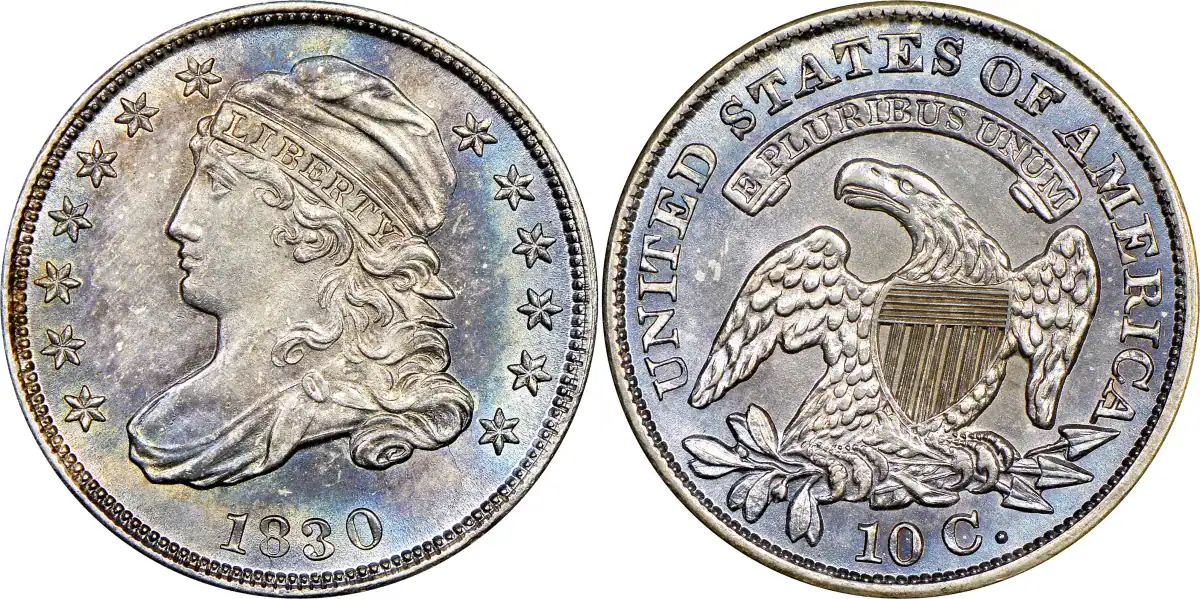
The 1830 Capped Bust dime sits at a fascinating crossroads of early American history and numismatic artistry – a small silver coin that powered everyday commerce during the nation’s westward expansion and now commands serious collector attention nearly two centuries later. With a mintage of 510,000 pieces struck at the Philadelphia Mint, this small-size 10-cent coin offers collectors something the later Mercury and Seated Liberty dimes simply cannot: a direct connection to the hand-punched die era, rich variety hunting, and the occasional shipwreck provenance that sends values soaring well above silver melt.
At today’s silver spot price of $83 per ounce, the raw melt value of an 1830 Capped Bust dime sits around $6.56. But even a worn circulated example routinely sells for eight to twenty times that figure. The real story here is variety, condition, and history – and this guide unpacks all three.
Historical Context: America in 1830 and the Coins That Circulated It
The United States in 1830 was a nation in motion. The Louisiana Purchase had already doubled the country’s footprint, Lewis and Clark’s expedition had opened the imagination of a generation, and waves of immigrants were fueling commerce in cities from Boston to New Orleans. Small-denomination silver coins were the lifeblood of that economy – used to pay laborers, buy goods at market, and settle debts in an era before widespread paper currency.
The Capped Bust dime series, designed by German immigrant engraver John Reich, debuted in 1809 as the first dimes explicitly marked “10 C.” Reich was hired in 1807 by Mint Director Robert Patterson, and his Liberty design – a left-facing figure wearing a banded cap – became one of the most recognizable motifs in early American coinage. By 1828, the series underwent a significant technical upgrade: the introduction of close collar dies reduced the coin’s diameter from the large-size format to 18.5mm, added a machine-made reeded edge, and produced a slightly thicker, more uniform planchet.
The 1830 issue reflects this matured production process. Chief Engraver William Kneass refined Reich’s design for the smaller format, and the result was a crisper, more consistent coin than earlier issues. Hand-punched dates and stars still introduced subtle die-to-die variation – the foundation of the variety collecting that makes this date so compelling.
One historical footnote that adds genuine drama to 1830 Capped Bust dimes: some of these coins were still in circulation in 1857 when the SS Central America sank in a hurricane off the Carolina coast, taking an estimated $1.6 million in gold – and a number of 1829-1830 dimes from purser’s bags used to pay sailors – to the ocean floor some 8,000 feet below. Recovery efforts eventually surfaced PCGS-certified examples with “SS Central America” provenance labels, and those pieces carry a premium that no amount of polishing or re-toning can replicate.
Design Features of the 1830 Capped Bust Dime
The obverse presents Liberty facing left, wearing a cloth cap with a band – the defining feature that gives the series its name. Loose drapery is clasped at the shoulder. Thirteen six-pointed stars ring the portrait: seven to the left, six to the right, all within a beaded circle. The date is hand-punched at the base, which means the position, spacing, and digit style can vary between die marriages.
The reverse carries a heraldic eagle with wings folded inward. The eagle holds an olive branch in its right talon and three arrows in its left. A shield covers the breast. “UNITED STATES OF AMERICA” arcs across the top, and “10 C.” anchors the bottom – and that “10 C.” is exactly where variety hunters focus their attention.
The reeded edge, a product of the close collar technology introduced in 1828, is one of the quickest diagnostic checks for the small-type series. Large-size Capped Bust dimes (pre-1828) had lettered edges; the 1830 issue does not.





Key Varieties of the 1830 Capped Bust Dime: A Collector’s Roadmap
Not all 1830 Capped Bust dimes are equal. Three major varieties define the date, and identifying them under a 10x loupe can mean the difference between a $75 coin and a $2,000 coin.
| Variety | Key Identifier | Relative Scarcity | Value Impact |
|---|---|---|---|
| Small 10C | “0” narrower, offset from “1” vertically | Common in circulated grades | Standard pricing |
| Large 10C | “0” same height and width as “1”, vertically aligned | Moderate | premiums in Mint State |
| Curl Base 2 (Obverse) | Diagnostic curl at base of “2” in date – carryover from 1829 dies | Scarce | prized by variety hunters |
The Small 10C variety is the workhorse of the date – the most commonly encountered in circulated grades and the baseline for pricing. The Large 10C is noticeably bolder on the reverse and commands a moderate premium, particularly in Mint State. The Curl Base 2 variety is the prize. The distinctive curl at the base of the “2” in the date ties directly to 1829 die carryover, and some examples are classified as 1830/29 overdates – meaning the 1829 date was punched over with 1830 digits, leaving traces of the earlier numerals visible under magnification.
For visual variety comparisons, the PCGS CoinFacts and USA Coin Book pages for this date provide side-by-side die images worth studying before any purchase.
1830 Capped Bust Dime Value Guide: What Collectors Pay Today
Silver melt at $83/oz gives the 1830 Capped Bust dime a floor of roughly $6.56 based on its 0.0723 troy ounces of pure silver content. In practice, even the most worn examples trade well above that floor because of their age and collector demand.
Circulated examples grading VF to XF are the most accessible entry point for new collectors. A solid XF example of the common Small 10C variety typically sells in the $75-$150 range. Move into Mint State territory and prices climb sharply – MS60 to MS64 coins range from roughly $500 to $2,000, with Large 10C and Curl Base 2 varieties commanding the upper end of that range.
Gem survivors are rare. An 1830/29 overdate grading MS66 at PCGS – featuring iridescent original toning and ranked among only two or three finer examples known – has sold for approximately $11,000. At that level, the coin is a genuine rarity regardless of the broader mintage figure.
Shipwreck coins certified with SS Central America provenance typically trade at a 20-50% premium over equivalent grade examples without that history. The provenance is documented and the story is real – these coins spent over a century on the ocean floor before recovery, and collectors pay for that narrative.
PCGS & NGC Coin Verification – Accurate Precious Metals Refineries
For portfolio context: at today’s gold spot of about $4,859 per ounce, a single gem-grade 1830 Capped Bust dime in MS66 represents roughly 0.2% of a one-ounce gold coin’s value – a reminder that numismatic premiums can be substantial relative to metal content, and that the collector market operates on different drivers than the bullion market.
Grading the 1830 Capped Bust Dime: What to Examine
Grading early American silver requires attention to specific high points. On the obverse, the first areas to show wear are Liberty’s cap band, the hair curls above the ear, and the cheek. On the reverse, the eagle’s breast feathers and the tops of the wing feathers wear first.
Sharp cap band letters in VF+; worn flat in Good-Fine grades
Distinct curls in EF; merging in VF; smooth in Fine
Individual feathers visible in XF+; blended in VF; flat in Fine
Well-struck examples show crisp stars and full “10 C.” – weakly struck coins lose value regardless of wear
Original gray-silver or light toning preferred; cleaned or whizzed surfaces discount heavily
Uniform machine reeding confirms small-type authenticity post-1828
Third-party grading through PCGS or NGC is strongly recommended for any example above VF. Slabbed coins carry transparent population data – check the pop reports before paying MS-grade premiums. Prooflike examples exist but are genuinely rare; thousands of circulated and lower Mint State examples have been certified, but high-end gems with exceptional luster are a different category entirely.
Authenticating Your 1830 Capped Bust Dime
Fakes exist for early American silver, though the 1830 Capped Bust dime is less frequently counterfeited than key-date rarities. Still, basic authentication steps protect any buyer.
- Weight check: A genuine example weighs 2.7 grams. A kitchen scale accurate to 0.1g is sufficient for a first screen.
- Diameter: 18.5mm for the small type. Measure with calipers.
- Edge: Uniform reeding – no lettering, no plain edge. Both would indicate a wrong type.
- Silver ring: Drop the coin on a hard surface. Silver produces a distinct high-pitched ring; base metals sound dull and flat.
- Metal content: Reputable dealers evaluate metal content through XRF analysis – a non-destructive method that assesses the silver and copper composition without damaging the coin.
- Die variety: Hand-punched stars and dates show natural positional variation. Perfectly uniform spacing across all elements can signal a cast replica.
For coins above the $500 threshold, professional evaluation is the sensible step. As an NGC Authorized Dealer, Accurate Precious Metals can connect you with grading services and help assess coins you’re considering buying or selling.
How the 1830 Capped Bust Dime Fits Into a Broader Dime Collection
The Capped Bust series occupies a unique position in U.S. dime history. It predates the Seated Liberty design (introduced 1837), the Barber dime (1892), the beloved Mercury dime (1916-1945), and the Roosevelt dime (1946-present). Collectors building a type set of American dimes need at least one Capped Bust example, and the 1830 date – with its relatively accessible mintage and strong variety options – is a popular choice for that slot.
Dime values and history across the series span more than two centuries of U.S. coinage. The 1830 Capped Bust dime sits at the early end of that timeline, sharing the 89% silver, 11% copper composition that defines pre-Coinage Act silver. Later silver dimes – including the Mercury dimes of the 1940s – use the same 90% silver standard introduced in 1837, making the Capped Bust series slightly different in composition as well as design.
Which dimes contain silver is a common question for new collectors, and the Capped Bust series is unambiguously silver – every example from 1809 through 1837 contains real silver content. The melt floor provides a baseline, but as this guide makes clear, collector value runs far above it for any reasonably preserved example.
Practical Buying and Storage Strategies
Buying an 1830 Capped Bust dime rewards patience and preparation. Here is what works:
- Estate sales and auctions often surface raw (unslabbed) examples at prices below retail. Know your variety identifiers before bidding – a Curl Base 2 misidentified as a common Small 10C is a genuine opportunity.
- Variety-focused purchasing: Buy a loupe (10x minimum) and study the “10 C.” on the reverse and the date digits on the obverse before committing to any purchase above $100.
- Slab vs. raw: For coins above $300, a PCGS or NGC slab provides grade transparency and market liquidity. Raw coins can offer value but require more due diligence.
- Provenance documentation: SS Central America examples come with PCGS certification noting the shipwreck. Verify that documentation exists before paying the provenance premium.
- Storage: Silver albums or PCGS/NGC slabs stored in a cool, dry environment protect the coin. Avoid PVC flips – the chlorine content causes irreversible green haze over time. A fireproof safe with low humidity is the right long-term solution.
- Insurance: Insure above melt value. A VF example worth $100 is 15 times its melt floor – standard homeowner’s policies may not cover numismatic value without a rider.
Common Misconceptions About the 1830 Capped Bust Dime
Selling Your 1830 Capped Bust Dime: What to Expect
If you have an 1830 Capped Bust dime and are considering selling, the process is straightforward – but the approach matters.
Circulated examples in Good to Fine grades will sell near the low end of the pricing range, typically $40-$80 for common varieties. VF to XF examples with original surfaces and no cleaning history command $75-$150. Mint State coins – especially slabbed examples with strong strikes and original toning – belong in a specialist auction environment where variety collectors compete directly.
For shipwreck examples, document the PCGS certification and provenance label carefully. That documentation is part of the value.
Accurate Precious Metals buys all types of precious metals, including numismatic coins like the 1830 Capped Bust dime. Whether you’re in Salem, Oregon and want to bring your coins in for an in-person evaluation, or you’re anywhere else in the United States, the mail-in service makes the process simple. You ship your coins with a free insured kit, the team examines them, and payment follows promptly. There are no hidden fees and no pawn-shop lowball offers – Accurate Precious Metals is a specialized precious metals dealer with over 12 years of experience and more than 1,000 five-star reviews from customers who have trusted the process.
For local collectors in the Salem area, stopping in person gives you the chance to discuss variety identification, get a transparent evaluation, and ask questions about the broader Capped Bust series. Sell your coins or precious metals through a dealer who understands the numismatic premium – not just the melt value.
Why Accurate Precious Metals Is the Right Partner for Capped Bust Collectors
Collecting early American silver like the 1830 Capped Bust dime requires a dealer who understands both the numismatic side and the precious metals market. Accurate Precious Metals, based in Salem, Oregon, operates at that intersection. As an NGC Authorized Dealer, the team can facilitate professional grading submissions for coins that warrant slabbing. The inventory spans silver coins across multiple eras, and the pricing reflects live spot – so you are never paying yesterday’s rates.
The nationwide shipping program with insured delivery means collectors from coast to coast can buy and sell with confidence. Gold and Silver IRA services are available for investors who want exposure to precious metals in a tax-advantaged account – a consideration worth exploring if you are building a broader portfolio alongside numismatic pieces.
At $83/oz silver today, the 1830 Capped Bust dime’s melt value is a floor, not a ceiling. The ceiling is set by condition, variety, and provenance – and Accurate Precious Metals has the expertise to help you evaluate all three. Reach the team at (503) 400-5608 or visit AccuratePMR.com to explore current inventory and selling options.
Frequently Asked Questions
What makes the 1830 Capped Bust dime a "small type" coin?
The small type refers to the reduced diameter introduced in 1828 when the U.S. Mint adopted close collar dies. The 1830 issue measures 18.5mm in diameter with a machine-made reeded edge, distinguishing it from the larger earlier Capped Bust dimes that had lettered edges and measured over 19mm.
How do I identify the Large 10C variety versus the Small 10C variety?
Examine the "10 C." on the reverse under a 10x loupe. On the Large 10C variety, the "0" is the same height and width as the "1" and aligns vertically with it. On the Small 10C, the "0" is narrower and offset. The difference is visible but requires careful comparison – variety reference images from PCGS CoinFacts are the best training tool.
Is the 1830/29 overdate a separate coin from the standard 1830 issue?
It is classified as a distinct variety rather than a separate date. The overdate occurs when 1829 die punches were partially reworked with 1830 digits, leaving traces of the earlier numerals. Under magnification, remnants of the "9" beneath the "0" in the date become visible. This variety commands a meaningful premium over standard 1830 examples.
What is the silver content of an 1830 Capped Bust dime?
The coin weighs 2.7 grams and contains approximately 0.0723 troy ounces of pure silver, based on the 89% silver, 11% copper alloy standard used for pre-1837 U.S. dimes. At $83/oz silver, the melt value is approximately $6.56.
Should I clean an 1830 Capped Bust dime before selling it?
No. Cleaning early American silver coins removes original surface patina and almost always reduces value significantly. Collectors and dealers identify cleaned coins immediately – they show unnatural brightness, hairline scratches from abrasives, or an artificial appearance. A coin with original gray-silver toning, even if darker, is worth more than a cleaned example of the same grade.
Where can I sell an 1830 Capped Bust dime?
Accurate Precious Metals buys numismatic coins including early American silver. Local sellers in the Salem, Oregon area can visit in person; sellers anywhere in the U.S. can use the mail-in service with free insured shipping and fast payment. For Mint State or gem-grade examples, specialist auction consignment through Heritage or Stack's Bowers is also worth considering.
How does the 1830 Capped Bust dime compare to Mercury dimes as a collectible?
The two series occupy very different niches. Mercury dimes from 1916-1945 are 20th-century coins with large surviving populations and strong collector demand driven by condition and mintmark. The 1830 Capped Bust dime is an early American piece with hand-punched die characteristics, genuine variety hunting, and historical weight that Mercury dimes simply cannot match. Both are legitimate collecting targets, but the Capped Bust series appeals to collectors drawn to the formative era of U.S. coinage.
Sources
- GovMint – 1829-1830 Capped Bust Dime Product and Provenance Information
- CoinWeek – Capped Bust Dime Small Size 1828-1837
- USA Coin Book – 1830-P Capped Bust Dime All Varieties
- Rare Coin Wholesalers – Capped Bust Dimes Pricing and Variety Data
- NGC Coin Explorer – 1830 10C Mint State
- PCGS CoinFacts – 1830 10C Small Capped Bust Dime


