

1803, Draped Bust Cent: An Essential Guide for Collectors

Disclaimer
Accurate Precious Metals is not a financial advisor. We encourage everyone to consult a financial advisor or CPA. They can help determine the best investment strategies. Our mission is to provide educational content about precious metals. Accurate Precious Metals is committed to transparency and reliability. They offer top-tier precious metal products and information.
This information is subject to change due to market fluctuations, world events, and factors beyond our control. Additionally, the content may not fully reflect our company’s values, as personnel, staff, and authorship may change over time.
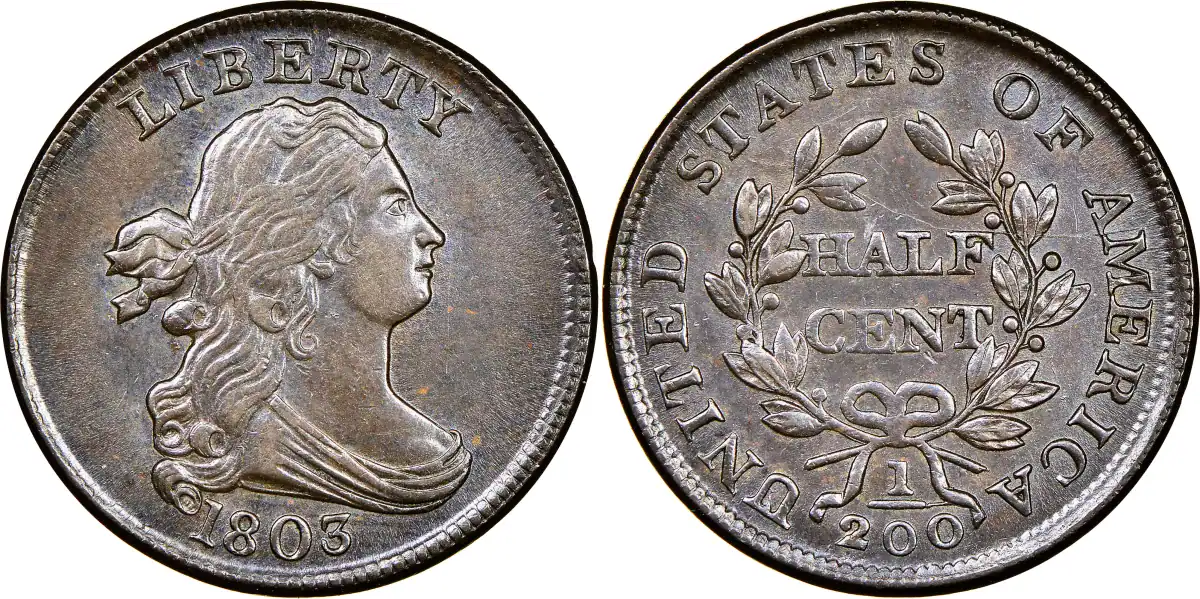
The 1803 Draped Bust Cent is one of the most historically rich copper coins ever struck by the United States Mint, and collectors have sought it out for generations. Minted in Philadelphia during Thomas Jefferson’s presidency, this large copper cent carries the fingerprints of an early American economy still finding its footing. Whether you own one and want to know what it’s worth, or you’re building a collection of early U.S. coinage, this guide covers everything you need – design details, known varieties, grading, pricing, and how to buy or sell one with confidence.
At roughly the size of a modern half-dollar, the 1803 Draped Bust Cent was everyday money in a nation that desperately needed small change. More than three million were struck that year. Most survived only in worn condition. The few that made it through the centuries in sharp detail are genuinely rare, and the market reflects that.
Historical Background: America’s Workhorse Coin
In 1803, the United States was still a young country with a fragile monetary system. Foreign coins circulated alongside domestic ones, and small-denomination copper cents were essential for daily commerce. People used them to buy bread, pay tolls, and settle small debts. The U.S. Mint in Philadelphia had been producing large cents since 1793, and by 1803, the Draped Bust design had been the standard for several years.
The Louisiana Purchase doubled the nation’s territory that same year. Trade was expanding. The Mint struggled to keep up – hand-punched dies, aging equipment, and periodic yellow fever outbreaks in Philadelphia all complicated production. Despite those obstacles, the Philadelphia Mint struck 3,131,691 cents in 1803, a substantial output that reflected genuine commercial demand.
The Draped Bust design itself was created by Chief Engraver Robert Scot in 1796. It replaced the earlier Liberty Cap design with something more refined – Liberty faces right, her hair loosely bound, her gown draped across her shoulder in a classical style inspired by ancient coinage. The design ran through 1807, when the Classic Head type took over.
Flowing Hair type debuts at Philadelphia Mint
Robert Scot’s Liberty replaces Liberty Cap
3,131,691 cents struck amid Louisiana Purchase era
Classic Head design replaces Draped Bust
Design Features of the 1803 Draped Bust Cent
The obverse shows Liberty facing right, with her name – LIBERTY – arching above her portrait and the date 1803 sitting below. Stars ring the edge. Her flowing hair and draped gown give the coin an elegant, almost sculptural quality unusual for early American copper.
The reverse centers on a laurel wreath encircling the denomination ONE CENT. UNITED STATES OF AMERICA runs around the outer edge. Below the wreath, a hand-punched fraction – 1/100 – identifies the cent as one one-hundredth of a dollar. That fraction is one of the key elements collectors use to identify varieties.
Key specifications:
- Metal: 100% copper
- Diameter: 28mm
- Weight: 10.89 grams
- Edge: Plain
- Designer: Robert Scot (obverse and reverse)
- Mint mark: None – Philadelphia Mint only



The Four Major Varieties: Why Die Combinations Matter
The 1803 cent is a playground for variety collectors. Because dies were hand-punched individually, the size of the date numerals and the fraction on the reverse could differ from one die pair to the next. The result is four recognized major varieties, cataloged using Sheldon (S-) numbers.
| Variety | Date Size | Fraction Size | Sheldon Number | Notes |
|---|---|---|---|---|
| Small Date, Small Fraction | Compact numerals | Tightly spaced 1/100 | S-250 | Most iconic and widely collected variety |
| Small Date, Large Fraction | Compact numerals | Bold, open 1/100 | S-257, S-258 | Reverse shows noticeably larger fraction |
| Large Date, Small Fraction | Bolder numerals | Tightly spaced 1/100 | Not fully cataloged | Less commonly listed in major guides |
| Large Date, Large Fraction | Bolder numerals | Bold, open 1/100 | Not detailed | Rarest die combination |
The Small Date, Small Fraction (S-250) is the most sought-after and the most recognizable. Identifying the variety requires a loupe or magnifier – compare the height of the date numerals and the spacing of the “1/100” fraction carefully. Buying a slabbed example from PCGS or NGC removes the guesswork, since professional graders document the variety on the label.
No overdate varieties exist for 1803, unlike some other years in the Draped Bust series. The variety hunt here is purely about date size and fraction size – two details that reward patient, detail-oriented collectors.
Grading the 1803 Draped Bust Cent
Most 1803 cents that survived 220-plus years of circulation are heavily worn. That’s expected – these were pocket change, handled constantly in an era before plastic sleeves and coin albums. Understanding the grading scale helps set realistic expectations.
The Sheldon scale runs from 1 to 70. For early copper, a few grades matter most:
Good (G-4): Outlines are visible, but surface detail is mostly flat. The date and LIBERTY are legible. This is the entry-level grade for most collectors. Still historically significant and affordable.
Fine (F-12) to Very Fine (VF-30): Liberty’s facial features sharpen. Hair strands become visible. The wreath on the reverse shows more definition. These are solid mid-grade examples.
Extremely Fine (EF-40) to About Uncirculated (AU-50): High points show light wear, but major details are crisp. These coins look impressive in hand and command serious premiums.
Mint State (MS-60 and above): Uncirculated examples are genuinely rare. PCGS has graded only four examples at MS-62 BN, with three graded higher. MS-65 BN examples exist but are auction-level rarities. Full red (RD) at any Mint State grade is essentially a unicorn for this date.
Eye appeal matters enormously with early copper. A coin with honest brown toning and strong strike can outperform a technically higher-graded piece with poor surfaces. Professional graders at PCGS and NGC account for this – understanding coin grades like MS-67 and what makes a high-grade coin desirable applies here too, even at lower numbers.
PCGS & NGC Coin Verification – Accurate Precious Metals Refineries
1803 Draped Bust Cent Value and Pricing Ranges
Prices for the 1803 Draped Bust Cent are driven entirely by numismatic demand – condition, variety, color, and eye appeal. The copper melt value is negligible (a few cents at most). This is a collector’s coin, not a bullion piece.
| Grade | Small Date Small Fraction | Small Date Large Fraction | Notes |
|---|---|---|---|
| G-4 (Good) | $50-$150 | $60-$200 | Common worn survivors |
| VF-20 (Very Fine) | $200-$500 | $250-$600 | Sharper details |
| EF-40 / AU-50 | $500-$2,000 | $600-$2,500 | Crisp high points |
| MS-60 to MS-62 BN | $5,000-$20,000+ | Similar, fewer pop reports | Ultra-low PCGS population |
| MS-65 BN | $50,000+ | Rarely available | Auction-dependent pricing |
A few factors push prices higher: the S-250 Small Date Small Fraction variety commands premiums over other varieties; original color (RB or RD) adds significant value over brown; and problem-free surfaces (no cleaning, no corrosion, no damage) are essential for top-tier prices. A cleaned coin – one that looks unnaturally bright or shows hairline scratches – can lose 50% or more of its value versus an original-surface example.
For live auction comparisons, Heritage Auctions and PCGS CoinFacts are the most reliable references. Prices shift with market conditions, so always check recent realized prices rather than fixed price guides alone.
How to Identify, Buy, and Authenticate an 1803 Cent
Buying an 1803 Draped Bust Cent raw (unslabbed) carries real risk. Cleaned coins, altered dates, and misidentified varieties are common pitfalls. Here’s how to approach it:
Use a loupe. A 5x or 10x magnifier lets you examine the date size and fraction spacing – the two details that separate one variety from another. Compare what you see against reference images from PCGS CoinFacts.
Look for original surfaces. Copper that has aged naturally develops an even, dark brown patina. Bright, shiny copper on a coin this old is a red flag – it almost always means the coin was cleaned with acid or abrasive. Cleaning destroys value.
Buy slabbed when possible. A PCGS or NGC holder documents the grade, variety, and color designation. For any coin worth more than a few hundred dollars, the cost of professional grading is worth it. What are BU coins and how grading works matters whether you’re buying a modern bullion piece or a 220-year-old cent.
Check population reports. PCGS and NGC publish “pop reports” showing how many examples of each coin have been graded at each level. Low populations at higher grades confirm genuine rarity.
Avoid pressure buying. Coin shows and online auctions move fast. If a seller won’t let you examine a coin carefully, walk away.
Storing and Preserving Early Copper Coins
Copper is reactive. It corrodes when exposed to humidity, skin oils, and PVC (the plastic in many cheap coin flips). An 1803 cent that survived two centuries deserves proper care.
- Store in inert, archival-quality holders – Mylar flips or PCGS/NGC slabs are ideal.
- Keep humidity between 40-60%. Too dry causes cracking; too humid accelerates oxidation.
- Never touch the face of the coin. Skin oils leave permanent fingerprints on copper surfaces.
- Avoid PVC flips – they leach a green, oily residue onto coin surfaces over time.
- Store in a cool, dark location away from temperature swings.
If you acquire a raw coin, consider having it professionally graded before storing it long-term. The slab itself provides the best protection available.
Selling an 1803 Draped Bust Cent: What to Expect
If you think you own an 1803 Draped Bust Cent, the first step is honest assessment. Most examples that surface in old collections or estate sales are worn, possibly cleaned, and worth somewhere between $50 and a few hundred dollars. That’s still a meaningful sum for a coin from Jefferson’s era – but condition is everything.
For coins in Fine or better condition, professional grading before selling is almost always worth the investment. A raw VF coin and a slabbed VF coin can fetch very different prices from serious buyers. Documentation matters.
When you’re ready to sell, Accurate Precious Metals is a strong option regardless of where you’re located. With more than 12 years in business and over a thousand five-star customer reviews, Accurate Precious Metals has built a reputation as a trusted buyer of numismatic coins and precious metals of all kinds. If you’re in the Salem, Oregon area, you can bring your coin in person for a direct evaluation. If you’re anywhere else in the country, the mail-in service makes it simple – request a free insured shipping kit, send your coin, and receive a fast, transparent offer.
Accurate Precious Metals buys coins across the full spectrum: worn examples, problem-free mid-grades, and high-end slabbed pieces. The team evaluates each coin on its own merits – condition, variety, color, and current market demand. As an NGC Authorized Dealer, Accurate Precious Metals works within industry-standard grading frameworks, which means your coin gets a fair, informed assessment rather than a pawn-shop lowball.
Request a mail-in kit at AccuratePMR.com – shipping is free and insured
Package your coin securely and ship it using the provided label
Our team evaluates the coin – condition, variety, and current market value
Receive a transparent offer with fast payment upon acceptance
For selling coins and precious metals online, Accurate Precious Metals handles everything from common worn cents to high-grade rarities. Local customers can call ahead at (503) 400-5608 or stop by the Salem location for an in-person conversation.
Why Serious Collectors Trust Accurate Precious Metals
Accurate Precious Metals isn’t a pawn shop. It’s a specialized precious metals and numismatic coin dealer with deep expertise across gold, silver, platinum, palladium, and collector coins. The inventory spans bullion bars and coins, diamonds, jewelry, and early American numismatics – all under one roof (or one website, for remote customers).
For collectors building a set of early U.S. cents, Accurate Precious Metals is worth checking regularly. The inventory shifts as new coins come in through purchases and trade-ins. The nationwide shipping infrastructure means you’re not limited to whatever happens to be at your local coin shop.
If you’re new to early copper and want to understand how identifying antique coins and their markings works before making a purchase, the team at Accurate Precious Metals can walk you through what to look for. That kind of guidance – grounded in real experience rather than sales pressure – is what separates a specialist dealer from a generalist.
Reach out at AccuratePMR.com or call (503) 400-5608. Whether you’re buying, selling, or just trying to figure out what you have, Accurate Precious Metals is the place to start.
Frequently Asked Questions
What makes the 1803 Draped Bust Cent valuable?
Value comes from age, historical significance, variety, and condition – not metal content. The copper itself is worth almost nothing. A worn example in Good grade might sell for $50-$150, while a Mint State example can reach $20,000 or more. The Small Date Small Fraction variety (S-250) is the most sought-after.
How do I tell which variety of 1803 cent I have?
Use a magnifier to examine the date numerals and the fraction on the reverse. Smaller, more compact date figures indicate a Small Date; a tightly spaced "1/100" indicates a Small Fraction. Comparing your coin against reference images on PCGS CoinFacts is the most reliable method. When in doubt, have it professionally graded.
Are there any 1803 Draped Bust Cent proofs?
No. The U.S. Mint did not produce official proof strikes for 1803 cents. Any coin presented as a proof from this year is almost certainly a later restrike or a fake. Be cautious of such claims.
What does "BN," "RB," and "RD" mean on a graded 1803 cent?
These are color designations for copper coins. BN (Brown) means the coin has fully toned to a dark brown. RB (Red-Brown) indicates partial original mint red remains. RD (Red) means the coin retains full original copper color – extremely rare on an 1803 cent and commands the highest premiums.
Should I clean my 1803 Draped Bust Cent before selling it?
No. Cleaning copper coins – even gently – destroys original surfaces and dramatically reduces value. A naturally toned coin with honest wear is worth far more than a bright, shiny coin that has been cleaned. Leave it as-is and let a professional evaluate it.
Can I sell an 1803 cent to Accurate Precious Metals if I'm not in Oregon?
Yes. Accurate Precious Metals offers a convenient mail-in service for customers anywhere in the United States. Shipping is free and insured. You'll receive a transparent offer based on current market conditions after the team evaluates your coin.
Is a high mintage of over three million coins good or bad for value?
High mintage means many were made, but it doesn't mean many survived in collectible condition. Most 1803 cents circulated heavily and were lost, damaged, or melted. Mint State examples are genuinely rare despite the large original production. Condition scarcity drives value far more than original mintage.


